
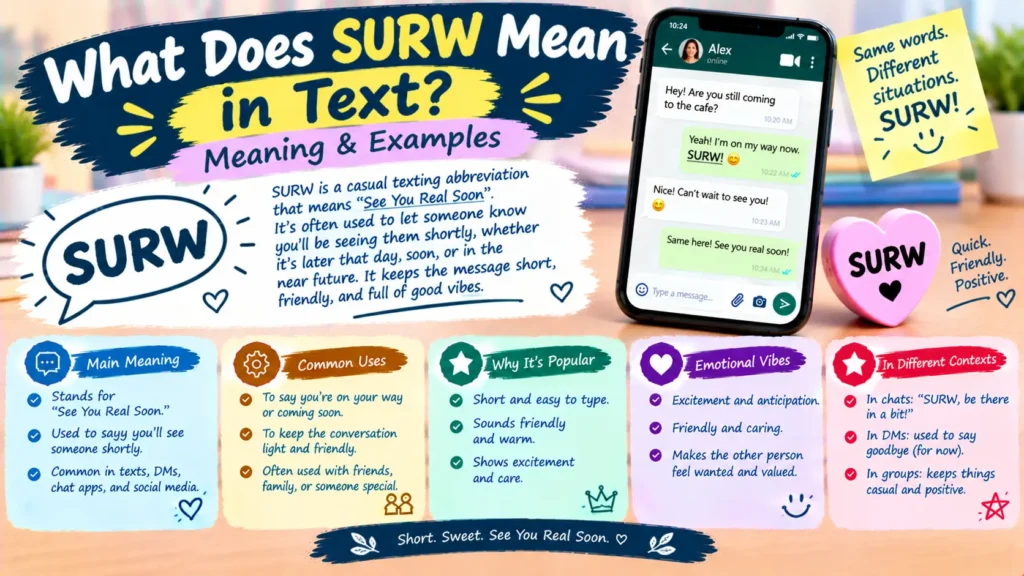
Have you ever received a message containing “SURW” and wondered whether it was a typo, slang, or some abbreviation you were somehow expected to know?
You are not alone. SURW is not as standardized as texting expressions such as LOL, BRB, IDK, or BTW. Its meaning can change depending on the conversation, the person using it, and the community where it appears.
In many casual texting situations, SURW is simply a playful or accidental version of “sure.” It may communicate agreement, acceptance, or reassurance. Someone might type “surw” quickly without correcting the spelling, while another person may deliberately use it as an informal style.
There are also niche definitions for SURW online. For example, an older Urban Dictionary entry records a humorous definition unrelated to ordinary texting, while acronym databases list SURW as an abbreviation for SureWest Communications. That is why context matters so much when you encounter it.
This guide explains what SURW usually means in texting, how people may use it, what emotional tone it can carry, and how to respond when you are not completely sure what someone intended.
SURW Meaning in Text: Quick Meaning
In casual texting, SURW most commonly functions as a typo, playful spelling, or informal variation of “sure.”
Depending on the conversation, it can suggest:
- Sure
- Yes
- Okay
- I agree
- That works
- Probably sure, depending on the surrounding message
- A deliberately informal spelling used between friends
For example:
“surw I’ll come with you.”
This probably means:
“Sure, I’ll come with you.”
Another example:
“You’re coming tonight, surw?”
The writer may simply have typed “sure” incorrectly or shortened it informally.
And:
“Yeah surw 😂”
can sound like a casual, relaxed agreement.
The important point is that SURW is not a fixed texting abbreviation with one official definition. A recent slang explainer likewise describes it as context-dependent and notes that it may arise from fast typing, personal slang, or interpretations such as “sure.”
Origin & Background of SURW
Unlike famous internet expressions such as LOL or OMG, SURW does not have a well-documented, universally recognized origin as modern texting slang.
One plausible explanation is simple typing behavior.
When people type quickly on phones, they make mistakes. Fingers land on neighboring keys, letters get reordered, and autocorrect does not always fix the result. A misspelling such as surw can therefore appear naturally when someone intended to write sure.
Sometimes a typo disappears immediately because the sender corrects it. Other times, it becomes part of someone’s personal texting style.
That is one reason internet language can feel unpredictable. A word does not always become slang because a large organization officially declares it slang. Sometimes a small group simply starts understanding a particular spelling and keeps using it.
The broader culture of digital communication also encourages this flexibility. Texting rewards speed, informality, and conversational rhythm. People frequently leave small spelling mistakes untouched when everyone involved understands the intended meaning.
There is evidence that SURW has also existed as a niche humorous term for many years. An Urban Dictionary entry dating from 2004 gives it a deliberately unusual definition involving a turkey leg caught on fire. That definition is clearly different from the ordinary “sure” interpretation and shows why context is essential.
So, rather than treating SURW as a word with one historical origin, it is more accurate to think of it as a context-sensitive internet expression or spelling variation.
Real-Life Conversations Using SURW
1. WhatsApp Conversation
Person A:
You free tonight?
Person B:
surw, what’s the plan?
Person A:
Pizza and a movie?
Person B:
Yeah I’m in 😂
Here, SURW works naturally as an informal version of “sure.”
2. Instagram DM
Person A:
We still meeting tomorrow?
Person B:
yeah surw, don’t cancel again 😭
Person A:
I promise this time lol
The expression feels friendly because the surrounding conversation is casual and playful.
3. TikTok Comments
User 1:
Part 2 coming?
Creator:
surw if this gets enough likes 😂
User 1:
Say less, I’m sharing it.
In this case, the unusual spelling helps maintain the relaxed tone of a comment section.
4. Text Messages
Person A:
Can you send me the notes?
Person B:
surw give me five mins
Person A:
You’re a lifesaver.
Person B:
I got you.
Here, SURW simply communicates willingness to help.
Emotional & Psychological Meaning of SURW
The emotional meaning of SURW usually comes from context rather than the four letters themselves.
If someone writes “surw” instead of “sure,” the unusual spelling can make the message feel more relaxed, spontaneous, or playful.
That does not automatically mean the person is trying to be funny. Sometimes people simply type quickly and move on.
This is an important feature of modern digital communication. People do not always communicate with perfect grammar because texting is designed to resemble conversation rather than formal writing.
Think about chatting with a close friend late at night. You are tired, your phone is in one hand, and someone asks:
“You coming tomorrow?”
You might type:
“surw lol”
You are not making a statement about grammar. You are simply responding naturally.
That small moment illustrates something important about texting: relationship and context often communicate as much as spelling does.
With close friends, an imperfect spelling can feel completely normal. With a stranger, however, the same expression may create confusion.
SURW in Different Contexts
Social Media
SURW can appear in Instagram comments, TikTok discussions, direct messages, gaming communities, and other informal online spaces.
Because these platforms encourage quick communication, unusual spellings are not necessarily treated as mistakes worth correcting.
Friends and Relationships
Among friends, SURW can sound relaxed and familiar.
A friend might write:
“surw I’ll pick you up.”
The meaning is generally straightforward: “Sure, I’ll pick you up.”
In romantic conversations, the surrounding words become especially important. “surw ❤️” may feel warm, while “surw.” could sound more neutral or even slightly reluctant depending on the conversation.
Work and Professional Settings
SURW is better avoided in formal professional communication.
If you are writing to a manager, customer, client, professor, or someone you do not know well, simply writing “sure,” “yes,” or “certainly” removes unnecessary ambiguity.
Casual vs. Serious Tone
SURW belongs primarily to casual communication.
A conversation about weekend plans can easily accommodate it. A serious discussion involving responsibilities, money, deadlines, or sensitive personal matters usually benefits from clearer language.
When NOT to Use SURW
There are several situations where SURW can create unnecessary confusion.
Avoid it when:
- Writing formal emails
- Communicating with customers or clients
- Applying for jobs
- Sending academic messages
- Discussing important deadlines
- Handling sensitive emotional conversations
- Communicating with someone unfamiliar with internet slang
There is also a cultural consideration.
Not everyone interprets unusual spellings in the same way. One person may see “surw” as cute or casual, while another may assume it is simply a typing mistake.
When clarity matters more than personality, write the complete word.
Common Misunderstandings About SURW
“SURW always means one specific phrase.”
Not necessarily.
Because SURW is not a standardized texting abbreviation, you should examine the surrounding conversation before assigning a meaning.
“It must be intentional slang.”
Not always.
It can simply be a typo or fast-typing mistake.
“SURW is the same as SURE in every situation.”
The intended meaning may be similar, but the tone can differ.
“SURE” can emphasize agreement, while “surw” may look playful, careless, spontaneous, or accidental.
“Everyone online understands SURW.”
Definitely not.
Less-established slang is often community-specific. A person seeing it for the first time may have no idea what it means.
“SURW has only one internet definition.”
No.
Online references contain different meanings. For instance, Urban Dictionary records an older humorous meaning that has nothing to do with ordinary texting.
Comparison Table
| Expression | Meaning in Text | How to Use It | Example | Tone |
|---|---|---|---|---|
| SURW | Usually a casual spelling or typo of “sure” | Use informally when context is obvious | “surw I’ll be there” | Casual |
| SURE | Clear agreement or confirmation | Use when emphasizing agreement | “SURE, I’ll help” | Emphatic |
| Sure | Agreement or acceptance | Works in almost any ordinary conversation | “Sure, no problem.” | Neutral |
| Yeah | Yes or agreement | Use for informal confirmation | “Yeah, I can come.” | Casual |
| IDK | I don’t know | Use when uncertain | “IDK yet.” | Casual |
| NVM | Never mind | Use to withdraw or dismiss a previous question | “NVM, I found it.” | Casual |
Key Insight
The biggest difference is that “sure” is universally recognizable, while “SURW” depends heavily on context. If someone uses SURW, look at the words around it before deciding whether it is intentional slang, a typo, or a personal spelling habit.
Variations and Related Forms
Because SURW is not standardized, its variations are also informal.
1. SURW Meaning
SURW meaning generally depends on context, but casual users may intend “sure.”
2. SURW in Text
SURW in text is commonly interpreted as a casual spelling or typo rather than a formal abbreviation.
3. SURW Abbreviation
As an abbreviation, SURW does not have one universally accepted texting expansion. Other databases list unrelated organizational meanings, demonstrating why context matters.
4. SURW Slang
As slang, SURW can function as an informal version of “sure,” particularly in casual online communication.
5. SURW in Chat
In chat, the intended meaning is often obvious from the sentence.
For example:
“surw I’ll join.”
usually communicates agreement.
6. SURE
The standard spelling is sure, which is clearer and understood by virtually all English speakers.
7. Surr
“Surr” can appear as a playful extension or informal spelling of “sure,” although it is not standardized.
8. Suree
“Suree” stretches the word visually and can add a playful or friendly quality.
9. Shur
“Shur” is another phonetic or playful spelling that may imitate casual pronunciation.
10. Sures
Depending on context, “sures” can appear as a joking or deliberately altered form, although it is not a standard texting abbreviation.
These variations demonstrate a broader pattern in internet language: users often modify familiar words to express personality, humor, emotion, or informality.
How to Respond When Someone Uses SURW
The best response depends on whether the meaning is obvious.
Casual Replies
If you understand that they mean “sure,” you can respond naturally:
- “Okay, sounds good.”
- “Perfect.”
- “Yeah, cool.”
- “Awesome.”
- “Got you.”
Funny Replies
If you have a playful relationship:
- “Surw? Is that the deluxe version of sure? 😂”
- “You typed that with your eyes closed 😂”
- “I’m choosing to believe that means sure.”
- “New spelling unlocked 😂”
Mature Replies
If you want clarification without making the person uncomfortable:
- “Do you mean sure?”
- “Just checking, did you mean ‘sure’?”
- “Got it. Just wanted to make sure I understood.”
Respectful Replies
When speaking with someone you do not know well:
- “Okay, understood.”
- “Sounds good, thank you.”
- “Alright, that works.”
- “Thanks for confirming.”
The safest approach is simple: match the tone of the conversation without overthinking the spelling.
Regional & Cultural Usage
Western Culture
In many English-speaking online communities, casual spelling changes are common. Younger users may intentionally ignore conventional spelling when chatting with friends.
SURW can therefore be understood as a playful or accidental variation of “sure,” although it is not universal.
Asian Culture
English texting habits vary enormously across Asian countries and communities.
Many users comfortably mix standard English with abbreviations, local expressions, emojis, and informal spellings. However, someone who has not encountered SURW before may prefer clearer wording.
Middle Eastern Culture
Younger internet users frequently participate in global social-media language trends, but English slang is not necessarily interpreted identically across communities.
A word like SURW may therefore be understood immediately by one person and seem like a typo to another.
Global Internet Usage
The internet has made slang highly fluid.
A spelling that begins as an accidental typo can become recognizable within a small community. Another community may never use it at all.
That makes context more reliable than the abbreviation itself.
Gen Z vs. Millennials
Generational differences are not absolute, but younger internet users are often more accustomed to deliberately flexible spelling, memes, abbreviations, and exaggerated words.
Millennials may recognize many of these expressions while using them less frequently.
Older users may be more likely to interpret SURW as a typing error unless the surrounding context makes the intended meaning obvious.
Is SURW Safe for Kids?
SURW itself is generally not considered inherently offensive or adult language when it is being used as a casual version of “sure.”
The important issue is context.
Children should still understand that informal internet slang is not appropriate for every situation. They may use casual expressions with friends but should know when standard language is more appropriate, such as school assignments, formal communication, or messages to teachers.
Because SURW can have different niche meanings online, parents and educators should consider the complete conversation rather than judging the four letters alone.
FAQs About SURW
What does SURW mean in text?
SURW commonly appears as an informal spelling or typo of “sure” in casual texting. Its exact meaning depends on context.
Is SURW slang?
It can function as informal internet slang, but it is not a standardized or universally recognized texting abbreviation.
Does SURW mean sure?
Often, yes. In casual conversations, SURW may simply be a misspelling or playful version of “sure.”
Is SURW a typo?
It can be. Fast typing, keyboard mistakes, and casual spelling are possible explanations for the appearance of SURW.
Is SURW appropriate for professional messages?
Generally, it is better to avoid it in professional communication because the reader may not recognize what you mean.
Can SURW have another meaning?
Yes. Online sources contain niche or unrelated definitions. An older Urban Dictionary entry, for example, records a humorous definition unrelated to ordinary texting.
How should I respond to SURW?
If the context clearly suggests “sure,” respond normally. If you are uncertain, politely ask what the sender meant rather than guessing.
Conclusion
So, what does SURW mean in text?
In ordinary casual messaging, the safest interpretation is often “sure,” especially when the word appears in a sentence expressing agreement or acceptance. It may be a simple typo, a fast-typing mistake, or an intentionally playful spelling.
But SURW is not a standardized abbreviation with one universal definition. Different online communities can use unusual spellings differently, and niche references may give the term completely unrelated meanings.
That is why context matters more than the letters themselves.
If a friend texts, “surw I’ll come,” you probably do not need to analyze it. They are most likely saying, “Sure, I’ll come.”
And if the meaning still feels unclear, there is nothing awkward about asking. Good digital communication is not about knowing every piece of slang. It is about understanding the person behind the message.




