
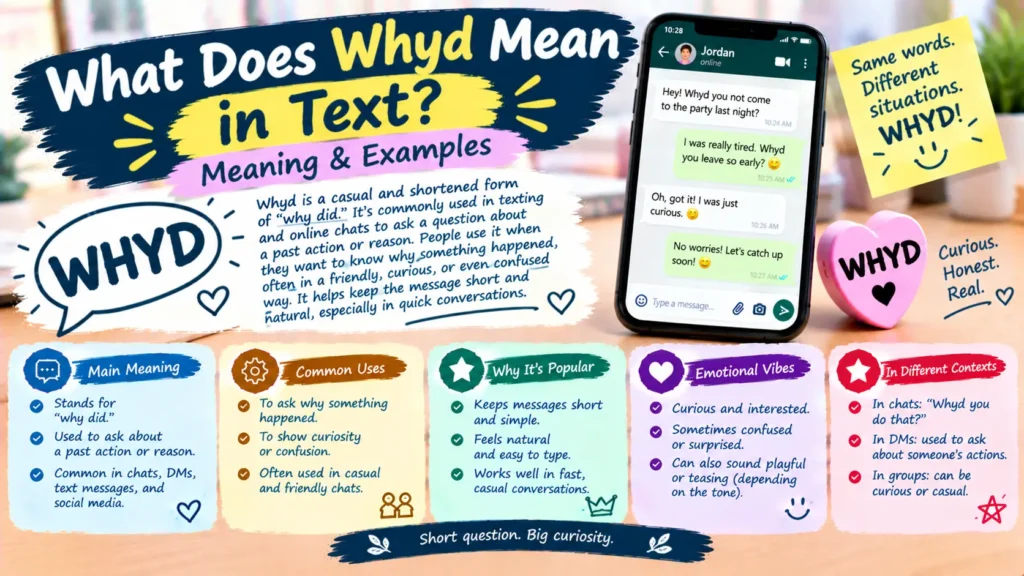
If someone texts you “whyd?”, it can look like a typo at first. You may wonder whether they meant “why did,” “why would,” or something completely different.
In casual digital communication, “whyd” is most commonly an informal way of writing “why’d,” which usually means “why did.” For example, “Whyd you leave?” means “Why did you leave?” The apostrophe is often dropped in fast texting.
The exact meaning still depends on the sentence. In some contexts, “why’d” can also represent “why would” or, less commonly, “why had.” Dictionaries and language references document these possibilities, although “why did” is the most natural interpretation in everyday texting.
That small distinction matters because text messages have no voice tone. A simple “whyd you do that?” might sound curious, confused, disappointed, playful, or even slightly annoyed depending on the relationship and conversation.
Whyd Mean in Text – Quick Meaning
Whyd is generally an informal texting form of “why’d,” most often meaning “why did.”
In simple terms:
- Whyd = Why did
- Why’d = Why did
- It can occasionally mean “why would”
- Less commonly, it can represent “why had”
- The form without the apostrophe is especially casual
For example:
“Whyd you leave so early?”
means:
“Why did you leave so early?”
Another example:
“Whyd you delete the message?”
means:
“Why did you delete the message?”
And:
“Whyd you say that 😂”
could express curiosity, surprise, or playful disbelief.
Language references identify “why’d” as a contraction involving why + did, while also recording possible uses with had and would.
Origin & Background of Whyd
Whyd is not really a new acronym created by social media. It is better understood as the casual, punctuation-free texting version of “why’d.”
The contraction itself reflects the way English speakers naturally compress words in speech. Forms such as “how’d,” “where’d,” “when’d,” and “who’d” can similarly shorten questions involving “did.” Linguistic discussions note that this kind of contraction is particularly natural in questions where “did” is unstressed.
Digital communication simply made the shortened form even more visible.
When people type quickly, punctuation is often the first thing to disappear. Therefore:
Why’d you do that?
may become:
Whyd you do that?
The meaning remains recognizable because the surrounding words provide the context.
Social media has also encouraged highly compressed communication. Instagram DMs, TikTok comments, gaming chats, group messages, and texting all reward quick, conversational language rather than formal punctuation.
So while “whyd” may look like a modern slang abbreviation, its underlying form is connected to an older English contraction.
Real-Life Conversations Using Whyd
The emotional meaning of whyd becomes much easier to understand when you see it in realistic conversations.
1. WhatsApp
Person A:
I left the party early last night.
Person B:
Whyd 😭
Person A:
I was exhausted lol.
Here, “whyd” means “why did you?” The crying emoji makes the question feel curious rather than aggressive.
2. Instagram DMs
Person A:
I unfollowed him today.
Person B:
Whyd you do that?
Person A:
He kept making weird comments.
This version is more direct. The person genuinely wants to understand the reason.
3. TikTok Comments
Person A:
Posts a video about accidentally deleting an entire project.
Person B:
Whyd you delete the whole thing 😭
Here, the word communicates surprise and disbelief. It is not necessarily criticism.
4. Text Messages
Person A:
I told Mom about our surprise.
Person B:
WHYD 😭
Person A:
I thought she already knew!
Capital letters completely change the visual energy. WHYD can feel much more dramatic than lowercase “whyd.”
Emotional & Psychological Meaning of Whyd
One reason whyd feels different from the formal phrase “why did” is that it sounds more conversational.
Compare:
“Why did you do that?”
with:
“Whyd you do that?”
The first sounds complete and grammatically polished. The second feels quicker, more spontaneous, and closer to spoken conversation.
That difference can communicate emotional closeness.
Friends may use “whyd” because they do not feel the need to carefully construct every sentence. The missing apostrophe can make the message feel relaxed and immediate.
The emotional meaning can include:
- Curiosity
- Surprise
- Confusion
- Concern
- Playful teasing
- Mild frustration
- Disbelief
- Genuine interest
For example, imagine a close friend suddenly tells you they are moving to another city.
You might instinctively type:
“Whyd you never tell me?”
That could contain much more emotion than the literal question suggests. It may communicate hurt, surprise, and a desire for explanation.
From a communication perspective, this is why context matters more than the abbreviation itself.
Usage in Different Contexts
1. Social Media
On TikTok, Instagram, Snapchat, and similar platforms, whyd can appear in comments, captions, replies, or private messages.
It is particularly natural when reacting to something unexpected.
“Whyd you post this 😂”
“Whyd he look so confused?”
The meaning is generally easy to understand from the surrounding content.
2. Friends & Relationships
Among friends, whyd can make a question sound informal and emotionally immediate.
“Whyd you leave without saying bye?”
Depending on the relationship, that could be affectionate, concerned, annoyed, or teasing.
3. Work & Professional Settings
This is where you should be more careful.
Avoid using “whyd” in formal emails, reports, business proposals, academic writing, or professional correspondence.
Instead of:
“Whyd you change the schedule?”
write:
“Why did you change the schedule?”
The full version is clearer and more professional.
4. Casual vs. Serious Tone
Whyd generally belongs to casual communication.
However, a casual spelling does not automatically make the underlying emotion casual.
Someone might type:
“Whyd you lie to me?”
The spelling is informal, but the subject can be very serious.
Always judge the emotional weight from the complete message rather than the abbreviation alone.
When NOT to Use Whyd
Although whyd is understandable in casual texting, there are situations where it is better avoided.
Formal communication
Do not use it in:
- Job applications
- Business emails
- School assignments
- Academic papers
- Official documents
- Customer-service communication
Sensitive conversations
If someone is discussing grief, conflict, a breakup, or another serious personal issue, the informal form may sometimes appear dismissive.
For example:
“Whyd you leave?”
could feel blunt during an emotionally serious conversation.
A more considerate version might be:
“Why did you decide to leave? I’m trying to understand.”
When clarity matters
If the person you’re talking to is learning English, whyd may be confusing.
Using “why did” removes unnecessary ambiguity.
Common Misunderstandings About Whyd
1. It is always “why did”
Not necessarily.
The most common interpretation is “why did,” but “why’d” can theoretically represent other constructions, including “why would” and “why had.”
The grammar surrounding the contraction usually makes the intended meaning clear.
2. Whyd means “why do”
Usually, no.
For example:
“Why do you like it?”
should not normally become:
“Whyd you like it?”
That would typically be interpreted as “Why did you like it?”
3. It is always slang
Not exactly.
Why’d is a contraction, while whyd is generally an informal punctuation-free spelling. It is better to think of it as casual digital writing rather than a completely separate vocabulary word.
4. It always sounds angry
No.
Compare:
“Whyd you do that 😂”
with:
“WHYD YOU DO THAT?”
The words are similar, but capitalization, punctuation, emojis, and context dramatically change the emotional impression.
Whyd vs. Other Similar Text Expressions
| Expression | Meaning / Intent | How to Use It | Example |
|---|---|---|---|
| Whyd | Usually “why did” | Casual texting | “Whyd you leave?” |
| Why’d | Usually “why did” | Informal written/spoken English | “Why’d you call?” |
| Why did | Full question asking for a reason | Formal or casual | “Why did you leave?” |
| Why would | Questions a possible or hypothetical action | Casual or formal | “Why would you say that?” |
| Why | Asks for a reason | Any casual context | “Why are you upset?” |
| How’d | Usually “how did” or contextually another “how + ’d” contraction | Casual conversation | “How’d you know?” |
Key Insight
The important thing about whyd is not the spelling alone. The words that follow it usually reveal what the sender means. When someone writes “whyd you leave,” the natural interpretation is “why did you leave?”
Variations and Related Forms
Here are common forms people may encounter when searching for whyd meaning in text.
1. Why’d meaning
Why’d usually means “why did.”
It is the standard apostrophe form of the casual contraction.
2. Whyd in text
Whyd in text usually means “why did” without the apostrophe.
It is common in quick, informal messages.
3. Whyd abbreviation
Whyd abbreviation can refer to the shortened written form of “why did.”
Strictly speaking, it is more accurately described as an informal contraction than a conventional acronym.
4. Whyd slang
Whyd slang refers to the casual way the expression appears in online communication.
It can carry curiosity, surprise, confusion, or frustration.
5. Whyd in chat
Whyd in chat usually means the sender wants to know the reason behind something that happened.
“Whyd you block him?”
6. WHYD
WHYD can also appear as an acronym with a different expansion, including “What Have You Done?” Some texting-reference sites list this separate uppercase meaning.
This is why capitalization and context matter.
7. Why’d you
Why’d you normally means “why did you.”
“Why’d you call me?”
8. Whyd you
Whyd you is the punctuation-free texting version.
“Whyd you delete it?”
9. Why’d he
Why’d he normally means “why did he.”
“Why’d he leave?”
10. Why’d they
Why’d they normally means “why did they.”
“Why’d they cancel the event?”
How to Respond When Someone Uses Whyd
Your response depends on the emotion behind the question.
Casual Replies
If a friend simply asks why you did something:
“Idk, I just felt like it 😂”
“Because I had to lol.”
“Long story 😭”
Funny Replies
If the conversation is playful:
“For scientific reasons.”
“Because apparently I make bad decisions 😂”
“Honestly? No idea.”
Mature Replies
For a serious question:
“I had a reason, but I should have explained it earlier.”
“I made that decision because I thought it was the best option at the time.”
Respectful Replies
If someone seems genuinely concerned:
“I understand why you’re asking. Let me explain.”
“I didn’t mean to upset you. I can explain what happened.”
The best response does not simply decode the abbreviation. It responds to the emotion behind the question.
Regional & Cultural Usage
Western Culture
In American and British online communication, contractions are extremely common in casual conversation. Forms like why’d can sound natural because they reflect conversational English.
The apostrophe may disappear in texting because users prioritize speed and informality.
Asian Culture
English is widely used in digital communication across many Asian communities, especially among younger internet users.
However, familiarity with contractions varies. Someone learning English may interpret whyd as a typo rather than recognizing it as “why’d.”
Middle Eastern Culture
English texting is also common in multilingual online communities across the Middle East.
Users may mix English abbreviations with local-language expressions. In these settings, context becomes especially important because English contractions may not be interpreted identically by everyone.
Global Internet Usage
Social media has made informal English increasingly international.
A phrase that began as conversational English can now appear in messages between people who speak English as a first, second, or third language.
That makes simple context especially valuable.
Gen Z vs. Millennials
Younger users are often comfortable dropping punctuation in informal messaging, but this does not mean every generation interprets the same spelling identically.
A Millennial may immediately read “whyd” as “why’d,” while another reader may initially think it is a typo.
The relationship between the people chatting usually matters more than their generation.
Is Whyd Safe for Kids?
Yes, the expression itself is generally harmless.
“Whyd” is normally just a casual way of asking why something happened. It does not inherently contain sexual, violent, or offensive meaning.
However, parents and educators should still consider context.
For example:
“Whyd you do that?”
is harmless on its own.
But the surrounding conversation could reveal whether someone is teasing, bullying, threatening, or discussing something inappropriate.
So the abbreviation itself is not the concern. The conversation around it is what matters.
FAQs About Whyd Mean in Text
1. What does whyd mean in text?
Whyd usually means “why did” in casual texting. It is commonly written without the apostrophe in fast, informal messages.
2. Is whyd the same as why’d?
Yes, in most casual texting situations. “Whyd” is generally the punctuation-free form of “why’d.”
3. Can whyd mean “why would”?
It can in some contexts, although “why did” is generally the more natural interpretation. The sentence determines the intended meaning.
4. Is whyd proper English?
“Why’d” is an informal contraction, while “whyd” without the apostrophe is especially casual. For formal writing, use “why did” instead.
5. Is whyd rude?
Not automatically. It can express curiosity, surprise, concern, teasing, or frustration. The tone depends on the surrounding conversation.
6. What does WHYD mean in capital letters?
In some texting references, WHYD is listed as “What Have You Done?” This is a separate acronym meaning, so context is essential.
7. Should I use whyd in professional messages?
Generally, no. In professional communication, “why did” is clearer and more polished.
Conclusion
So, what does whyd mean in text?
In most casual messages, whyd means “why did.” It is essentially the informal, punctuation-free version of “why’d.”
You might see:
“Whyd you leave?”
and understand it as:
“Why did you leave?”
The expression itself is simple, but its emotional meaning can change considerably. A friend saying “whyd 😂” may be joking, while “WHYD YOU DO THAT?” could communicate genuine frustration.
There is also a less common possibility that “why’d” means “why would” or “why had,” so the words surrounding it should always guide your interpretation.
The safest rule is simple: read the whole message, not just the abbreviation. In casual texting, “whyd” is usually nothing more mysterious than a quick way of asking for a reason.




