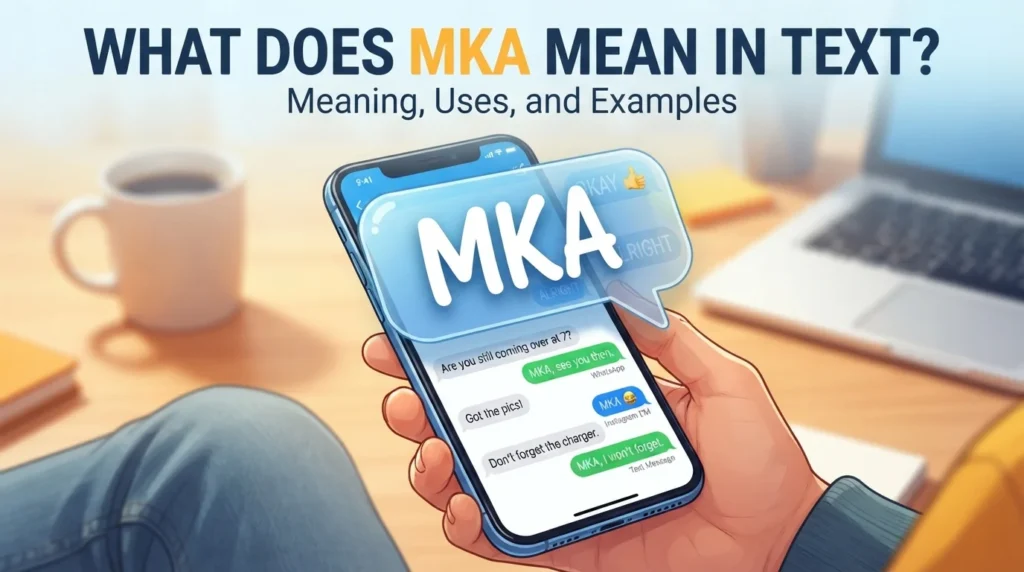
Have you ever received a message that simply said “MKA” and wondered what the person was trying to say?
You’re not alone. Short texting expressions can be surprisingly confusing because three letters may carry a completely different tone depending on the conversation.
So, what does MKA mean in text?
In casual digital communication, MKA can be used as an informal way of saying “okay” or “alright.” It generally works as a quick acknowledgment, agreement, or confirmation.
However, MKA does not have one universally accepted definition. Acronym references list several meanings for the same three letters, including “Maybe Known As,” while other slang references associate it with different terms. That makes context especially important.
If someone sends you “MKA” after you explain something, they may simply mean “okay, I understand.” But if the conversation is about a person, organization, game, or another specific topic, MKA could mean something completely different.
Let’s break down the meaning, tone, examples, and appropriate usage so you can understand it without guessing.
MKA – Quick Meaning
In casual texting, MKA can function as a shortened or stylized form of “okay” or “alright.”
It can communicate acknowledgment without requiring a complete sentence.
Depending on the situation, it may mean:
- Okay
- Alright
- Got it
- Sure
- I understand
- Noted
For example:
“MKA, I’ll call you later.”
Here, MKA basically means “Okay.”
Another example:
“MKA, I understand what you mean.”
The person is acknowledging the message.
And:
“You can send the file tonight.”
“MKA 👍”
The response shows simple agreement.
Importantly, MKA isn’t as standardized as abbreviations such as LOL, BRB, or FYI. Some acronym databases list multiple unrelated meanings for MKA, which is why you should always consider the surrounding conversation.
See Also: What Does FYTB Mean in Text? Meaning, Tone, and Examples
Origin & Background of MKA
There isn’t a single well-established origin story for MKA as a texting expression.
Unlike common internet abbreviations that have relatively clear histories, MKA appears to be a flexible shorthand whose interpretation depends heavily on the person and context.
Text messaging encouraged people to shorten words, remove unnecessary letters, and communicate quickly. That habit eventually became part of social media culture.
People began developing personal typing styles. Some wrote “kk,” others wrote “k,” “mk,” “mkay,” “aight,” or other variations of agreement.
MKA can appear within this broader culture of informal digital shorthand.
Social platforms have also changed how people communicate. A person might reply to a WhatsApp message with only two or three characters because both participants already understand the context.
The same principle applies to Instagram DMs, TikTok comments, Snapchat conversations, gaming chats, and ordinary SMS messages.
However, it is important not to assume that every appearance of MKA means “okay.” Acronym references document several unrelated meanings, including “Maybe Known As,” “Mortal Kombat Armageddon,” “Mary-Kate and Ashley,” and others.
That is why context beats the abbreviation itself.
Real-Life Conversations Using MKA
The easiest way to understand MKA meaning in text is to see how it can work in everyday conversations.
WhatsApp Conversation
Person A:
Are you still coming over at 7?
Person B:
Yeah, I’ll leave around 6:30.
Person A:
MKA, see you then.
Here, MKA works like “okay” or “alright.”
It doesn’t add strong emotion. It simply confirms the information.
Instagram DM
Person A:
I sent you the pictures. Check your requests.
Person B:
Got them! They look amazing.
Person A:
MKA 😂 I was worried they didn’t go through.
In this example, MKA feels relaxed because the surrounding conversation is friendly.
TikTok Comment Thread
User A:
This trend makes absolutely no sense 😭
User B:
I thought I was the only one confused.
User C:
MKA, so I’m not crazy then 😂
Here, the expression can act as a playful acknowledgment rather than a serious statement.
Text Message
Person A:
Don’t forget to bring my charger tomorrow.
Person B:
MKA, I won’t forget.
Person A:
Good because I actually need it 😭
The meaning is straightforward: “Okay, understood.”
These examples also show why tone matters. The letters themselves are limited. The surrounding words, emojis, punctuation, and relationship between the speakers provide the emotional information.
Emotional & Psychological Meaning of MKA
A short response can sometimes communicate more than its literal meaning.
When someone uses MKA to mean “okay,” the emotional tone is usually neutral or casual. It can suggest that the person has acknowledged what you said without wanting to expand the conversation.
But there is an important difference between:
“MKA 😊”
and:
“MKA.”
The first can feel friendly. The second may feel dry or abrupt.
This doesn’t automatically mean the sender is annoyed. Text doesn’t carry facial expressions, voice volume, or body language. Readers therefore fill in missing emotional information themselves.
That is one reason short replies can create unnecessary misunderstandings.
Imagine telling a friend:
“I’m sorry I couldn’t come today. I had a really difficult day.”
They respond:
“MKA.”
You might wonder whether they’re upset.
But perhaps they simply type that way.
This is where modern digital communication becomes psychologically interesting. People often judge emotion through tiny details such as punctuation, response length, emojis, and capitalization.
A three-letter response can therefore feel emotionally heavier than the literal word suggests.
Usage in Different Contexts
MKA on Social Media
On social media, MKA can be used as a quick acknowledgment.
Someone may use it in a comment, reply, or direct message when they don’t need to write a complete response.
The informal nature makes it more suitable for casual online interactions.
MKA Between Friends
Friends are more likely to understand personal texting habits.
If your friend regularly uses MKA, you probably won’t analyze it every time.
You may simply understand it as their version of “okay,” “sure,” or “got it.”
MKA in Relationships
In romantic conversations, context becomes even more important.
A message such as:
“MKA ❤️”
may feel warm and relaxed.
But:
“MKA.”
during an argument could feel dismissive.
The abbreviation itself hasn’t necessarily changed. The emotional situation has.
MKA at Work
Professional communication is different.
Even if your coworkers understand MKA, it is generally safer to use clearer language such as:
- “Okay.”
- “Understood.”
- “Got it.”
- “Noted.”
- “Thanks, I’ll take care of it.”
A professional email isn’t the place to make the recipient wonder what an unfamiliar abbreviation means.
Casual vs. Serious Tone
MKA works best when the conversation is casual.
For serious, emotional, academic, or professional situations, a complete response is usually clearer.
See Also: What Does BDH Mean in Text? Meaning, Uses, Examples & More
When NOT to Use MKA
MKA may be harmless, but that doesn’t mean it belongs everywhere.
Avoid using it when clarity matters more than speed.
For example, don’t rely on MKA when discussing:
- Workplace responsibilities
- Important deadlines
- Customer communication
- Academic matters
- Legal or financial issues
- Serious personal conversations
- Instructions that require confirmation
Instead of writing:
“MKA.”
you could write:
“Understood. I’ll complete it by Friday.”
That response removes uncertainty.
Cultural sensitivity also matters. Abbreviations can have unrelated meanings in different communities or languages. An acronym reference, for example, lists several distinct meanings for MKA beyond texting acknowledgment.
Common Misunderstandings About MKA
One of the biggest mistakes is assuming that MKA has exactly one meaning.
It doesn’t.
The meaning can change according to the conversation.
Misunderstanding 1: MKA Always Means “Okay”
Not necessarily.
In casual texting, it can function like “okay,” but MKA also appears as an abbreviation for unrelated names and expressions.
Misunderstanding 2: MKA Is Always Friendly
Not necessarily.
A short response can sound neutral, cold, sarcastic, or friendly depending on the context.
Misunderstanding 3: MKA Is a Formal Abbreviation
It shouldn’t be treated as formal English.
If the recipient might not recognize it, use the full word instead.
Misunderstanding 4: Capital Letters Change the Meaning
“MKA,” “mka,” and “Mka” may simply reflect different typing styles.
Capitalization alone doesn’t establish the intended meaning.
Misunderstanding 5: A Short Reply Means Someone Is Angry
Not automatically.
Some people naturally communicate with very short messages.
Look at the entire conversation before deciding what emotion is present.
MKA Comparison Table
| Search Intent / Term | Meaning in Text | How to Use It | Example |
|---|---|---|---|
| MKA | Usually an informal acknowledgment such as “okay” in casual texting | Use with people who understand your texting style | “MKA, see you later.” |
| OK | Agreement, acceptance, or acknowledgment | Suitable in most casual situations | “OK, I’ll do it.” |
| K | Very short form of “okay” | Best for quick, informal replies | “K, thanks.” |
| KK | Casual acknowledgment, often friendlier than “K” | Use in relaxed chats | “KK, got it!” |
| Got it | Clear confirmation of understanding | Good when clarity matters | “Got it, thanks.” |
| Alright | Agreement or acceptance | Works in casual and some semi-formal situations | “Alright, I’ll come.” |
| Noted | Confirmation that information was received | Better for professional settings | “Noted. Thank you.” |
Key Insight
MKA is best understood through context. If it appears in an ordinary casual conversation, it may simply mean “okay” or “alright.” But because MKA has multiple documented meanings, don’t assume the texting interpretation when the surrounding conversation suggests otherwise.
Variations and Related Forms
If you’re searching for MKA meaning in text, you’ll probably encounter several related expressions.
1. MKA Meaning
MKA can function as a casual acknowledgment similar to “okay.”
It is most useful when both people are already comfortable with informal texting.
2. MKA in Text
MKA in text generally refers to a quick acknowledgment when used in casual conversation.
The exact tone depends on the surrounding messages.
3. MKA Abbreviation
As an abbreviation, MKA doesn’t have one universal expansion.
Different reference sources list different meanings, so context is essential.
4. MKA Slang
When used as informal slang, MKA may simply serve as a short, relaxed response.
It is not considered standard formal English.
5. MKA in Chat
In chat, MKA can save time when someone wants to acknowledge a message without writing a longer sentence.
6. MK
MK is commonly used online as a short form of “okay” or “mkay.”
Its tone can range from neutral to slightly dry depending on context.
7. K
K is an extremely short form of “okay.”
Because it is so brief, it can sometimes sound colder than the sender intended.
8. KK
KK is another casual acknowledgment.
It often feels slightly more relaxed than a single “K.”
9. Aight
Aight is an informal spelling of “alright.”
It is common in casual speech and online communication.
10. Got It
Got it is a clearer alternative when you want to show that you’ve understood something.
It is especially useful when the conversation involves instructions.
How to Respond When Someone Uses MKA
Your response should match the situation rather than the abbreviation alone.
Casual Replies
You can keep things simple:
- “Cool!”
- “Perfect.”
- “Sounds good.”
- “Thanks!”
- “Alright 👍”
Funny Replies
If you’re joking with a close friend:
- “That’s the enthusiasm I needed 😂”
- “MKA? Very convincing 😂”
- “Short and sweet, huh?”
- “I’ll take that as a yes 😭”
Mature Replies
If the conversation is important:
- “Understood.”
- “Thanks for confirming.”
- “Got it. I’ll handle it.”
- “Okay, I appreciate the clarification.”
Respectful Replies
When speaking with someone you don’t know well:
- “Okay, thank you.”
- “Understood.”
- “Sure, thanks.”
- “Got it. I appreciate it.”
The best response is usually the one that keeps the conversation moving naturally.
Regional & Cultural Usage
Digital language doesn’t belong to one country.
People around the world adapt English abbreviations to their own communication styles, which means the same expression may not feel identical everywhere.
Western Culture
In Western online communication, short forms such as “K,” “KK,” “OK,” and “aight” are familiar forms of casual digital speech.
MKA may be understood as an informal acknowledgment, but it isn’t as universally recognizable as “OK.”
Asian Culture
In many Asian online communities, English abbreviations are mixed naturally with local languages and informal expressions.
This creates highly flexible texting styles.
However, MKA should still be interpreted through the actual conversation rather than assumed to have one universal meaning.
Middle Eastern Culture
Young internet users in Middle Eastern communities often combine English texting abbreviations with Arabic or other local-language expressions.
As a result, an English abbreviation may appear inside a multilingual conversation.
Again, context matters more than the letters themselves.
Global Internet Usage
The internet constantly changes informal language.
A phrase that feels obvious to one online community may be completely unfamiliar to another.
That is particularly true for less-established abbreviations such as MKA.
Gen Z vs. Millennials
Younger users often adapt quickly to new slang, abbreviations, memes, and platform-specific language.
Millennials may recognize many common texting shortcuts but can be less familiar with newer niche expressions.
Older users may prefer complete words because they grew up with communication styles where abbreviations were less common.
These are general tendencies, not strict rules. Individual texting habits matter much more than someone’s age alone.
Is MKA Safe for Kids?
Generally, MKA is not inherently offensive or dangerous when it is being used as a casual acknowledgment such as “okay.”
The bigger lesson for children is context.
Kids should learn that informal abbreviations are appropriate for some chats but not for every situation.
For example, “MKA” may be fine when texting a friend, while “Understood” or “Okay, I’ll complete it” may be better when communicating with a teacher.
Parents and teachers can use abbreviations as an opportunity to teach digital communication skills: understand the context, consider the audience, and choose language that cannot easily be misunderstood.
FAQs About What Does MKA Mean in Text
1. What does MKA mean in text?
In casual texting, MKA can be used as an informal acknowledgment meaning “okay,” “alright,” or “got it.” However, it has other documented meanings, so context is important.
2. Is MKA a slang word?
MKA can be used informally in digital communication, but it isn’t a universally standardized slang term with one fixed definition.
3. Is MKA the same as OK?
Sometimes. When MKA is being used as a casual acknowledgment, it can serve a similar purpose to “OK.” The exact meaning depends on the conversation.
4. Is MKA rude?
Not necessarily. However, a very short “MKA” response can sound dry or dismissive in a serious conversation, especially without an emoji or additional explanation.
5. What does MKA mean on social media?
On social media, MKA may be used as a quick acknowledgment or casual response. However, because the abbreviation has multiple meanings, the surrounding post or conversation should be considered.
6. Should I use MKA at work?
It’s better to avoid MKA in formal workplace communication unless you’re certain the recipient understands it and the environment is highly informal. “Okay,” “understood,” or “noted” is clearer.
7. Can MKA have another meaning?
Yes. MKA has multiple documented meanings outside casual acknowledgment, including “Maybe Known As” and other names or terms.
Conclusion
So, what does MKA mean in text?
In a casual conversation, it can be a short and informal way of saying “okay,” “alright,” or “got it.” It usually signals acknowledgment without adding much extra emotion.
But don’t treat MKA as a universal abbreviation.
Its meaning can change depending on the platform, conversation, community, and person using it. Reference sources list several unrelated meanings for MKA, which reinforces the importance of context.
The emotional tone matters, too.
“MKA 😊” can feel relaxed and friendly, while “MKA.” during an argument might feel cold. Sometimes that difference says more about the situation than the abbreviation itself.
When in doubt, look at the messages before and after it.
That small habit can save you from reading too much—or too little—into a three-letter reply.