
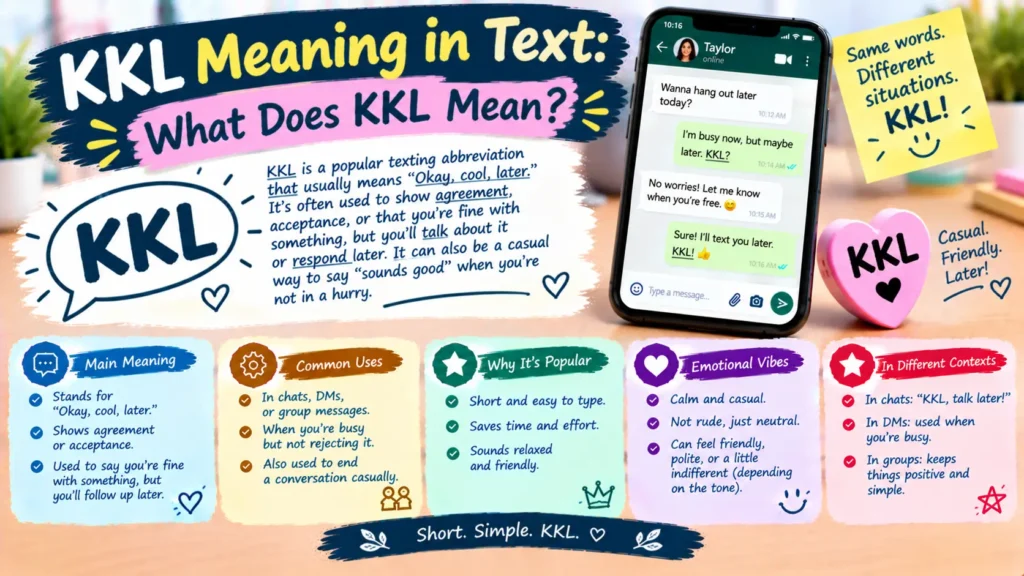
If someone sends you “KKL” in a text, you might pause and wonder what those three letters are supposed to mean. Is it simply “okay”? Is it slang? Or does it carry some hidden meaning?
In casual online conversations, KKL usually means “Okay, Cool.” It is a short chat abbreviation used to acknowledge what someone has said, agree with a plan, or show that something is fine.
For example, if your friend says, “I’ll meet you at 7,” you might answer, “KKL.” In other words, you are saying, “Okay, cool,” “Sounds good,” or “That works.”
KKL is not as universally recognized as abbreviations such as LOL, IDK, or BRB. That is one reason people search for KKL meaning in text. The same three letters can also represent unrelated names, organizations, or terms outside casual messaging, so the surrounding conversation matters.
Let’s look at what KKL means, how people use it, what emotional tone it can carry, and when another expression would be clearer.
KKL Meaning in Text: Quick Meaning
The most documented chat meaning of KKL is “Okay, Cool.” It works as informal shorthand for agreement, acknowledgment, or relaxed acceptance.
Depending on the conversation, KKL can communicate:
- Okay, cool
- Sounds good
- Got it
- That works
- Sure
- I understand
- No problem
- Alright
Here are a few simple examples:
“I’ll send you the photos tonight.”
“KKL.”
“We’re meeting at 8 instead.”
“KKL, sounds good.”
“I finally finished the assignment 😂”
“KKL nice!”
The exact emotional shade depends on the conversation, punctuation, emojis, and relationship between the people.
Origin & Background of KKL
There does not appear to be a single confirmed inventor or origin story for KKL as a texting abbreviation.
A documented Internet/chat listing for KKL meaning “Okay, Cool” was submitted to Abbreviations.com in November 2012. That provides evidence that the expression has been recorded in online chat terminology for more than a decade.
KKL fits into a much larger tradition of digital shorthand. Online communication has encouraged people to shorten common expressions because texting rewards speed and simplicity.
Words and phrases such as “okay,” “laughing out loud,” and “I don’t know” have all developed shorter forms that are easier to type.
Social media has also made brief responses feel normal. A person may want to acknowledge a message without turning a simple exchange into a long conversation.
That is where an expression like KKL can be useful.
It says enough to keep the interaction moving without sounding overly formal.
At the same time, KKL remains relatively niche compared with extremely familiar expressions such as LOL or IDK. Some people will understand it immediately, while others may have never encountered it.
That difference is important when interpreting slang.
Real-Life Conversations Using KKL
The easiest way to understand KKL in text is to see how it sounds in natural conversations.
1. WhatsApp Conversation
Person A: We’re leaving around 6:30 instead of 6.
Person B: KKL, that works for me.
Person A: Perfect, see you then.
Here, KKL is simply a relaxed confirmation.
2. Instagram DM
Person A: I’ll send you the pictures after I edit them.
Person B: KKL, no rush 😊
Person A: Thanks!
The abbreviation makes the response feel casual and friendly.
3. TikTok Comments
Person A: Bro really thought he was going to win 😭
Person B: KKL this comment section is wild.
Person A: Fr 😂
Here, the expression works as part of a playful online exchange.
4. Text Message
Person A: Can we move dinner to Friday?
Person B: Yeah, Friday is fine.
Person A: KKL, Friday it is.
In this situation, KKL means something close to “Okay, cool, Friday works.”
These examples also show why context matters. KKL itself is short, but the surrounding words reveal whether the person is simply agreeing, joking, teasing, or responding casually.
Emotional & Psychological Meaning of KKL
Texting is not only about transferring information. People also use short expressions to manage emotional tone.
KKL can make an acknowledgment feel relaxed rather than formal.
Compare these responses:
“Okay.”
“KKL.”
“Okay, sounds good!”
All three can communicate agreement, but they do not necessarily feel identical.
“Okay” can be neutral.
“KKL” can feel more casual and conversational.
“Okay, sounds good!” feels more openly enthusiastic.
This is why small differences in digital language can affect how a message is received.
Imagine telling a friend:
“I finally got the job I told you about!”
If they respond:
“KKL.”
you might wonder whether they are genuinely excited for you.
The abbreviation itself does not necessarily mean they are being cold. However, because the response is so short, you may interpret it according to your existing relationship and the emotional importance of the message.
That is one of the interesting realities of modern texting. Short messages leave more room for the reader to fill in the emotional gaps.
In my experience with everyday digital communication, people often judge tone not from one word alone, but from the entire pattern of the conversation. Emojis, punctuation, response time, previous messages, and familiarity can completely change how a short abbreviation feels.
How KKL Is Used in Different Contexts
KKL on Social Media
On Instagram, TikTok, Snapchat, and similar platforms, KKL can function as a quick reaction or acknowledgment.
Someone might comment:
“I’m actually trying this tomorrow.”
A friend could respond:
“KKL 😂”
The response keeps things informal and conversational.
Because social media conversations move quickly, short forms can feel natural.
KKL Between Friends
Friends are one of the easiest audiences for KKL.
If someone says:
“I’ll pick you up at 8.”
You can reply:
“KKL.”
There is usually no need for a formal response.
Among people who already understand each other’s communication style, the abbreviation can feel effortless.
KKL in Relationships
Partners may use KKL when making ordinary plans or acknowledging small requests.
For example:
“I’ll call you after dinner.”
“KKL ❤️”
The heart emoji adds warmth that the abbreviation itself does not necessarily contain.
Without context, KKL should not automatically be interpreted as romantic, affectionate, sarcastic, or distant. The relationship and surrounding conversation provide those clues.
KKL at Work
Professional communication is different.
Even if coworkers use slang casually, KKL may not be understood by everyone.
Instead of:
“KKL, I’ll send it later.”
a clearer workplace message would be:
“Okay, sounds good. I’ll send it later.”
In professional settings, clarity usually matters more than saving a few characters.
Casual vs. Serious Conversations
KKL is naturally suited to casual situations.
It can work well for:
- Making plans
- Confirming information
- Responding to friends
- Casual DMs
- Group chats
- Light conversations
It is less suitable when someone is discussing grief, conflict, health concerns, relationship problems, or another emotionally serious subject.
When NOT to Use KKL
Knowing when not to use slang is just as important as knowing what it means.
Avoid KKL when the person you are talking to may not understand internet abbreviations.
For example, sending it to someone who rarely uses social media could create unnecessary confusion.
It is also better to avoid it in formal emails, job applications, customer communication, academic communication, or messages to people who expect professional language.
There is another important situation: emotional conversations.
Suppose someone tells you:
“I’ve been having a really difficult week.”
Responding only with:
“KKL.”
could easily sound dismissive.
The problem is not necessarily that KKL is rude. The problem is that the response does not match the emotional weight of the message.
A better response might be:
“I’m sorry you’re dealing with that. Do you want to talk about it?”
Good communication is not simply about knowing slang. It is about knowing when slang fits.
Common Misunderstandings About KKL
1. Thinking KKL Has One Meaning Everywhere
KKL can represent different things outside texting. Acronym databases list several unrelated meanings, including organizations and institutional names.
Therefore, context is essential.
2. Assuming KKL Is Always Funny
Although KKL can sound relaxed, it does not automatically mean the person is laughing.
If someone writes:
“KKL, I understand.”
they may simply be acknowledging your message.
3. Assuming It Is Automatically Rude
A short reply can sometimes feel dismissive, but KKL itself is generally a casual acknowledgment when used with its “Okay, Cool” meaning.
Tone comes from context.
4. Confusing KKL With Similar-Looking Abbreviations
Three-letter abbreviations can be surprisingly easy to misread.
KKL should not automatically be interpreted as another abbreviation simply because the letters look similar.
5. Believing It Is a Formal English Expression
KKL is informal chat shorthand.
It should not be treated as standard written English suitable for every situation.
KKL Comparison Table
| Search or Use | Meaning / Intent |
|---|---|
| KKL mean in text | Usually “Okay, Cool” |
| How to use KKL | Use it for casual acknowledgment or agreement |
| Examples of KKL | “KKL, sounds good.” / “KKL, see you then.” |
| KKL vs KK | KKL commonly means “Okay, Cool,” while KK is a shorter acknowledgment |
| KKL vs LOL | KKL signals acknowledgment; LOL primarily signals laughter |
| KKL vs IDK | KKL indicates agreement or acceptance; IDK means “I don’t know” |
| KKL vs “Sounds good” | Both can confirm a plan, but “Sounds good” is clearer and more broadly understood |
| KKL vs “Okay” | Both can acknowledge something, while KKL has a more internet-chat style |
Key Insight
KKL is useful because it communicates agreement quickly, but its relatively niche status means that plain language can sometimes be more effective. The best choice depends on who you are talking to and what the conversation is about.
Variations and Related Forms of KKL
The following forms may appear in casual conversations around the same idea. They are not all separate official meanings of KKL, but they show how people can express a similar casual acknowledgment.
1. KKL Meaning
Meaning: Okay, Cool.
In text: A quick acknowledgment or agreement.
Abbreviation: KKL.
Slang: Casual internet shorthand.
In chat: “KKL, I’ll be there.”
2. KK
Meaning: Okay or got it.
In text: A short acknowledgment.
Abbreviation: KK.
Slang: Informal texting shorthand.
In chat: “KK, see you soon.”
3. Kk Lol
Meaning: Okay, laughing or keeping things light.
In text: Agreement with a humorous tone.
Abbreviation: Kk lol.
Slang: Casual chat expression.
In chat: “Kk lol, you got me.”
4. KKL 😂
Meaning: Okay, cool with a playful tone.
In text: The emoji adds humor or warmth.
Abbreviation: KKL.
Slang: Informal digital language.
In chat: “KKL 😂 that was funny.”
5. Okay, Cool
Meaning: The full phrase represented by KKL.
In text: Agreement or acknowledgment.
Abbreviation: KKL.
Slang: Informal phrase when shortened.
In chat: “Okay, cool, I’ll meet you there.”
6. Sounds Good
Meaning: I agree with the plan.
In text: Positive confirmation.
Abbreviation: None required.
Slang: Casual conversational phrase.
In chat: “Sounds good, see you tonight.”
7. Got It
Meaning: I understand.
In text: Confirmation of understanding.
Abbreviation: GI can sometimes appear, but it is not as standard as KKL.
Slang: Casual conversational wording.
In chat: “Got it, thanks.”
8. Alright
Meaning: Okay or accepted.
In text: A neutral acknowledgment.
Abbreviation: None.
Slang: Casual everyday language.
In chat: “Alright, let’s do it.”
9. KKL!
Meaning: Okay, cool!
In text: More energetic acknowledgment.
Abbreviation: KKL.
Slang: Informal chat shorthand.
In chat: “KKL! See you there.”
10. KKL, Thanks
Meaning: Okay, cool, thank you.
In text: Acceptance plus appreciation.
Abbreviation: KKL.
Slang: Friendly texting shorthand.
In chat: “KKL, thanks for letting me know.”
How to Respond When Someone Uses KKL
You normally do not need to give a complicated response.
Casual Replies
- “Cool!”
- “Sounds good.”
- “Perfect.”
- “Yep!”
- “Alright.”
- “Awesome.”
Funny Replies
If the conversation is playful, you could say:
- “Very enthusiastic 😂”
- “Glad we agree.”
- “That’s all I get? 😂”
- “KKL accepted.”
- “We have reached an agreement 😭”
Mature Replies
When you want to sound calm and clear:
- “Got it, thanks.”
- “Sounds good to me.”
- “Understood.”
- “Okay, I appreciate it.”
Respectful Replies
For someone you do not know well:
- “Alright, thank you.”
- “Sounds good, thanks.”
- “Okay, I understand.”
- “Thank you for confirming.”
Your response should match the tone of the original conversation rather than simply copying the abbreviation.
Regional & Cultural Usage
There is no strong evidence that KKL has a completely different standard texting definition in Western, Asian, or Middle Eastern cultures. Its documented “Okay, Cool” meaning belongs to general Internet/chat terminology, while other meanings of KKL exist outside casual texting.
Western Culture
In English-speaking online spaces, KKL can work as casual shorthand for “Okay, Cool.”
Its use is more natural among people who are already comfortable with internet abbreviations.
Asian Culture
English-language digital communication is common across many Asian online communities, but slang familiarity varies considerably by country, age, language background, and social group.
Someone may understand KKL immediately, while another person may prefer “Okay” or “Sounds good.”
Middle Eastern Culture
The same principle applies in Middle Eastern online communication.
English slang may be common in some social circles but unfamiliar in others. The safest interpretation comes from the actual conversation rather than assuming a regional meaning.
Global Internet Usage
Internet slang crosses borders quickly.
A phrase created or documented in one online community can appear elsewhere through social media, gaming, messaging apps, and international friendships.
However, global exposure does not make every abbreviation universally understood.
Gen Z vs. Millennials
Gen Z users often communicate comfortably through abbreviations, emojis, memes, and compressed expressions.
Millennials also use texting shorthand, but individual preferences vary widely.
Neither generation should automatically be assumed to know KKL. Because the abbreviation is less universal than expressions such as LOL or IDK, familiarity depends heavily on someone’s online habits.
Is KKL Safe for Kids?
Yes, KKL is generally harmless when it is being used to mean “Okay, Cool.”
It does not inherently contain offensive or adult language.
The more important lesson for younger users is context awareness.
Children and teenagers should understand that casual slang is appropriate with friends but may not be suitable when speaking with teachers, school administrators, parents in formal situations, or other adults who expect clearer communication.
They should also understand that short replies can sometimes be misunderstood, especially during emotional conversations.
FAQs About KKL Meaning in Text
What does KKL mean in text?
KKL usually means “Okay, Cool.” It is an informal abbreviation used to acknowledge a message, agree with something, or confirm that a plan is fine.
Is KKL slang?
KKL is best understood as casual chat shorthand or a texting abbreviation. It is not a standard English word.
What does KKL mean on Instagram?
On Instagram, KKL can mean “Okay, Cool” when used in a casual DM, comment, or conversation. The surrounding message should be considered before interpreting it.
Is KKL rude?
KKL is not inherently rude. However, using only “KKL” in response to a serious or emotional message could make the response feel dismissive.
Can I use KKL at work?
It is usually better to use clearer wording in professional communication, such as “Okay, sounds good” or “Understood.”
What is the difference between KKL and KK?
KKL generally means “Okay, Cool,” while KK is a shorter acknowledgment meaning “Okay” or “Got it.” Their exact tone depends on context.
Does KKL always mean “Okay, Cool”?
No abbreviation has to mean the same thing in every context. KKL has several unrelated meanings outside chat, so the conversation and setting should determine the intended meaning.
Conclusion
So, what does KKL mean in text? In casual messaging, the most documented meaning is “Okay, Cool.” It is a quick way to acknowledge something, agree with a plan, or keep a conversation relaxed.
You might see KKL in texts, WhatsApp conversations, Instagram DMs, TikTok comments, group chats, or other informal digital spaces.
The important part is not just memorizing the abbreviation. It is understanding the tone around it.
A simple “KKL” between friends can feel perfectly natural. The same response to an emotional message may feel too brief. And in professional communication, “Sounds good” or “Okay, thank you” is usually easier for everyone to understand.
Digital language works best when it matches the person, relationship, and moment.
Once you recognize those clues, KKL becomes much less mysterious. In most casual conversations, it is simply a short, relaxed way of saying, “Okay, cool.”




