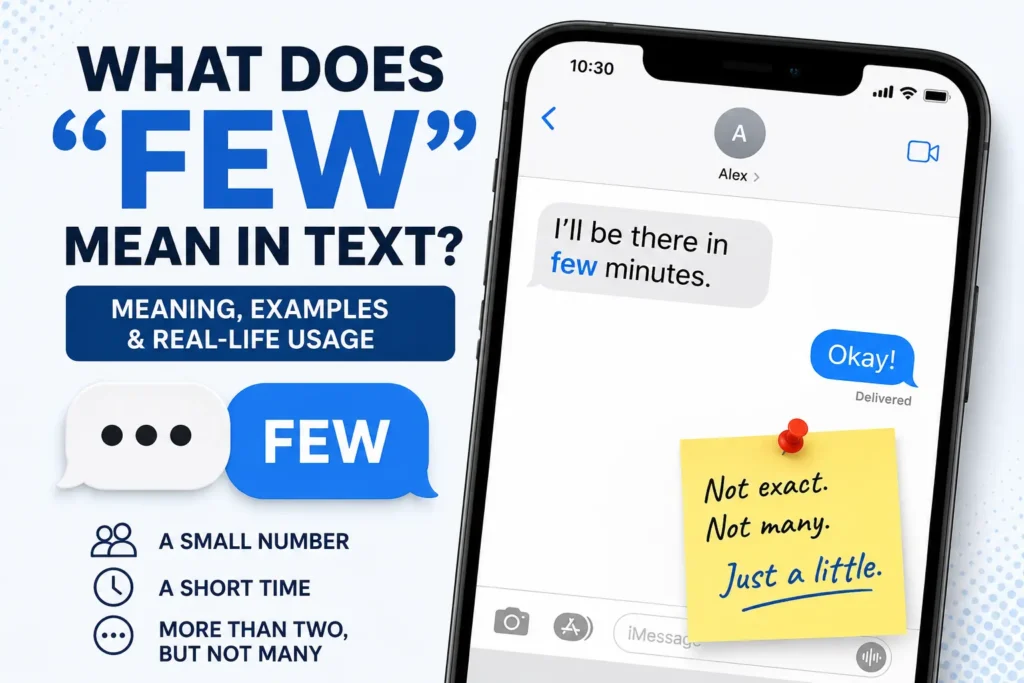
Have you ever received a text saying, “I’ll be there in a few minutes,” and wondered whether that means three minutes, five minutes, or something longer?
You’re not alone. “Few” is one of those everyday English words that seems simple until you try to put an exact number on it. In texting, social media, and casual conversation, people use it loosely, which can make its meaning feel uncertain.
So, what does “few” mean in text? Usually, it means a small number or amount, more than two but not a large quantity. However, the exact number depends heavily on context.
For example, “I have a few questions” might mean three questions. “Give me a few minutes” could mean anywhere from three to ten minutes depending on the speaker and situation.
Understanding this small difference can help you avoid awkward misunderstandings, especially when texting friends, making plans, or communicating at work.
“What Does Few Mean in Text” – Quick Meaning
In text messages, “few” generally means a small number or amount. It doesn’t normally give an exact figure.
When someone says “a few,” they usually mean more than two, but not many.
Here are some natural examples:
“I’ll call you in a few minutes.”
“I’ve got a few things to finish.”
“We only have a few seats left.”
The important point is that “few” is flexible. The listener often has to understand the situation to estimate the intended amount.
In everyday texting, “few” can sometimes feel almost like a soft estimate rather than a mathematical measurement.
Origin & Background of “Few”
The word few has a very old history in the English language. It comes from Old English “fēaw,” which referred to a small number or quantity.
Its basic meaning has remained surprisingly stable over centuries.
What has changed is how people use it in informal communication. Modern English speakers often use “few” without intending to communicate an exact number.
Texting has made this flexibility even more noticeable.
A person sending “I’ll be there in a few” usually isn’t calculating a specific number of minutes. They are communicating the general idea that the wait should be short.
Social media has also encouraged shorter, more conversational language. People often leave out words that would normally provide additional context.
For example, someone might comment:
“Give me a few 😭”
The meaning could be “give me a few minutes,” “give me a few seconds,” or even “give me a few more chances,” depending on the conversation.
This is why context matters so much when interpreting casual English online.
Real-Life Conversations: How “Few” Works in Texting
WhatsApp Conversation
Person A: Are you coming to dinner?
Person B: Yeah, give me a few. I’m almost ready.
Person A: How many minutes?
Person B: Like 5–10 mins 😂
Here, “a few” doesn’t mean a strict number. Person B uses it as a casual way to say a short amount of time.
Instagram DM
Person A: Did you finish the photos?
Person B: I have a few left.
Person A: How many?
Person B: Maybe four or five.
In this situation, “a few” refers to a small number of photos. The follow-up makes the approximate quantity clearer.
TikTok Comments
Person A: How long did this take you?
Person B: A few hours 😭
Person A: That looks like more than a few!
Here, “a few hours” could mean three, four, or even several hours. The phrase is intentionally approximate.
Text Message
Person A: Can you lend me some money until Friday?
Person B: I can send you a few dollars.
Person A: No worries, anything helps.
Here, “a few” simply means a small amount. The exact amount depends on what both people consider reasonable in the situation.
Emotional & Psychological Meaning of “Few”
The word few isn’t usually emotional by itself, but the way someone uses it can reveal something about their attitude.
In casual communication, “a few” often makes a statement sound less rigid and more relaxed.
Compare these two messages:
“I’ll be there in exactly five minutes.”
and
“I’ll be there in a few minutes.”
The first sounds precise and committed. The second sounds casual and flexible.
That’s one reason people prefer “few” in everyday conversations. It gives them room without sounding vague or dismissive.
I’ve noticed this especially in conversations where people don’t want to overpromise. Saying “I need a few minutes” can feel softer than saying “I need 10 minutes.”
There is also a psychological element. People often communicate in estimates because everyday life doesn’t happen with perfect precision. A friend getting ready, finishing work, or replying to messages may not know the exact amount of time involved.
“Few” allows communication to stay natural.
Usage in Different Contexts
On Social Media
On Instagram, TikTok, Snapchat, and other platforms, few is commonly used in a casual and abbreviated way.
Examples include:
“I’ll post a few later.”
“Just give me a few.”
“I’ve got a few more pics.”
The meaning is usually obvious from the surrounding conversation.
With Friends and Relationships
Friends and couples frequently use “few” when making informal plans.
For example:
“I’ll be there in a few.”
“Give me a few minutes.”
“We talked for a few hours.”
These expressions sound natural because they’re relaxed rather than formal.
However, if someone repeatedly says “a few minutes” and actually means 30 minutes, frustration can develop.
In Work and Professional Settings
“Few” can be useful professionally, but precision is sometimes better.
For example:
“I have a few questions about the report.”
This is perfectly professional.
But:
“The project will be finished in a few days.”
could be unclear if a deadline matters.
In professional communication, use a specific number when timing or quantity affects a decision.
Casual vs. Serious Tone
In casual conversation, “few” is usually harmless.
In serious situations, ambiguity can create problems.
If someone says, “I’ll send the payment in a few days,” the recipient may reasonably ask for an exact date.
The more important the information, the more useful precision becomes.
When NOT to Use “Few”
There are situations where using “few” can create unnecessary confusion.
Avoid relying on “few” when you need to communicate an exact deadline, quantity, measurement, or commitment.
For example, don’t tell a client:
“Your order will arrive in a few days.”
if the delivery date is already known.
It’s better to say:
“Your order should arrive within three business days.”
Cultural sensitivity can matter too. Some people interpret “few” as three, while others use it for five or more.
If you’re communicating with someone who expects precise information, clarify rather than assuming they interpret the word the same way.
Common Misunderstandings About “Few”
One of the biggest misconceptions is that few always means exactly three.
It doesn’t.
Three is a common interpretation because “a few” often suggests a small number, and three is frequently used as a practical example. But English dictionaries do not define “few” as a fixed number of three.
Another misunderstanding comes from the difference between “few” and “a few.”
These expressions can have noticeably different meanings.
Compare:
“Few people came to the event.”
This suggests that not many people came, possibly fewer than expected.
Now compare:
“A few people came to the event.”
This simply means some people came, probably a small number.
That tiny word “a” changes the feeling of the sentence.
What does a few mean in numbers
In numbers, “a few” usually refers to a small quantity greater than two, but it has no universally fixed numerical value.
Most people naturally interpret “a few” as somewhere around three to five, although context can push the meaning higher or lower.
For example:
- “a few people” → perhaps 3–5 people
- “a few minutes” → perhaps 3–10 minutes
- “a few dollars” → a small amount
- “a few days” → commonly several days
These are practical interpretations, not strict mathematical rules.
Is a few = 3
No, “a few” does not always equal three.
Three is probably the clearest example of “a few,” which is why people often associate the two.
However, if someone says, “I bought a few books,” they might have bought three, four, or five.
The surrounding context determines the likely number.
If someone says:
“I have a few minutes before my meeting.”
you shouldn’t automatically assume they have exactly three minutes.
Can a few mean 2
In standard English, “a few” generally suggests more than two, so two is not the strongest interpretation.
If someone has exactly two items, “a couple” is usually more natural.
For example:
“I have a couple of questions.”
normally suggests two questions.
“I have a few questions.”
normally suggests a small number greater than two.
That said, casual speakers may sometimes use “a few” loosely, especially when they aren’t counting carefully.
A few and few meaning
The difference between “a few” and “few” is important.
A few means some, but a small number. It usually carries a relatively positive or neutral feeling.
“I have a few good friends.”
This suggests the speaker has some good friends.
Few without “a” means not many and can sound more negative.
“I have few close friends.”
This emphasizes that the speaker has a limited number of close friends.
So, “a few” highlights what exists, while “few” often highlights what is lacking.
What does a couple mean
“A couple” traditionally means two, especially when referring to people or objects.
For example:
“I need a couple of minutes.”
Literally, this can mean two minutes.
However, in casual American and international English, people sometimes use “a couple” more loosely to mean approximately two or a small number close to two.
This is why “a couple of days” doesn’t always mean exactly 48 hours.
Still, if you need precision, use the exact number.
What does a few minutes mean
“A few minutes” means a short period of time, usually more than two minutes but not a long wait.
In everyday conversation, people might use it for approximately 3–10 minutes.
But there is no official time limit.
If your friend says:
“Give me a few minutes.”
they could mean five minutes.
They could also mean eight minutes if they’re finishing something.
Context, urgency, and the speaker’s habits all influence the meaning.
Is a few 3 or 4
A few can mean three or four.
Both numbers fit the ordinary conversational meaning of “a few.”
Three may feel like the clearest example, but four is also completely natural.
For example:
“I watched a few episodes last night.”
That could mean three episodes or four episodes.
The speaker may not even know or care about the exact number while speaking.
What does a several mean
The natural phrase is “several,” not usually “a several.”
“Several” means more than two but not many, often suggesting a somewhat larger number than “a few.”
For example:
“Several people attended the meeting.”
This could mean five, six, seven, or another relatively small number.
There is no exact numerical definition.
A useful general distinction is:
a couple → around 2
a few → around 3–5
several → more than a few, but not many
These are guidelines rather than mathematical formulas.
Variations and Types of “Few” in Modern Communication
1. “A few” meaning
A small number or amount, usually more than two.
2. “A few” in text
A casual way to express an approximate small quantity.
3. “Few” abbreviation
“Few” has no standard texting abbreviation. People normally write the full word.
4. “A few” slang
“A few” isn’t technically slang, but it is extremely common in informal speech and texting.
5. “A few” in chat
It often means “some” or “a small amount,” depending on the conversation.
6. “Few minutes” meaning
A short, approximate period, commonly understood as several minutes.
7. “Few days” meaning
A small number of days without specifying an exact duration.
8. “Few people” meaning
A small number of people.
9. “Few more” meaning
An additional small number or amount.
“Give me a few more minutes.”
10. “Few left” meaning
Only a small number remain.
“There are only a few seats left.”
How to Respond When Someone Uses “Few”
Sometimes the easiest way to understand “few” is simply to ask for clarification.
Casual Replies
- “Sure, take your time.”
- “How many exactly?”
- “Okay, I’ll wait.”
- “No problem!”
Funny Replies
- “Your ‘few’ better not mean 30 minutes 😂”
- “Define few! 😂”
- “Three minutes or three business days? 😭”
Mature Replies
- “Sure. Just let me know when you’re ready.”
- “No problem. Do you have an approximate time?”
- “That’s fine. Please keep me updated.”
Respectful Replies
- “Of course. Take the time you need.”
- “Sure, just let me know when you’re available.”
- “No worries. I’ll wait for your message.”
The best response depends on whether precision actually matters.
Regional & Cultural Usage
The meaning of “few” is broadly understood across English-speaking communities, but people’s interpretation of its size can differ.
Western Culture
In the United States, Canada, the United Kingdom, Australia, and other Western English-speaking environments, “a few” commonly communicates a small, approximate number.
However, Americans may use “a few” quite casually for quantities that aren’t literally tiny.
Asian Culture
English users across Asian countries often understand “few” according to standard English rules, but local communication habits can influence how precise the phrase feels.
In professional or educational settings, speakers may prefer exact numbers to prevent ambiguity.
Middle Eastern Culture
English is widely used as a second or professional language across many Middle Eastern communities.
Because English users may come from different linguistic backgrounds, “a few” can sometimes be interpreted more literally.
If the information is important, adding a number is the safest approach.
Global Internet Usage
Online communication has made “few” even more flexible.
People type quickly, use incomplete sentences, and assume shared context.
As a result, “few” may function more as a general estimate than a precise quantity.
Gen Z vs. Millennials
Gen Z and Millennials generally understand “few” in similar ways, but younger users may use it more casually in short-form communication.
A Gen Z user might say:
“Wait a few 😭”
where the missing noun is understood from context.
Millennials may be slightly more likely to write:
“Give me a few minutes.”
The difference isn’t grammatical. It’s mainly about communication style and platform habits.
Is “Few” Safe for Kids?
Yes. “Few” is a completely ordinary and age-appropriate English word.
Children can safely use it in schoolwork, conversations, messages, and everyday writing.
The main lesson for younger learners is understanding the difference between few, a few, a couple, and several.
Parents and teachers can explain these words with simple counting examples.
For instance, show two objects and call them “a couple,” then show three or four and describe them as “a few.”
This gives children a practical sense of how approximate quantity words work.
FAQs About “Few” in Text
What does “few” mean in a text message?
“Few” usually means a small number or amount. It is approximate rather than an exact numerical measurement.
Does “a few” always mean three?
No. Three is a common interpretation, but “a few” can also mean four, five, or another small number depending on context.
Is “a couple” the same as “a few”?
Not exactly. “A couple” traditionally means two, while “a few” generally suggests a small number greater than two.
Can “a few” mean two?
It can be used loosely to mean a very small number, but two is more naturally described as “a couple.”
How long is “a few minutes”?
Usually, it means a short period of several minutes, often around three to ten minutes, but there is no fixed definition.
What is the difference between “few” and “a few”?
“A few” means some small number, while “few” without “a” emphasizes that the number is small or insufficient.
Is “several” more than “a few”?
Usually, yes. “Several” generally suggests more than “a few,” although neither word has an exact numerical value.
Conclusion
Understanding “few” is less about memorizing one exact number and more about reading the situation. In everyday English, it usually describes a small, approximate amount, often more than two. Whether someone means three minutes, four people, or several days depends on context. When precision matters, simply ask for clarification or provide an exact number. Once you understand that “few” is flexible rather than fixed, texting, conversation, and everyday English become much easier to interpret confidently.