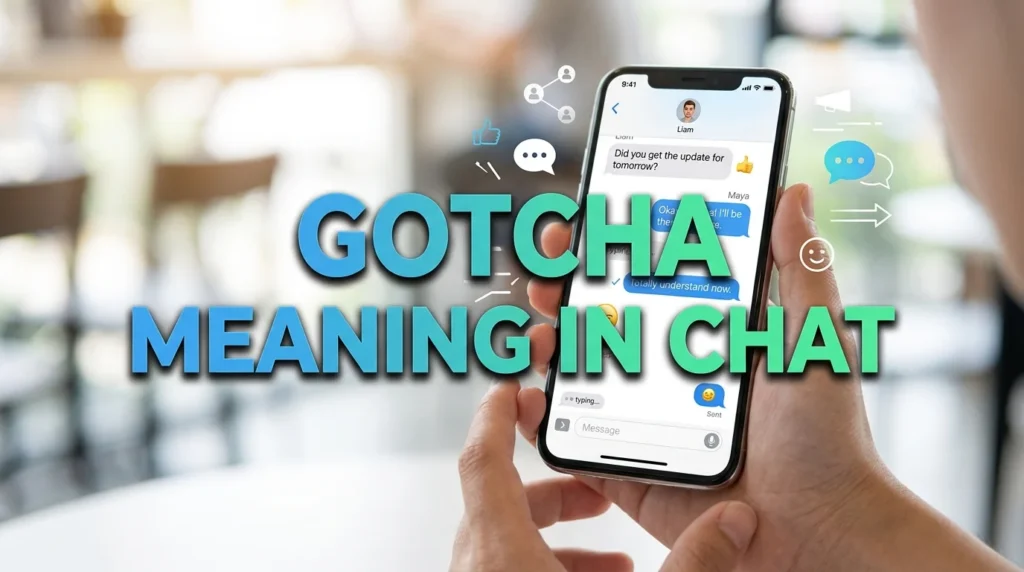
Have you ever received a message saying “gotcha” and wondered whether the person was agreeing with you, teasing you, or simply acknowledging what you said?
You’re not alone.
The phrase “gotcha” is one of the most common expressions used in texting, social media conversations, online chats, and even everyday speech. While it looks simple, its meaning can change depending on the context, tone, and relationship between the people communicating.
In this guide, you’ll learn exactly what gotcha meaning in chat is, where it came from, how it’s used in different situations, and how to respond naturally when someone sends it.
Gotcha Meaning in Chat
In chat, “gotcha” usually means:
- I understand
- I got it
- I see what you mean
- Message received
- Okay, understood
It is an informal way of showing that you’ve understood what someone said.
Quick Examples
“The meeting starts at 3 PM.”
“Gotcha.”
“Take the second left after the traffic light.”
“Gotcha, thanks.”
“I’ll send the file tomorrow.”
“Gotcha.”
In most online conversations, “gotcha” acts as a friendly acknowledgment rather than a detailed response.
gotcha Definition
The dictionary-style definition of gotcha is:
An informal expression meaning “I understand,” “I caught you,” or “I have successfully understood or trapped someone.”
The exact meaning depends on the situation.
It can express:
- Understanding
- Recognition
- Discovery
- Catching someone in a mistake
- Agreement
Because of its flexibility, it appears frequently in texts, comments, memes, and conversations.
What Does ‘Gotcha’ Mean?
The phrase combines the words:
“Got” + “You” = Got You = Gotcha
Over time, English speakers began pronouncing “got you” quickly, which naturally sounded like “gotcha.”
Today, the shortened version has become its own word.
Depending on context, it may mean:
- I understand you.
- I caught you.
- I figured it out.
- I see your point.
- I successfully tricked or surprised you.
Meaning of “Gotcha”
When someone says “gotcha,” they’re usually communicating one of two ideas:
Understanding Meaning
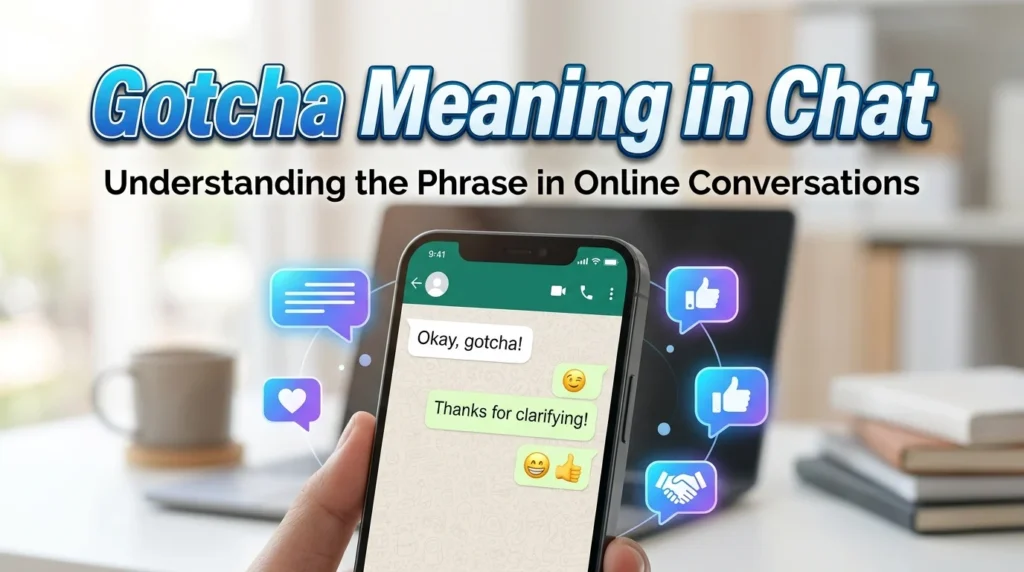
“I understand what you’re saying.”
Example:
“The password is in the email.”
“Gotcha.”
Catching Meaning
“I caught you.”
Example:
“You said you weren’t eating cookies.”
“Gotcha! I saw you.”
The first meaning is much more common in chats and text messages.
Gotcha: Meaning & Examples
Here are some everyday examples:
Example 1
“Send me the notes after class.”
“Gotcha.”
Meaning: I understand and will do it.
Example 2
“The restaurant changed locations.”
“Gotcha.”
Meaning: Thanks for informing me.
Example 3
“You said you weren’t online today.”
“Gotcha!”
Meaning: I caught you.
Example 4
“So that’s why the app wasn’t working.”
“Ah, gotcha.”
Meaning: Now I understand.
Gotcha Meaning in Chat from a Girl
When a girl texts “gotcha,” it usually doesn’t carry a hidden romantic meaning by itself.
Most often it means:
- I understand.
- Okay.
- Noted.
- Message received.
- I see what you mean.
Examples:
“I’ll be late by ten minutes.”
“Gotcha.”
“I had a stressful day today.”
“Gotcha, that sounds rough.”
The emotional tone depends more on the rest of the conversation than on the word itself.
If she adds emojis, punctuation, or extra words, the meaning may feel warmer or more personal.
Gotcha Meaning in Chat in English
In English conversations, gotcha is an informal acknowledgment phrase.
Native speakers often use it instead of:
- I understand.
- Understood.
- Okay.
- I got it.
- Noted.
Because it sounds friendly and conversational, it appears frequently in:
- Text messages
- Social media chats
- Workplace messaging apps
- Online gaming communities
You Gotcha Me Meaning
The phrase “you gotcha me” usually means:
- You fooled me.
- You surprised me.
- You caught me.
- You tricked me successfully.
Examples:
“I really thought that story was true.”
“Haha, gotcha!”
Or:
“I didn’t think you’d notice.”
“You gotcha me.”
This version often appears in playful conversations and jokes.
Gotcha Moment Meaning Slang
A gotcha moment is a slang expression describing a situation where someone catches another person making a mistake, contradicting themselves, or revealing something unintentionally.
Examples include:
- Winning an argument.
- Catching someone in a lie.
- Exposing an inconsistency.
- Successfully pulling a prank.
Example:
“He said he never watched the show, but then he quoted an episode.”
“That’s a gotcha moment.”
Gotcha Full Form
Many people search for a full form of gotcha, but it is not an acronym.
There is no official full form.
The word simply evolved from:
“Got you” → “Gotcha”
It is a contraction created through natural spoken English.
Gotcha Meaning Programming
In programming and software development, a gotcha refers to:
A hidden problem, unexpected behavior, or tricky detail that can cause errors if overlooked.
Programmers often say:
“There’s a gotcha in this code.”
Meaning:
There is something easy to miss that could create bugs or confusion.
Example:
A programming language may handle numbers differently than expected. That unexpected behavior would be called a gotcha.
Gotcha Pronunciation
The pronunciation of gotcha is:
GOT-chuh
Phonetic spelling:
/ˈɡɑːtʃə/
It sounds almost exactly like:
“Got-cha”
The second syllable is soft and quick.
Gotcha in a Sentence
Here are several natural examples:
- Gotcha, I’ll be there at six.
- Gotcha, thanks for explaining.
- I finally gotcha hiding the surprise.
- Ah, gotcha now.
- Gotcha, that makes sense.
- The teacher gotcha cheating during the test.
- Gotcha! You almost fooled me.
What Does Gotcha Stand For?
Technically, gotcha does not stand for anything.
It originated from the spoken phrase:
“Got you.”
Over many years, English speakers blended the sounds together until “gotcha” became a standalone word.
How to Abbreviate “I Get You”?
Common alternatives include:
- Gotcha
- I got you
- IGY (rare)
- Understood
- Copy that
- Roger
- Okay
- Makes sense
Among these, gotcha is the most natural and widely used in casual conversations.
What Is the Meaning of Gotcha Abbreviation?
Although many people think it’s an abbreviation, gotcha is actually a contraction and slang expression.
Its meaning usually includes:
- I understand.
- I hear you.
- I see your point.
- Message received.
Origin & Background
The roots of “gotcha” go back to spoken English in the United States.
When people spoke quickly, “got you” naturally blended into:
“gotcha”
Over time, the expression became common in:
- Movies
- Television
- Radio
- Everyday speech
The internet accelerated its popularity.
Today, you’ll see it everywhere:
- Instagram comments
- TikTok videos
- WhatsApp chats
- Discord servers
- Online gaming communities
The meaning has evolved from simply “caught you” to also include “I understand.”
Real-Life Conversations
WhatsApp Conversation
Person A: Don’t forget to bring the charger tomorrow.
Person B: Gotcha, it’s already in my bag.
Instagram DM
Person A: The link is in my bio.
Person B: Gotcha, checking it now.
TikTok Comments
Person A: The song starts at 0:47.
Person B: Gotcha! Thanks for the timestamp.
Text Message
Person A: Dinner is moved to 8 PM.
Person B: Gotcha. See you then.
Emotional & Psychological Meaning
Communication today moves fast.
People often want to acknowledge a message without writing a long response.
That’s where “gotcha” becomes useful.
Emotionally, it can signal:
- Understanding
- Attention
- Agreement
- Validation
- Engagement
Imagine a friend explaining a difficult situation.
Instead of responding with a simple “okay,” saying “gotcha” can feel slightly warmer because it suggests you’ve actually processed what they said.
In my experience observing online conversations, people often use “gotcha” when they want to sound attentive without making the exchange overly formal.
Usage in Different Contexts
Social Media
Used to acknowledge information quickly.
Example:
“Gotcha, thanks for sharing.”
Friends & Relationships
Often friendly and relaxed.
Example:
“Gotcha, I know what you mean.”
Work & Professional Settings
Acceptable in informal workplace chats.
Example:
“Gotcha. I’ll review the report.”
Casual vs Serious Tone
Casual: Very common.
Serious: Use carefully, as some situations may require a more detailed response.
When NOT to Use It
Avoid using “gotcha” in:
Formal Business Documents
Use:
- Understood
- Acknowledged
- Received
Sensitive Conversations
If someone shares bad news, a simple “gotcha” may seem dismissive.
Legal or Official Communication
Choose precise language instead.
Cultural Situations
Some people may interpret “gotcha” as overly casual.
Common Misunderstandings
Confusing Understanding with Catching
Many learners think it always means “I caught you.”
In modern chat, it usually means “I understand.”
Tone Misinterpretation
Without emojis or context, “gotcha” can sometimes sound abrupt.
Assuming It Is Rude
Most users see it as neutral or friendly.
Thinking It Is an Acronym
It is not.
Comparison Table
| Term | Definition Intent |
|---|---|
| Gotcha mean in text | I understand or message received |
| How to Use Gotcha | Quick acknowledgment in conversation |
| Examples of Gotcha | “Gotcha, thanks” or “Gotcha, see you then” |
| Gotcha vs Okay | Gotcha implies understanding; okay may simply acknowledge |
| Gotcha vs Understood | Understood is more formal |
| Gotcha vs I See | I see focuses on comprehension |
| Gotcha vs Roger That | Roger that is more instruction-oriented |
Key Insight
The biggest difference is that gotcha communicates both understanding and acknowledgment at the same time, making it especially useful in fast-paced digital conversations.
Variations / Types
Gotcha Meaning
General understanding or catching someone.
Gotcha in Text
A quick acknowledgment message.
Gotcha Abbreviation
Informal contraction of “got you.”
Gotcha Slang
Casual conversational expression.
Gotcha in Chat
Indicates understanding.
Ah Gotcha Meaning
“Now I understand.”
Okay Gotcha Meaning
“I understand and agree.”
Gotcha Bro Meaning
Friendly acknowledgment between friends.
Gotcha Thanks Meaning
Understanding combined with gratitude.
Gotcha Now Meaning
Realization or sudden understanding.
How to Respond When Someone Uses It
Casual Replies
- Cool.
- Sounds good.
- Perfect.
- Great.
Funny Replies
- Glad we’re on the same page.
- Achievement unlocked: Understanding.
- Finally, my explanation worked.
Mature Replies
- Thank you for understanding.
- I appreciate that.
- Glad that makes sense.
Respectful Replies
- Thanks for acknowledging.
- Let me know if you have questions.
- I appreciate your attention.
Regional & Cultural Usage
Western Culture
Very common and widely understood.
Asian Culture
Often learned through movies, social media, and English-language content.
Middle Eastern Culture
Used mainly among younger English-speaking internet users.
Global Internet Usage
Recognized across most online communities.
Gen Z vs Millennials
Gen Z: Uses it frequently in texting and social apps.
Millennials: Often use it in both speech and digital communication.
Both generations generally interpret it as “I understand.”
Is It Safe for Kids?
Yes.
“Gotcha” is generally considered a safe and harmless expression.
Children may encounter it in:
- School conversations
- Online games
- Social media
- Text messages
The phrase itself contains no offensive meaning, although context always matters.
FAQs
What does gotcha mean in texting?
It usually means “I understand” or “I got it.”
Is gotcha rude?
No. It is generally informal and friendly.
Does gotcha mean okay?
Sometimes. It often serves a similar purpose but emphasizes understanding.
What is the difference between gotcha and understood?
“Understood” is more formal, while “gotcha” is conversational.
Can I use gotcha at work?
Yes, in informal workplace chats. For formal communication, choose more professional wording.
Why do people say gotcha?
It saves time while showing that they understood the message.
Is gotcha slang?
Yes. It is considered informal slang derived from “got you.”
Conclusion
Understanding gotcha meaning in chat helps you navigate modern digital conversations with confidence. In most situations, the phrase simply means “I understand,” “I got it,” or “message received.” However, depending on context, it can also refer to catching someone, surprising them, or identifying a mistake.
Its popularity comes from its simplicity. One short word can acknowledge information, confirm understanding, and keep a conversation moving naturally. Whether you’re chatting on WhatsApp, replying to Instagram messages, participating in TikTok comments, or texting friends, knowing how and when to use “gotcha” makes communication feel smoother and more authentic.
The next time someone sends you “gotcha,” you’ll know exactly what they mean—and how to respond naturally.