
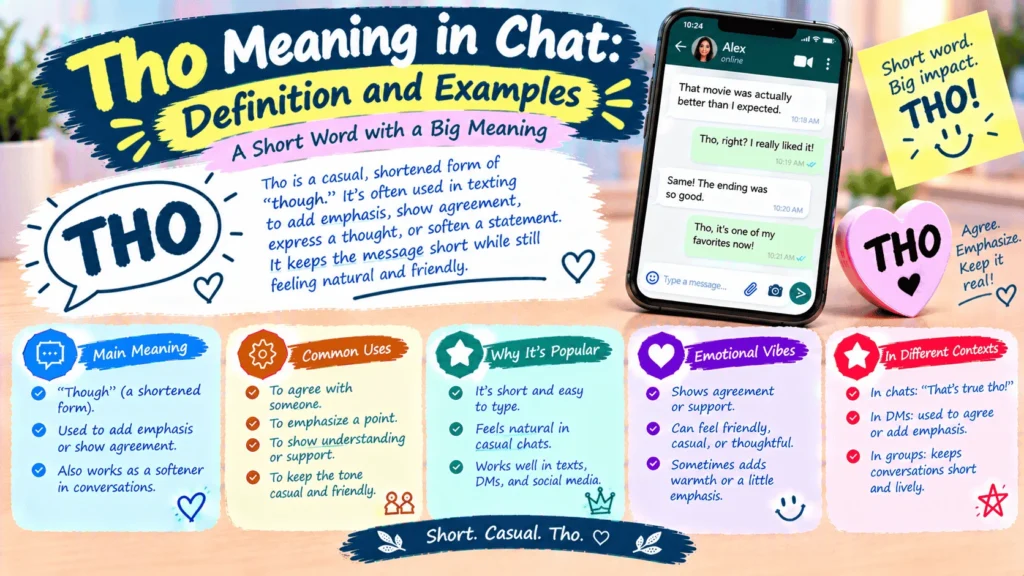
If you have ever received a text message ending with “tho,” you might have wondered what the sender really meant. Is it a casual way to agree, a subtle way to disagree, or simply a shorter version of another English word?
The tho meaning in chat is usually “though,” an informal spelling commonly used in texting, social media, and online conversations. People use it to express contrast, add emphasis, share an opinion, or make a sentence sound more relaxed.
For example, someone might text, “That movie was expensive tho.” They are saying that the movie was expensive, perhaps even though they enjoyed it or thought it was worth watching.
The word is short, but its meaning can change slightly depending on the conversation. A message such as “You look good tho” may sound like a compliment, while “I understand tho” can communicate acceptance without necessarily indicating complete agreement.
You will often see “tho” on WhatsApp, Instagram, TikTok, Snapchat, gaming chats, and everyday text messages. Understanding it helps you recognize the difference between someone’s literal words and the feeling behind them.
In this guide, you will learn what “tho” means in text, where it comes from, how people use it in real conversations, and how to respond naturally.
Tho Meaning in Chat – Quick Meaning
Tho means “though.” It is an informal spelling used in digital communication and casual writing.
Depending on the context, it can express contrast, emphasis, mild disagreement, or an additional thought.
Common meanings include:
- Though: The standard English word written informally.
- However: Introducing a contrasting idea.
- Still or nevertheless: Acknowledging something without changing your opinion.
- Emphasis: Highlighting a particular feeling or observation.
- Playful disagreement: Responding to someone with a slightly different opinion.
Examples of “Tho” in Text
Example 1: “It was a long day tho.”
Meaning: The day was long, and the sender wants to emphasize that point.
Example 2: “You were right tho.”
Meaning: The sender acknowledges that the other person was correct.
Example 3: “I don’t like the color, cute design tho.”
Meaning: The sender dislikes the color but likes the design.
In each example, “tho” keeps the conversation casual and conversational. It does not usually represent a separate acronym or abbreviation with an entirely different meaning.
Origin and Background of Tho
“Tho” developed as an informal spelling of “though,” reflecting the way people shorten words in everyday writing. Although the spelling is particularly familiar in internet conversations, informal spellings of common English words existed long before smartphones and social media.
The relationship between the two words is straightforward. “Though” is the standard spelling, while “tho” is a casual alternative frequently used in digital communication.
How Texting Popularized Tho
Text messaging encouraged people to communicate quickly using shorter words, abbreviations, and relaxed spelling. Expressions such as “tho,” “gonna,” “wanna,” and “kinda” became familiar in informal digital spaces.
As instant messaging evolved, people also began using spelling choices to communicate personality and tone. Writing “That was fun tho” can feel more relaxed than writing “That was fun, though.”
The shorter form became especially common in social media comments, where users often prefer brief reactions rather than complete, formally structured sentences.
The Influence of Social Media
Platforms such as TikTok, Instagram, and Snapchat helped make “tho” a recognizable feature of online conversation.
Someone commenting “The outfit is simple but amazing tho” is using the word to highlight a contrast. Another person might write “That’s expensive tho” to express surprise or mild concern.
Memes and humorous posts also use “tho” to make observations feel spontaneous. The spelling can give a sentence a conversational rhythm that resembles spoken English.
Has the Meaning Changed?
The central meaning has remained connected to “though.” What has changed is how people use it to convey tone.
In modern texting, “tho” can sometimes function as an emphasis marker. A person might write “You’re actually so funny tho” to make the compliment feel more spontaneous or expressive.
Its meaning still depends on the surrounding words, the relationship between the people chatting, and the situation.
Real-Life Conversations Using Tho
Seeing “tho” in realistic conversations makes its meaning easier to understand. Here are four examples from common messaging situations.
1. WhatsApp Conversation Between Friends
Person A: Are you coming to the party tonight?
Person B: Probably not, I’m exhausted.
Person A: Come for just an hour tho.
Person B: Okay, that sounds manageable.
Meaning: Person A is suggesting that the other person should still come, even if they cannot stay long. “Tho” makes the suggestion sound casual rather than demanding.
2. Instagram DM Between Two People
Person A: I thought my new haircut looked terrible.
Person B: Honestly, it looks really good.
Person A: You think so?
Person B: Yeah, it suits you tho.
Meaning: The sender reinforces the compliment in a friendly way. Here, “tho” adds emphasis and makes the reassurance feel natural.
3. TikTok Comment About a Video
Person A: This recipe takes forever to make.
Person B: Worth it tho 😭
Person A: The final result does look amazing.
Meaning: Person B agrees that the recipe takes a long time but believes the result makes the effort worthwhile. The crying emoji may indicate playful frustration or dramatic humor.
4. Text Messages Between Partners
Person A: I know we disagreed earlier, but I don’t want you to think I’m upset with you.
Person B: I understand. I was frustrated too.
Person A: I still care about you tho.
Person B: I know, and I care about you too.
Meaning: “Tho” introduces reassurance despite the earlier disagreement. The sender wants to communicate that the relationship remains important even when conflict occurs.
These examples demonstrate an important point: “Tho” does not have one fixed emotional meaning. It can communicate humor, encouragement, affection, or contrast.
Emotional and Psychological Meaning of Tho
Although “tho” is a small word, it can influence how a message feels. People do not communicate only through definitions; they also use word choice, punctuation, emojis, and sentence structure to express their intentions.
It Can Soften Disagreement
Consider these two messages:
- “You’re wrong.”
- “I see your point, but I disagree tho.”
The second message acknowledges the other person’s perspective before expressing a different opinion. Depending on the relationship and context, it may sound less confrontational.
However, “tho” does not automatically make a disagreement polite. The rest of the sentence still matters.
It Can Add Emphasis
Someone might write, “That was genuinely impressive tho.”
The word emphasizes the positive reaction, almost as if the sender is adding one more thought they do not want the reader to overlook.
This is common in compliments, jokes, and reactions to surprising events.
It Can Communicate Affection
In a friendly or romantic conversation, “I miss you tho” may communicate that someone still feels attached to the other person.
Likewise, “You’re annoying sometimes tho 😂” might be playful teasing between people who know each other well.
The same words can feel affectionate in one relationship and insulting in another. Familiarity and shared humor make a difference.
Why People Use It
People often choose informal language because it feels natural and requires little effort. A short word like “tho” can also make a message sound closer to everyday speech.
Imagine a friend who has been nervous about an exam. You might text, “It was difficult, but you did great tho.”
The final word reinforces the encouragement. It helps the message sound like a genuine response rather than a formal assessment.
That is the practical value of understanding texting slang: you begin to recognize not just what a person says, but how they may be trying to make the message feel.
Usage of Tho in Different Contexts
The meaning of “tho” stays connected to “though,” but its tone can change with the situation.
Tho on Social Media
On Instagram, TikTok, and Snapchat, “tho” commonly appears in comments, captions, and direct messages.
Examples:
- “The sunset was unreal tho.”
- “This trend is getting old tho.”
- “Your pictures look amazing tho.”
In these cases, it adds emphasis, contrast, or a personal reaction.
Tho Between Friends
Friends often use “tho” when joking, teasing, or offering opinions.
Example:
“Your team lost again tho 😂”
This could be friendly banter if both people enjoy joking about sports. If the other person is upset about the loss, the same comment might feel insensitive.
Tho in Romantic Relationships
In romantic conversations, “tho” may reinforce affection or express mixed feelings.
Examples:
- “I was upset earlier, but I miss you tho.”
- “You’re stubborn tho 😂.”
- “That was really sweet of you tho.”
Do not assume that “tho” signals romantic interest by itself. The overall conversation provides much better evidence of someone’s feelings.
Tho at Work
In professional settings, “tho” may appear in relaxed team chats, particularly when colleagues already communicate informally.
Example:
“The presentation looks good. The introduction needs a little work tho.”
For a formal email, a clearer alternative would be:
“The presentation looks good. However, the introduction needs a little more work.”
The standard spelling “though” is also appropriate in professional writing, depending on the sentence structure.
Casual Versus Serious Tone
In casual conversation, “tho” can make an observation sound relaxed or playful.
In a serious conversation, it may introduce a contrasting feeling:
“I know things are difficult right now, but I believe in you tho.”
However, in sensitive situations, avoid relying on slang to communicate something important. Clear, direct language is usually more helpful.
When NOT to Use Tho
Although “tho” is common online, it is not appropriate for every situation.
Formal Emails and Official Documents
Avoid using “tho” in academic assignments, formal applications, business proposals, and official correspondence.
Use “though,” “although,” or “however,” depending on the sentence.
Sensitive Conversations
If someone is sharing painful news, a response such as “That’s sad tho” might sound dismissive.
A more thoughtful response would be:
“I’m really sorry you’re going through this. I’m here if you want to talk.”
The issue is not necessarily the word itself. It is whether the message acknowledges the other person’s feelings.
Conversations With Unfamiliar People
Some people understand internet slang immediately, while others may find it confusing or overly casual.
When communicating with someone you do not know well, standard spelling is often the safer choice.
Situations Requiring Precision
Legal, medical, academic, and technical communication benefits from clear language. Avoid informal shorthand when there is a possibility of misunderstanding.
The general rule is simple: use “tho” when the conversation is relaxed and the meaning is clear. Choose standard English when clarity or professionalism matters more.
Common Misunderstandings About Tho
1. Thinking Tho Is a Separate Acronym
In ordinary texting, “tho” is generally an informal spelling of “though,” not an acronym formed from several words.
If it appears in an unusual context, consider the surrounding message before deciding what the sender means.
2. Assuming It Always Means Disagreement
“Tho” often introduces contrast, but it can also emphasize a compliment or reinforce an opinion.
For example, “You did amazing tho” is usually supportive rather than argumentative.
3. Assuming It Always Sounds Friendly
Tone depends on context. “You talk a lot tho” could be playful teasing or criticism.
A familiar relationship, an emoji, and the previous conversation may help clarify the intended tone.
4. Confusing Literal and Implied Meaning
The literal meaning relates to “though.” The implied meaning may involve reassurance, humor, surprise, or mild disagreement.
For instance, “I don’t usually like horror movies, but this one was good tho” expresses an exception to the sender’s usual preference.
5. Treating It as Proof of Someone’s Feelings
A message ending in “tho” does not automatically indicate flirting, anger, sarcasm, or affection.
Look at the entire conversation instead of drawing conclusions from one word.
Comparison Table: Tho and Related Texting Terms
| Term or search phrase | Meaning or purpose | Example |
|---|---|---|
| Tho mean in text | Explains the informal meaning of “though” | “Nice outfit tho.” |
| How to use tho | Shows how to add contrast or emphasis | “It’s difficult tho.” |
| Examples of tho | Demonstrates the word in conversation | “I enjoyed it tho.” |
| Tho vs. though | Informal spelling versus standard spelling | “Good tho” / “Good, though.” |
| Tho vs. but | Both can express contrast, but they work differently in sentences | “It’s small, but useful.” |
| Tho vs. however | Casual contrast versus a more formal transition | “Expensive tho” / “However, it’s expensive.” |
| Tho vs. although | Informal conversational usage versus a standard conjunction | “Tired tho” / “Although I’m tired…” |
Key Insight
“Tho” and “though” generally carry the same core meaning, but they create different impressions. “Tho” feels informal and conversational, while “though” is the standard spelling and works in both casual and formal contexts. Choose the form that fits your audience and the tone you want to convey.
Variations and Types of Tho
Understanding related searches can help you recognize the term across different platforms and sentence structures.
1. Tho Meaning
Meaning: An informal spelling of “though.”
It is commonly used to add contrast or emphasis in everyday messages.
2. Tho Meaning in Text
Meaning: The same as “though,” used in text messages.
Example: “I’m busy tho.”
The sender is emphasizing that they are busy, potentially in response to a suggestion or request.
3. Tho Meaning in Chat
Meaning: An informal conversational form of “though.”
It is common in instant messaging, group chats, and social media discussions.
4. Tho Abbreviation
Meaning: A shortened informal spelling rather than a conventional initialism.
Unlike “BRB” or “LOL,” it is not generally formed from the first letters of several words.
5. Tho Slang
Meaning: Casual internet language used in relaxed conversation.
Example: “That song is good tho.”
The word makes the statement feel informal and expressive.
6. Tho in WhatsApp
Meaning: A casual way to express contrast or add a final observation.
Example: “I’ll be late tho.”
The exact implication depends on the preceding messages.
7. Tho in Instagram
Meaning: A familiar expression used in DMs, comments, and captions.
Example: “Your photos are stunning tho.”
It can strengthen a compliment or emphasize an opinion.
8. Tho in TikTok Comments
Meaning: An informal word used for humorous reactions, agreement, and contrasting opinions.
Example: “The ending was unexpected tho.”
It adds emphasis to the reaction.
9. Tho at the End of a Sentence
Meaning: A common position for the word in informal online English.
Example: “I still want to go tho.”
The sender communicates that their intention remains unchanged.
10. Tho in a Compliment
Meaning: A way to reinforce praise or make a positive reaction sound spontaneous.
Example: “You look amazing tho.”
It may sound warm or playful, but the relationship and context determine whether it is flirtatious.
How to Respond When Someone Uses Tho
The best response depends on what the person is saying. You usually do not need to mention the word itself.
Casual Replies
Use these when chatting with friends:
- “Haha, true!”
- “I get what you mean.”
- “Fair enough.”
- “Yeah, honestly.”
- “Exactly!”
Funny Replies
If the conversation is playful, try:
- “Why the extra emphasis tho? 😂”
- “Okay, you have a point.”
- “Not you making sense tho 😭”
- “Can’t even argue with that.”
Use humorous replies only when they fit your relationship and the conversation.
Mature Replies
When someone expresses a different opinion, you can respond thoughtfully:
- “I understand your point.”
- “That’s a fair observation.”
- “I hadn’t thought about it that way.”
- “I agree with part of that.”
Respectful Replies
For sensitive or professional conversations, choose clear and considerate language:
- “Thanks for explaining.”
- “I understand what you mean.”
- “That’s helpful to know.”
- “I appreciate your honesty.”
If you are uncertain whether someone is being sarcastic, ask a simple question instead of assuming the worst.
For example: “Do you mean that seriously, or are you joking?”
Regional and Cultural Usage of Tho
The core meaning of “tho” is widely recognizable in online English, but the frequency and tone of its use vary among individuals and communities.
Western Culture
In the United States, Canada, the United Kingdom, and other English-speaking communities, “tho” is familiar in casual online writing.
It commonly appears in social media comments, texting, humor, and informal conversation. Its exact frequency varies by age group, platform, and personal writing style.
Asian Culture
In countries such as Pakistan, India, the Philippines, and Singapore, English-language messaging often incorporates international internet slang.
People who communicate in English may use “tho” to express contrast or emphasis, sometimes alongside local expressions and other abbreviations.
Usage differs widely by country, language background, and individual familiarity with English.
Middle Eastern Culture
In Middle Eastern communities where English is used in everyday digital communication, “tho” may appear in social media posts, private messages, and conversations among multilingual friends.
Its basic meaning remains connected to “though.” Local language habits and the relationship between speakers influence how naturally it fits into a message.
Global Internet Usage
Online platforms allow expressions to travel between countries quickly. As a result, users may encounter “tho” in international gaming communities, comment sections, fan groups, and messaging apps.
Even so, not every English speaker uses internet slang regularly. Standard English remains useful when communicating across different language backgrounds.
Gen Z Versus Millennials
Gen Z users may encounter “tho” frequently in memes, short-form videos, and casual online discussions. Millennials also use it in texting and social media.
However, there is no strict generational rule. Individual habits, social circles, and platform preferences often matter more than age alone.
Is Tho Safe for Kids?
Yes. “Tho” is generally harmless slang and is simply an informal spelling of “though.”
It does not inherently refer to adult content, violence, or dangerous activity. Children may encounter it in games, group chats, videos, and comments.
The important consideration is the surrounding conversation. Like ordinary English words, “tho” can appear in kind, humorous, sarcastic, or unkind messages.
Parents and educators can explain its meaning while helping children understand online tone, respectful communication, privacy, and the importance of asking for clarification when a message feels uncomfortable.
Frequently Asked Questions About Tho
1. What does tho mean in chat?
“Tho” means “though.” It is an informal spelling used to express contrast, emphasis, or an additional thought in digital conversations.
2. Is tho short for though?
Yes. “Tho” is a common informal spelling of “though.” It is widely used in texting and online communication, but “though” remains the standard spelling.
3. What does tho mean at the end of a sentence?
At the end of a sentence, “tho” often adds emphasis or introduces a contrasting thought.
For example, “I’m tired tho” emphasizes the sender’s tiredness or connects it to the previous message.
4. What does tho mean from a girl or a guy?
The word has the same basic meaning regardless of who sends it. Depending on the context, it can communicate humor, agreement, contrast, or affection. It does not automatically indicate romantic interest.
5. Is tho rude or disrespectful?
No. “Tho” is not inherently rude. However, the complete message may sound dismissive, sarcastic, or critical depending on the wording and situation.
6. What is the difference between tho and though?
They generally have the same meaning. “Tho” is an informal spelling commonly used online, while “though” is the standard spelling appropriate for formal and informal writing.
7. Can I use tho in professional messages?
You can use it in relaxed workplace chats if that matches your team’s communication style. In formal emails, reports, and official documents, “though,” “although,” or “however” is usually more appropriate.
Conclusion
Understanding the tho meaning in chat is simple once you recognize its connection to the word “though.” It is an informal spelling that people use to express contrast, emphasize a point, or make online conversations feel relaxed and natural.
You might see it in a friend’s WhatsApp message, an Instagram compliment, a TikTok comment, or a conversation with someone you care about. The word itself stays familiar, but its emotional effect changes with the situation.
The most important thing is to read the complete message rather than judging the sender’s intentions from one word. Pay attention to the surrounding conversation, the relationship, and the overall tone.
Use “tho” freely in casual conversations when it feels natural, and choose “though” when you need a more formal or polished style. Once you understand that distinction, you can interpret and use the expression confidently.




