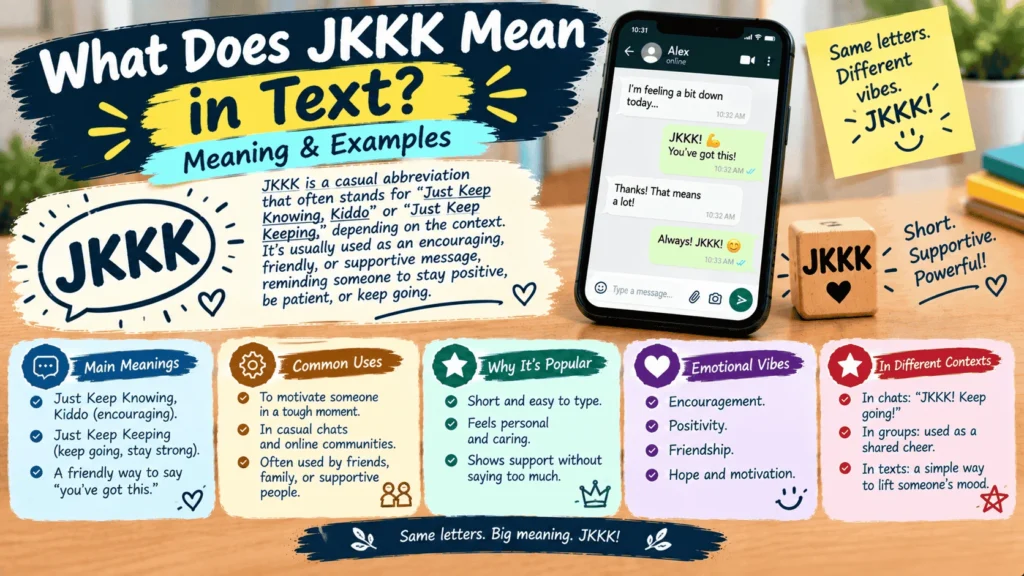
If someone sends you “JKKK” in a text, comment, or DM, it can be surprisingly difficult to know what they mean. Is it a typo? Does the extra K change the meaning of JK? Or is there some completely different slang behind it?
In most casual online conversations, JKKK means “just kidding” or “I’m joking.” It is generally an exaggerated, playful version of JK, with the repeated K adding emphasis.
For example, if a friend says, “I’m never talking to you again JKKK 😂,” they probably are not announcing the end of the friendship. They are signaling that the dramatic statement was a joke.
That said, JKKK is informal rather than a universally standardized abbreviation. Context matters, especially because JKKK can also appear as an acronym for organizations outside casual texting.
JKKK – Quick Meaning
JKKK in text usually means “just kidding” or “I’m only joking.”
The simplest way to understand it is:
- JK = Just kidding
- JKK = An informal extended form of JK
- JKKK = A more exaggerated or playful version of “just kidding”
- JKKKK/JKKKKK = Usually the same idea with even more emphasis
The additional K’s normally do not create a completely new meaning. They add emotional energy, much like people write “noooo,” “heyyy,” or “lollll” to make a message feel more expressive.
Examples
“I’m stealing your fries. JKKK 😂”
“You’re blocked forever. JKKK!”
“I told everyone your secret… JKKK 😭”
In each example, the surrounding message helps reveal that the sender is not being completely literal.
Origin & Background of JKKK
There is no well-established single person, event, or platform credited with inventing JKKK.
Its clearest connection is to JK, the long-standing abbreviation for “just kidding.” As texting and social media became more expressive, users began repeating letters to communicate emphasis and emotion.
This pattern appears throughout internet language.
People might type:
- “okkk” instead of “okay”
- “heyyy” instead of “hey”
- “noooo” instead of “no”
- “lollll” instead of “lol”
JKKK follows the same basic principle.
Digital communication lacks many of the cues we normally use in face-to-face conversations. When someone jokes in person, their facial expression, voice, timing, and body language help you understand the intention.
A text message has none of those automatically.
As a result, people use repeated letters, emojis, punctuation, capitalization, and abbreviations to recreate some of that emotional information.
JKKK is therefore better understood as expressive texting language rather than a formal English abbreviation.
Social media has helped this style of writing spread internationally, particularly among younger internet users. However, it is still important not to assume that every person interprets repeated letters in exactly the same way.
There is another reason context matters: JKKK can have unrelated acronym meanings in organizational settings, including Malaysian terms referring to village development and security committees.
So, in a casual DM, “JKKK” is likely playful slang. In an official document, it could mean something entirely different.
Real-Life Conversations Using JKKK
The easiest way to understand JKKK is to see how it works in natural conversations.
WhatsApp Conversation
Person A:
You ate the last slice of pizza?
Person B:
Yep. It was amazing 😂
Person A:
I’m never sharing food with you again.
Person B:
JKKK, I saved you a slice.
Here, JKKK changes the emotional direction of the conversation. The first statement sounds annoyed, but the abbreviation reveals that the speaker is teasing.
Instagram DM
Person A:
You really wore that outfit to the party?
Person B:
Wait, is it that bad? 😭
Person A:
JKKK! You actually look great.
The sender intentionally creates a moment of uncertainty before revealing the joke.
TikTok Comment
Person A:
I tried this dance and almost broke my ankle 😂
Person B:
JKKK, you actually nailed it!
The expression keeps the comment light and playful rather than making it sound like criticism.
Text Message
Person A:
I think I’m moving to another country tomorrow.
Person B:
WHAT?
Person A:
JKKK 😭 I just need a vacation.
The extra K’s reinforce the fact that the dramatic announcement was not meant literally.
Emotional & Psychological Meaning of JKKK
JKKK is not simply about shortening words. It is also about managing tone.
Imagine telling someone:
“I hate you.”
Without context, that can sound genuinely hostile.
Add:
“I hate you JKKK 😂”
and the emotional interpretation changes considerably.
The abbreviation gives the reader a signal: “Don’t take my previous statement completely literally.”
This is especially useful when someone is teasing a friend, exaggerating a situation, or deliberately pretending to be serious.
Why People Use JKKK
People may use it to:
- Make a joke obvious
- Reduce the chance of being taken literally
- Soften teasing
- Add playful energy
- Create dramatic humor
- Show that they are not angry
- Make a conversation feel more relaxed
There is also an interesting psychological side to this kind of communication.
Sometimes people make a genuine observation and then add “jk” or “jkkk” because they feel safer expressing it as a joke. That does not necessarily mean they are secretly serious, but it can make the emotional meaning less straightforward.
For instance:
“I miss you JKKK.”
Depending on the relationship, that could be completely playful—or it could be a shy way of testing the other person’s reaction.
A Personal-Style Example
I have seen this kind of wording create confusion between friends: one person makes a teasing comment, adds “JKKK,” and assumes the joke is obvious, while the other person focuses on the original sentence and feels slightly hurt.
That is a useful reminder that JKKK can clarify intention, but it cannot automatically erase the emotional effect of the words that came before it.
Usage in Different Contexts
Social Media
JKKK works naturally in Instagram comments, TikTok conversations, Snapchat messages, and other casual platforms.
It is especially useful after exaggerated statements.
“I’m deleting this account JKKK.”
“You actually thought I was serious? JKKK 😂”
Friends & Relationships
Among close friends, JKKK can make teasing feel lighter.
In romantic conversations, however, context becomes more important.
Someone might write:
“You’re annoying JKKK ❤️”
That may be affectionate teasing.
But:
“I don’t like you anymore JKKK”
could still cause confusion, particularly if the relationship is emotionally sensitive.
Work & Professional Settings
JKKK is generally better avoided in professional communication.
A colleague might understand it perfectly, but a manager, client, customer, or international business contact may interpret it differently.
Instead of:
“I’m quitting JKKK 😂”
a workplace message should communicate the intended meaning directly.
Casual vs. Serious Tone
JKKK belongs primarily to casual communication.
It fits:
- Friends
- DMs
- Gaming chats
- Group chats
- Informal comments
It is less suitable for:
- Formal emails
- Academic writing
- Official notices
- Customer communication
- Serious workplace discussions
When NOT to Use JKKK
Although JKKK is harmless in ordinary situations, there are moments when it can create problems.
1. Serious Conversations
If someone is discussing grief, relationship problems, money, safety, or another sensitive issue, joking abbreviations can come across as dismissive.
2. Professional Communication
The abbreviation is informal and may make a professional message look careless.
3. Sensitive Jokes
Adding JKKK after an offensive or deeply personal comment does not automatically make the comment acceptable.
4. With Someone Who Does Not Know Slang
If the recipient is unfamiliar with internet abbreviations, they may wonder whether JKKK is a typo or an acronym.
5. When You Actually Mean Something Serious
Do not hide a genuine message behind “JKKK” simply because you are nervous about the other person’s reaction.
Clear communication is usually kinder.
Common Misunderstandings About JKKK
“JKKK must be a completely different abbreviation.”
Not necessarily.
In casual texting, it is usually an extended version of JK, meaning “just kidding.”
“Every extra K has a separate meaning.”
Usually, no.
The additional letters generally provide emphasis rather than adding individual words.
“JKKK always means the person is laughing.”
Not exactly.
It tells you that the preceding statement is intended as a joke, but the exact emotional tone can range from playful to sarcastic.
“JKKK guarantees that nobody will be offended.”
Definitely not.
A joke can still hurt someone’s feelings even when the sender adds JKKK afterward.
“JKKK always has the same meaning.”
Not in every context.
The letters can have unrelated meanings as formal acronyms, which is why the surrounding conversation matters.
JKKK Comparison Table
| Term | Meaning in Text | How to Use | Example |
|---|---|---|---|
| JK | Just kidding | Use after a joke or teasing statement | “I’m keeping your hoodie, JK.” |
| JKKK | Just kidding, emphasized | Use for stronger playful emphasis | “I’m deleting your number JKKK 😂” |
| LOL | Laughing out loud | Show amusement | “That was hilarious LOL.” |
| LMAO | Laughing very hard | Strong informal reaction | “LMAO, you actually did it.” |
| Haha | Laughter | Respond naturally to something funny | “Haha, that’s true.” |
| /j | Joking | Mark a statement as a joke online | “That was terrible advice /j.” |
| Seriously | Genuine statement | Signal that you are not joking | “Seriously, call me.” |
| Just kidding | Full form of JK | Use when clarity matters | “I’m just kidding.” |
JKKK vs. JK
JK is the standard abbreviation. JKKK is an informal, more exaggerated version.
JKKK vs. LOL
JKKK tells you the previous statement was a joke. LOL primarily communicates that something is funny.
JKKK vs. /j
Both can signal joking, but /j is a tone indicator used in some online communities, while JKKK feels more like traditional casual texting.
Key Insight
JKKK is best understood as an expressive variation of JK, not a completely separate slang word. The repeated K’s generally add playful emphasis rather than changing the basic meaning.
Variations / Types of JKKK
1. JK Meaning
JK meaning: Just kidding.
This is the standard form and the easiest one for most people to recognize.
2. JKK Meaning
JKK in text: Usually an extended form of JK.
The extra K adds a slightly more playful feel.
3. JKKK Meaning
JKKK abbreviation: Just kidding with exaggerated emphasis.
This is the form discussed throughout this guide.
4. JKKKK Meaning
JKKKK slang: Usually the same “just kidding” meaning with stronger exaggeration.
More letters often mean more expressive energy.
5. JKJK Meaning
JKJK in chat: Repeated “JK” for additional emphasis.
It can make the joking intention especially obvious.
6. JKKK 😂 Meaning
JKKK with an emoji: A playful joke marker strengthened by the laughing emoji.
7. JKKK 😭 Meaning
JKKK with a crying emoji: Often expresses exaggerated humor or laughing-so-hard-you’re-crying energy.
8. JK!!! Meaning
JK with exclamation marks: Uses punctuation instead of repeated letters to emphasize the joke.
9. Jk…
Jk with an ellipsis: Can feel softer, awkward, understated, or uncertain depending on the conversation.
10. Just Kidding
Just kidding in chat: The full phrase behind JK and JKKK.
It is the clearest option when slang might cause confusion.
How to Respond When Someone Uses JKKK
Your response depends on the relationship and the situation.
Casual Replies
- “Haha, I knew you were joking.”
- “You almost got me!”
- “Okay 😂”
- “I figured!”
- “Haha, fair enough.”
Funny Replies
- “Too late, I already got offended 😂”
- “Nice try!”
- “You had me for a second!”
- “I was about to start a whole argument 😭”
Mature Replies
- “Haha, understood. I know you were joking.”
- “Got it. Thanks for clarifying.”
- “I figured you weren’t serious.”
Respectful Replies
If the joke was unclear:
“I wasn’t sure if you were serious at first. Thanks for clarifying.”
This is often better than pretending you understood something that genuinely confused you.
Regional & Cultural Usage
Western Culture
JKKK fits naturally into informal online communication in English-speaking internet communities. It is particularly understandable among people familiar with texting abbreviations.
Still, not everyone uses it, and JK remains the more established abbreviation.
Asian Culture
Young internet users across many Asian communities may encounter or use English-based texting slang through social media, gaming, entertainment, and international online communities.
However, local slang and language habits can influence how abbreviations are interpreted.
Middle Eastern Culture
JKKK may appear in English-language chats among younger social-media users, particularly where English and local-language internet communication mix.
Its meaning still depends more on the immediate conversation than geography.
Global Internet Usage
Because social media connects people across countries, expressions such as JK and JKKK can travel far beyond their original English-language environments.
That does not mean everyone understands them automatically.
Gen Z vs. Millennials
Younger users may be more comfortable with exaggerated spelling, emojis, lowercase writing, and rapidly changing internet conventions.
Millennials may recognize JK immediately but be less accustomed to increasingly stretched versions such as JKKKK.
These are broad tendencies, not fixed rules. Individual communication habits vary enormously.
Is JKKK Safe for Kids?
Generally, JKKK is not inherently inappropriate for children.
In ordinary use, it simply communicates “just kidding” or “I’m joking.”
The more important issue is what the child is joking about.
For example:
“You’re stupid JKKK.”
still has the potential to hurt someone even though JKKK has been added.
Children can benefit from learning that a slang abbreviation does not automatically make teasing harmless. They should consider the person’s feelings, the subject of the joke, and the relationship involved.
FAQs About JKKK
What does JKKK mean in text?
JKKK usually means “just kidding” or “I’m joking.” The extra K’s generally add playful or exaggerated emphasis.
Is JKKK the same as JK?
They are closely related. JK is the standard abbreviation for “just kidding,” while JKKK is an informal extended version that usually adds emphasis.
Why does JKKK have three Ks?
The extra K’s are generally used for emphasis. They make the message feel more playful, dramatic, or exaggerated.
Is JKKK a real English word?
No. JKKK is informal internet/texting language rather than a standard English word.
Can I use JKKK in a professional email?
It is usually better to avoid it. Professional communication should favor clear language over casual texting slang.
Can JKKK be sarcastic?
Yes. JKKK can appear in teasing or sarcastic conversations. The abbreviation signals joking, but it does not determine exactly how the joke should feel.
What should I reply when someone says JKKK?
You can respond with “Haha, you got me!”, “I knew you were joking,” or simply “Haha, okay.” If you genuinely aren’t sure what they mean, asking for clarification is perfectly reasonable.
Conclusion
So, what does JKKK mean in text?
In most casual conversations, JKKK means “just kidding” and works as an exaggerated version of JK. The repeated K’s usually add extra playfulness, emphasis, or dramatic humor.
The important thing is not to read JKKK in isolation.
Look at the sentence before it, the relationship between the people, the emojis, and the overall mood of the conversation. A JKKK from a close friend may feel completely different from one sent by someone you barely know.
And remember: adding “JKKK” does not automatically make every joke harmless. Good digital communication is still about understanding how your words may land on the other person.
When you understand that small difference between what someone says and how they intend it, internet slang becomes much easier to read—and much easier to use naturally.