
Have you ever received a message that simply says “yup” and wondered whether the person is agreeing with you, ending the conversation, or responding without much interest? You’re not alone. Short replies can sometimes feel confusing, especially when you cannot hear the other person’s voice or see their facial expression.
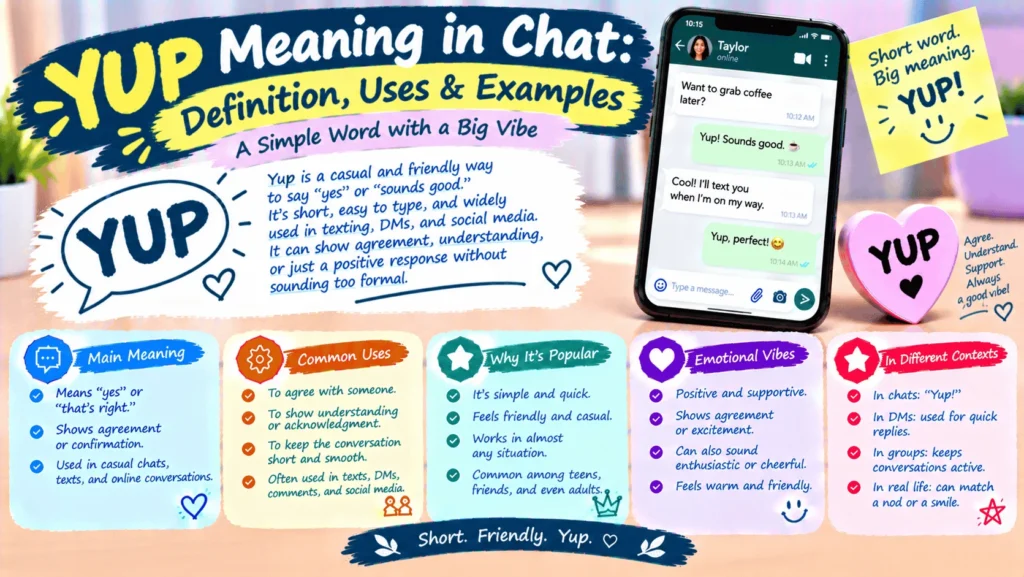
The yup meaning in chat is simple: it usually means “yes.” People use it in text messages, WhatsApp conversations, Instagram DMs, TikTok comments, and everyday online communication to agree, confirm something, or answer a question casually.
However, the meaning can change slightly depending on the situation. A friendly “yup!” may express excitement, while a plain “yup” after a serious question might sound neutral or distant.
Understanding this small word can help you read messages more confidently without overthinking every reply. Let’s explore what “yup” means, where it comes from, how people use it, and how you can respond naturally.
1. Yup Meaning in Chat – Quick Meaning
Yup means “yes” in casual conversation. It is an informal way to agree with someone, confirm information, or answer a question quickly.
People often choose “yup” because it sounds relaxed, friendly, and conversational.
Here is what “yup” commonly communicates:
- Agreement: You agree with someone’s statement or suggestion.
- Confirmation: You confirm that something is correct or has happened.
- Acknowledgment: You show that you understand what someone said.
- Casual friendliness: You answer without sounding overly formal.
- Conversation closure: You give a brief answer that may naturally end the exchange.
Examples of “Yup” in texting
- “Are we meeting at 6?” — “Yup!”
- “You finished the assignment?” — “Yup, all done.”
- “That movie was amazing, right?” — “Yup, absolutely.”
In each example, “yup” communicates agreement, but the additional words and punctuation help establish the tone.
2. Origin and Background of “Yup”
“Yup” is an informal English expression used as an alternative to “yes.” It belongs to a broader family of conversational responses that includes “yep,” “yeah,” and “uh-huh.”
Its exact historical development is difficult to pin down to one moment or source. However, forms such as “yep” and “yup” have long been associated with everyday spoken English rather than formal writing.
Unlike many modern texting abbreviations, “yup” was not created specifically for the internet. People were already using it in conversation before smartphones, instant messaging, and social media became common.
How “Yup” became popular online
As text messaging developed, people increasingly favored short expressions that could communicate an entire response in just a few characters.
“Yup” fit naturally into this style. It was brief, easy to understand, and familiar to English speakers.
Today, it appears across platforms such as WhatsApp, Instagram, Snapchat, TikTok, Discord, and ordinary SMS messages.
How its meaning has evolved
The basic meaning has remained the same: “yes.”
What has changed is the range of tones people associate with it. Depending on the conversation, “yup” can sound cheerful, relaxed, matter-of-fact, playful, or even dismissive.
For example, “Yup!!” may convey enthusiasm, while “yup.” might feel more restrained in a conversation where the other person expected a longer answer.
The word itself has not necessarily changed meaning. Digital communication has simply made punctuation, timing, and surrounding messages more important when interpreting it.
3. Real-Life Conversations Using “Yup”
The easiest way to understand “yup meaning in chat” is to see how people use it in realistic conversations.
Example 1: WhatsApp conversation between friends
Person A: Are you coming over this evening?
Person B: Yup! I’ll be there around 7.
Person A: Great, I’ll order something for us.
Person B: Perfect 😄
Meaning: Here, “yup” is a positive confirmation. The exclamation mark and follow-up message make the response sound friendly and enthusiastic.
Example 2: Instagram DMs between two people dating
Person A: You remembered our anniversary?
Person B: Yup ❤️ How could I forget?
Person A: Okay, that was actually sweet.
Person B: I have my moments 😂
Meaning: In this exchange, “yup” communicates confirmation while the heart emoji and affectionate follow-up add warmth. The word itself does not automatically imply romance; the relationship and surrounding conversation create that meaning.
Example 3: TikTok comments
Person A: This is exactly how my weekends look.
Person B: Yup 😂
Person A: Especially when Monday is around the corner.
Person B: Don’t remind me 😭
Meaning: The reply shows agreement and shared humor. A single word is enough because both people understand the joke.
Example 4: Text messages about a serious plan
Person A: Did you send the documents to the office?
Person B: Yup.
Person A: And did you include the signed form?
Person B: Yes, both files are attached.
Meaning: The first response is a straightforward confirmation. It does not prove that the sender is annoyed or uninterested. The follow-up provides the information needed for the situation.
These examples show that “yup” is flexible. It can fit friendly chats, romantic conversations, humorous exchanges, and practical discussions.
4. Emotional and Psychological Meaning of “Yup”
Although “yup” usually means “yes,” people often pay attention to how it feels rather than just what it says.
In face-to-face conversation, tone of voice helps us recognize whether someone is excited, bored, irritated, or simply busy. Texting removes many of those clues, so readers may try to interpret small details such as punctuation, response length, and timing.
It can express comfort and familiarity
Friends who communicate regularly often use short replies because they already understand each other’s communication styles.
A quick “yup” may indicate that the person feels comfortable enough not to write a complete sentence every time.
It can communicate efficiency
Sometimes people are busy working, traveling, studying, or handling everyday responsibilities.
A brief confirmation allows them to respond without interrupting what they are doing. It is not always a sign of low interest.
It can sound emotionally distant
Consider a conversation where someone shares an important personal experience and receives only “yup.”
The response might feel disappointing because the sender offered little emotional acknowledgment. However, the person might also be distracted, unsure what to say, or unaware that a more supportive response was needed.
A relatable scenario
Imagine telling a friend that you finally passed an exam you had been worried about for weeks.
They respond, “Yup.”
You might wonder whether they are happy for you. But the word alone cannot tell you that. Perhaps they are replying between classes, or perhaps they misunderstood how important the result was to you.
A better approach is to consider the broader relationship and communication pattern instead of treating one short message as proof of someone’s feelings.
The key psychological insight: A short reply communicates information, but it does not reveal someone’s entire emotional state.
5. Usage of “Yup” in Different Contexts
The meaning of “yup” remains close to “yes,” but its suitability depends on the setting.
On social media
On Instagram, TikTok, Snapchat, and other social platforms, “yup” is common in comments, replies, and direct messages.
People use it to agree with opinions, confirm plans, respond to jokes, or acknowledge relatable content.
Example:
“That’s the best song on the album.”
“Yup, no competition.”
Between friends
Among friends, “yup” is usually natural and informal.
Example:
“Pizza tonight?”
“Yup, I’m in.”
It helps conversations move quickly without making every response sound formal.
In romantic relationships
Partners may use “yup” to confirm plans, answer questions, or maintain a relaxed conversational style.
Example:
“Still picking me up at 8?”
“Yup ❤️”
However, if one partner expects emotional reassurance, a very brief response may feel less affectionate than a fuller reply. Communication habits differ from couple to couple.
At work or in professional communication
“Yup” can be acceptable in relaxed team chats where informal language is normal.
Example:
“Can you review the draft before lunch?”
“Yup, I’ll check it.”
In formal emails, client communication, interviews, or conversations with unfamiliar colleagues, “Yes, certainly” or “Yes, I’ll review it before lunch” is generally safer.
Casual versus serious situations
| Situation | Example | Likely tone |
|---|---|---|
| Casual planning | “Yup, see you soon!” | Friendly |
| Quick confirmation | “Yup.” | Neutral |
| Exciting news | “Yup!! We did it!” | Enthusiastic |
| Serious discussion | “Yup, I understand.” | Depends on context |
| Playful disagreement | “Yup, you’re totally right 😂” | Potentially sarcastic |
The surrounding words matter more than the spelling alone.
6. When NOT to Use “Yup”
Although “yup” is widely understood, it is not the best choice for every conversation.
Formal emails and official communication
Avoid using “yup” when writing to clients, senior executives, unfamiliar professional contacts, or official organizations unless you know that informal communication is welcome.
Instead of:
“Yup, I’ll send the report.”
Consider:
“Yes, I’ll send the report by 3 p.m.”
The second version is clearer and more professional.
Emotional conversations
If someone shares something painful, a bare “yup” may appear dismissive even if you intend to show that you are listening.
For example, if a friend says they had a difficult day, “I understand” or “I’m sorry you had to deal with that” provides more emotional support.
Important agreements
When discussing deadlines, financial arrangements, or responsibilities, a one-word response may not confirm enough detail.
Instead of saying only “yup,” repeat the important information so both people understand what has been agreed.
Cross-cultural communication
Not everyone interprets informal English expressions in the same way. Some people may understand “yup” immediately, while others may prefer the more familiar “yes.”
If you are unsure about the other person’s language preferences or the formality of the relationship, use straightforward wording.
7. Common Misunderstandings About “Yup”
Several common assumptions can make simple messages seem more complicated than they are.
Misunderstanding 1: “Yup” always sounds rude
Not true. It is a normal informal response in many English conversations.
It may sound abrupt in some situations, but that depends on the relationship, expectations, and surrounding messages.
Misunderstanding 2: “Yup” means someone is angry
Anger cannot be reliably identified from this word alone.
If someone usually writes long, warm messages and suddenly responds with one-word answers, the change might be worth noticing. Even then, it does not establish the reason.
Misunderstanding 3: “Yup” and “yeah” are completely different
Both generally mean “yes.” Their perceived tones can vary by speaker and situation, but neither word has a universally fixed emotional meaning.
Misunderstanding 4: “Yup” is a texting abbreviation
It is better described as an informal word or variant of “yes,” not an abbreviation formed from the initial letters of a longer phrase.
Misunderstanding 5: A period makes “yup” negative
A period can make a message look more final or restrained to some readers, particularly in casual texting. But punctuation habits vary, so it is not reliable evidence of irritation.
Misunderstanding 6: “Yup” always ends the conversation
Sometimes it does, particularly when it answers a complete question. In other cases, it simply confirms information before the conversation continues.
8. Comparison Table: “Yup” vs. Similar Texting Expressions
| Term or search phrase | Meaning or purpose |
|---|---|
| Yup meaning in text | Understand the informal meaning of “yup” in written messages. |
| How to use yup | Learn when and how to use “yup” naturally. |
| Examples of yup in chat | See realistic conversations using the expression. |
| Yup vs. yep | Compare two informal ways to say “yes.” |
| Yup vs. yeah | Understand the similarities and possible differences in tone. |
| Yup vs. yes | Compare an informal answer with a more neutral or formal one. |
| Yup vs. YUP | Explore how capitalization can change perceived emphasis. |
Key Insight
“Yup,” “yep,” “yeah,” and “yes” can communicate the same basic answer, but they do not always create the same impression. Choose the expression that fits your relationship with the other person and the seriousness of the situation.
9. Variations and Types of “Yup”
Small changes in spelling, capitalization, and punctuation can influence how a response feels. These interpretations are tendencies, not strict rules.
1. Yup meaning
“Yup” means yes in casual English.
Example: “Are you ready?” — “Yup.”
2. Yup in text
It is a short confirmation used in SMS messages, messaging apps, and online conversations.
Example: “Did you get my message?” — “Yup.”
3. Yup abbreviation
“Yup” is not technically an abbreviation. It is an informal variant of “yes.”
Example: “Yup, that’s correct.”
4. Yup slang
As casual conversational language, “yup” fits naturally into relaxed chats with friends and acquaintances.
Example: “Movie night?” — “Yup, let’s go.”
5. Yup in chat
In chat, it usually confirms information or agrees with another person’s statement.
Example: “We’re meeting at the usual place?” — “Yup.”
6. Yep
“Yep” is another informal equivalent of “yes.”
Example: “You finished?” — “Yep!”
Some speakers perceive “yep” as slightly lighter or more conversational, but usage varies.
7. Yup!
An exclamation mark can suggest enthusiasm, confidence, or friendliness.
Example: “You got the tickets?” — “Yup!”
The context determines whether the excitement is genuine or playful.
8. YUP
Capital letters can emphasize agreement or make the response appear louder.
Example: “That was the funniest scene!” — “YUP 😂”
It can also be used neutrally by people who prefer capital letters.
9. Yup 😂
This version combines agreement with humor or amusement.
Example: “I said I’d sleep early and stayed up until 3 a.m.”
“Yup 😂”
10. Yup ❤️
A heart emoji adds an affectionate or supportive element.
Example: “You’ll call me when you get home?”
“Yup ❤️”
The emoji provides the emotional cue; “yup” itself still means yes.
10. How to Respond When Someone Uses “Yup”
Your response depends on what the person is confirming and whether the conversation needs to continue.
Casual replies
Use these when chatting with friends or making plans.
- “Okay, perfect!”
- “Sounds good.”
- “Awesome, see you then.”
- “Cool, thanks!”
Funny replies
Choose playful responses when you already share a joking relationship.
- “Wow, such a detailed answer 😂”
- “Yup is all I get? 😂”
- “A person of many words, I see.”
- “Straight to the point, huh? 😭”
Use teasing carefully if the other person might be busy or if the conversation is serious.
Mature replies
These responses keep the conversation clear and constructive.
- “Great, I’ll take care of the rest.”
- “Thanks for confirming.”
- “Perfect. Let me know if anything changes.”
- “Understood. I’ll proceed as planned.”
Respectful replies
Use these when the discussion involves work, unfamiliar people, or important arrangements.
- “Thank you for confirming.”
- “Understood, I appreciate the update.”
- “That works for me.”
- “Thanks. I’ll keep that in mind.”
What if “yup” feels cold?
If you are unsure about someone’s tone, avoid immediately assuming that they are upset.
You can continue the conversation naturally or ask a gentle question if clarification matters.
For example:
“Everything okay? Just checking because I couldn’t tell from your message.”
This invites an honest response without accusing the other person of being rude.
11. Regional and Cultural Usage of “Yup”
“Yup” is widely recognizable in English-language digital communication, but familiarity and preferred levels of formality vary across communities.
Western culture
In the United States, Canada, the United Kingdom, Australia, and other English-speaking settings, “yup” is commonly understood as an informal alternative to “yes.”
Its tone can range from relaxed agreement to straightforward confirmation.
However, there is no single interpretation shared by everyone in these countries.
Asian culture
In countries where English is used as an additional language, people may encounter “yup” through school, international workplaces, entertainment, and social media.
Some use it frequently, while others prefer “yes,” “okay,” or “yeah.” The choice depends on individual fluency, social environment, and communication habits.
Middle Eastern culture
English-language messaging in Middle Eastern communities often mixes international internet expressions with local languages and cultural communication styles.
“Yup” may be understood in English conversations, particularly among people who regularly use English online. Nevertheless, more formal expressions may be preferred in professional or unfamiliar settings.
Global internet usage
Social media has made informal English expressions accessible across borders.
Someone can use “yup” in a conversation with an international friend without sharing the same first language. Emojis, shared experiences, and surrounding messages can make the intended meaning easier to understand.
Gen Z vs. Millennials
Both Gen Z and Millennials use “yup,” although individual preferences differ.
Some younger users may combine it with memes, emojis, exaggerated capitalization, or playful punctuation. Some Millennials may use it as a straightforward confirmation in everyday messages.
These are broad tendencies rather than fixed generational rules. Personal style matters more than age alone.
12. Is “Yup” Safe for Kids?
Yes. “Yup” is generally a harmless, age-appropriate expression meaning “yes.”
Children and teenagers may use it when messaging friends, responding to questions, or communicating in online games and social apps.
The word itself is not offensive, sexually explicit, or inherently inappropriate.
Parents can explain that informal language is useful in casual conversations, while full sentences and polite expressions are often better for schoolwork, official messages, and communication with unfamiliar adults.
As with any online conversation, the important consideration is the overall context rather than this particular word.
13. Frequently Asked Questions (FAQs)
1. What does “yup” mean in chat?
“Yup” means “yes.” It is an informal expression used to agree with someone, confirm information, or answer a question in everyday digital conversations.
2. Is “yup” positive or negative?
It is generally a neutral or positive confirmation. Its perceived tone depends on the situation, punctuation, relationship, and surrounding messages.
3. Does “yup” mean someone is annoyed?
Not necessarily. A short response may reflect a person’s normal texting style, limited time, or desire to answer quickly. One message alone cannot establish annoyance.
4. What is the difference between “yup” and “yep”?
Both mean “yes” and are informal. Some people perceive subtle differences in friendliness or emphasis, but there is no universal rule separating them.
5. Is “yup” flirty when someone texts it?
Not by itself. It can appear in a flirtatious conversation, but romantic interest is better understood through the broader interaction, affectionate language, and the person’s consistent behavior.
6. Is “yup” professional?
It may be acceptable in relaxed workplace chats, depending on company culture. For formal emails, client communication, and important professional discussions, “yes” or a complete sentence is usually more appropriate.
7. Should I reply when someone says “yup”?
Reply if the conversation needs another step, such as confirming a plan or asking a follow-up question. If the message already answers your question, no additional response may be necessary.
14. Conclusion: Understand “Yup” Without Overthinking It
The yup meaning in chat is straightforward: it usually means “yes.” People use it to agree, confirm plans, acknowledge information, and keep conversations moving naturally.
Its tone can feel friendly, neutral, playful, or occasionally distant, depending on the situation. That flexibility is part of what makes it useful in everyday texting.
The most important thing is not to judge an entire conversation by one short word. Consider the relationship, the surrounding messages, and the person’s usual communication style before deciding what they mean.
Whether you are chatting with a friend, messaging someone you like, or replying to a colleague, “yup” is perfectly natural when the setting is informal.
Use it confidently, choose more formal wording when appropriate, and remember that clear communication matters far more than finding a hidden meaning in every message.




