
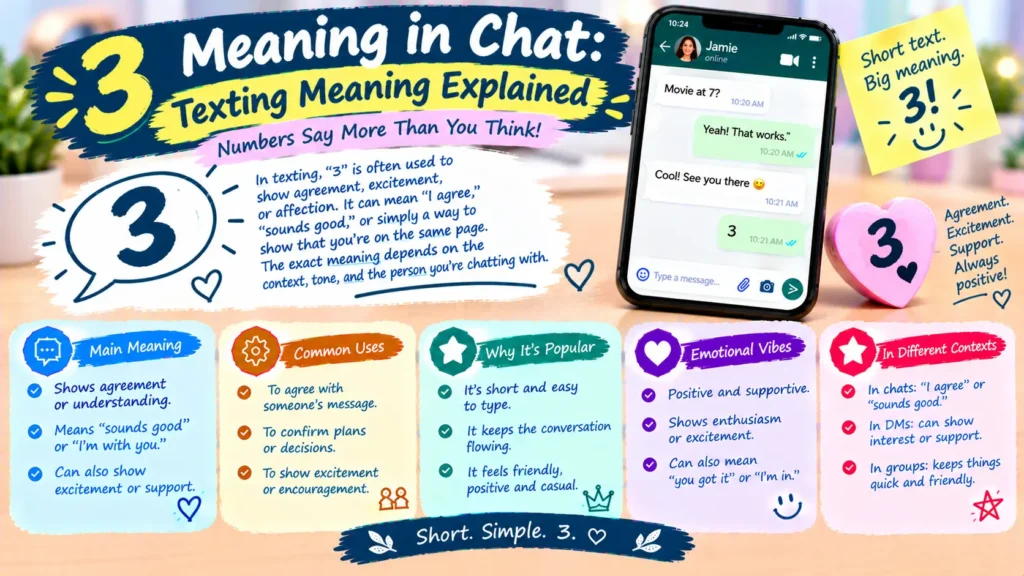
If someone sends you “3” in a chat, it can look strangely simple. Is it just the number three, a typo, or does it carry an emotional meaning?
The answer depends heavily on context. In ordinary conversation, “3” simply means the number three. But in informal internet communication, the number can also appear as part of expressive symbols such as <3 and :3.
The most familiar example is <3, a sideways heart used to express love, affection, appreciation, warmth, or support. The symbol became popular during the early internet and texting era, when people relied on keyboard characters to express emotions before emoji became widespread.
A standalone “3”, however, is much less standardized. Some people use it playfully as a shortened or stylized affectionate expression, while others simply mean the number itself. That is why understanding the surrounding message matters more than the symbol alone.
This guide explains 3 meaning in chat, its emotional uses, variations, examples, cultural differences, and how to respond without misunderstanding the sender.
3 Meaning in Chat – Quick Meaning
In chat, “3” can have several meanings depending on how it is written and what surrounds it.
The most common interpretations are:
- 3 = the number three in an ordinary message.
- <3 = love, affection, appreciation, or a heart.
- :3 = a cute, playful, coy, or slightly mischievous expression.
- 3 by itself = sometimes a playful shorthand for affection, although this is less standardized than <3.
The classic <3 symbol is understood as a sideways heart. The “<” creates the pointed portion, while “3” creates the rounded portion.
For example:
“I’ll call you in 3 minutes.”
Here, 3 simply means three.
“Thank you <3”
Here, <3 means affection or warmth.
“You’re so cute :3”
Here, :3 gives the message a cute, playful tone.
The important point is that 3 does not have one universal slang definition. Context determines what the sender intends.
Origin & Background of 3 in Chat
The emotional use of 3 is closely connected with the history of text-based emoticons.
Before smartphones made colorful emoji easily available, internet users had to communicate emotion using ordinary keyboard characters. People created combinations such as :), :(, and <3 to make plain text feel more expressive.
The heart symbol <3 became especially recognizable because it visually resembles a heart when turned sideways. It was used in early email, instant messaging, forums, and online communities.
Its exact invention cannot be confidently attributed to one person or one precise date. What is clear is that it developed within early internet and texting culture, where users needed quick ways to communicate emotion through limited characters.
As social media developed, symbols such as <3 moved into blogs, forums, comments, messaging apps, and eventually platforms such as Instagram and other social networks.
Emoji later became much more common, but <3 never completely disappeared. In fact, some people continue using it because it feels nostalgic, personal, cute, or less polished than a standard heart emoji.
The number 3 also became part of other emoticons. For example, :3 is generally associated with a cute or playful facial expression, often compared with a cat-like face.
So, what looks like a simple number can actually be part of a much larger history of digital emotional language.
Real-Life Conversations Using 3
1. WhatsApp Conversation
Person A:
“Thanks for staying up and talking to me last night.”
Person B:
“Of course. Anytime <3”
Here, the heart symbol expresses care and emotional support. It does not necessarily mean romantic love.
2. Instagram DM
Person A:
“I finally got the job!!”
Person B:
“OMG I’m so happy for you <3”
In this situation, <3 communicates warmth, happiness, and affection toward the other person.
3. TikTok Comments
Person A:
“This song literally reminds me of my childhood.”
Person B:
“Same <3”
The heart adds an emotional layer to an otherwise short comment. It means something close to “I feel this too” or “I love this.”
4. Text Message
Person A:
“Goodnight 3”
Person B:
“Goodnight 😊”
If someone uses 3 by itself, the interpretation becomes less certain. Depending on the person’s texting habits, it could be an affectionate shorthand, a stylistic choice, or simply a typo.
This is why you should not automatically interpret every standalone “3” as romantic.
Emotional & Psychological Meaning of 3
Digital communication removes many of the emotional signals we normally receive during face-to-face conversation.
When someone speaks to you, you can hear their voice and see their expression. In texting, those signals disappear. Symbols and emojis often fill that gap.
That is one reason people use expressions like <3.
A message such as:
“Thanks.”
can sound neutral.
But:
“Thanks <3”
feels warmer and more personal.
The symbol tells the reader, “Please don’t read this as cold or formal. There is emotion behind these words.”
Depending on the situation, 3-related expressions can communicate:
- Love
- Affection
- Appreciation
- Friendship
- Emotional support
- Playfulness
- Cuteness
- Enthusiasm
- Flirting
But emotional meaning is relational. The same <3 can mean something different when sent by your best friend, romantic partner, coworker, sibling, or someone you barely know.
For example, if a close friend says, “Proud of you <3,” the heart may simply communicate genuine friendship and encouragement.
If someone you are romantically involved with writes, “Miss you <3,” the same symbol may reinforce romantic affection.
A useful personal rule is to look at the whole conversation rather than one symbol. If someone repeatedly uses affectionate language, checks on you, and sends hearts, the emotional pattern tells you far more than “3” alone.
Usage in Different Contexts
Social Media
On Instagram, TikTok, Snapchat, and similar platforms, <3 can be used to express appreciation or emotional agreement.
Someone might comment:
“This is beautiful <3”
The meaning is usually simply “I love this” or “This is beautiful and I appreciate it.”
Friends and Relationships
Friends often use <3 to show affection without making the conversation feel overly serious.
For example:
“Thanks for always listening <3”
This can communicate sincere friendship rather than romantic attraction.
Among couples, however, the same symbol can naturally become more intimate.
Work and Professional Settings
It is better to avoid using 3, <3, or :3 in formal professional communication unless you know the workplace culture very well.
A manager, client, teacher, or professional contact may interpret a heart symbol differently from a close friend.
Instead of:
“Thanks for your help <3”
a professional version would be:
“Thank you for your help. I really appreciate it.”
Casual vs. Serious Tone
The symbol generally belongs to casual digital communication.
It works naturally in:
- Friendly texts
- Social media comments
- Personal DMs
- Gaming chats
- Informal group conversations
It can feel out of place in:
- Formal emails
- Job applications
- Official complaints
- Academic writing
- Business proposals
When NOT to Use 3
Although 3 and its variations are usually harmless, context still matters.
Avoid using <3 when a conversation requires clear professional boundaries. A heart can unintentionally sound overly familiar.
You should also be careful when communicating with someone whose texting style you do not know.
For example, sending:
“Nice meeting you <3”
to a new professional contact could be interpreted as flirtatious, even if you intended it as simple friendliness.
Cultural expectations matter too. Not everyone interprets digital symbols in exactly the same way.
Most importantly, don’t assume that someone who sends <3 is romantically interested. The symbol can express friendship, gratitude, admiration, or support.
Common Misunderstandings About 3
“3 Always Means Love”
Not necessarily.
<3 commonly represents love or affection, but 3 alone does not have one fixed meaning.
“If Someone Sends <3, They Like Me Romantically”
Not automatically.
A friend might send:
“You did amazing <3”
without any romantic intention.
“3 and <3 Are Exactly the Same”
They are not.
<3 is a recognizable heart emoticon. A standalone 3 is much more ambiguous.
“:3 Means Love”
Usually, :3 has a different tone. It is commonly associated with cuteness, playfulness, coyness, or a cat-like expression rather than directly meaning love.
“A Heart Always Means Romance”
Digital hearts are surprisingly flexible.
They can communicate:
“I love you.”
But they can also mean:
“I appreciate you.”
“That’s adorable.”
“I love this song.”
“I’m supporting you.”
Context decides which interpretation makes sense.
Comparison Table
| Search Intent | Meaning / Explanation | Example |
|---|---|---|
| 3 mean in text | Usually the number three; may have an expressive meaning depending on context | “See you in 3.” |
| How to Use 3 | Use it naturally as a number or as part of an emoticon when the conversation is informal | “Thanks <3” |
| Examples of 3 | 3, <3, :3, <333 and other combinations have different functions | “Goodnight <3” |
| 3 vs <3 | 3 alone is ambiguous; <3 is a recognizable heart symbol | “I appreciate you <3” |
| 3 vs :3 | <3 expresses affection; :3 generally creates a cute or playful facial expression | “Okay :3” |
| 3 vs ❤️ | <3 is a keyboard-based heart; ❤️ is a graphical heart emoji | “Love this <3” |
Key Insight
The safest way to understand 3 meaning in chat is to examine the characters around it, the message itself, the relationship between the people, and the usual texting style of the sender.
Variations and Types of 3 in Chat
1. 3 Meaning
3 meaning: Usually the number three.
It can refer to quantity, time, ranking, counting, or position.
2. 3 in Text
3 in text: A standalone “3” can be literal or expressive.
Its meaning depends strongly on the surrounding message.
3. 3 Abbreviation
3 abbreviation: 3 is not technically a standard abbreviation for one specific phrase.
It is primarily a numeral or part of an emoticon.
4. 3 Slang
3 slang: In informal online communication, 3 may appear as playful shorthand.
However, it is much less standardized than established texting slang.
5. 3 in Chat
3 in chat: It can simply mean the number three or form part of an emotional symbol.
Always consider the context.
6. <3
<3 meaning: Love, affection, warmth, appreciation, or emotional support.
It is the classic keyboard heart emoticon.
7. <333
<333 meaning: Usually an intensified or exaggerated expression of affection.
Extra 3s can make the heart feel more enthusiastic or emotionally expressive.
8. :3
:3 meaning: A cute, playful, coy, mischievous, or cat-like expression.
It is common in informal online communities and playful conversations.
9. </3
</3 meaning: A broken-heart expression.
It is generally used to communicate sadness, heartbreak, disappointment, or emotional pain.
10. I<3U
I<3U meaning: “I love you.”
It combines ordinary letters with the heart symbol to create a playful romantic expression.
How to Respond When Someone Uses 3
Your response should match the emotional level of the original message.
Casual Replies
- “Aww, thanks!”
- “Same <3”
- “You’re sweet.”
- “Haha, I appreciate it.”
Funny Replies
- “Was that a secret heart? 😂”
- “I see the tiny heart!”
- “Okayyy, getting emotional now 😂”
- “That 3 is doing a lot of work.”
Mature Replies
- “That means a lot to me.”
- “I really appreciate you saying that.”
- “Thank you. I genuinely needed to hear that.”
- “I’m glad we understand each other.”
Respectful Replies
- “Thank you, that’s very kind.”
- “I appreciate the thought.”
- “That’s really sweet of you.”
- “Thank you for being supportive.”
If you are unsure whether the person intended something romantic, there is no need to immediately assume anything. Continue the conversation naturally and look at the broader pattern of communication.
Regional & Cultural Usage
Western Culture
In Western internet culture, <3 is widely recognized as a text-based heart. It can express romantic love, friendship, appreciation, fandom, or general enthusiasm.
Its association with early internet culture also gives it a slightly nostalgic feeling for some users.
Asian Culture
In Asian online communities, numbers and symbols can sometimes develop additional meanings because numbers may be used for phonetic wordplay in particular languages.
That means you should avoid assuming that every use of “3” has the Western heart interpretation.
Middle Eastern Culture
In Middle Eastern digital communication, English-language internet symbols such as <3 are widely recognizable among people who use global social platforms.
However, individual comfort with romantic symbols can vary according to age, relationship, family expectations, and social setting.
Global Internet Usage
The internet has made symbols such as <3 remarkably portable.
A person in one country may immediately understand it as affection even when the two people do not share the same first language.
That is one of the fascinating things about digital communication: visual symbols can sometimes cross language barriers more easily than words.
Gen Z vs. Millennials
Millennials who spent time on early forums, MSN, blogs, or older messaging platforms may associate <3 with classic internet culture.
Gen Z users are generally more surrounded by emojis, GIFs, stickers, and reaction features. Some may use <3 ironically, aesthetically, nostalgically, or simply because it feels cute.
Neither generation has one universal interpretation.
Is 3 Safe for Kids?
Generally, the number 3 itself is completely ordinary and harmless.
Expressions such as <3 are also generally harmless and commonly mean affection or appreciation.
The important issue is context.
Children and younger users should understand that a heart symbol does not automatically indicate romantic interest. If an unfamiliar person uses affectionate symbols repeatedly, especially alongside requests for personal information or secret conversations, the situation deserves more attention than the symbol itself.
Parents and educators can use examples like <3 as an opportunity to teach children that online symbols need to be understood alongside the sender’s behavior and the overall conversation.
FAQs About 3 Meaning in Chat
What does 3 mean in chat?
“3” usually means the number three when used alone. In informal digital communication, it can also appear as part of expressive symbols such as <3 or :3.
What does <3 mean in texting?
<3 usually represents a heart and expresses love, affection, appreciation, warmth, or support. It is not necessarily romantic.
What does 3 mean from a girl in chat?
A girl sending “3” may simply mean the number three, or she may be using it as playful or affectionate shorthand. Look at the surrounding conversation instead of assuming romantic interest.
What does 3 mean from a guy in text?
The interpretation is the same: context matters. A standalone 3 does not automatically indicate romantic feelings.
What does :3 mean in texting?
:3 is generally a cute, playful, coy, mischievous, or cat-like emoticon rather than a direct heart symbol.
What does <333 mean in chat?
<333 usually intensifies the affectionate feeling of <3. The extra 3s can make the expression feel more enthusiastic, emotional, or playful.
Is 3 the same as a heart emoji?
Not exactly. <3 is a keyboard-based heart emoticon, while ❤️ is a graphical emoji. They can communicate similar feelings, but their visual style and cultural associations differ.
Conclusion
So, what does 3 meaning in chat really tell you?
The simplest answer is that 3 is normally just the number three, but in digital communication it can become expressive when combined with other characters. The most recognizable example is <3, which represents a heart and can communicate love, affection, appreciation, support, or warmth.
Meanwhile, :3 has a more playful and cute personality, while a standalone 3 is much more ambiguous.
The biggest lesson is not to decode a single symbol in isolation. Texting is emotional shorthand, and meaning comes from the words, relationship, timing, platform, and tone surrounding the symbol.
If someone sends you <3, you can usually read it as warmth. Whether that warmth is romantic, friendly, supportive, or simply enthusiastic depends on the person and the conversation.
That little “3” may look simple, but digital language has a way of turning simple characters into surprisingly human expressions.




