
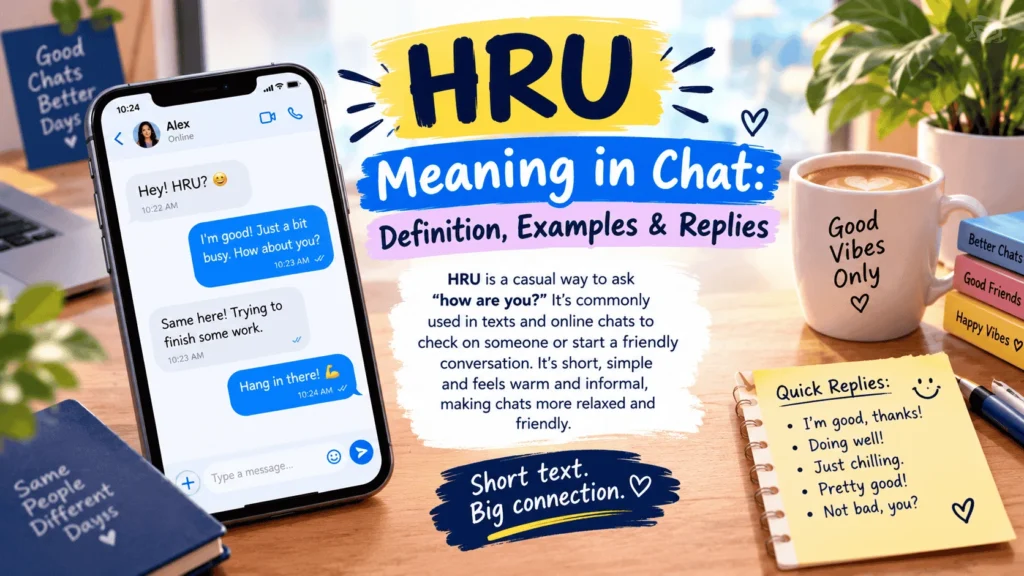
If someone sends you “HRU” in a text message, Instagram DM, or WhatsApp conversation, they are probably asking a simple question: How are you?
HRU is a popular texting abbreviation that makes everyday conversations quicker and more casual. Instead of typing the complete question, people use three letters to check in with friends, start conversations, or show interest in how someone is feeling.
However, the meaning can sometimes feel unclear. Is someone genuinely asking about your well-being, casually saying hello, or trying to start a conversation with you? The answer often depends on your relationship with that person and what you were discussing before the message arrived.
Understanding the HRU meaning in chat helps you interpret these short messages without overthinking them. Whether you see HRU in a message from a friend, someone you like, a new online acquaintance, or a social media follower, knowing how it works makes responding easier.
This guide explains what HRU means in texting, where it came from, how people use it in real conversations, and which replies sound natural in different situations.
HRU Meaning in Chat – Quick Meaning
HRU stands for “How Are You?” It is an informal abbreviation commonly used in text messages, online chats, and social media conversations.
People use it to ask about someone’s well-being, open a conversation, or check in without typing the full phrase.
Here is what HRU usually communicates:
- Basic meaning: How are you?
- Tone: Casual, friendly, and conversational.
- Purpose: Greeting someone, checking in, or starting a chat.
- Common platforms: WhatsApp, Instagram, Snapchat, TikTok, and SMS.
- Typical response: “I’m good, hbu?” meaning “I’m good, how about you?”
Examples of HRU in a message
- “Hey, hru?” means “Hey, how are you?”
- “Hru today?” means “How are you today?”
- “Hru bestie?” means “How are you, best friend?”
The abbreviation does not automatically express romantic interest or deep concern. It is simply a shorter way to ask a familiar question, although the surrounding conversation can give it a more personal meaning.
Origin and Background of HRU
HRU developed from the broader culture of internet abbreviations and informal electronic communication. As texting became popular, people began shortening common expressions to make messages faster and easier to type.
Phrases such as “How are you?” appeared frequently in everyday conversations. Turning the phrase into HRU offered a compact alternative that could be sent quickly, especially when mobile keyboards, character limits, and slower typing made brevity useful.
The abbreviation became familiar through SMS messaging, online chat rooms, instant messaging services, and early internet communities. As social networking grew, similar shorthand spread across platforms where people communicated through short messages and comments.
Today, HRU is used in casual digital conversations even though modern smartphones make typing the full phrase easy. Its continued popularity shows that texting shortcuts are not only about saving time. They also help establish an informal tone.
For example, “How are you doing today?” can sound thoughtful and complete, while “hru?” feels relaxed and spontaneous. Both ask essentially the same question, but they create slightly different conversational moods.
Social media has also made these abbreviations easier to recognize across communities. Someone might encounter HRU in an Instagram message, see it in a Snapchat conversation, or receive it from a friend who prefers short text messages.
Although the exact origin of HRU is difficult to attribute to one person or platform, its development follows a familiar pattern: everyday language becomes shorter when people communicate frequently through digital channels.
Real-Life Conversations: How HRU Is Used
The easiest way to understand HRU is to see how it works in ordinary conversations. Its meaning remains consistent, but the emotional tone can change with the situation.
1. WhatsApp Conversation Between Friends
Person A: Hey, hru? Haven’t talked to you in ages.
Person B: I’m good! Just busy with college. Hru?
Person A: Same here, honestly. We should catch up this weekend.
In this conversation, HRU opens the door to reconnecting. The question is casual, but the follow-up reveals that both people want to continue talking.
2. Instagram DM With Someone You Like
Person A: Heyy, hru? 😊
Person B: I’m good, thanks! How about you?
Person A: Better now that we’re talking lol.
Here, HRU is a friendly conversation starter. The emoji and playful follow-up add a potentially flirty tone.
However, the abbreviation alone does not prove romantic interest. The person’s other messages and overall behavior provide better clues.
3. TikTok Comment Conversation
Person A: Your videos always make me laugh 😂
Person B: Thank you so much!
Person A: Hru btw? Hope you’re doing good.
Person B: I’m doing great, thanks for asking!
In this example, HRU helps move the interaction beyond a comment about content. It shows a friendly interest in the other person’s well-being.
4. Text Messages Between Close Friends
Person A: hru? You sounded upset earlier.
Person B: Not gonna lie, I’m having a rough day.
Person A: I’m sorry. Want to talk about it?
Person B: Yeah, actually. I could use someone to listen.
This conversation demonstrates how a short abbreviation can begin a meaningful exchange. The emotional importance comes from the context and the willingness to listen, not from the letters themselves.
Emotional and Psychological Meaning of HRU
Although HRU literally means “How are you?”, its emotional meaning depends on the person sending it, the timing, and the relationship between the two people.
It Can Show Friendliness
When a friend sends “hru?”, they may simply be checking in or keeping the conversation alive. The abbreviation makes the question feel easygoing rather than formal.
It Can Show Concern
If someone sends HRU after noticing that you seemed upset, tired, or unusually quiet, the question may communicate genuine concern.
For instance, “Hey, hru after everything that happened yesterday?” feels more personal than a random greeting because it refers to a specific experience.
It Can Start a Conversation
Many people use HRU when they want to talk but do not have a particular topic in mind. It provides a natural opening without requiring an elaborate introduction.
It Can Be a Romantic Icebreaker
Someone interested in getting to know you might use HRU to begin a private conversation. However, friends, acquaintances, and strangers use it too.
It is better to look at the larger pattern of communication than to interpret one short message as proof of attraction.
A Small Message Can Create a Meaningful Moment
Imagine receiving “hru?” after a stressful day when you have not spoken to anyone for hours. The question might feel comforting because someone has made the effort to reach out.
That does not mean every sender has a deep emotional intention. Sometimes a simple question is simply a greeting. Still, small conversational gestures can help people feel noticed and connected.
Usage of HRU in Different Contexts
HRU is flexible, but not every situation calls for the same style of communication.
HRU on Social Media
On Instagram, Snapchat, TikTok, and other social platforms, HRU often appears in direct messages or casual exchanges.
Examples include:
- “Hey, hru?”
- “Hru today? 😊”
- “Hru after your exam?”
It works particularly well when two people already have a casual way of communicating.
HRU Between Friends and in Relationships
Friends may use HRU to check in, reconnect, or continue a conversation. In romantic relationships, it can be a simple way to ask how a partner is doing.
For example, “Morning babe, hru?” feels more affectionate because of the relationship and the word “babe,” not because HRU has a special romantic definition.
HRU in Work or Professional Settings
HRU is generally too informal for important business emails, official messages, and communication with unfamiliar clients.
Instead of writing “HRU?” to a manager, you might say, “Hi, how are you doing?” or “I hope you’re doing well.”
In a relaxed workplace chat with a colleague you know well, HRU may be perfectly acceptable.
Casual Versus Serious Conversations
In a casual conversation, HRU usually functions as a greeting. In a serious situation, it can introduce a more personal question.
Compare these messages:
- Casual: “Hey hru? What are you up to?”
- Concerned: “Hru after your doctor’s appointment?”
- Supportive: “Hru today? I’m here if you need to talk.”
The words are similar, but the surrounding details change the message’s emotional weight.
When Not to Use HRU
HRU is useful in casual communication, but it is not appropriate everywhere.
Avoid it in formal correspondence. Professional emails, job applications, official requests, and academic communication usually benefit from complete sentences and a more polished tone.
Avoid it when someone needs a serious response. If a person is sharing grief, describing a difficult experience, or asking for urgent help, a thoughtful and specific response is more appropriate than a quick abbreviation.
Be careful when messaging unfamiliar people. A sudden “hru?” can feel generic or overly familiar when the recipient does not know you. A brief introduction may make the interaction more comfortable.
Consider language and cultural differences. Not everyone recognizes internet abbreviations. If you are communicating with someone who prefers standard English, writing “How are you?” avoids unnecessary confusion.
Finally, remember that asking someone how they are doing creates an opportunity for them to answer honestly. If they share something personal, take their response seriously rather than treating the question as an empty greeting.
Common Misunderstandings About HRU
Several misconceptions can make a simple message seem more complicated than it is.
1. Thinking HRU Has a Secret Meaning
HRU generally means “How are you?” It does not inherently represent a hidden phrase or romantic code.
2. Assuming the Sender Is Flirting
A person may use HRU to start a conversation with someone they like, but the abbreviation itself is not a declaration of attraction.
Look for additional signs, such as personal questions, consistent engagement, and the tone of the broader conversation.
3. Believing HRU Always Shows Deep Concern
Sometimes people ask HRU because they genuinely want to know how you feel. Other times, it is simply a conventional greeting.
The context and follow-up messages help distinguish these uses.
4. Confusing HRU With HBU
These abbreviations are related but have different meanings.
- HRU: How are you?
- HBU: How about you?
A conversation might begin with HRU and continue with HBU after the first person answers.
5. Thinking Capitalization Changes the Meaning
“HRU,” “hru,” and “Hru” usually mean the same thing. Capitalization generally reflects personal typing habits rather than a different definition.
6. Assuming a Short Message Means Someone Is Rude
Some people naturally prefer brief messages. A three-letter question does not automatically indicate disinterest or disrespect.
Pay attention to how the person treats you over time rather than judging the entire relationship by message length.
HRU Comparison Table
| Term or phrase | Meaning | How it is used |
|---|---|---|
| HRU meaning in text | How are you? | Asking about someone’s well-being |
| How to use HRU | A casual greeting or check-in | Starting a conversation with a friend |
| Examples of HRU | “Hey, hru?” | Opening an informal chat |
| HRU vs. HBU | How are you? vs. How about you? | Asking an initial question versus returning it |
| HRU vs. WYD | How are you? vs. What are you doing? | Checking well-being versus asking about activities |
| HRU vs. SUP | How are you? vs. What’s up? | Asking about someone’s state versus offering a casual greeting |
| HRU vs. WBU | How are you? vs. What about you? | Asking about well-being versus asking for the other person’s perspective |
| HRU vs. HYD | How are you? vs. How you doing? | Similar informal ways to ask how someone feels |
Key Insight
HRU focuses on how someone is doing, while abbreviations such as WYD focus on what they are doing. HBU and WBU commonly appear as follow-up questions. Understanding this small difference helps you choose a response that fits the conversation naturally.
Variations and Types of HRU
People often search for different versions of the same abbreviation because they want to understand how it works across texting situations.
1. HRU Meaning
HRU means “How are you?” It is the standard definition used in informal digital communication.
2. HRU Meaning in Text
HRU meaning in text refers to the use of the abbreviation in SMS messages and other written conversations. It is a quick way to check in with someone.
3. HRU Meaning in Chat
HRU meaning in chat is the same as its general texting meaning. It commonly appears in private messages, group chats, and online conversations.
4. HRU Abbreviation
HRU is an abbreviation formed from the initial letters of “How Are You?” It shortens the full expression for quick typing.
5. HRU Slang
HRU is considered informal texting shorthand. It is widely recognizable in casual online communication, although not everyone uses it.
6. HRU in WhatsApp
On WhatsApp, HRU can begin a conversation, reconnect friends, or check on a family member. The relationship determines whether the message feels casual or caring.
7. HRU in Instagram DMs
On Instagram, HRU often works as a conversation starter. It may be friendly, curious, or lightly flirtatious depending on the other messages.
8. HRU From a Guy
When a guy texts HRU, he may be greeting you, checking in, or looking for a reason to talk. The abbreviation alone does not establish romantic interest.
9. HRU From a Girl
When a girl sends HRU, the usual meaning remains “How are you?” It can express friendliness, concern, or an interest in continuing the conversation.
10. HRU Meaning in Love
In a romantic context, HRU can be a gentle check-in or an easy way to start talking to a partner or crush. Its affectionate meaning depends on the relationship rather than the abbreviation itself.
How to Respond When Someone Uses HRU
The best response is usually simple and natural. You do not need to write a long explanation unless you want to share more.
Casual Replies
Use these when talking to friends or acquaintances.
- “I’m good, hbu?”
- “Doing great! You?”
- “Pretty good, thanks!”
- “I’m okay. How about you?”
Funny Replies
A little humor can keep a friendly conversation lively.
- “Surviving on snacks and sleep 😂 hbu?”
- “Alive and thriving, mostly!”
- “Currently powered by coffee. You?”
- “Better now that lunch is on the way 😂”
Choose a playful response that suits the relationship and the other person’s sense of humor.
Mature Replies
These work when you want to sound composed and genuine.
- “I’m doing well, thanks for asking. How are you?”
- “It’s been a busy day, but I’m good. How about you?”
- “I’m doing okay and taking things one step at a time. You?”
Respectful Replies
Use these with acquaintances, older people, or people you do not know very well.
- “I’m well, thank you. How are you?”
- “I’m doing fine, thanks for checking in.”
- “I’m doing well. I hope you’re doing well too.”
What If You’re Not Doing Well?
You do not have to pretend everything is perfect.
You can say, “Honestly, I’ve had a difficult day, but thanks for asking.” If you trust the person, you might add, “Would you mind talking for a bit?”
A simple question can become an opportunity for an honest conversation, but you decide how much you want to share.
Regional and Cultural Usage of HRU
HRU appears across international digital communities, but familiarity with texting abbreviations varies according to age, language, and communication habits.
Western Culture
In the United States, the United Kingdom, Canada, and other English-speaking communities, HRU is familiar to many people who regularly use informal digital communication.
It may appear in messages between friends, online acquaintances, and romantic interests. The level of familiarity varies from person to person.
Asian Culture
In countries across Asia, English texting abbreviations often mix with local languages and expressions. HRU may appear in English-language conversations among students, professionals, and social media users.
However, usage differs by country, community, and individual language proficiency. Some people prefer the full question or a local-language equivalent.
Middle Eastern Culture
In Middle Eastern online communities, HRU may be used by people who communicate in English or participate in international social networks.
In multilingual conversations, English shorthand can appear alongside Arabic and other languages. The abbreviation does not replace local greetings or cultural expectations about politeness.
Global Internet Usage
Social media allows abbreviations such as HRU to cross borders quickly. People may recognize the term through online friendships, gaming communities, entertainment content, and international messaging.
Recognition does not guarantee universal understanding, so the full phrase can be helpful when clarity matters.
Gen Z Versus Millennials
Many Gen Z users are comfortable with short, casual messages, while Millennials may also use HRU through habits developed during earlier SMS and instant-messaging eras.
Neither generation uses the abbreviation universally. Individual preference, social environment, and communication style matter more than a simple age-based distinction.
Is HRU Safe for Kids?
Yes. HRU is generally a harmless texting abbreviation that stands for “How are you?” It does not inherently contain offensive, sexual, or dangerous meaning.
Children may encounter it in messages, online games, social media, and conversations with classmates.
The important consideration is the context in which it appears. Parents and caregivers can help children understand that familiar abbreviations do not automatically mean an online stranger is trustworthy.
Children should avoid sharing private information with strangers, recognize uncomfortable interactions, and speak to a trusted adult if someone pressures them or makes them feel unsafe.
Learning common texting shorthand can help young people understand digital conversations while developing sensible online communication habits.
Frequently Asked Questions About HRU
1. What does HRU mean in chat?
HRU means “How are you?” It is an informal abbreviation used to ask about someone’s well-being in text messages and online conversations.
2. What does HRU mean from a guy?
When a guy sends HRU, he is generally asking how you are doing. He might be friendly, concerned, or interested in talking, but the abbreviation alone does not prove romantic attraction.
3. What does HRU mean from a girl?
HRU from a girl usually means “How are you?” It can be a friendly greeting, a personal check-in, or a way to begin a conversation.
4. How do you reply to HRU?
You can reply with “I’m good, hbu?”, “Doing well, thanks!”, or “I’ve had a long day, but I’m okay.” Choose an answer that reflects how you actually feel.
5. What is the difference between HRU and HBU?
HRU means “How are you?” and is generally used to ask the initial question. HBU means “How about you?” and commonly returns the question after someone has answered.
6. Is HRU flirting?
Not necessarily. HRU can start a flirty conversation, but it is also a common greeting between friends and acquaintances. Look at the broader conversation before drawing conclusions.
7. Is HRU formal or informal?
HRU is informal texting shorthand. It is suitable for many casual conversations but is usually less appropriate than “How are you?” in professional emails or formal communication.
Conclusion
HRU is a simple abbreviation with a straightforward meaning: “How are you?” It helps people greet each other, start conversations, and check in without typing a complete sentence.
You may see it in WhatsApp messages, Instagram DMs, text conversations, and other online spaces. Depending on the situation, it can feel friendly, caring, playful, or slightly flirtatious.
The most important thing is to understand the context rather than overthink the letters. A message from a close friend may feel different from one sent by a stranger, even when both people use exactly the same abbreviation.
Now that you understand the HRU meaning in chat, you can recognize it confidently and respond in a way that feels natural to you. Sometimes, a simple “I’m good, hbu?” is all it takes to turn three letters into a genuine conversation.




