
If someone sends you a message containing “yk,” you might wonder what they mean. Are they asking a question, sharing something obvious, or expecting you to understand what they are talking about? The answer usually depends on the conversation and the relationship between the people texting.
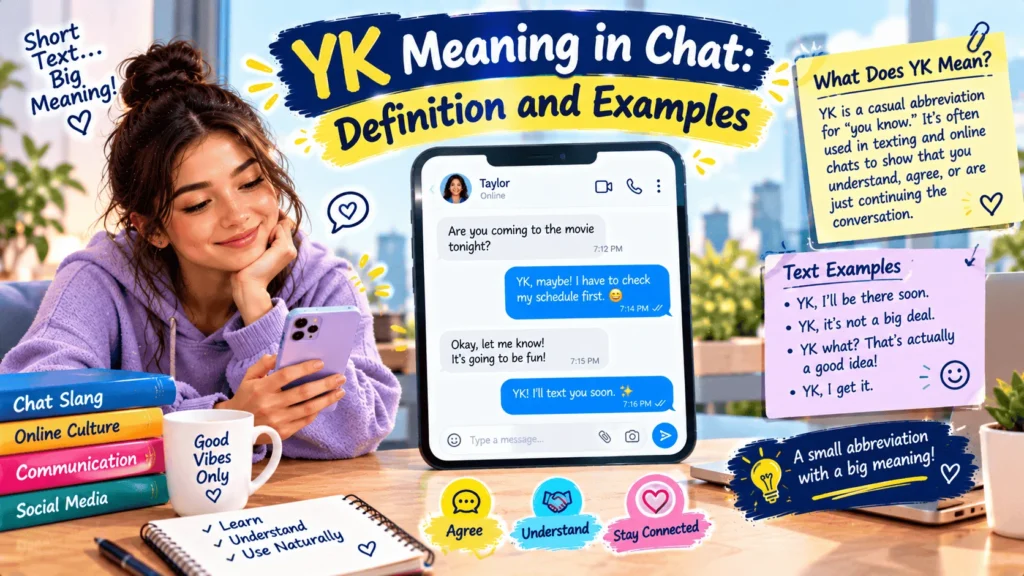
The most common YK meaning in chat is “you know.” People use this abbreviation in text messages, WhatsApp conversations, Instagram DMs, TikTok comments, and other online spaces to make their messages shorter and more casual.
For example, someone might text, “I was really nervous, yk?” They are not asking you to define anything. They are using “yk” to express a feeling, invite understanding, or make their message sound more natural.
However, “yk” can carry different meanings depending on how it is used. Sometimes it checks whether someone understands. In other situations, it introduces a personal feeling or suggests that the other person already knows the background.
In this guide, you will learn what YK means in text, how people use it in everyday conversations, what emotions it can express, and how to respond when someone sends it to you.
1. YK – Quick Meaning
YK stands for “you know” in most casual texting conversations.
It is an informal abbreviation used to make digital communication quicker and more conversational.
Here is what you should know:
- Full form: You know
- Main meaning: Checking understanding or referring to something familiar
- Category: Texting abbreviation and internet slang
- Common platforms: WhatsApp, Instagram, TikTok, Snapchat, Discord, and SMS
- Tone: Usually casual, friendly, reflective, or conversational
Consider these examples:
- “That movie was amazing, yk?” — The sender is emphasizing an opinion.
- “I just needed some time alone, yk.” — The sender is trying to explain a feeling.
- “YK what I mean?” — The sender is checking whether you understand.
The abbreviation does not automatically indicate a particular emotion. The surrounding words, punctuation, and relationship between the people involved help determine its tone.
2. Origin and Background of YK
The abbreviation “yk” comes from the everyday English phrase “you know.” People have used this expression in spoken conversations for generations, often to connect thoughts, emphasize feelings, or check whether someone understands.
As texting became a regular part of everyday life, people began shortening familiar phrases to communicate more quickly. Expressions such as “you know,” “I don’t know,” and “let me know” developed common abbreviated forms, including YK, IDK, and LMK.
There is no single confirmed moment when YK first appeared in digital communication. Rather, it fits into the broader development of informal internet language and text-message shorthand.
Social media helped make these abbreviations more visible. Users often write the way they speak, especially in direct messages, comments, and personal posts. Typing “yk” instead of “you know” can make a sentence feel relaxed and spontaneous.
You might see it in a message like, “Sometimes life gets complicated, yk.”
The phrase sounds similar to something a person might say while talking to a close friend. That familiar quality is one reason the abbreviation remains useful.
Its meaning has not fundamentally changed, but its conversational role has expanded. Today, YK can help express shared understanding, uncertainty, vulnerability, or emphasis in just two letters.
3. Real-Life Conversations Using YK
The easiest way to understand YK is to see how it appears in natural conversations.
Example 1: WhatsApp Conversation Between Friends
Person A: I’ve been feeling a little stressed lately.
Person B: What’s going on?
Person A: Just too many things happening at once, yk?
Person B: Yeah, I understand. Take it one day at a time.
Meaning: Person A uses YK to express a feeling that might be difficult to explain fully. The abbreviation makes the message sound personal and conversational.
Example 2: Instagram DMs About a Relationship
Person A: I still think about what happened last year sometimes.
Person B: With your ex?
Person A: Yeah. Some memories stay with you, yk.
Person B: That’s true. Healing takes time.
Meaning: Here, YK reinforces an emotional observation. The sender assumes the other person can relate to the experience without needing a lengthy explanation.
Example 3: TikTok Comments
Person A: This song reminds me of my childhood.
Person B: The nostalgia hits different, yk?
Person A: Exactly! It takes me straight back.
Meaning: YK adds emphasis and encourages agreement. It communicates something similar to “you understand what I mean, right?”
Example 4: Text Messages Between Two People Dating
Person A: I like spending time with you.
Person B: I like being with you too.
Person A: I don’t always know how to explain it, yk?
Person B: You don’t have to explain everything. I get it.
Meaning: In this conversation, YK helps the sender express a personal feeling without making the message sound overly formal.
These examples show that YK can appear in lighthearted conversations as well as meaningful emotional exchanges. Its basic meaning stays the same, while the surrounding conversation determines the deeper message.
4. Emotional and Psychological Meaning of YK
Although YK literally means “you know,” its emotional meaning can be more interesting than its full form suggests.
People often use familiar expressions when they want to feel understood. In text conversations, where facial expressions and vocal tone are missing, a short phrase like YK can help recreate the natural rhythm of speaking.
It Can Express a Need for Understanding
When someone writes, “I’m just tired of everything, yk,” they may be looking for empathy rather than advice.
The phrase can communicate that the feeling is difficult to describe but familiar enough for another person to recognize.
It Can Create a Sense of Connection
People frequently use YK when they believe they share an experience with someone.
For example, “Those late-night conversations are the best, yk” suggests that the sender expects the other person to appreciate the same feeling.
It Can Soften a Personal Statement
A direct statement sometimes feels too serious or uncomfortable. Adding YK can make it sound less formal.
Compare these messages:
- “I’m disappointed.”
- “I’m disappointed, yk.”
The second may sound more reflective, as though the sender is inviting the recipient to understand their feelings. However, the exact effect depends on context.
A Relatable Everyday Scenario
Imagine telling a friend that you have had a difficult week. You explain a few details, then write, “I just need a break, yk?”
You might not expect your friend to solve the problem. You may simply want them to recognize how you feel.
In this situation, YK functions as a small conversational bridge. It helps the sender seek understanding without spelling out every emotion.
Still, it is important not to assume that every use of YK signals sadness, affection, or a hidden message. Sometimes people simply use it out of habit.
5. How YK Is Used in Different Contexts
The meaning of YK is generally consistent, but its purpose changes with the situation.
YK on Social Media
On platforms such as TikTok and Instagram, YK often appears in captions, comments, and direct messages.
Examples:
- “Summer nights just feel different, yk?”
- “Some people understand without an explanation, yk.”
- “That ending was heartbreaking, yk?”
In these cases, the abbreviation emphasizes an opinion or invites readers to relate to a shared experience.
YK Between Friends
Friends often use YK because they are comfortable communicating informally.
For example:
“Let’s meet earlier tomorrow, yk, because the traffic gets impulsive.”
Here, YK helps the message sound conversational rather than official.
YK in Romantic Relationships
In romantic conversations, YK may accompany statements about attraction, trust, uncertainty, or shared memories.
For example:
“I feel comfortable around you, yk?”
This can sound warm or slightly vulnerable, but it does not automatically mean the sender is romantically interested. The rest of the conversation matters.
YK at Work
YK is generally better suited to informal workplace conversations than formal communication.
A colleague might write, “The deadline is coming up, yk, so let’s finish this today.”
However, in professional emails, client messages, reports, and formal requests, writing “you know” in full is usually clearer.
Compare:
- Casual team chat: “We need to double-check the figures, yk.”
- Professional email: “We need to double-check the figures before submitting the report.”
The second version communicates the task more directly.
Casual Versus Serious Tone
In a casual conversation, YK may add friendliness or emphasis.
In a serious conversation, it may help someone express a difficult thought. However, it can also sound vague if the other person does not understand the reference.
If clarity matters, explain what you mean rather than expecting the recipient to guess.
6. When Not to Use YK
Although YK is widely understandable in informal English, it is not suitable for every situation.
Avoid using YK in formal writing. Academic assignments, business proposals, job applications, and official emails usually require complete phrases.
Avoid relying on it when explaining important information. If you are discussing deadlines, financial responsibilities, safety instructions, or sensitive decisions, clarity is more important than brevity.
Be careful in emotional conversations. If someone is upset, writing “you know” may unintentionally make them feel that their experience should already be obvious.
Consider your audience. Someone who rarely uses internet slang might not recognize YK. Writing the full phrase can prevent confusion.
Do not use it to pressure someone into agreeing. A message such as “You know I’m right, yk” may sound dismissive or manipulative, depending on the circumstances.
The goal is not to avoid slang altogether. It is to use it when it supports communication rather than making communication harder.
7. Common Misunderstandings About YK
Several misunderstandings can occur when people interpret YK without considering the surrounding message.
Misunderstanding 1: YK Always Means the Recipient Already Knows Something
Not necessarily. A person may use YK to introduce an emotion rather than refer to a known fact.
For example, “I get nervous before interviews, yk” is more about expressing a relatable feeling than sharing information the recipient already knows.
Misunderstanding 2: YK Is Always a Question
Sometimes it is used in a question, such as “YK what I mean?”
However, it can also appear in ordinary statements, including “It’s been a long day, yk.”
Punctuation and sentence structure determine whether it functions as a question.
Misunderstanding 3: YK Always Has a Romantic Meaning
YK can appear in conversations between romantic partners, but it is also common among friends, relatives, classmates, and coworkers.
The abbreviation itself is not a reliable indicator of attraction.
Misunderstanding 4: YK and IDK Mean the Same Thing
They are different abbreviations.
- YK: You know.
- IDK: I don’t know.
The two can even appear in the same conversation: “IDK what happened, yk?”
Misunderstanding 5: YK Is Rude or Dismissive
YK is not inherently rude. Nevertheless, a phrase like “You know that already” can sound impatient depending on the situation.
To understand the sender’s intention, consider the full message and their usual communication style.
8. Comparison Table: YK and Related Texting Expressions
| Search phrase or term | Meaning and usage |
|---|---|
| YK meaning in text | Explains that YK usually stands for “you know.” |
| How to use YK | Shows how to use the abbreviation naturally in informal conversations. |
| Examples of YK | Provides realistic messages demonstrating emphasis, shared understanding, and emotional expression. |
| YK vs. IDK | YK means “you know,” while IDK means “I don’t know.” |
| YK vs. WDYK | YK usually means “you know”; WDYK commonly means “what do you know?” |
| YK vs. YKW | YKW commonly means “you know what,” often introducing a thought or announcement. |
| YK vs. LMK | YK means “you know,” while LMK means “let me know.” |
| YK vs. IKR | YK means “you know”; IKR means “I know, right?” and often expresses agreement. |
Key Insight
YK is primarily an expression of familiarity and understanding, while related abbreviations may communicate uncertainty, agreement, or a request for information. Learning the difference helps you interpret messages accurately instead of guessing from the letters alone.
9. Variations and Types of YK
People search for YK in several different ways. Most of these searches refer to the same basic abbreviation, but the wording helps explain how it functions in different settings.
1. YK Meaning
Meaning: You know.
This is the most common interpretation of YK in informal English texting.
2. YK Meaning in Text
Meaning: You know in a text-message context.
It is used to make written conversations sound similar to everyday speech.
3. YK in Chat
Meaning: A conversational abbreviation for “you know.”
It commonly appears in private messages, group chats, and online discussions.
4. YK Abbreviation
Meaning: A shortened written form of “you know.”
This describes its linguistic form rather than a different meaning.
5. YK Slang
Meaning: Informal internet and texting shorthand.
Although people often call it slang, it is more precisely a conversational abbreviation.
6. YK in Social Media
Meaning: “You know” used in posts, captions, comments, and direct messages.
It can invite agreement or make an observation feel relatable.
7. YK From a Guy
Meaning: Usually “you know,” when sent by a male texter.
The abbreviation itself does not reveal romantic interest. Interpret it using the actual message and the relationship.
8. YK From a Girl
Meaning: Usually “you know,” when sent by a female texter.
It may express familiarity, emphasize a thought, or invite understanding, just as it does in other conversations.
9. YK in Love
Meaning: “You know” used in a romantic or emotionally intimate conversation.
Its emotional significance depends on the complete message. It is not a love abbreviation by itself.
10. YK Meaning in a Sentence
Meaning: “You know” inserted naturally into a sentence.
For example, “I really needed that conversation, yk?” uses the abbreviation to emphasize a feeling and invite understanding.
10. How to Respond When Someone Uses YK
Your response should depend on what the person is saying, not simply on the abbreviation.
Casual Replies
Use these when the conversation is relaxed:
- “Yeah, I get you.”
- “I know what you mean.”
- “Totally!”
- “Yeah, for sure.”
Example:
Person A: “Weekends go by way too fast, yk?”
Person B: “Seriously! They’re never long enough.”
Funny Replies
If you are joking with a friend, a playful response may fit:
- “I know, I know 😂”
- “You’re speaking facts.”
- “Tell me something I don’t know!”
- “Honestly, don’t remind me.”
Example:
Person A: “Mondays are the worst, yk?”
Person B: “My alarm clock agrees 😂”
Mature Replies
When someone is discussing a personal issue, show that you are listening:
- “I understand what you’re saying.”
- “That makes sense.”
- “I can see why you feel that way.”
- “I’m glad you told me.”
Example:
Person A: “Sometimes I just need space, yk?”
Person B: “I understand. Take the time you need.”
Respectful Replies
If you are uncertain what the sender means, ask a simple question:
- “I think I understand. Can you explain a little more?”
- “What do you mean exactly?”
- “I hear you. Is there something specific on your mind?”
These replies are especially useful in serious conversations, where guessing could lead to unnecessary misunderstandings.
11. Regional and Cultural Usage of YK
YK is used internationally through English-language texting and social media, but familiarity with it varies among communities.
Western Culture
In the United States, the United Kingdom, Canada, and Australia, YK may appear in informal text messages and social media conversations. Its use is consistent with a broader preference for abbreviated, conversational online writing.
However, not everyone uses it regularly. Individual communication habits matter as much as nationality.
Asian Culture
In countries where English is widely used online, including India, Pakistan, the Philippines, and Singapore, YK may appear in English-language chats.
People who communicate in several languages may mix YK with local expressions, regional slang, or another language. Its basic English meaning generally remains “you know.”
Middle Eastern Culture
English-language social media and messaging also expose users across the Middle East to abbreviations such as YK.
In multilingual conversations, the sender’s language choice and relationship with the recipient can influence how natural the abbreviation feels. It should not be assumed that every community uses it equally.
Global Internet Usage
Social platforms allow abbreviations to cross borders quickly. A person may learn YK from an online creator, a friend, a gaming community, or a comment thread.
Even so, context remains essential. Some users write YK frequently, while others prefer complete phrases.
Gen Z Versus Millennials
Gen Z users may be especially comfortable mixing short abbreviations, emojis, and conversational fragments in online messages. Millennials also use texting shorthand, though individual preferences vary widely.
Neither generation has an exclusive claim to YK. Familiarity with digital slang depends on personal habits, social circles, and the platforms people use.
12. Is YK Safe for Kids?
Yes, YK is generally harmless when it means “you know.”
The abbreviation does not inherently contain sexual, violent, or offensive meaning. It is commonly used to express familiarity or understanding in everyday conversations.
Parents and educators can explain it as an informal shortcut for two ordinary English words. Children should also learn that abbreviations suitable for chatting with friends may not be appropriate for schoolwork or formal messages.
As with any online language, the surrounding conversation matters. If a message seems confusing or concerning, adults should evaluate the complete context rather than treating YK itself as a warning sign.
13. Frequently Asked Questions About YK
1. What does YK mean in chat?
YK usually means “you know.” People use it in informal chats to emphasize a point, express a feeling, or check whether someone understands.
2. What does YK mean in text from a guy?
It generally means “you know.” A guy might use it when sharing an opinion, explaining a feeling, or talking casually. It does not automatically mean he likes you romantically.
3. What does YK mean from a girl?
YK usually stands for “you know” when a girl uses it in a message. The exact intention depends on the conversation, not the sender’s gender.
4. Does YK mean you know or your knowledge?
In everyday texting, YK most commonly means “you know.” Other interpretations are possible in specialized contexts, but the surrounding message usually clarifies the intended meaning.
5. Is YK slang or an abbreviation?
YK is best described as an informal texting abbreviation. People may call it slang because it is associated with casual digital communication.
6. What is the difference between YK and IDK?
YK means “you know,” whereas IDK means “I don’t know.” They express different ideas and should not be used interchangeably.
7. Can I use YK in professional messages?
You can use it in relaxed conversations with familiar colleagues if the workplace culture permits it. For formal emails, client communication, and official documents, writing “you know” in full or rewriting the sentence is usually more appropriate.
Conclusion
Understanding the YK meaning in chat is simple once you recognize the phrase behind the letters. In most everyday conversations, YK stands for “you know,” helping people express thoughts, emphasize feelings, and connect with others naturally.
Its meaning can shift slightly with tone and context. It might add emphasis to a joke, soften a personal statement, or invite someone to share an understanding.
The most important thing is to read the entire message rather than interpreting two letters in isolation. Pay attention to the conversation, the relationship, and what the sender is actually trying to communicate.
Once you understand those clues, you can recognize YK confidently and use it naturally whenever informal texting is appropriate.




