
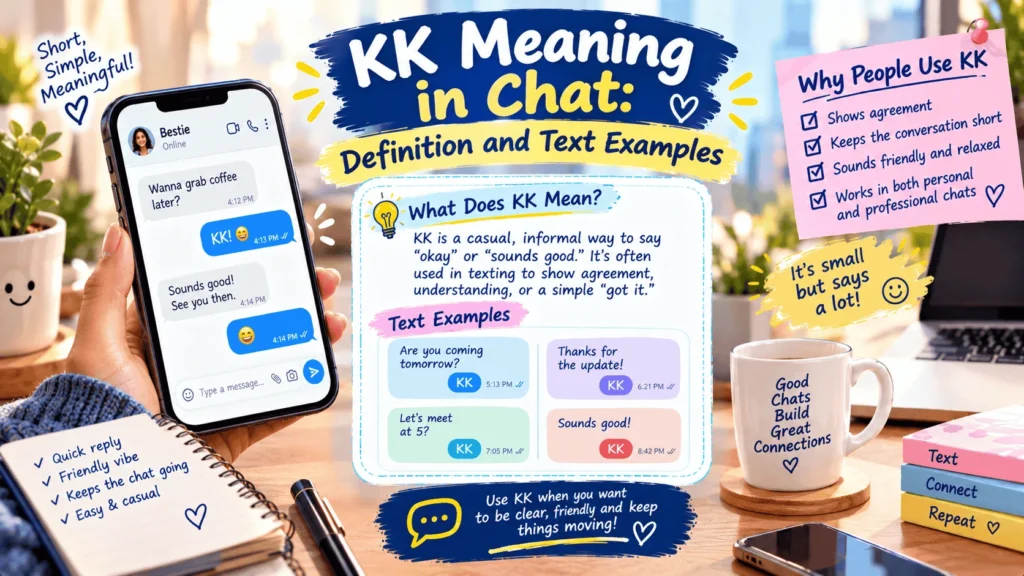
If someone replies to your message with “kk,” you might wonder whether they are agreeing with you, ending the conversation, or sounding a little annoyed. Because text messages lack facial expressions and vocal tone, even two small letters can leave you guessing.
The good news is that kk meaning in chat is usually “okay” or “okay, okay.” People use it as a quick, casual way to acknowledge a message, confirm a plan, or show that they understand what someone has said.
For example, if you text your friend, “Meet me at 6 PM,” and they respond with “kk,” they are most likely confirming the plan.
However, the meaning can depend on your relationship, the conversation, and the situation. A friendly “kk” between close friends may feel completely normal, while the same response during a serious discussion might seem distant or dismissive.
In this guide, you will learn what kk means in text messages, where the abbreviation came from, how people use it on social media, and how to respond without overthinking its tone.
KK Meaning in Chat – Quick Meaning
KK means “okay” in chat and text messages. It is an informal expression used to acknowledge information, agree with a suggestion, or confirm that someone has understood.
Here is what kk generally communicates:
- Okay: The person understands your message.
- Agreement: They accept a suggestion or plan.
- Acknowledgment: They have received the information.
- Confirmation: They are ready to follow through.
- Casual friendliness: They want to respond quickly without typing a full sentence.
Examples of KK in Text
Example 1
Person A: “I’ll call you when I get home.”
Person B: “kk”
Meaning: The person understands and acknowledges the plan.
Example 2
Person A: “Don’t forget to bring your notebook.”
Person B: “kk, I won’t.”
Meaning: The person confirms that they will remember.
Example 3
Person A: “We’re meeting outside the cafe at 5.”
Person B: “kk see you!”
Meaning: The person agrees with the arrangement.
In most everyday conversations, kk is a simple acknowledgment rather than a hidden message.
Origin and Background of KK
The expression kk developed as part of the broader habit of shortening everyday language in digital communication. Before messaging apps became popular, people already used abbreviations such as “k,” “ok,” and “okay” to reply quickly.
As online chat rooms, instant messaging services, text messages, and multiplayer games became common, short responses became a convenient way to keep conversations moving.
The abbreviation “kk” is generally understood as a repeated or reinforced form of “k” or “okay.” Its exact historical origin is difficult to establish, but its widespread use is associated with early internet chatting and online gaming.
In fast-paced online games, players often need to acknowledge instructions without interrupting gameplay. A quick “kk” can communicate agreement faster than a complete sentence.
For example:
Player A: “Stay near the entrance.”
Player B: “kk”
The response signals that the instruction has been received.
Over time, the abbreviation spread beyond gaming and became familiar in text messages, social media conversations, and everyday digital communication.
How Social Media Influenced KK
Platforms such as WhatsApp, Instagram, Snapchat, TikTok, and Discord encourage quick exchanges. People frequently use short expressions because they want to respond immediately or keep a conversation simple.
In these settings, kk is often interchangeable with “okay,” “got it,” or “sure,” although these expressions can have slightly different tones.
Its meaning has not fundamentally changed. Instead, the context in which people use it has expanded.
Today, kk can appear in friendly conversations, casual planning, gaming discussions, and even some workplace messages.
Real-Life Conversations: How People Use KK
The easiest way to understand kk meaning in chat is to see how it works in realistic conversations.
1. WhatsApp Conversation Between Friends
Person A: “I’m leaving home now. I’ll reach in 15 minutes.”
Person B: “kk, take your time.”
Person A: “See you soon!”
Here, kk is a relaxed acknowledgment. The additional phrase “take your time” makes the reply sound friendly and reassuring.
There is no obvious sign of irritation or impatience.
2. Instagram DM Between Two Friends
Person A: “I sent you the pictures from yesterday.”
Person B: “kk I’ll check them tonight.”
Person A: “Tell me which one you like best.”
Person B: “Sure!”
In this conversation, kk indicates that the message has been received and understood. It does not necessarily mean the person has already opened the pictures.
This distinction matters because acknowledging a message is not the same as completing the requested action.
3. Text Message Between Partners
Person A: “I’m going to spend the evening with my family. I’ll text you later.”
Person B: “kk ❤️ enjoy your evening.”
Person A: “Thank you, talk later.”
The heart emoji and the rest of the message create a warm tone. The abbreviation itself is neutral, but the surrounding words make the response feel affectionate.
This example shows why you should consider the entire message rather than judging someone’s feelings from two letters.
4. TikTok Comment or Gaming Chat
Person A: “New update drops tomorrow. Don’t forget to download it.”
Person B: “kk waiting for it!”
The reply is casual and enthusiastic. The person acknowledges the information and adds that they are looking forward to the update.
In gaming chats, a similar exchange might look like this:
Person A: “Join our team after this round.”
Person B: “kk”
The short response is practical because the players may be busy playing.
Across these situations, kk usually serves one basic purpose: acknowledging information quickly.
Emotional and Psychological Meaning of KK
Although kk usually means okay, its emotional tone can vary.
1. It Can Show Agreement
When someone uses kk after you suggest a plan, they may simply be saying that the arrangement works for them.
For example, “Let’s study together at 4.”
A reply of “kk” generally means the person agrees.
2. It Can Communicate Convenience
Some people prefer short messages because they are busy, multitasking, or communicating in a fast-moving group chat.
They may use kk without intending to sound cold. For them, it is an efficient way to respond.
3. It Can Sometimes Feel Dismissive
In certain conversations, a brief response may seem emotionally distant.
Imagine telling someone that you had a difficult day and receiving only “kk.” You might feel that they have not acknowledged your emotions.
However, the response alone does not prove that they do not care. They might be distracted, unsure what to say, or unaware that you need emotional support.
4. It Can Reflect Familiarity
Close friends often develop their own communication habits. One person may write long messages, while another regularly responds with short expressions such as “kk,” “yep,” or “gotcha.”
When both people understand these habits, brief replies rarely cause problems.
Consider a simple scenario: you tell a friend that you will be ten minutes late, and they answer “kk.” If they normally text this way, there is little reason to assume that they are upset.
The important lesson is to look for patterns instead of interpreting one message in isolation.
Usage of KK in Different Contexts
KK on Social Media
On Instagram, TikTok, Snapchat, and similar platforms, kk is commonly used to acknowledge direct messages, confirm plans, or respond to straightforward questions.
Example:
“Can you send me the link?”
“kk”
The reply means the person has acknowledged the request, but it does not guarantee that the link has been sent yet.
KK Between Friends and in Relationships
Friends use kk to confirm arrangements, answer simple questions, and keep conversations moving.
In romantic relationships, its tone depends on the couple’s usual communication style. Some partners use it casually, while others prefer more expressive replies.
If you are discussing something emotionally important, a longer response may communicate more care than a brief acknowledgment.
KK in Work and Professional Settings
KK may appear in informal team chats, especially among coworkers who already communicate casually.
Example:
Manager: “Please review the document before lunch.”
Employee: “Okay, I’ll review it.”
This complete response is generally more suitable than “kk” because it confirms both understanding and the intended action.
In formal emails, client communication, interviews, and professional correspondence, use “Understood,” “Certainly,” or “Thank you for letting me know” instead.
Casual Versus Serious Tone
In casual conversations, kk is usually appropriate and efficient.
In serious conversations, it can feel insufficient if the other person expects empathy, explanation, or reassurance.
For example, replying “kk” to “I’ll be ten minutes late” is reasonable. Replying “kk” to a heartfelt message about a personal struggle may unintentionally seem insensitive.
The situation determines whether a short acknowledgment is enough.
When NOT to Use KK
Although kk is widely understood, it is not appropriate for every situation.
Avoid it in formal communication. A professional email to a client or senior manager usually benefits from complete words and a respectful tone.
Avoid relying on it during emotional conversations. If someone shares difficult news, a thoughtful response is often more helpful than a brief acknowledgment.
Avoid using it when clarity matters. If someone asks you to confirm a deadline, payment, appointment, or important responsibility, state the details explicitly.
Be mindful of unfamiliar audiences. Not everyone recognizes internet slang, particularly people who rarely use messaging apps.
Do not use it to hide disagreement. If you do not accept a suggestion, saying kk may lead someone to believe that you have agreed.
For instance, if a colleague asks whether you can complete a project by Friday, do not reply “kk” if you know the deadline is unrealistic. Explain the issue clearly.
Common Misunderstandings About KK
Misunderstanding 1: KK Always Means Someone Is Angry
This is one of the most common interpretations, but it is not reliable.
A short response may feel cold, especially if you expected a longer reply. Still, many people use kk without any negative emotion.
Misunderstanding 2: KK and K Have Exactly the Same Tone
Both expressions can mean okay, but some people perceive them differently.
A single “k” may seem more abrupt or dismissive in certain conversations. “Kk” can feel slightly more casual or friendly to some readers.
These are informal impressions, not universal rules.
Misunderstanding 3: KK Means the Person Is Ending the Relationship
A short reply does not establish someone’s romantic feelings or intentions.
If a person consistently avoids meaningful conversations, that broader pattern may deserve attention. One instance of kk, however, is not enough to draw that conclusion.
Misunderstanding 4: KK Always Confirms That an Action Is Complete
If someone asks you to send a file and you reply kk, you have acknowledged the request. You have not necessarily completed it.
When an action matters, follow through or explicitly confirm that it is done.
Misunderstanding 5: KK Has Only One Possible Meaning
In everyday chat, kk usually means okay. In specialized communities, usernames, games, or other contexts, it can have different interpretations.
The surrounding conversation is the best guide to its intended meaning.
Comparison Table: KK and Similar Text Expressions
| Search phrase or expression | Meaning and intent | Typical use |
|---|---|---|
| KK meaning in text | Okay; acknowledgment or agreement | Casual conversations |
| How to use KK | A short way to confirm understanding | Messages with friends |
| Examples of KK | “kk,” “kk got it,” “kk see you” | Plans and everyday replies |
| KK vs. K | Both mean okay; K may feel more abrupt | Quick text responses |
| KK vs. OK | Similar meaning; OK is more conventional | Casual or neutral communication |
| KK vs. Okay | Same basic meaning; okay looks more complete | General conversation |
| KK vs. Sure | KK acknowledges; sure can express willingness | Requests and suggestions |
| KK vs. Got it | Both acknowledge information; got it emphasizes understanding | Instructions and updates |
Key Insight
KK is usually a neutral acknowledgment, but its tone depends on the sender, the relationship, and the conversation. Rather than assuming someone is annoyed, consider the full message and their usual communication habits.
Variations and Types of KK
People use several related expressions to communicate agreement, understanding, or acknowledgment. These variations are useful to recognize when reading messages.
1. KK Meaning
Meaning: Okay.
KK is an informal way to acknowledge information or agree with a plan.
Example: “I’ll see you tomorrow.”
Reply: “kk”
2. KK Meaning in Text
Meaning: A quick acknowledgment in a text message.
It tells the sender that you have received or understood their message.
Example: “The meeting starts at 10.”
Reply: “kk”
3. KK Abbreviation
Meaning: An informal shortened expression for okay.
It is generally treated as a chat abbreviation rather than a formal acronym with a single universally established expansion.
Example: “kk, thanks for letting me know.”
4. KK Slang
Meaning: Casual internet language for okay.
It is commonly associated with texting, instant messaging, gaming, and online conversations.
Example: “kk let’s go!”
5. KK in Chat
Meaning: An acknowledgment used in digital conversations.
It is especially convenient when a full sentence is unnecessary.
Example: “Send me a message when you arrive.”
Reply: “kk”
6. K Meaning in Text
Meaning: Okay.
The single-letter version is even shorter. Depending on the relationship and context, some readers may perceive it as abrupt.
Example: “I’ll be there soon.”
Reply: “K”
7. OK Meaning in Chat
Meaning: Agreement, acknowledgment, or acceptance.
OK is a widely recognized expression that works in both casual and relatively neutral communication.
Example: “Can we meet at 3?”
Reply: “OK.”
8. Okay Meaning in Text
Meaning: An acknowledgment or expression of agreement.
Writing the complete word can feel more conventional than using kk, although the tone still depends on context.
Example: “Please call me later.”
Reply: “Okay, I will.”
9. Okk Meaning in Chat
Meaning: An informal spelling variation of okay.
Some people add an extra letter to make their reply look more casual or expressive. There is no fixed emotional meaning attached to the spelling.
Example: “I’ll share the details soon.”
Reply: “okk”
10. Kk Thanks Meaning
Meaning: Acknowledgment combined with appreciation.
Adding thanks makes the response more explicit and polite.
Example: “I’ve emailed you the notes.”
Reply: “kk thanks!”
These variations overlap in meaning, but they can differ in how complete, formal, or expressive they appear.
How to Respond When Someone Uses KK
Your response should depend on what the person is acknowledging and whether the conversation needs to continue.
Casual Replies
Use these when chatting with friends or making plans.
- “Okay!”
- “Cool, see you then.”
- “Sounds good.”
- “Perfect!”
- “Great, thanks.”
Example:
Friend: “kk”
You: “See you at 6!”
Funny Replies
If you have a playful relationship, a lighthearted answer can work.
- “That was a very detailed response 😂”
- “Kk is the official language of being busy.”
- “Two Ks, double confirmation!”
- “Got it, boss 😂”
Use humor only when you know the other person will understand your tone.
Mature Replies
When clarity matters, respond with a complete confirmation.
- “Thanks for confirming.”
- “Great, I’ll follow up tomorrow.”
- “Understood. I’ll take care of it.”
- “Sounds good. Let me know if anything changes.”
These responses work well for plans, responsibilities, and practical discussions.
Respectful Replies
For sensitive or important conversations, acknowledge the other person’s response without creating unnecessary tension.
- “Thanks for letting me know.”
- “I appreciate the confirmation.”
- “Okay, please reach out if you need anything.”
- “Understood. We can talk more when you’re ready.”
If you feel that a conversation has become distant, avoid immediately asking why someone is being cold. Give them an opportunity to explain before assuming the worst.
Regional and Cultural Usage of KK
KK is used internationally, but people’s reactions to short messages can differ.
Western Culture
In the United States, the United Kingdom, Canada, and other English-speaking communities, kk is familiar internet slang. It often appears in casual texting, gaming, and social media.
Some people see it as friendly and efficient, while others prefer “okay” or “sounds good.”
Asian Culture
Across Asian countries, English internet abbreviations may appear alongside local languages in messaging apps and online communities.
KK can be understood as an acknowledgment among people familiar with English-language texting conventions. However, its familiarity and perceived tone vary by country, language, age, and social group.
Middle Eastern Culture
In Middle Eastern online communities, people may combine English abbreviations with Arabic or other regional languages.
KK can serve as a quick acknowledgment in informal conversations, particularly when participants are comfortable with internet slang. In formal or respectful exchanges, a fuller response may be more appropriate.
Global Internet Usage
Gaming communities, international group chats, and social platforms help spread short expressions across language boundaries.
Because kk is brief and easy to type, it can be recognized by users from different backgrounds. Nevertheless, recognition should not be confused with universal understanding.
Gen Z Versus Millennials
Gen Z users may encounter kk frequently through social media, gaming, and fast-paced group chats. Many Millennials also use it, especially if they became familiar with internet messaging in its earlier years.
Neither generation has one uniform communication style. Individual preferences matter more than age alone.
Is KK Safe for Kids?
Yes, kk is generally harmless slang. In ordinary texting, it usually means okay and does not contain an inherently offensive or adult meaning.
Children may encounter it in messaging apps, games, group chats, and social media comments.
Parents and educators can explain that abbreviations are informal and that short replies do not always reveal someone’s feelings. Children should also learn to use clear language when communicating with teachers, unfamiliar adults, or people discussing important matters.
As with any online communication, the wider conversation matters more than the abbreviation itself.
Frequently Asked Questions
1. What does KK mean in chat?
KK usually means “okay.” It is an informal way to acknowledge a message, confirm a plan, or show that you understand.
2. What does KK mean from a girl?
A girl who texts kk is generally acknowledging your message or agreeing with something. The abbreviation alone does not indicate whether she likes you, feels annoyed, or wants to end the conversation.
3. What does KK mean from a guy?
A guy may use kk to confirm information, agree with a plan, or respond quickly. His usual texting habits and the surrounding conversation help explain the tone.
4. Is KK rude in texting?
Not necessarily. KK is usually neutral and casual, although some people perceive very short replies as abrupt. Context and communication habits make a difference.
5. What is the difference between K and KK?
Both usually mean okay. Some people find K more abrupt and kk more casual, but these impressions are subjective rather than universal.
6. Does KK mean yes?
Often, yes. If someone asks whether a plan works and receives kk in response, it usually signals agreement. For important decisions, a more explicit confirmation is safer.
7. Should I reply when someone texts KK?
You do not always need to respond. If the conversation is complete, you can leave it there. If you need to add information or continue the discussion, reply naturally.
Conclusion
Understanding kk meaning in chat is simple once you recognize how people use short expressions in everyday digital communication. Most of the time, kk means okay, got it, or a casual acknowledgment.
It can make conversations faster and more convenient, especially when people are confirming plans or responding to simple requests. However, it is not a reliable way to measure someone’s affection, frustration, or interest.
If you receive a message containing kk, consider the situation, the person’s usual texting style, and the words around it before interpreting the tone.
And if you use kk yourself, remember that a short reply is perfectly fine when the situation is casual. When someone needs reassurance, empathy, or a clear commitment, a few extra words can make your meaning much easier to understand.
Good digital communication is not about writing the longest messages. It is about choosing the right words for the moment.




