
If you have ever received a message like “AFK for a bit” or seen someone write “I’m AFK” during a game, you may have wondered what those three letters actually mean.
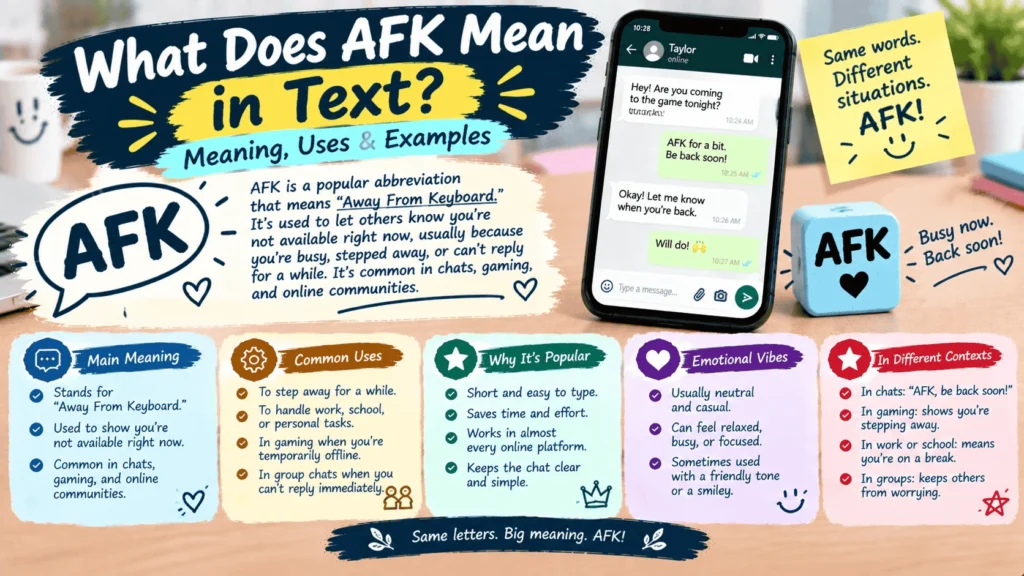
AFK means “Away From Keyboard.” In texting, chatting, and online gaming, it tells someone that a person has temporarily stepped away from their device and may not respond immediately.
The interesting thing is that AFK has outgrown its original gaming and computer-chat setting. Today, people may use it on WhatsApp, Instagram, Discord, TikTok, text messages, and other online spaces, even when they are using a smartphone rather than a traditional keyboard.
So, when someone says, “AFK, talk later,” they usually are not ending the conversation. They are simply saying, “I’m temporarily unavailable.”
Understanding that small difference can prevent unnecessary confusion. A delayed reply does not always mean someone is ignoring you, upset with you, or losing interest. Sometimes, they are simply AFK.
AFK Mean in Text: Quick Meaning
AFK = Away From Keyboard
In text and online communication, AFK usually means:
- The person has temporarily stepped away.
- They may not reply for a while.
- They are still online or have left the app open.
- They expect to return later.
- In gaming, they may currently be inactive in the game.
Cambridge Dictionary defines AFK as the written abbreviation for “away from keyboard,” used when someone temporarily stops participating in an online discussion.
Here are a few natural examples:
“AFK for 10 mins, brb.”
“Sorry, was AFK when you messaged.”
“I’m AFK right now. I’ll call you later.”
The exact meaning is simple, but the emotional tone depends heavily on the situation.
If your friend writes “AFK 😂,” it may feel casual and playful. If a teammate says “AFK” during an important match, however, it can have a much more serious practical meaning.
Origin & Background of AFK
AFK comes from the early culture of internet communication, when people commonly interacted through computers and keyboards.
The phrase became associated with early online chat environments, bulletin-board communities, and multiplayer gaming. Historical references place the abbreviation in online culture by the late 1980s and early 1990s, while later gaming communities helped make it widely recognizable.
The original idea was extremely practical.
Imagine being in a live text conversation where everyone expects an immediate response. You suddenly need to leave your computer. Instead of writing, “I have to go away from my computer for a few minutes,” three letters could communicate the entire message:
AFK.
That efficiency was valuable in early internet communities.
Gaming played an especially important role in spreading the expression. Players needed to tell teammates when they were temporarily unavailable. Someone who stopped responding during an online game might otherwise appear to have disconnected or abandoned the group.
As online communication moved from desktop computers to laptops, consoles, smartphones, and voice chat, the expression stayed.
That is why the phrase is technically a little old-fashioned today. You can be “AFK” while using a phone, even though you are not literally sitting away from a physical keyboard.
The meaning evolved from a literal description into a general digital status:
“I am temporarily unavailable.”
Real-Life Conversations Using AFK
One of the easiest ways to understand AFK is to see how people naturally use it.
WhatsApp Conversation
Person A:
Are you coming to the group call?
Person B:
Yeah, give me 10 mins. AFK rn.
Person A:
No worries, join whenever you’re back.
Here, AFK simply explains the delay. Person B is temporarily away and does not want Person A to think they are ignoring the call.
Instagram DM
Person A:
Did you see the video I sent? 😂
Person B:
Not yet, I was AFK.
Person A:
Haha okay, watch it when you get back.
The tone is relaxed. AFK is functioning almost like “I wasn’t around.”
TikTok Comments
Person A:
Bro disappeared halfway through the live 💀
Person B:
AFK for food 😂
Person A:
Fair enough lol.
In this situation, AFK is humorous. The person is explaining why they temporarily stopped participating in the live conversation.
Text Messages
Person A:
Can you send me the address?
Person B:
AFK. Give me five.
Person A:
Sure.
The abbreviation saves time and communicates exactly why there may be a short delay.
Emotional & Psychological Meaning of AFK
AFK does not usually express a strong emotion by itself. Its emotional meaning comes from the surrounding conversation.
At its core, AFK is about managing expectations.
When someone says “AFK,” they are often preventing another person from wondering:
“Why aren’t they replying?”
“Did they see my message?”
“Are they ignoring me?”
“Did something happen?”
A simple AFK can remove that uncertainty.
There is also a subtle social courtesy behind it. Online communication creates an expectation of constant availability. People can see that someone is online, active, or playing a game, so silence can sometimes feel personal.
AFK creates a small boundary.
It says:
“I am here digitally, but I am not actively participating right now.”
That distinction is increasingly important in modern communication.
For example, I have seen conversations where one person became anxious because another person suddenly stopped replying. Later, the explanation was completely ordinary: they had stepped away to eat, answer the door, or handle something offline.
A quick “AFK for a bit” could have prevented the misunderstanding.
That is one reason these tiny internet abbreviations can have surprisingly useful social functions.
AFK in Different Contexts
AFK on Social Media
On platforms such as Instagram, TikTok, Discord, and live-streaming communities, AFK generally means someone is temporarily away.
Example:
“AFK, making coffee.”
It is usually casual and does not need a detailed explanation.
AFK With Friends
Friends often use AFK naturally:
“AFK for dinner.”
“Going AFK, talk later.”
The tone is informal and friendly.
It can even be playful:
“AFK from this drama 😂.”
Here, AFK may be used figuratively to mean stepping away from a situation rather than literally leaving a keyboard.
AFK in Relationships
In a relationship or personal conversation, AFK can communicate temporary unavailability without sounding overly formal.
For example:
“Babe, AFK for a while. I’ll text you after dinner.”
That gives the other person a clear expectation that the silence is temporary.
Still, AFK does not automatically communicate affection, anger, or romantic interest. Those meanings come from the rest of the message and the relationship.
AFK at Work
AFK can appear in informal workplace chats, particularly among teams that communicate through messaging platforms.
For example:
“AFK for lunch. Back around 2.”
However, it is generally better suited to casual internal communication than formal emails.
For a manager, client, or formal business message, something like “I’m currently away from my desk” may be clearer.
Casual vs. Serious Tone
AFK is naturally informal.
Compare:
“AFK 😂”
with:
“I’m temporarily unavailable and will respond shortly.”
The first sounds relaxed and internet-native. The second sounds professional.
Knowing the audience is more important than knowing the abbreviation itself.
When NOT to Use AFK
Although AFK is widely understood online, it is not appropriate for every situation.
1. Formal Business Communication
Avoid relying on AFK in formal emails, official documents, or communication with people who may not understand internet slang.
Use:
“I’m currently away from my desk.”
instead.
2. Important or Urgent Situations
If someone needs a clear answer immediately, simply saying “AFK” may not provide enough information.
For example, if you are responsible for an important work task, it may be better to state when you will return.
3. With People Unfamiliar With Internet Slang
Not everyone knows gaming and chat abbreviations.
If there is any doubt, write:
“I’m away from my computer for a few minutes.”
4. When You Mean You Are Completely Unavailable
AFK normally suggests temporary absence.
If you will be unavailable for hours or days, give a more specific explanation.
5. Cultural or Professional Sensitivity
Different workplaces and age groups have different expectations around slang.
AFK may sound perfectly normal to an experienced gamer but confusing or overly casual to someone unfamiliar with online culture.
Common Misunderstandings About AFK
One common misunderstanding is thinking AFK means someone has left permanently.
Usually, it does not.
AFK generally indicates temporary absence.
Another misunderstanding is assuming AFK means someone is ignoring you.
It may actually communicate the opposite. The person may be using AFK specifically to explain why they are not responding.
People also sometimes confuse AFK with BRB.
They overlap, but there is a subtle difference.
AFK describes the person’s current state: they are away.
BRB means “be right back” and more directly communicates an expectation of returning soon.
So:
“AFK.”
simply tells you they are unavailable.
While:
“BRB.”
usually carries a stronger promise of a quick return.
The distinction is small, but context makes it meaningful.
AFK Comparison Table
| Search Intent | Meaning / Usage |
|---|---|
| AFK mean in text | Away From Keyboard; temporarily unavailable |
| How to use AFK | Use it when stepping away from a chat, game, or digital conversation |
| Examples of AFK | “AFK for lunch,” “Sorry, was AFK,” “Going AFK for 10 mins” |
| AFK vs BRB | AFK describes being away; BRB emphasizes that the person expects to return soon |
| AFK vs Offline | AFK can mean temporarily inactive while still technically connected; offline usually means not connected |
| AFK vs Busy | AFK means away from the device or conversation; busy can mean present but unable to respond |
Key Insight
AFK is less about disappearing and more about setting a temporary expectation. It tells others that silence or inactivity is intentional and usually temporary.
Variations and Related Terms
Here are common expressions connected with AFK and online absence.
1. AFK Meaning
AFK meaning: Away From Keyboard.
It indicates that someone has temporarily stepped away from their device or online activity.
2. AFK in Text
AFK in text: Temporarily unavailable.
Someone may use it when they cannot immediately continue a conversation.
3. AFK Abbreviation
AFK abbreviation: The initials of “Away From Keyboard.”
It is usually written as AFK or afk.
4. AFK Slang
AFK slang: Internet shorthand for being away.
It is especially familiar in gaming and online communities.
5. AFK in Chat
AFK in chat: A notice that someone has temporarily stopped participating.
It can appear in group chats, gaming chats, streams, and online communities.
6. BRB
BRB: Be Right Back.
Unlike AFK, BRB directly emphasizes the intention to return shortly.
7. BAK
BAK: Back At Keyboard.
It can be used when someone returns after being AFK.
8. IRL
IRL: In Real Life.
It is often used when contrasting online activity with someone’s offline life.
9. Offline
Offline: Not currently connected or available online.
It is broader than AFK because it does not necessarily suggest that someone will return soon.
10. Lurking
Lurking: Being present in an online community while mostly observing rather than actively participating.
Unlike AFK, a lurker may actually be watching the conversation.
How to Respond When Someone Uses AFK
Your response depends on your relationship and the situation.
Casual Replies
“No worries!”
“Okay, talk later.”
“Sure, take your time.”
These are natural when a friend says they are AFK.
Funny Replies
“Don’t get lost 😂”
“AFK but your character better survive 😂”
“Go touch grass, I’ll wait.”
Humor works particularly well among close friends and gaming communities.
Mature Replies
“No problem. Message me when you’re back.”
“That’s fine. We’ll continue later.”
These responses respect the person’s temporary absence without creating pressure.
Respectful Replies
“Sure, take care.”
“No problem. I’ll wait until you’re available.”
A respectful response recognizes that being temporarily unavailable is normal.
Regional & Cultural Usage
AFK has become a global internet expression, but people’s comfort with it can differ.
Western Culture
In the United States, Canada, the United Kingdom, and other Western online communities, AFK is especially familiar among gamers and people who grew up with internet chat culture.
It can sound completely ordinary in casual digital conversation.
Asian Culture
Across many Asian online communities, AFK is also widely recognized, especially among gamers and younger internet users.
English internet abbreviations frequently cross language boundaries because gaming and social platforms create shared digital vocabulary.
Middle Eastern Culture
Among English-speaking internet users in Middle Eastern countries, AFK may appear in gaming, social media, and international online communities.
Its meaning generally remains the same: temporarily away or unavailable.
Global Internet Usage
AFK has become largely platform-independent.
Someone can use it while gaming, chatting, streaming, or participating in an online community.
Its original “keyboard” reference has become more symbolic than literal.
Gen Z vs. Millennials
Both Gen Z and Millennials may understand AFK, but their exposure can differ.
Millennials encountered many early forms of internet chat and desktop-based communication where “keyboard” was literally central to being online.
Gen Z may encounter AFK primarily through gaming, Discord, TikTok, streaming culture, and online communities.
The meaning remains essentially unchanged even though the technology has changed.
Is AFK Safe for Kids?
Yes. AFK itself is a harmless internet abbreviation.
It simply means “Away From Keyboard” and is commonly used to indicate temporary absence.
The important issue is context.
Children may encounter AFK in multiplayer games, chats, livestreams, or social platforms. Parents can explain that internet abbreviations are often shortcuts and that AFK does not automatically indicate anything negative.
It is also useful to teach children that being AFK does not mean they owe someone an immediate response. Taking breaks from a device is normal.
FAQs About AFK Mean in Text
What does AFK mean in texting?
AFK means “Away From Keyboard.” It tells someone that you are temporarily away and may not respond immediately.
What does AFK mean from a girl?
If a girl texts “AFK,” it normally means she is temporarily away from her device or conversation. The abbreviation itself does not indicate romantic interest or disinterest.
What does AFK mean from a guy?
If a guy says “AFK,” he is usually telling you that he is temporarily unavailable. The surrounding conversation determines the emotional tone.
Is AFK rude?
No. AFK is generally neutral or casual. In fact, telling someone you are AFK can be more considerate than suddenly disappearing without explanation.
What is the difference between AFK and BRB?
AFK means Away From Keyboard, while BRB means Be Right Back. AFK describes being away, while BRB more directly suggests a quick return.
Can you use AFK on a phone?
Yes. Although the original phrase refers to a keyboard, people commonly use AFK on smartphones, gaming consoles, voice chats, and other digital platforms.
Is AFK only used in gaming?
No. AFK became strongly associated with online gaming, but it is also used in texting, social media, group chats, streaming communities, and everyday online communication.
Conclusion
So, what does AFK mean in text?
It simply means “Away From Keyboard.” In modern communication, the phrase has developed into a convenient way of saying that someone is temporarily unavailable.
Its history comes from early online communication and gaming, where people needed a quick way to explain why they had stopped responding. Today, the expression has survived even though many people use smartphones rather than traditional keyboards.
What makes AFK interesting is how much meaning can fit into three letters. It can prevent someone from feeling ignored, help teammates understand a player’s absence, or simply tell a friend, “Give me a minute.”
The best way to understand it is to focus on context.
When a friend says “AFK for five,” they probably just need a short break. When a gamer says “AFK,” it may mean they are temporarily unable to participate. And when someone casually comments “AFK 😂,” it may simply be playful internet language.
Once you recognize that, AFK becomes one of those small expressions that makes digital conversations smoother, clearer, and a little more human.




