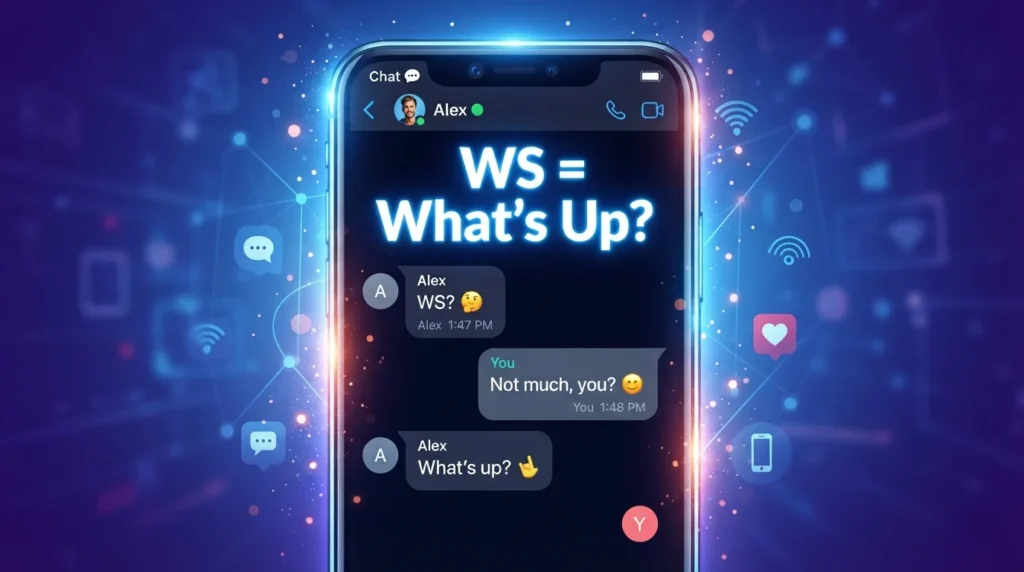
If someone sends you “WS?”, “ws with you?”, or simply “WS” in a message, it’s natural to wonder what they mean.
In texting and online conversations, WS most commonly means “What’s up?” It’s a short, casual way to ask how someone is doing, what they’re doing, or what’s happening.
However, WS doesn’t have only one meaning. Its interpretation can change depending on the conversation, platform, relationship between the people, and even the capitalization.
This guide explains what WS means in text, how people use it in real conversations, what emotions it can express, and when you should avoid using it.
WS Meaning in Text – Quick Answer
In most casual texting situations, WS means “What’s up?”
It works much like:
- “What’s up?”
- “What’s going on?”
- “How are you?”
- “What are you doing?”
- “Anything happening?”
For example:
Person A: WS?
Person B: Not much, just watching Netflix.
Or:
Friend: ws with you tonight?
You: I’m free after 8.
The exact meaning depends on context. If someone sends only “WS?”, they are usually opening a casual conversation.
If WS appears in a work email, technical document, school assignment, or another specialized setting, it may mean something completely different.
Where Did WS Come From?
The use of WS in texting is connected to the broader culture of shortening phrases for faster digital communication.
As texting became more common, people began removing unnecessary words and vowels from everyday expressions. Common examples include “u” for “you,” “r” for “are,” and “wyd” for “what are you doing?”
WS follows the same general idea.
Instead of typing the complete phrase “What’s up?”, someone may shorten it to “WS?” when they already share an informal communication style with the recipient.
There isn’t one universally documented moment when WS became a standard abbreviation for “What’s up?” Unlike some older internet abbreviations, its meaning can be highly context-dependent.
Social media has also encouraged this kind of compressed communication. Instagram DMs, Snapchat messages, TikTok comments, gaming chats, and ordinary text messages often reward speed and simplicity.
The result is a communication style where a few letters can replace an entire sentence.
That doesn’t necessarily make communication less meaningful. In many cases, it simply means people expect the other person to understand the context.
Real-Life Conversations Using WS
The easiest way to understand WS in text is to see how it works naturally.
WhatsApp Conversation
Person A:
WS? You disappeared all day 😂
Person B:
Haha, work was cra*y. I just got home.
Here, WS is being used as a casual way of saying “What’s up?” The emoji and follow-up sentence make the tone friendly rather than serious.
Instagram DM
Person A:
ws with you this weekend?
Person B:
Nothing planned yet. Why?
In this situation, WS can still mean “what’s up,” but the phrase is being used to ask about someone’s plans.
The surrounding words help clarify the intended meaning.
TikTok Comment
Person A:
WS bro?
Person B:
Just chilling 😂
A short abbreviation like this can work particularly well in social media conversations where comments are usually brief.
Text Message
Person A:
WS?
Person B:
Not much. You?
Person A:
Same. Wanna grab coffee?
Here, “WS?” acts as a conversation starter. It doesn’t necessarily ask about one specific thing.
It simply opens the door for the other person to respond.
See Also: What Does RS Mean in Text? Meaning, Uses, Examples & More
The Emotional Meaning Behind WS
At first glance, WS looks like nothing more than two letters. But short messages often carry emotional information through context.
When a friend texts “WS?”, they may simply be checking in.
Sometimes it can communicate:
- Curiosity
- Friendliness
- Interest
- Casual concern
- A desire to start talking
- Boredom
- An invitation to continue a conversation
The relationship matters.
If a close friend sends “WS?”, it may feel warm and familiar. If someone you barely know sends the same message, it might simply feel like a casual introduction.
Tone also depends heavily on punctuation.
Compare:
WS?
with:
WS 😂
and:
WS??
The first is neutral and casual. The second feels playful. The third may suggest excitement, urgency, or confusion.
In modern digital communication, people often use tiny details like punctuation, emojis, timing, and capitalization to replace the vocal cues we normally get from face-to-face conversation.
A Realistic Personal-Style Scenario
Imagine you haven’t spoken to an old friend for several months. One evening, they suddenly message:
WS?
You might initially wonder why they contacted you.
But after replying, you discover they simply saw something that reminded them of you and wanted to reconnect.
That’s an important part of texting language: the abbreviation itself may be simple, but the reason behind the message can be meaningful.
WS in Different Contexts
WS on Social Media
On platforms such as Instagram, TikTok, Snapchat, and similar services, WS can be used as a quick conversation opener.
A person might comment:
“WS?”
or send:
“ws bro”
The goal is usually to start a relaxed conversation rather than communicate something formal.
WS Between Friends
Friends often use abbreviations without worrying about grammar or complete sentences.
For example:
“ws tonight?”
could mean:
“What’s up tonight?”
“What are you doing tonight?”
“What’s happening tonight?”
Friends normally understand these shortcuts because they already know each other’s communication style.
See Also: What Do FYB Mean in Text? Meaning, Uses, Examples & More
WS in Relationships
In romantic or dating conversations, WS can be more ambiguous.
Someone might use it simply to ask what you’re doing:
“ws rn?”
In another conversation, they may be trying to restart communication after a quiet period.
The abbreviation itself doesn’t prove romantic interest. You need to look at the surrounding conversation.
WS at Work
This is where caution becomes important.
You generally shouldn’t assume WS means “What’s up?” in professional communication.
For example, if you receive:
“Please review the WS before Friday.”
the abbreviation may have an industry-specific meaning.
In workplace messages, it’s better to consider the subject matter and ask for clarification if necessary.
Casual vs. Serious Tone
WS is usually casual.
It fits naturally in:
- Text messages
- Friend chats
- Social media DMs
- Gaming conversations
- Informal group chats
It is generally less suitable for:
- Formal emails
- Job applications
- Official notices
- Academic writing
- Business proposals
- Professional reports
When the setting is formal, spelling out the intended phrase is usually clearer.
When Should You NOT Use WS?
Although WS can be harmless in casual conversations, it isn’t appropriate everywhere.
1. Formal Communication
Don’t use “WS?” in a formal email when you could simply say:
“How are you?”
“How can I help?”
“What is the current status?”
Professional communication benefits from clarity.
2. When the Recipient May Not Know Slang
Not everyone uses texting abbreviations.
If you’re messaging someone older, a new colleague, a client, or someone from a different cultural background, WS might confuse them.
3. When the Message Needs Precision
If you’re asking an important question, don’t hide the meaning behind a short abbreviation.
For example, instead of:
“WS with the project?”
say:
“What is the current status of the project?”
The second version leaves much less room for interpretation.
4. Sensitive Conversations
During serious conversations, abbreviations can accidentally make your message sound careless.
If someone is discussing a personal problem, responding with a casual “WS?” may not communicate the level of concern you intend.
Common Misunderstandings About WS
One of the biggest mistakes people make is assuming that WS always means “What’s up?”
It doesn’t.
Abbreviations can have multiple meanings, especially outside casual texting.
For example, WS can appear as an abbreviation in technical, business, academic, medical, gaming, and other specialized contexts.
That’s why the surrounding words matter.
Another misunderstanding comes from treating capitalization as a strict rule.
Someone may write:
WS
or:
ws
or:
Ws
In casual texting, capitalization often doesn’t change the intended meaning.
Context is much more important.
“WS” vs. “WYD”
These two abbreviations are related but not identical.
WYD usually means “What are you doing?”
WS may mean “What’s up?”
For example:
WS?
“What’s up?”
versus:
WYD?
“What are you doing?”
A person could answer both with “Nothing much,” but the questions aren’t technically the same.
WS vs. Other Texting Abbreviations
| Texting term | Common meaning | Typical intent | Example |
|---|---|---|---|
| WS | What’s up? | Start a casual conversation | “WS?” |
| WYD | What are you doing? | Ask about someone’s current activity | “WYD rn?” |
| WYA | Where you at? | Ask someone’s location | “WYA?” |
| HMU | Hit me up | Invite someone to contact you | “HMU later.” |
| SUP | What’s up? | Casual greeting | “Sup bro?” |
| HY | Hell yeah / Hey you, depending on context | Agreement or greeting | “HY, that sounds good.” |
| WBU | What about you? | Return a question | “I’m good, WBU?” |
| HBU | How about you? | Ask the same question back | “I’m fine, HBU?” |
Key Insight
The important thing isn’t memorizing every abbreviation.
It’s learning to read the context around the abbreviation. Texting language changes quickly, and the same two letters can mean different things in different communities.
Variations and Related Uses of WS
Because WS is context-sensitive, you may encounter several forms around the internet.
1. WS Meaning
WS meaning usually refers to the general definition of the abbreviation.
In casual texting, “What’s up?” is a common interpretation.
2. WS Meaning in Text
WS meaning in text usually concerns informal digital communication.
If someone sends only “WS?”, they’re often asking what’s happening or how you’re doing.
3. WS Meaning in Chat
WS in chat generally works as a quick conversation starter.
The meaning becomes clearer from the messages before and after it.
4. WS Abbreviation
WS abbreviation simply refers to the shortened form “WS.”
However, its expansion isn’t universal.
5. WS Slang
When used as slang, WS can function as a casual greeting or question.
Its tone depends heavily on the people involved.
6. WS in Social Media
On social platforms, WS may appear in comments, captions, replies, or DMs.
Users often shorten phrases because social conversations move quickly.
7. “WS?” as a Greeting
A person may use “WS?” almost like saying:
“Hey, what’s up?”
It can be less about obtaining specific information and more about opening a conversation.
8. “WS With You?”
In a longer phrase, WS can sometimes be interpreted according to the surrounding words.
For example:
“WS with you tonight?”
may be intended as a shortened question about someone’s plans.
9. Lowercase “ws”
Writing “ws” instead of “WS” doesn’t necessarily create a different meaning.
Lowercase abbreviations are extremely common in casual digital communication.
10. “WS?” With an Emoji
Adding an emoji can change the emotional feel:
“WS? 👀”
may sound more curious.
“WS? 😂”
may feel playful.
The abbreviation stays the same, but the emotional context changes.
How to Respond When Someone Uses WS
If someone sends “WS?”, you don’t need to overthink your response.
Your answer should match the relationship and tone.
Casual Replies
You could say:
“Not much, you?”
“Just chilling. What’s up with you?”
“Nothing crazy, how about you?”
These responses keep the conversation relaxed.
Funny Replies
If you’re talking to a close friend, you can make it playful:
“My bank account is not doing well 😂”
“Currently fighting for my life against Monday.”
“Waiting for someone interesting to text me 👀”
Humor works best when you already know the other person’s communication style.
Mature Replies
If you want to sound calm and confident:
“I’m doing well. Just finishing some work. How are you?”
Or:
“Not much at the moment. What did you have in mind?”
Respectful Replies
If the person is someone you don’t know very well:
“Hi! I’m doing well, thanks. How about you?”
This avoids being overly casual while still keeping the conversation friendly.
Regional and Cultural Usage of WS
Texting abbreviations don’t behave exactly the same way everywhere.
Western Culture
In the United States, Canada, the UK, and other English-speaking environments, shortened greetings are common in casual digital communication.
However, “WS” is less universally recognizable than established abbreviations such as “WYD” or “WBU.”
So context still matters.
Asian Culture
English texting slang is widely used across many Asian online communities, particularly among younger internet users.
People may combine English abbreviations with local languages in the same conversation.
For example, a person might write an English abbreviation followed by a phrase in their native language.
Middle Eastern Culture
English abbreviations are also common among many bilingual or multilingual internet users in the Middle East.
However, people may switch between English and Arabic depending on who they are speaking with.
A short abbreviation that feels natural among friends may not be appropriate in a more formal conversation.
Global Internet Usage
Social media has made English internet slang much more international.
A person doesn’t necessarily need to live in an English-speaking country to understand phrases such as “WYD,” “LOL,” “BRB,” or “HMU.”
Still, local communication habits influence how frequently different abbreviations are used.
Gen Z vs. Millennials
Younger users tend to experiment more freely with lowercase writing, shortened phrases, emojis, and rapidly changing slang.
Millennials may recognize many of the same expressions but use them differently.
This doesn’t mean one generation understands texting better than another. Digital language is simply shaped by the communities people participate in.
Is WS Safe for Kids?
WS is generally harmless when it means “What’s up?”
The abbreviation itself isn’t inherently inappropriate.
However, parents and guardians should understand that context matters more than the abbreviation.
If a child receives “WS?” from an unknown account, the important question isn’t simply what WS means. It’s who sent the message, what they are discussing, and whether the conversation contains inappropriate or concerning content.
Teaching children to recognize context, protect personal information, and avoid communicating with suspicious strangers is more useful than simply memorizing slang definitions.
FAQs
What does WS mean in text?
In casual texting, WS commonly means “What’s up?” It can be used as a short greeting or a way to ask what someone is doing or what is happening.
What does WS mean in chat?
In chat, WS can mean “What’s up?” when the conversation is informal. However, the abbreviation can have other meanings in specialized contexts.
Is WS the same as WYD?
No. WYD usually means “What are you doing?”, while WS commonly means “What’s up?” The two questions can receive similar answers but have slightly different meanings.
What does “WS?” mean from a girl?
If a girl texts “WS?”, it usually means “What’s up?” in a casual context. The message alone doesn’t necessarily indicate romantic interest.
What does “WS?” mean from a guy?
If a guy sends “WS?”, it commonly means “What’s up?” or “What’s going on?” The relationship and surrounding messages determine the tone.
Is WS a slang word?
WS is better described as an abbreviation than a traditional slang word. In casual digital communication, it may be used as shorthand for “What’s up?”
Should I use WS in professional messages?
Usually, no. In professional communication, spelling out the question is clearer and more appropriate. Use “What’s the status?”, “How are you?”, or another precise phrase instead.
Conclusion
So, what does WS mean in text?
In casual conversations, WS most commonly means “What’s up?” It’s a short, informal way to check in with someone, start a conversation, or ask what’s happening.
But don’t treat WS as having one universal definition. Digital abbreviations depend heavily on context, and WS can have different meanings in professional, technical, academic, or specialized conversations.
The best approach is simple: look at the words around it, consider your relationship with the sender, and pay attention to the tone.
If a friend texts “WS?”, a relaxed reply like “Not much, you?” is usually enough.
And that’s really the beauty of modern texting language. Sometimes two letters can say very little on their own, yet communicate exactly what two people understand from the context they share.