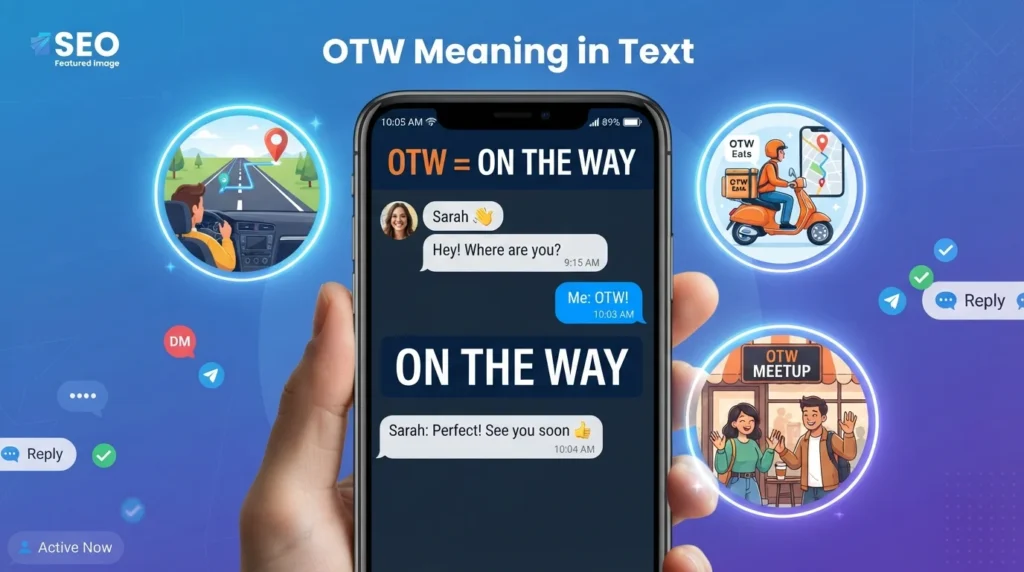
If someone sends you a message that simply says “OTW”, the meaning is usually much simpler than it looks. In texting and online conversations, OTW most commonly means “On The Way.” It tells someone that a person or thing is heading toward a destination or is expected to arrive soon.
You may see it in WhatsApp messages, Instagram DMs, Snapchat chats, TikTok comments, group conversations, and ordinary text messages. For example, if a friend asks, “Where are you?” and you reply, “OTW,” you mean, “I’m on the way.”
However, there is a small detail worth knowing: OTW does not necessarily mean “almost there.” Someone could be five minutes away, or they could have just started traveling. Context matters.
This guide explains the OTW meaning in text, its background, emotional tone, common uses, differences from similar abbreviations, and the best ways to respond.
OTW Meaning in Text – Quick Meaning
OTW = On The Way
It is an informal texting abbreviation used to communicate that someone or something is moving toward a destination or is expected soon.
In simple terms:
- OTW means “On The Way.”
- It usually indicates movement or progress.
- It can refer to a person, food, package, document, or another thing.
- It is common in casual texts, chats, and social media.
- It does not automatically mean the person is almost there.
For example:
“OTW, see you soon.”
This means the person is heading toward the meeting place.
“Food is OTW.”
This means the food is coming or has been sent.
“I’m OTW to the office.”
This means the sender is traveling to the office.
The abbreviation is popular because it communicates a complete idea with only three letters. Similar texting references consistently identify “On The Way” as the primary meaning of OTW.
See Also: What Does WS Mean in Text? Meaning, Uses, Examples & More
Where Did OTW Come From?
OTW belongs to the broader world of digital shorthand that developed alongside SMS texting, online chat, instant messaging, and social media.
When texting became a major part of everyday communication, people naturally started shortening familiar expressions. Writing “on the way” takes more space than simply typing “OTW.”
The abbreviation also fits the practical nature of texting. If someone is getting into a car, walking to a meeting, or rushing to meet friends, they may want to send a quick update rather than type a complete sentence.
Over time, this kind of shorthand moved beyond traditional SMS. It became familiar across messaging apps and social platforms.
Today, OTW can appear in everything from a WhatsApp group chat to an Instagram DM. It can even describe things other than physical travel, such as food, packages, content, or an upcoming task.
There are also less common interpretations of OTW, including “off to work” and “off the wall.” These meanings depend heavily on context, so “on the way” remains the safest interpretation in ordinary texting.
Real-Life Conversations Using OTW
The easiest way to understand texting abbreviations is to see them in natural conversations.
WhatsApp Conversation
Person A:
Are you coming? Everyone is waiting 😂
Person B:
OTW. Give me 15 mins.
Here, OTW means “on the way.” Person B has started traveling toward the location.
Instagram DM
Person A:
Did you order the shoes?
Person B:
Yep. They’re OTW 📦
In this case, OTW describes a package rather than the sender.
TikTok Comments
Person A:
When the new episode drops?
Person B:
OTW 😭🔥
Here, the meaning is slightly more figurative. The commenter is saying that something is coming soon.
Text Message
Person A:
Where are you? The movie starts in 20 minutes.
Person B:
OTW! Parking was cra*y.
This use is extremely common because OTW quickly reassures the other person that the sender is actually heading there.
Notice something important: OTW itself does not tell you how far away someone is. If timing matters, a clearer message would be “OTW, about 10 minutes away.”
Emotional & Psychological Meaning of OTW
At first glance, OTW seems completely neutral. But in real conversations, the abbreviation can carry a subtle emotional message.
When someone says “OTW,” they are often providing reassurance.
Imagine waiting outside a restaurant for a friend who is late. You text:
“Where are you?”
They respond:
“OTW.”
Those three letters can immediately reduce uncertainty. You now know they are coming rather than wondering whether they forgot the plan.
That is one reason short status updates are so useful in modern communication. People often want certainty without a long explanation.
OTW can also communicate urgency:
“OTW!!!”
The extra punctuation may suggest excitement, panic, or that the person is rushing.
Meanwhile:
“otw lol”
feels much more relaxed.
The letters stay the same, but the surrounding language changes the emotional tone.
A simple real-life scenario makes this clear. If I were meeting a friend and received “OTW, five mins,” I would understand that the person is already moving and has given me a useful time estimate. If I received only “OTW,” I would know they were coming but would still need more information if I were in a hurry.
That is the deeper lesson behind abbreviations: brevity is useful, but context carries the emotion.
See Also: What Does RS Mean in Text? Meaning, Uses, Examples & More
How OTW Is Used in Different Contexts
OTW on Social Media
On social media, OTW often means that something is coming soon.
For example:
- “New photos OTW.”
- “New video OTW.”
- “Big announcement OTW.”
- “Vacation OTW!”
In these cases, the phrase doesn’t necessarily describe physical movement. It can mean “coming soon” or “in progress.”
OTW Between Friends
Friends commonly use OTW when making plans.
“OTW to your house.”
“OTW, save me a seat.”
“Just left. OTW.”
The tone is casual and direct.
OTW in Relationships
Partners may also use OTW when meeting each other.
“OTW babe ❤️”
“I’m OTW. See you soon.”
It can feel warm and reassuring because it confirms that the person is actually coming.
OTW at Work
OTW can appear in casual workplace messaging, especially when colleagues already communicate informally.
For example:
“OTW to the meeting room.”
However, it is better to avoid abbreviations like OTW in formal emails, official documents, client communication, or important professional messages.
Instead of:
“OTW to your office.”
A formal message could say:
“I’m on my way to your office.”
Clarity matters more than saving three keystrokes in professional communication.
Casual vs. Serious Tone
OTW is naturally informal.
It works well with friends, family, online communities, and casual group chats. In serious or formal communication, spelling out “on the way” is safer.
When Not to Use OTW
Although OTW is harmless in most casual situations, there are times when it can create confusion.
Avoid It in Formal Writing
Do not normally use OTW in:
- Academic assignments
- Formal reports
- Official letters
- Business proposals
- Legal documents
- Formal client emails
The full phrase is clearer and more professional.
Avoid Ambiguity
Suppose someone asks:
“Are you five minutes away?”
Replying “OTW” does not answer the actual question.
You could be two minutes away or 45 minutes away.
A better response is:
“OTW, about 10 minutes away.”
Be Careful With Unfamiliar People
Not everyone understands internet shorthand.
If you’re communicating with an older relative, new client, teacher, or someone who rarely uses texting abbreviations, writing “I’m on the way” avoids unnecessary confusion.
Don’t Assume It Means “Almost There”
This is probably the most common misunderstanding.
OTW means someone or something is on the way. It does not guarantee immediate arrival.
If someone says “OTW” while still getting ready, the message may be technically vague. That is why a time estimate is useful when plans are time-sensitive.
Common Misunderstandings About OTW
Does OTW Mean “Almost There”?
Not necessarily.
OTW means “on the way,” but it does not specify distance.
“OTW, just leaving now.”
means the person has probably just started.
“OTW, two minutes away.”
means they are nearly there.
Is OTW the Same as OMW?
They are very similar, but not identical.
OMW means “On My Way.”
OTW means “On The Way.”
OMW is specifically about the sender’s own movement, while OTW can describe a person or thing.
For example:
“OMW to your house.”
“The pizza is OTW.”
Both are natural, but they have slightly different uses.
Does OTW Mean “Off to Work”?
Sometimes, yes.
Some texting references list “off to work” as another interpretation of OTW. However, this is much more context-dependent than “on the way.”
If someone texts:
“OTW, see you after work.”
you might need the surrounding conversation to determine exactly what they mean.
Can OTW Mean Something Is Coming?
Yes.
For example:
“Your package is OTW.”
means the package is coming.
Likewise:
“New merch OTW.”
can mean new merchandise is coming soon.
OTW vs. Similar Texting Terms
| Term | Meaning in Text | Typical Intent | Example |
|---|---|---|---|
| OTW | On The Way | Someone or something is coming | “OTW to your place.” |
| OMW | On My Way | The sender is traveling | “OMW now.” |
| ETA | Estimated Time of Arrival | Asking or giving arrival time | “ETA 10 mins?” |
| BRB | Be Right Back | Temporarily leaving | “BRB, grabbing coffee.” |
| AFK | Away From Keyboard | Temporarily unavailable | “AFK for 20 mins.” |
| BTW | By The Way | Introducing another point | “BTW, are you coming?” |
| LMK | Let Me Know | Requesting information | “LMK when you’re OTW.” |
Key Insight
The closest match to OTW is OMW, but OTW has a broader meaning. OMW specifically highlights the sender’s movement, while OTW can describe a person, object, delivery, or even something that is coming soon.
OTW Variations and Common Forms
There is no need to treat every variation as a separate slang word. Most are simply different ways people use the same abbreviation.
1. OTW Meaning
OTW meaning: On The Way.
It is the standard interpretation in casual texting.
2. OTW in Text
OTW in text: A quick update that someone or something is coming or moving toward a destination.
Example: “I’m OTW.”
3. OTW Abbreviation
OTW abbreviation: A shortened form of “on the way.”
It saves typing and keeps messages brief.
4. OTW Slang
OTW slang: Informal digital shorthand for “on the way.”
It is common in casual online communication.
5. OTW in Chat
OTW in chat: Usually means that the sender is traveling somewhere.
Example: “OTW, see you soon.”
6. OTW Home
OTW home: On the way home.
Example: “Leaving now, OTW home.”
7. OTW to Work
OTW to work: Traveling toward the workplace.
Example: “OTW to work. Call you later.”
8. OTW to You
OTW to you: Heading toward the person receiving the message.
Example: “OTW to you now.”
9. Food OTW
Food OTW: Food has been ordered, prepared, delivered, or is coming.
Example: “Don’t worry, food OTW.”
10. Package OTW
Package OTW: A package is currently being delivered or is expected soon.
Example: “Your birthday gift is OTW!”
How to Respond When Someone Says OTW
Your response depends on the relationship and situation.
Casual Replies
- “Okay, see you soon!”
- “Perfect.”
- “Cool, drive safe.”
- “Alright, I’ll wait.”
- “See you in a bit.”
Funny Replies
If you’re close friends, you can play with the abbreviation:
- “OTW as in actually OTW? 😂”
- “Define ‘OTW’ because you said that 30 minutes ago 😂”
- “Finally! 😭”
- “I’ll believe it when I see you 😂”
Mature Replies
If the timing matters:
- “Thanks for the update. What’s your ETA?”
- “No problem. Let me know when you’re close.”
- “Got it. I’ll be ready when you arrive.”
Respectful Replies
For someone you don’t know very well:
- “Thanks for letting me know.”
- “Okay, see you soon.”
- “Understood. Please travel safely.”
The best response often depends less on the abbreviation itself and more on the relationship between the two people.
Regional & Cultural Usage
OTW has become fairly recognizable across online communication, but people’s comfort with abbreviations varies by culture, age, and digital habits.
Western Culture
In the United States, Canada, the UK, Australia, and other English-speaking environments, OTW can appear naturally in casual texts and group chats.
It is especially useful for coordinating transportation, social plans, meals, and meetups.
Asian Culture
English-based texting abbreviations are widely used across many Asian online communities, particularly among people who communicate regularly in English.
However, usage varies significantly by country and language background. A person may understand OTW perfectly online while still preferring complete English sentences in formal situations.
Middle Eastern Culture
Among English-speaking internet users in Middle Eastern communities, OTW may appear in casual WhatsApp conversations, social media messages, and mixed-language chats.
The abbreviation generally keeps its basic meaning: on the way.
Global Internet Usage
One reason OTW travels so easily across borders is that it is based on an extremely common English phrase.
The abbreviation does not require much cultural explanation when the conversation is already happening in English.
Gen Z vs. Millennials
Younger users often communicate with a mixture of abbreviations, emojis, lowercase writing, memes, and context-dependent slang.
Millennials who grew up with SMS and instant messaging may also recognize OTW immediately.
The bigger difference is often personal texting style, not age. Some people love abbreviations; others prefer complete sentences regardless of generation.
Is OTW Safe for Kids?
Yes. OTW is generally harmless and not inherently inappropriate for children.
Its standard meaning is simply “on the way.” It can be used in ordinary conversations about school, friends, family, sports, transportation, food, or activities.
For example:
“OTW home.”
is completely ordinary.
Parents should still consider the context of the conversation, because almost any abbreviation can have different meanings in different communities. But OTW itself is not generally considered an adult or offensive expression.
FAQs
What does OTW mean in text?
OTW usually means “on the way.” It tells someone that a person or thing is heading toward a destination or is expected to arrive soon.
What does OTW mean on Instagram?
On Instagram, OTW usually means “on the way.” Depending on the context, it can describe someone traveling or something that is coming soon.
What does OTW mean on WhatsApp?
On WhatsApp, OTW commonly means “on the way.” For example, “OTW to your house” means “I’m on the way to your house.”
Is OTW the same as OMW?
Not exactly. OTW means “on the way,” while OMW means “on my way.” They are often interchangeable when someone is traveling, but OMW specifically refers to the sender.
Does OTW mean almost there?
No. OTW only indicates that someone or something is on the way. It does not tell you how close they are. For an exact update, ask for an ETA.
Can OTW refer to a package?
Yes. “Package OTW” means the package is coming or is in transit. The exact delivery status depends on the context.
Is OTW appropriate for professional communication?
It can be acceptable in casual workplace chats where abbreviations are normal. For formal emails, reports, and client communication, “on the way” is clearer and more professional.
Conclusion
The OTW meaning in text is straightforward: “on the way.” It is a quick, informal way to tell someone that a person or thing is heading somewhere or is expected soon.
Its usefulness comes from simplicity. Instead of typing “I’m on my way,” someone can write three letters and communicate the same basic idea.
Still, don’t assume OTW means “almost there.” If timing matters, add an estimate such as “OTW, 10 minutes away.” That small detail can prevent misunderstandings.
Whether you see OTW in a WhatsApp message, Instagram DM, TikTok comment, or ordinary text, the surrounding conversation usually gives you the answer. Once you understand the context, this little abbreviation becomes one of those simple pieces of digital language that hardly needs explanation.