Have you ever received a message ending with “JP” and wondered whether the person was serious, joking, or referring to something completely different?
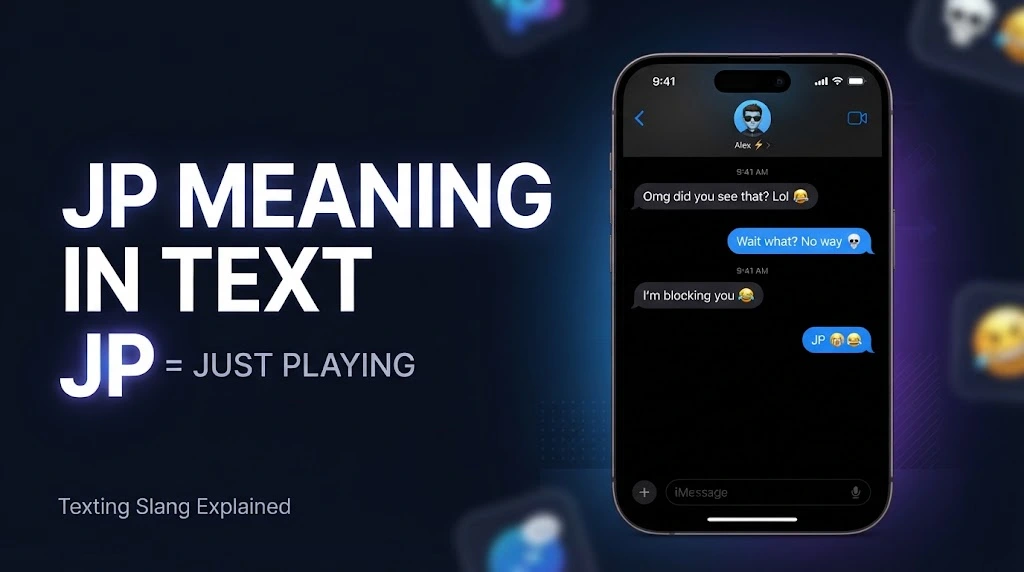
In casual texting and social media conversations, JP most commonly means “Just Playing.” It tells the other person that a previous statement was meant as a joke, tease, or playful comment rather than a serious claim.
For example, someone might text, “I’m never talking to you again, JP 😂.” The first part sounds dramatic, but “JP” immediately changes the tone. It basically says, “Relax, I’m only joking.”
However, JP does not have only one meaning. Depending on the conversation, it can refer to Japan, someone’s initials, a professional term, or another context-specific phrase.
So, if you’re asking “What is JP mean in text?”, the simplest answer is: JP usually means “Just Playing,” but context determines the exact meaning.
JP Meaning in Text – Quick Meaning
In everyday chats, JP = Just Playing.
It is an informal abbreviation used after a playful, exaggerated, sarcastic, or teasing statement.
Think of it as a softer, less formal cousin of “just kidding.”
Common uses include:
- JP = Just Playing
- Used to show that a statement isn’t serious
- Often used after teasing someone
- Common in casual texts and social media
- Sometimes paired with emojis such as 😂, 😭, 😜, or 😅
Simple examples
“You really thought I forgot your birthday. JP 😂”
“I’m blocking you right now. JP 😭”
“That was the worst outfit ever… JP 😭😂”
In each example, JP tells the reader not to take the previous statement literally.
One important point is that JP is less universally recognized than abbreviations such as LOL or JK, so context matters. Recent explanations of the term consistently identify “Just Playing” as its most common casual-text meaning.
Origin & Background of JP
There isn’t a single well-documented moment when JP was officially created. Like many internet abbreviations, it developed within a broader culture of shortening expressions for faster digital communication.
Early texting and online chat encouraged people to communicate with fewer characters. Abbreviations such as LOL, BRB, JK, and similar expressions became part of everyday online language.
JP fits naturally into that pattern. Instead of typing “I’m just playing” after a joke, a person can simply add two letters.
The phrase became especially useful in situations where written communication lacked facial expressions and vocal tone. A sarcastic sentence can look surprisingly serious when the reader cannot hear your voice.
Social media made this even more important. Short comments, disappearing messages, gaming chats, and fast-moving group conversations all reward concise expressions.
Today, JP still appears in casual chats, social media comments, gaming communities, and conversations between friends. However, it is not as universal as some older texting abbreviations, so unfamiliar readers may need the surrounding context to understand it.
See Also: What Does FR Mean in Text? Meaning, Uses, Replies & Examples
JP in Real-Life Conversations
The easiest way to understand JP meaning in text is to see how it works naturally in conversations.
WhatsApp Conversation
Person A:
You didn’t save me any pizza? I’m unfriending you 😭
Person B:
Bro I ate one slice 😂
Person A:
JP 😂 You know I’m not actually mad.
Here, JP turns what initially sounds like genuine annoyance into friendly teasing.
Instagram DM
Person A:
You looked terrible in that picture 😭
Person B:
EXCUSE ME??
Person A:
JP 😭😂 You actually looked amazing.
The second message clarifies that the first comment was playful rather than insulting.
TikTok Comments
Person A:
Bro really thought he was going to win 💀
Person B:
I did win though 😭
Person A:
JP 😂 you actually killed it.
On social platforms, JP can help soften teasing that might otherwise sound unnecessarily harsh.
Text Message
Person A:
I’m telling Mom you broke the lamp.
Person B:
WAIT WHAT 😭
Person A:
JP 😂 I’ll take the blame.
The abbreviation works almost like a quick signal saying, “Don’t panic. I’m joking.”
Emotional & Psychological Meaning of JP
The interesting thing about JP isn’t just what the letters stand for. It’s what the abbreviation does emotionally.
When someone writes something that could be interpreted as serious, JP provides a quick change in emotional direction.
For example:
“I hate you. JP 😂”
Without context, “I hate you” sounds aggressive.
With JP and a laughing emoji, it becomes playful teasing.
This is especially useful because digital communication removes many natural signals. In face-to-face conversation, you can recognize a joke from someone’s smile, voice, facial expression, or body language.
Text removes most of those clues.
JP helps restore some of that missing context.
It can also reduce social tension. If a friend makes a dramatic statement and immediately follows it with JP, they’re essentially telling you, “I’m comfortable joking with you, but I don’t want you to misunderstand me.”
In everyday communication, I’ve found that the best way to interpret abbreviations like JP is to look at the relationship and the sentence around them, rather than treating the abbreviation as an isolated code.
A close friend saying “You’re impossible, JP 😂” is very different from a stranger sending “You’re impossible” without any context.
JP Usage in Different Contexts
JP on Social Media
On Instagram, TikTok, Snapchat, and similar platforms, JP can be used after a sarcastic or exaggerated statement.
For example:
“This is officially the worst song ever. JP 😂”
The person may actually like the song.
Because comments are short, an abbreviation can quickly signal playful intent.
JP Between Friends
Friends are probably the most natural audience for JP.
It can appear after:
- Friendly insults
- Exaggerated threats
- Sarcastic comments
- Playful complaints
- Fake arguments
- Jokes
For example:
“I’m never helping you again. JP 😭”
JP in Relationships
Partners may use JP when teasing each other, especially when both people already understand each other’s humor.
For example:
“You ate my fries. We’re breaking up. JP 😂”
However, relationship context matters. A joke about a sensitive subject may still hurt someone even if you add JP afterward.
JP at Work
This is where caution becomes important.
JP is informal slang. It may be fine in a relaxed team chat where everyone communicates casually, but it isn’t ideal for formal emails, client communication, job applications, reports, or serious workplace discussions.
Instead of:
“I’m quitting tomorrow. JP 😂”
a professional message should communicate the intended meaning directly.
When NOT to Use JP
Although JP is harmless in many casual situations, it isn’t appropriate everywhere.
Avoid using it when:
1. The subject is genuinely serious
If you’re discussing an emergency, financial issue, legal matter, workplace problem, or serious personal concern, adding JP can create confusion.
2. You’re speaking to someone who may not understand slang
Not everyone knows modern texting abbreviations.
A simple phrase such as “I’m joking” can be much clearer.
3. You’re making a hurtful comment
Adding “JP” doesn’t automatically erase the impact of an insulting statement.
For example:
“You’re so stupid. JP.”
That may still hurt.
4. You’re communicating professionally
Clients, employers, teachers, senior colleagues, and unfamiliar professional contacts may not understand what you mean.
5. The joke depends on cultural context
Humor doesn’t translate perfectly between cultures. Something playful to one person may sound disrespectful to another.
When there’s doubt, clarity is usually better than cleverness.
Common Misunderstandings About JP
JP Doesn’t Always Mean Just Playing
This is the biggest mistake people make.
In casual texting, “Just Playing” is usually the intended meaning, but JP can represent other things in different settings. For example, JP may refer to Japan, someone’s initials, or professional terminology.
JP Isn’t Exactly the Same as JK
JP and JK can both communicate that something isn’t serious.
However:
- JP = Just Playing
- JK = Just Kidding
They can often be used in similar situations, but they aren’t literally the same phrase.
Context Changes Everything
Consider this:
“I finally got my JP visa.”
Here, JP probably isn’t “Just Playing.”
Now consider:
“I hate your new haircut. JP 😂”
Here, “Just Playing” makes much more sense.
The words surrounding the abbreviation provide the clue.
JP Meaning Compared With Similar Terms
| Term | Meaning in Text | Main Intent | Typical Use |
|---|---|---|---|
| JP | Just Playing | Shows you’re joking or teasing | Casual chats |
| JK | Just Kidding | Shows a previous statement wasn’t serious | Texting and social media |
| LOL | Laugh Out Loud | Shows amusement | General online communication |
| LMAO | Laughing My Ass Off | Stronger expression of amusement | Casual conversations |
| FR | For Real | Shows seriousness or agreement | Texts and social media |
| NGL | Not Gonna Lie | Introduces an honest opinion | Casual online talk |
| J/K | Just Kidding | Clarifies a joke | Texting and older internet slang |
Key Insight
JP is mainly a tone marker. Its purpose isn’t to introduce new information; it tells the reader how to interpret what was just said. That’s why it is especially useful after teasing, sarcasm, or exaggerated comments.
Variations and Related JP Expressions
Because people use texting slang creatively, you may encounter several related forms and searches.
JP meaning
Meaning: Usually “Just Playing.”
It is the basic abbreviation used to signal playful intent.
JP in text
Meaning: “Just Playing” in a text-message context.
The surrounding sentence usually reveals whether the sender is joking.
JP in chat
Meaning: Usually a casual way to say the previous comment wasn’t serious.
It works best between people who already understand each other’s humor.
JP abbreviation
Meaning: A shortened form of “Just Playing.”
It saves typing while still communicating the speaker’s tone.
JP slang
Meaning: Informal internet shorthand for playful communication.
It belongs more naturally in casual digital conversations than formal writing.
JP in social media
Meaning: A way to soften teasing or sarcasm in comments and DMs.
An emoji often makes the intended tone even clearer.
JP 😂
Meaning: Usually “Just Playing” with an obvious humorous signal.
The laughing emoji makes it easier to recognize the joke.
JP 😭
Meaning: Usually playful exaggeration or joking frustration.
The crying emoji can make the statement feel dramatically funny rather than genuinely upset.
JP bro
Meaning: A casual way of telling a friend that the previous statement was only playful.
It is particularly natural in relaxed conversations and gaming communities.
JP vs JK
Meaning: Both can clarify that a statement wasn’t serious.
JP means “Just Playing,” while JK means “Just Kidding.”
How to Respond When Someone Uses JP
Your response depends on the relationship and the tone of the conversation.
Casual Replies
- “Lmao I knew you were joking 😂”
- “Bro, you almost got me 😭”
- “Haha okay 😂”
- “I figured!”
Funny Replies
- “Too late. I’m already offended 😭”
- “Nice save 😂”
- “You almost started a war.”
- “JP noted. You’re still suspicious 😂”
Mature Replies
- “Haha, I understand.”
- “Got you. I knew you were joking.”
- “No worries, I understood the tone.”
- “Fair enough.”
Respectful Replies
If you’re unsure what the person means:
“Do you mean you’re just playing?”
That’s completely acceptable. You don’t have to pretend you understand slang when you don’t.
Regional & Cultural Usage
JP is primarily an internet abbreviation, so its use crosses national boundaries. Still, the way people interpret it can differ.
Western Culture
In American, Canadian, British, and other Western online communities, JP may be understood as casual slang meaning “Just Playing,” particularly among people familiar with internet shorthand.
However, it isn’t universal.
Asian Culture
English-language internet slang is widely used across many Asian online communities, especially among younger users.
But JP can also create confusion because JP may refer to Japan in travel, gaming, anime, or international contexts.
For example:
“I’m playing on the JP server.”
Here, the context strongly suggests Japan rather than “Just Playing.”
Middle Eastern Culture
English abbreviations are common in many online conversations, especially among younger internet users who communicate across languages.
Still, slang familiarity varies from person to person. A bilingual speaker may understand JP immediately, while someone who primarily communicates in another language may not.
Global Internet Usage
The global internet has made slang increasingly cross-cultural.
A person in one country may use an abbreviation originally encountered from a different online community.
That doesn’t mean everyone interprets it identically.
Gen Z vs Millennials
Younger users are often comfortable decoding short, context-heavy expressions, but that doesn’t mean every Gen Z user knows JP.
Millennials who grew up with SMS, forums, MSN, AIM, or early social media may recognize many abbreviations immediately, while others may prefer clearer language.
The important lesson is simple: age can influence familiarity, but context matters more than age alone.
Is JP Safe for Kids?
In the sense of the phrase “Just Playing,” JP is generally harmless slang.
However, the safety of any message depends on the conversation surrounding it.
Parents and younger users should understand that abbreviations can sometimes hide different meanings. JP itself isn’t inherently inappropriate, but the sentence before it could contain teasing, bullying, sexual references, threats, or other inappropriate content.
For children, the best approach is to teach context awareness rather than memorizing every internet abbreviation.
If a child receives a message they don’t understand, asking a trusted adult is better than guessing.
FAQs
What does JP mean in text?
In most casual texting situations, JP means “Just Playing.” It tells someone that a previous comment was meant as a joke, tease, or playful statement.
Is JP the same as JK?
Not exactly. JP means “Just Playing,” while JK means “Just Kidding.” Both can be used to show that a previous statement wasn’t serious.
What does JP mean on social media?
On social media, JP usually means “Just Playing.” It is commonly added after teasing, sarcasm, or an exaggerated statement to make the intended tone clearer.
Does JP always mean Just Playing?
No. Context matters. JP can also refer to Japan, a person’s initials, or other terms in specialized conversations.
Can I use JP in a professional message?
It’s better to avoid it in formal or professional communication. Use clear language such as “I’m joking” or “I didn’t mean that seriously” when clarity matters.
What does JP 😂 mean?
“JP 😂” usually means “Just Playing” with a clearly humorous tone. The laughing emoji reinforces that the person is joking.
What should I do if I don’t understand JP?
Look at the surrounding message first. If the meaning is still unclear, simply ask, “What do you mean by JP?” It’s better to clarify than misunderstand the conversation.
Conclusion
So, what is JP mean in text? In most casual conversations, JP means “Just Playing.”
It’s a quick way to tell someone that a previous statement was playful rather than serious. You’ll most likely see it in texts, group chats, social media comments, DMs, gaming conversations, and friendly banter.
The key is not to memorize JP as having only one fixed meaning. Context always comes first. If someone says “I hate your new haircut, JP 😂,” the joke is obvious. If someone says “JP server,” the letters may have nothing to do with “Just Playing.”
That small difference is what makes modern digital language interesting. Two letters can carry a completely different message depending on the conversation.
When you’re confident about the context, JP is a simple, friendly way to keep casual conversations playful. When you’re not sure, clarity wins every time.