If someone suddenly texts you “FYTB?”, you might wonder whether they’re confused, annoyed, joking, or actually looking for an argument. That uncertainty is exactly why so many people search for what FYTB mean in text.
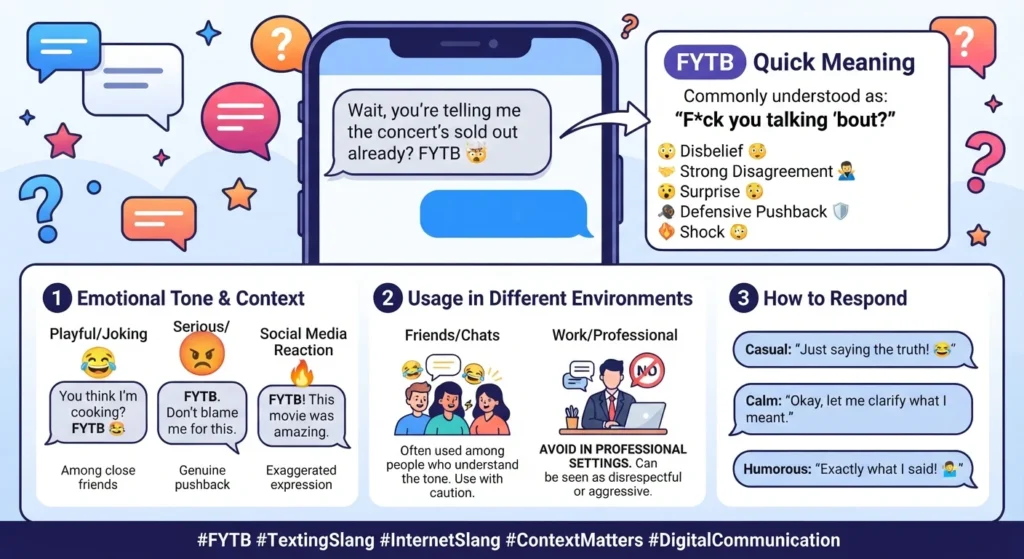
FYTB is a piece of modern texting slang used to express disbelief, disagreement, surprise, or defensive pushback. In most cases, it is understood as a shortened form of “F* you talking ’bout?”**, which is a more forceful version of “What are you talking about?”
However, the literal words don’t tell the whole story.
Among close friends, FYTB can be playful. In another conversation, the same three letters can sound rude or confrontational. Emojis, punctuation, relationship, and the situation all influence its meaning.
Understanding that emotional context is important. Text messages don’t carry facial expressions or voice tone, so a short slang expression can easily be misunderstood.
This guide explains the FYTB meaning in text, where the slang comes from, how people use it, what it says emotionally, when to avoid it, and how to respond when someone sends it to you.
FYTB – Quick Meaning
FYTB is a texting abbreviation commonly understood as:
“F* you talking ’bout?”**
In softer language, it essentially means:
- “What are you talking about?”
- “What do you mean?”
- “Are you serious?”
- “That doesn’t make sense.”
- “What are you saying?”
The FYTB slang meaning depends heavily on context.
It can communicate disbelief without necessarily expressing genuine anger. For example, a friend might say:
“You really think I’m paying for your dinner again? FYTB 😂”
Here, the emoji makes the message feel playful.
Another example is:
“They said the meeting is at 6 a.m. tomorrow.”
“FYTB??”
The speaker is probably expressing shock rather than attacking someone.
But consider:
“You never help anyone.”
“FYTB. I’ve been here all day.”
Here, FYTB sounds more defensive because the speaker feels accused.
So, when asking what does FYTB mean in texting, remember that its meaning is not simply a dictionary definition. Its emotional tone matters just as much.
Origin & Background
FYTB belongs to the wider world of internet slang and informal conversational language.
The expression is connected to the spoken phrase “what you talking about?”, which has long appeared in informal English and African American Vernacular English (AAVE). The abbreviated form adds profanity to make the reaction more forceful.
It is important to distinguish between the linguistic roots of the underlying phrase and the later internet abbreviation. FYTB is not simply a formal linguistic term shortened for convenience. It represents the way spoken expressions are transformed into quick digital reactions.
Social media helped accelerate this process.
Platforms such as TikTok, Instagram, Twitter/X, and messaging apps encourage people to communicate quickly. A short expression can carry an entire emotional reaction without requiring a complete sentence.
That is where slang like FYTB becomes useful.
Instead of typing, “I strongly disagree with what you just said because I think your claim is completely unreasonable,” someone can simply write:
“FYTB 😭”
The abbreviation communicates disbelief, attitude, and emotional energy almost instantly.
Meme culture has also changed how people interpret the phrase. Someone may use FYTB ironically, especially when reacting to an exaggerated statement or funny situation.
Its meaning has therefore expanded beyond serious confrontation. Today, FYTB can signal playful disbelief, sarcasm, defensive denial, annoyance, or genuine pushback.
See Also: What Does BDH Mean in Text? Meaning, Uses, Examples & More
Real-Life Conversations
The best way to understand FYTB in chat is to see how it works in realistic conversations.
Person A:
You still owe me pizza from last Friday.
Person B:
FYTB 😂 You were the one who ate mine!
Here, FYTB is clearly playful. Person B isn’t starting an argument. They’re jokingly rejecting the accusation.
Instagram DMs
Person A:
You’ve been ignoring me all day.
Person B:
FYTB 😭 I literally replied this morning.
The phrase expresses defensive disbelief. Person B feels that the accusation isn’t fair.
TikTok Comments
User 1:
That song is honestly terrible.
User 2:
FYTB 😭🔥 This song is amazing.
In this context, FYTB works as an exaggerated reaction. The user is disagreeing in a humorous social-media style.
Text Messages
Friend:
Bro, I thought you were scared to come.
You:
FYTB 😂 I’m already outside.
Again, the phrase isn’t necessarily hostile. The speaker is defending themselves while maintaining a casual tone.
These examples show why FYTB tone cannot be understood from the abbreviation alone. The surrounding conversation provides the emotional clues.
Emotional & Psychological Meaning
FYTB often appears when someone feels that another person’s statement doesn’t match reality.
The emotion may be disbelief.
The speaker hears something surprising and immediately rejects it.
It can also express defensiveness. If someone feels accused or misunderstood, FYTB gives them a quick way to push back.
Sometimes it communicates annoyance. The speaker may believe the other person is making an unreasonable claim.
In friendly conversations, however, it can simply be playful disbelief.
This makes FYTB an interesting example of modern digital communication. People often use short expressions to communicate emotional reactions rather than carefully constructed arguments.
A three-letter abbreviation can effectively mean, “I don’t agree with that at all.”
A personal-style example makes this easier to understand.
Imagine a friend says, “You never show up when we make plans.” If you know you’ve attended several recent gatherings, you might reply, “FYTB, I was literally there last weekend.”
You’re not necessarily angry. You’re defending yourself against something you believe is unfair.
That emotional distinction is what makes slang difficult to translate literally.
Usage in Different Contexts
Social Media
FYTB is common in informal social media environments, especially comments, memes, and reaction posts.
People may use it to challenge an opinion, joke about an exaggerated statement, or express disbelief.
For example:
“Pineapple doesn’t belong on pizza.”
“FYTB 😭”
The dramatic wording makes the response feel humorous rather than genuinely hostile.
See Also: Wa Mean in Text: Meaning, Slang, Examples, and Usage Guide
Friends & Relationships
Among close friends, FYTB may function as casual reaction slang.
People who understand each other’s communication style are more likely to recognize when the expression is joking.
For example:
“You don’t miss me.”
“FYTB, I talk to you every day.”
The phrase provides playful emotional pushback.
Still, relationships matter. What sounds funny between two close friends may sound disrespectful when sent to someone you barely know.
Work / Professional Settings
FYTB should generally be avoided in professional communication.
Even if you intend it as a joke, the implied profanity can make the message sound disrespectful, aggressive, or immature.
Instead of writing:
“FYTB, I already sent it.”
A professional alternative would be:
“I believe I already sent it. Let me check.”
The second version removes unnecessary tension while keeping the message clear.
Casual vs Serious Tone
The same FYTB abbreviation can have very different emotional meanings.
Casual:
“FYTB 😂 You know I wasn’t serious.”
Serious:
“FYTB. Don’t put that on me.”
The first sounds playful. The second sounds confrontational.
Emojis, capitalization, punctuation, and the relationship between the speakers all affect interpretation.
When NOT to Use It
Knowing when not to use FYTB is just as important as understanding its meaning.
Avoid it in professional emails, workplace chats, academic communication, customer-service conversations, and formal messages.
You should also be careful when communicating with elders, teachers, managers, clients, or people you don’t know well.
Cultural sensitivity matters too.
Someone unfamiliar with English-language internet slang may interpret FYTB literally and assume you’re being insulting.
It’s also a poor choice during serious disagreements.
If someone is already upset, responding with FYTB may increase tension rather than solve the problem.
In sensitive conversations, direct and respectful language is usually much safer.
Instead of:
“FYTB.”
Try:
“I think there may be a misunderstanding.”
The second response creates room for conversation instead of confrontation.
Common Misunderstandings
1. FYTB Always Means Anger
Not necessarily.
FYTB can express anger, but it can also show surprise, humor, disbelief, or playful disagreement.
2. FYTB Is Always a Personal Insult
The phrase contains profanity, but the person using it may not intend a literal insult.
Context determines whether it feels hostile or humorous.
3. The Literal Meaning Is Everything
Text slang rarely works that way.
The words provide the basic meaning, while emojis, punctuation, relationship, and context provide the emotional meaning.
4. FYTB and WYM Are Identical
They aren’t.
WYM means “what you mean?” and is generally much softer.
FYTB carries stronger emotional energy because of its profanity and confrontational wording.
5. FYTB and FTB Mean the Same Thing
They are different abbreviations.
This is an easy mistake to make because the letters look similar, but their meanings and uses can differ significantly.
Comparison Table
| Expression | Meaning in Text | Typical Tone | Strength |
|---|---|---|---|
| FYTB | What are you talking about? | Defensive, incredulous | Strong |
| WYM | What do you mean? | Neutral, curious | Mild |
| BRUH | Disbelief or surprise | Casual, humorous | Medium |
| You serious? | Are you serious? | Doubtful | Mild |
| That’s cap | That’s false or untrue | Playful accusation | Medium |
Key Insight
FYTB is stronger than ordinary questioning slang because it combines disbelief with emotional pushback and implied profanity. WYM usually asks for clarification, while FYTB often challenges what the other person has said.
Variations / Types
FYTB doesn’t always appear by itself. Small additions can change its tone.
1. FYTB??
FYTB meaning in text: Strong disbelief or shock.
Two question marks can make the reaction feel more dramatic.
2. FYTB Bro
FYTB slang: Friendly disbelief.
Adding “bro” can make the expression feel more conversational among friends.
3. FYTB 😂
FYTB in chat: Playful denial.
The laughing emoji often signals that the speaker isn’t genuinely angry.
4. FYTB Fr
FYTB abbreviation: Serious correction.
“Fr” means “for real” and can make the response sound more sincere or emphatic.
5. FYTB Man
FYTB meaning: Casual pushback.
“Man” gives the message a conversational quality but doesn’t necessarily remove its confrontational edge.
6. FYTB RN
FYTB in text: Immediate disbelief.
“RN” means “right now,” emphasizing an immediate emotional reaction.
7. FYTB, You Trippin
FYTB slang meaning: Strong rejection.
This combination tells someone that the speaker thinks their statement or behavior is unreasonable.
8. FYTB, Stop Playing
FYTB in chat: Playful or semi-serious disbelief.
It can suggest that the speaker thinks someone is joking or exaggerating.
9. FYTB, I Did That
FYTB meaning in texting: Defensive correction.
The speaker is rejecting someone’s claim and defending their own actions.
10. FYTB, I Said Yes
FYTB abbreviation: Direct correction.
This version is more assertive and can sound serious depending on the conversation.
How to Respond When Someone Uses It
Your response should depend on the person’s tone and your relationship with them.
Casual Replies
If the message seems playful, you can keep the response relaxed:
- “I’m just saying 😂”
- “You know what I meant.”
- “Relax lol.”
- “I was only joking.”
Funny Replies
If you want to match their humor:
- “Exactly what I said.”
- “Read it again slowly 😂.”
- “Don’t act brand new.”
- “You heard me.”
Mature Replies
If the conversation feels tense, lower the temperature:
- “I meant that you seemed busy.”
- “Maybe I misunderstood.”
- “Let me explain what I meant.”
- “I wasn’t trying to accuse you.”
Respectful Replies
When you’re speaking with someone you don’t know well:
- “Sorry if that sounded wrong.”
- “I wasn’t accusing you.”
- “I was just asking.”
- “I think there may have been a misunderstanding.”
The goal isn’t to mirror someone’s aggressive tone. Sometimes the best response is simply to clarify what you meant.
Regional & Cultural Usage
Western Culture
In Western online communication, FYTB is most likely to appear in informal youth slang, memes, social media comments, and conversations influenced by hip-hop and internet culture.
Among people familiar with the expression, it may be understood as humorous or exaggerated.
Asian Culture
FYTB isn’t traditionally native to many Asian English-speaking communities.
People may encounter it through TikTok, Instagram, gaming communities, movies, music, or other online spaces.
Because the implied profanity may be unfamiliar, it can sound harsher when interpreted literally.
Middle Eastern Culture
In Middle Eastern online communities where English is commonly used, FYTB may appear through global social media culture.
However, people from different linguistic and cultural backgrounds may interpret its profanity differently. What one person considers casual slang may sound openly disrespectful to another.
Global Internet Usage
The internet has made slang highly portable.
An expression can originate within one speech community and quickly become recognizable worldwide through memes, videos, music, and social platforms.
That doesn’t mean everyone shares the same understanding of its tone.
Generational Differences
Gen Z users may be more likely to recognize FYTB as playful reaction slang, particularly in meme-heavy environments.
Millennials may recognize it too but sometimes perceive it as more confrontational because of its literal wording.
Older generations may be even more likely to interpret it as rude or inappropriate.
These aren’t strict rules. Individual experience with internet culture matters more than age alone.
Is It Safe for Kids?
FYTB is not ideal for children or formal youth communication because it contains implied profanity.
A teenager may encounter it on TikTok, Instagram, gaming chats, or messaging platforms. Simply seeing the abbreviation doesn’t mean the child understands its emotional or cultural meaning.
The important lesson is context.
Young users should understand that slang appropriate among friends may not be appropriate when communicating with teachers, parents, employers, or unfamiliar adults.
Learning the meaning is useful, but learning when not to use it is even more important.
FAQs
What does FYTB mean in text?
FYTB usually means “F* you talking ’bout?”**, a slang expression meaning “What are you talking about?” It can express disbelief, disagreement, or defensiveness.
Is FYTB rude?
Yes, FYTB can be considered rude because it contains implied profanity. However, close friends may use it playfully depending on their relationship.
Is FYTB aggressive?
It can be aggressive, especially without emojis or friendly context. In casual conversations, it may simply express exaggerated disbelief.
What does FYTB mean on TikTok?
On TikTok, FYTB is often used as a reaction to something surprising, questionable, funny, or strongly disagreeable.
Is FYTB the same as WYM?
No. WYM means “what you mean?” and is generally more neutral. FYTB is stronger and carries more emotional and confrontational energy.
How do you respond to FYTB?
You can respond casually with “I’m just saying,” humorously with “Exactly what I said,” or maturely by explaining what you meant.
Should I use FYTB at work?
Generally, no. Because it contains implied profanity and can sound confrontational, it is better to use professional language in workplace communication.
Conclusion
Understanding what FYTB mean in text isn’t just about learning three letters.
It’s about understanding the emotion behind them.
FYTB usually communicates some version of “What are you talking about?”, but the emotional message can range from playful disbelief to serious defensive pushback.
A laughing emoji might turn it into a joke. A period might make it sound firm. A close friendship might make the phrase harmless, while the same words sent to a manager could create an uncomfortable situation.
That’s the real lesson with texting slang: meaning depends on context.
If someone sends you FYTB, look beyond the abbreviation. Consider what was said before it, who sent it, the punctuation, and the overall relationship.
And if you’re thinking about using FYTB yourself, save it for informal situations where you know the tone will be understood.
Knowing slang is useful. Knowing when to use it—and when to choose clearer, more respectful language—is what makes digital communication genuinely effective.