If someone sends you “Let’s talk FTF” in a message, would you know exactly what they mean?
Text abbreviations can sometimes feel like a language of their own. People shorten words to type faster, keep conversations casual, or fit their personality into a quick message. But the same abbreviation can leave you wondering what the sender actually intended.
So, what does FTF mean in text?
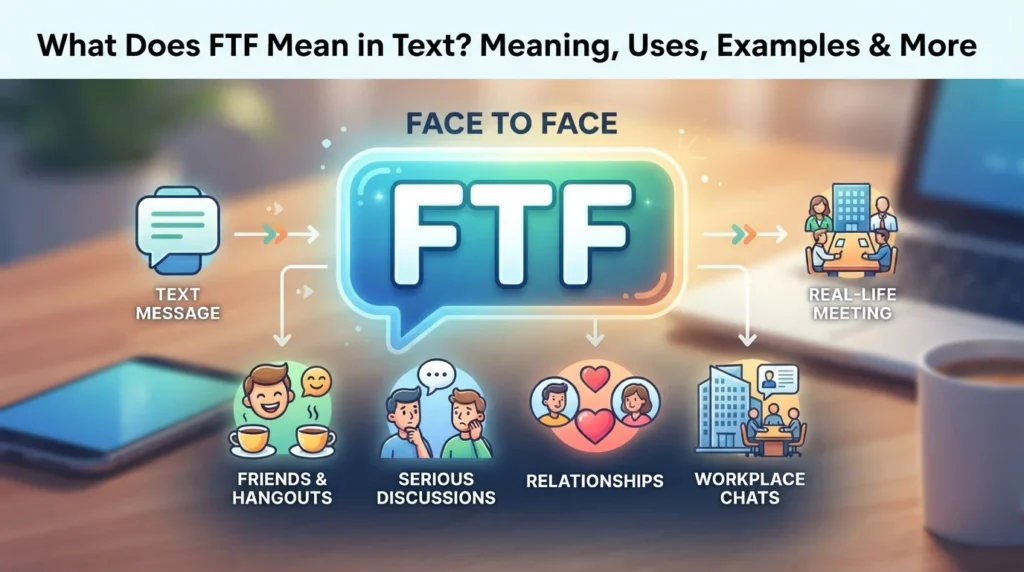
In most texting, social media, and messaging conversations, FTF means “face to face.” It usually refers to talking, meeting, or dealing with someone personally rather than through messages, phone calls, or video chats.
For example, if a friend says, “We need to discuss this FTF,” they probably mean, “We need to discuss this face to face.”
Understanding the abbreviation is easy. Understanding the tone behind it can be a little more interesting. Depending on the conversation, FTF can sound friendly, serious, personal, or even slightly confrontational.
Let’s look at what FTF really means and how people use it in everyday communication.
FTF Meaning in Text – Quick Meaning
FTF means “face to face” in text and online communication.
It describes an interaction where people communicate personally and directly, usually by meeting in person.
Here are the basic meanings:
- FTF = Face to face
- FTF meaning in text = Meeting or talking in person
- FTF in chat = An offline, personal conversation
- FTF abbreviation = Face to face
- FTF slang = A casual way to refer to an in-person meeting
Here are a few natural examples:
“Can we talk FTF tomorrow?”
“I’d rather explain it FTF.”
“We’ve been texting for weeks. We should meet FTF!”
The exact feeling depends on the situation. A friend may use FTF because they simply want to meet you, while someone discussing a serious issue may use it to emphasize that texting isn’t enough.
Origin & Background of FTF
The phrase “face to face” existed long before smartphones, social media, or texting abbreviations.
People have traditionally used it to describe direct, personal interaction between individuals. Over time, the phrase became common in workplaces, schools, relationships, and everyday conversation.
As digital communication became more popular, the distinction between online and in-person communication became more important.
People started talking about face-to-face meetings compared with phone calls, emails, instant messages, and video calls. Eventually, “face to face” was shortened to FTF in informal digital communication.
The abbreviation became especially useful in text messages, online forums, instant messaging, and social media.
It saves space and makes a message feel more casual.
Social media also changed how people think about personal interaction. Someone can now communicate with another person every day without ever physically meeting them.
That’s why FTF can carry a little more meaning than simply “meeting.”
When someone says, “Let’s talk FTF,” they may be emphasizing the value of seeing each other’s expressions, hearing the tone of voice, and having a more direct conversation.
In other words, FTF developed alongside a world where communication increasingly happens through screens.
See Also: What Does MKA Mean in Text? Meaning, Uses, and Examples
FTF in Real-Life Conversations
The easiest way to understand FTF meaning in chat is to see how people actually use it.
1. WhatsApp Conversation
Person A:
“Are you still upset about yesterday?”
Person B:
“Kind of. I don’t want to argue over WhatsApp.”
Person A:
“Fair. Can we talk FTF after work?”
Person B:
“Yeah, I think that’s better.”
Here, FTF suggests that the topic is emotional enough to deserve a personal conversation.
The sender isn’t necessarily angry. In fact, suggesting an FTF conversation can show that they care about resolving the issue properly.
2. Instagram DM
Person A:
“You seem really interesting from your posts 😂”
Person B:
“Haha thanks!”
Person A:
“We should grab coffee FTF sometime.”
Person B:
“Sure, why not?”
In this context, FTF simply means meeting in person.
The abbreviation keeps the message casual and avoids making the invitation sound overly formal.
3. TikTok Comments
Person A:
“You can’t convince me that story is true 😭”
Person B:
“Come debate me FTF 😂”
Here, FTF has a playful meaning.
The person isn’t necessarily demanding a serious meeting. They’re jokingly saying, “Come say that to my face.”
4. Text Message
Person A:
“I don’t think texting is helping us understand each other.”
Person B:
“I agree.”
Person A:
“Let’s meet FTF this weekend.”
Person B:
“Okay. Saturday?”
This is a more serious use.
The abbreviation emphasizes the difference between typing messages and having an actual conversation.
Emotional & Psychological Meaning of FTF
At first glance, FTF seems like nothing more than a convenient abbreviation.
But communication is rarely just about words.
When someone chooses FTF instead of texting, they may be looking for something digital communication cannot completely provide: human presence.
Face-to-face conversations allow people to notice facial expressions, pauses, body language, eye contact, and changes in tone.
These details can completely change how a message is understood.
For example, the text “Fine, whatever” can sound angry, sad, sarcastic, or genuinely relaxed depending on the situation.
In person, many of those emotional signals become easier to recognize.
That’s one reason people may suggest an FTF conversation when a topic feels important.
From a psychological perspective, an FTF conversation can also signal a desire for clarity, connection, accountability, or emotional honesty.
Imagine a friend sends you several long messages after an argument. Instead of continuing the discussion through your phone, they say, “Can we talk FTF?”
That doesn’t automatically mean something bad is coming.
It may simply mean they believe the relationship deserves a real conversation.
In my experience with everyday communication, one of the biggest problems with texting is that people often read emotion into words that wasn’t intended by the sender. FTF removes some of that uncertainty because communication becomes much more human and immediate.
Usage of FTF in Different Contexts
FTF on Social Media
On platforms such as Instagram, TikTok, Snapchat, and Facebook, FTF usually means face to face or in person.
Someone might say:
“DMs are cool, but I’d rather talk FTF.”
Or:
“We need to meet FTF soon!”
The tone is usually informal.
FTF Between Friends and Relationships
Friends commonly use FTF when they want to meet physically.
For example:
“Can we discuss this FTF?”
“We haven’t hung out FTF in months.”
“I want to tell you FTF.”
In relationships, the abbreviation can carry more emotional weight.
A person may prefer an FTF conversation when discussing feelings, disagreements, apologies, or important decisions.
FTF at Work
FTF can also appear in professional communication, particularly in informal workplace messages.
For example:
“Can we discuss the project FTF?”
However, be careful with workplace abbreviations.
If you’re writing a formal email, “face-to-face meeting” is usually clearer and more professional than simply writing FTF.
For internal chats with colleagues who regularly use abbreviations, FTF may be perfectly understandable.
Casual vs. Serious Tone
FTF itself isn’t inherently serious.
The surrounding words determine its tone.
“Let’s catch up FTF sometime!” sounds friendly.
“We need to discuss this FTF” sounds much more serious.
So, don’t judge the meaning of FTF without reading the whole conversation.
When NOT to Use FTF
Although FTF is common in casual communication, it isn’t suitable everywhere.
Avoid using it when your audience may not understand texting abbreviations.
For example, a formal business proposal, academic assignment, official letter, or important client communication isn’t the best place for unexplained slang.
Instead of:
“Let’s discuss this FTF.”
You could write:
“Let’s discuss this in a face-to-face meeting.”
Cultural sensitivity matters too.
If you’re suggesting an in-person meeting with someone you don’t know well, consider whether the situation is appropriate and comfortable for them.
An FTF invitation can feel more personal than a simple online conversation.
There’s also a safety consideration when meeting someone you’ve only known online. An abbreviation may sound casual, but an in-person meeting is still a real-world interaction that deserves appropriate boundaries.
Common Misunderstandings About FTF
One common mistake is assuming that FTF always means “meet me immediately.”
It doesn’t.
FTF simply refers to face-to-face interaction. The timing and seriousness depend on the context.
Another misunderstanding comes from tone.
If someone says:
“We should talk FTF.”
You might immediately assume they’re angry.
But they could simply dislike discussing complicated subjects over text.
Another issue is confusing FTF with other abbreviations.
Some people may encounter FTF in gaming, business, technology, or other specialized communities where it can have different meanings.
That’s why context is essential.
If you’re reading a normal text message about meeting or talking, “face to face” is usually the intended meaning.
FTF Meaning Compared With Related Terms
| Term / Search Intent | Meaning / Usage |
|---|---|
| FTF mean in text | Usually means “face to face,” referring to an in-person interaction. |
| How to use FTF | Use it casually when talking about meeting or communicating in person. |
| Examples of FTF | “Let’s talk FTF,” “We should meet FTF,” or “I’d rather explain it FTF.” |
| FTF vs face to face | FTF is simply the abbreviated form of “face to face.” |
| FTF vs IRL | FTF specifically emphasizes direct personal interaction; IRL means “in real life” and is broader. |
| FTF vs online | FTF happens physically in person, while online communication happens through digital platforms. |
Key Insight
FTF is simply a shorter way to say “face to face,” but the emotional meaning depends heavily on context. It can express friendship, connection, seriousness, or simply a preference for talking in person.
Variations and Related Forms of FTF
People may search for FTF in several different forms. These phrases usually point to the same basic meaning.
1. FTF Meaning
FTF meaning: Face to face.
It refers to direct personal interaction rather than communicating through a screen.
2. FTF Meaning in Text
FTF meaning in text: Meeting or talking with someone in person.
It commonly appears in informal texts and messages.
3. FTF Abbreviation
FTF abbreviation: Face to face.
It’s a shortened version of the full phrase.
4. FTF Slang
FTF slang: A casual reference to an in-person conversation or meeting.
It isn’t offensive slang; it’s simply informal internet language.
5. FTF in Chat
FTF in chat: Usually means that someone wants to communicate personally.
For example, “Can we discuss this FTF?”
6. FTF in a Text Message
FTF in a text message: A quick way to say “face to face.”
Friends often use it because it’s short and easy to understand.
7. Talk FTF
Talk FTF: Talk to someone personally rather than through texts or calls.
Example: “I’d rather talk FTF.”
8. Meet FTF
Meet FTF: Meet someone in person.
Example: “We should meet FTF sometime.”
9. FTF Conversation
FTF conversation: A conversation that takes place in person.
It’s often used when the subject is important or personal.
10. FTF Meeting
FTF meeting: A physical meeting where participants communicate directly.
It’s especially common when comparing in-person meetings with virtual meetings.
How to Respond When Someone Uses FTF
Your response should match the tone of the original message.
Casual Replies
If a friend says, “We should talk FTF,” you could reply:
- “Sure, when are you free?”
- “Yeah, sounds good!”
- “Absolutely. Coffee?”
- “Let’s do it.”
Funny Replies
If the conversation is playful:
- “FTF? So we’re going old school? 😂”
- “Okay, but I’m bringing evidence 😂”
- “Only if you promise not to win the argument 😭”
- “Fine, say it to my face 😂”
Mature Replies
For a serious conversation:
- “I agree. I think this would be better discussed in person.”
- “Sure. Let me know when you’re available.”
- “I’d rather have this conversation face to face too.”
Respectful Replies
If you’re uncomfortable meeting immediately:
- “I understand. I’d prefer to talk by phone first.”
- “I’d like to discuss it, but can we choose a time that works for both of us?”
- “I appreciate that. Let me think about the best way to discuss this.”
You don’t have to agree to an FTF meeting simply because someone asks.
Communication should work for both people.
Regional & Cultural Usage of FTF
FTF is widely understood across English-speaking internet communities, but communication habits can differ between cultures and generations.
Western Culture
In countries such as the United States, Canada, the United Kingdom, and Australia, FTF is commonly associated with informal digital communication.
People may use it when discussing meetings, friendships, dating, work, or disagreements.
Asian Culture
In many Asian online communities where English is widely used, FTF may appear in workplace chats, social media conversations, and international communication.
However, people may switch between English abbreviations and local-language expressions depending on who they’re talking to.
The meaning generally remains “face to face.”
Middle Eastern Culture
Among people who communicate in English online, FTF can similarly refer to an in-person meeting or discussion.
However, the appropriateness of an FTF invitation can depend more strongly on the relationship, setting, age, and cultural expectations involved.
That’s why context matters more than the abbreviation itself.
Global Internet Usage
The internet has made abbreviations like FTF increasingly international.
Someone in one country can easily understand an abbreviation used by someone thousands of miles away.
Still, not every abbreviation is universally understood.
When communicating with an international audience, spelling out “face to face” is often the safest option.
Gen Z vs. Millennials
Gen Z tends to use highly contextual and rapidly changing internet language. Millennials also use texting abbreviations but may be more familiar with traditional forms of digital shorthand.
Neither group has a completely fixed vocabulary.
The same person might write “FTF,” “in person,” or simply “IRL” depending on the platform and conversation.
Is FTF Safe for Kids?
Yes, FTF itself is a harmless abbreviation meaning “face to face.”
The important issue is the context surrounding it.
If a child receives a message from someone online asking to meet FTF, the abbreviation isn’t the problem. The proposed meeting is what requires attention.
Children should understand that online conversations don’t automatically mean they know the person in real life.
Parents and guardians can teach children to avoid meeting online contacts alone and to speak with a trusted adult about unexpected invitations.
So, FTF is safe as language, but an FTF meeting may require appropriate safety awareness.
FAQs About FTF Meaning in Text
What does FTF mean in text?
FTF usually means “face to face.” It refers to talking, meeting, or interacting with someone in person rather than through digital communication.
What does FTF mean in chat?
In chat, FTF generally means face to face. Someone may use it when suggesting an in-person meeting or conversation.
Is FTF slang?
FTF is informal internet shorthand rather than offensive slang. It is commonly used in texts, chats, and casual online conversations.
What does “talk FTF” mean?
“Talk FTF” means talk face to face, or have a conversation in person rather than through messages, email, or another digital channel.
What does “meet FTF” mean?
“Meet FTF” means meet in person. For example, “We should meet FTF soon” means the person wants to meet physically.
Is FTF the same as IRL?
Not exactly. FTF means face to face, while IRL means in real life. FTF specifically describes direct personal interaction, whereas IRL can describe anything happening outside the online world.
Can FTF have other meanings?
Yes. Abbreviations can have different meanings in specialized fields or communities. However, in ordinary texting and social media conversations, FTF most commonly means face to face.
Conclusion
So, what does FTF mean in text?
In everyday texting, FTF means “face to face.” It’s a simple abbreviation for talking or meeting with someone personally.
But the interesting part isn’t just the definition.
When someone chooses FTF, they may be saying more than “let’s meet.” They may want a clearer conversation, a stronger connection, or a chance to discuss something that doesn’t feel right over a screen.
That’s why context matters.
“Let’s hang out FTF” feels warm and casual. “We need to discuss this FTF” feels much more serious.
Once you understand that difference, FTF becomes easy to recognize and use.
And when you’re unsure whether someone will understand the abbreviation, there’s nothing wrong with simply writing “face to face.” Clear communication is always more important than saving a few characters.