
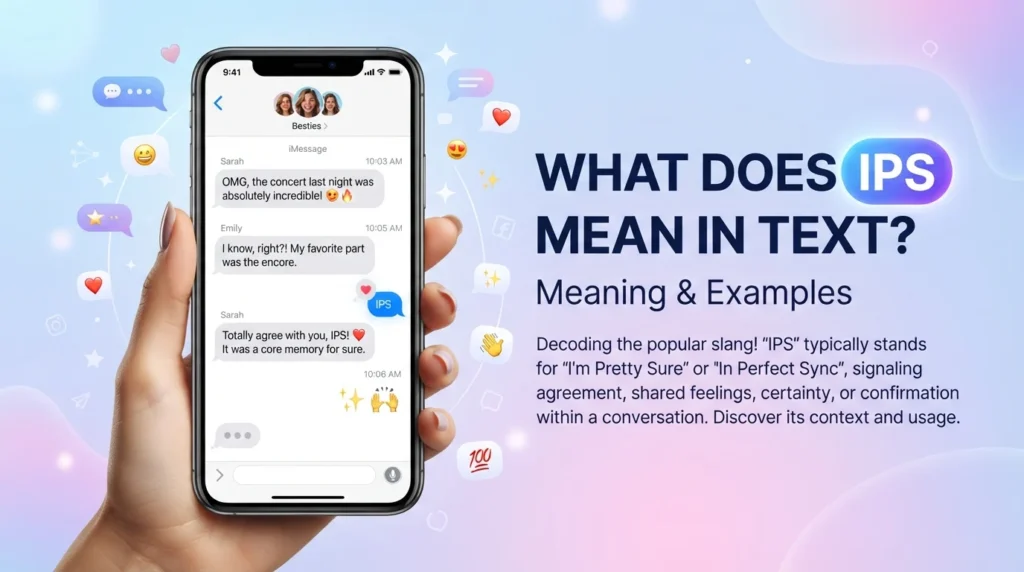
If you have received a message containing “IPS” and wondered what those three letters mean, you are not alone. Texting abbreviations can be confusing because the same short form may have completely different meanings depending on the conversation.
In casual online communication, IPS is commonly used to mean “In Personal Opinion,” expressing that the speaker is sharing their own viewpoint rather than stating an objective fact. Some sources also expand it as “In My Personal Opinion,” although that expansion is less consistent because the “M” is not represented in IPS.
The important thing is context. If someone says, “IPS, I think the movie was overrated,” they are essentially telling you, “That is just my personal view.”
However, IPS is not a universally standardized texting abbreviation like LOL, BTW, or IMO. It can also refer to technical or professional terms in other contexts. Therefore, the surrounding words are your best clue.
IPS Meaning in Text: Quick Meaning
In casual texting, IPS generally means “In Personal Opinion.” It is used to introduce or emphasize someone’s personal perspective.
You can think of it as a short way of saying:
- “This is my personal view.”
- “Personally, I think…”
- “That’s how I see it.”
- “This is only my opinion.”
For example:
“IPS, that restaurant is way too expensive.”
Or:
“IPS, I think you should go for the blue one.”
Another example:
“IPS, the old version was much better.”
The abbreviation makes the statement feel subjective rather than absolute.
One important distinction is worth remembering: IMO (“In My Opinion”) is much more established in everyday internet language than IPS. So if you see IPS, do not automatically assume it has the same meaning without considering the conversation.
Origin & Background of IPS
Unlike older abbreviations such as LOL and BRB, IPS does not have a clearly documented, universally accepted origin as a major piece of internet slang.
Its appearance fits into a broader digital communication habit: people shorten common phrases to type faster and make conversations more compact.
Online communication has encouraged users to turn longer expressions into abbreviations. Forums, instant messaging, social networks, gaming communities, and group chats all contributed to this style.
The idea behind IPS is particularly connected with the need to distinguish personal opinions from facts.
For example, saying:
“This is the best restaurant in town.”
sounds definite.
But:
“IPS, this is the best restaurant in town.”
signals that the speaker is giving a personal judgment.
Social media has made this distinction increasingly useful because people regularly discuss movies, celebrities, fashion, relationships, politics, food, music, and everyday experiences.
Still, IPS should not be treated as a universally recognized abbreviation. Its meaning can vary, and IPS also has established meanings outside texting, including technical and professional uses.
Real-Life Conversations Using IPS
The easiest way to understand an abbreviation is to see how it behaves in an actual conversation.
WhatsApp Conversation
Person A:
Do you think I should take the new job?
Person B:
IPS, I think you should. The salary and experience both look good.
Here, IPS tells the other person that the recommendation is a personal judgment rather than guaranteed advice.
Instagram DM
Person A:
Which picture should I post?
Person B:
IPS, definitely the second one. Your smile looks more natural there.
The abbreviation makes the recommendation feel personal and conversational.
TikTok Comments
User 1:
Am I the only one who thinks the original song was better?
User 2:
IPS, I actually prefer this version 😂
Here, IPS introduces a different opinion without making the disagreement sound aggressive.
Text Message
Person A:
Should I buy the black jacket or the brown one?
Person B:
IPS, black. It goes with almost everything.
The person is not claiming that black is objectively better. They are simply giving their preference.
Emotional & Psychological Meaning of IPS
When someone uses IPS to introduce an opinion, there is often a subtle emotional purpose behind it.
It can create a little space between what the person believes and what they expect everyone else to believe.
That distinction matters.
Imagine someone says:
“You should break up with him.”
That can sound forceful.
Now compare it with:
“IPS, I think you deserve someone who communicates better.”
The second statement still expresses a strong opinion, but it acknowledges that the decision ultimately belongs to the other person.
This is one reason opinion-based expressions can make digital conversations feel less confrontational.
Text messages lack many of the signals we naturally receive during face-to-face conversations, such as facial expressions, gestures, and vocal tone. Communication guidance from the CDC similarly notes that tone, humor, and sarcasm can be difficult to interpret through text.
A personal-style example would be a friend asking, “Do you think I handled that argument badly?”
Replying with:
“IPS, I think you could have explained yourself more calmly.”
sounds different from simply saying:
“You handled it badly.”
The first leaves room for another perspective.
IPS in Different Contexts
1. Social Media
IPS can be used when commenting on someone’s post, discussing a trend, or sharing an opinion about entertainment.
Example:
“IPS, this is the best outfit from the whole collection.”
It communicates personal preference rather than objective truth.
2. Friends and Relationships
Among friends, IPS can introduce advice without sounding overly controlling.
“IPS, you should probably talk to her directly.”
The speaker is offering an opinion, not giving an unquestionable instruction.
3. Work and Professional Settings
Be careful here.
IPS is not ideal for formal emails, reports, proposals, or official communication. Writing:
“IPS, I think this strategy needs work.”
can sound unnecessarily informal.
A professional alternative would be:
“In my view, this strategy could be improved.”
4. Casual vs. Serious Conversations
IPS works best in relaxed conversations where both people understand abbreviation-heavy language.
In serious conversations involving money, legal matters, health, conflict, or important decisions, spelling out your meaning is safer.
When NOT to Use IPS
Although the slang itself is harmless, there are situations where using it may create unnecessary confusion.
Avoid It in Formal Writing
School assignments, business reports, official letters, and formal emails generally benefit from standard language.
Avoid It When Clarity Is Critical
If someone needs precise instructions, abbreviations can create uncertainty.
Avoid Assuming Everyone Knows It
Older users, people from different language backgrounds, or people unfamiliar with internet slang may not recognize IPS.
Avoid Using It to Hide a Strong Judgment
Adding IPS does not automatically make a rude statement polite.
For example:
“IPS, you’re completely useless.”
is still insulting.
The abbreviation cannot replace respectful wording.
Common Misunderstandings About IPS
IPS Does Not Always Mean the Same Thing
This is the biggest point to remember.
IPS has numerous established meanings in technical, professional, medical, and other contexts. For example, abbreviation databases list meanings ranging from computing terms to other specialized expressions.
IPS Is Not Automatically the Same as IMO
IMO means “In My Opinion” and is much more familiar in internet communication.
IPS may be interpreted as “In Personal Opinion,” but it is not as standardized.
IPS Does Not Mean a Fact
When used as an opinion marker, IPS actually emphasizes subjectivity.
Context Determines the Meaning
If someone says:
“IPS, I would choose the blue dress.”
the conversational meaning is obvious.
But if someone says:
“The IPS display looks amazing.”
they are almost certainly talking about In-Plane Switching, a display technology, not texting slang.
IPS Comparison Table
| Term | Meaning in Text | How to Use It | Example | Compared With |
|---|---|---|---|---|
| IPS | In Personal Opinion | Introduce a personal viewpoint | “IPS, I prefer the first one.” | Less established than IMO |
| IMO | In My Opinion | Share a personal opinion | “IMO, that movie was better.” | More common than IPS |
| IMHO | In My Humble Opinion | Give an opinion with a softer tone | “IMHO, the old design was better.” | More self-effacing |
| TBH | To Be Honest | Introduce honesty or a candid thought | “TBH, I didn’t enjoy it.” | More emotional |
| FWIW | For What It’s Worth | Offer an opinion or information modestly | “FWIW, I’d wait.” | More tentative |
| FYI | For Your Information | Provide information | “FYI, the meeting moved.” | Informative, not opinion-based |
Key Insight
If IPS is being used as an opinion marker, its main purpose is to show personal perspective. However, IMO is generally the clearer and more widely recognized choice when you want to say “in my opinion.”
Variations and Related Forms
Because IPS is not a strongly standardized texting abbreviation, its variations are better understood as related expressions rather than official forms.
1. IPS Meaning
Meaning: In Personal Opinion.
Used to identify a statement as someone’s personal viewpoint.
2. IPS in Text
Meaning: A personal opinion marker in casual communication.
Its exact interpretation depends on surrounding context.
3. IPS Abbreviation
Meaning: A shortened form associated with personal opinion in some online usage.
It should not be treated as a universal abbreviation.
4. IPS Slang
Meaning: Informal internet usage for expressing a viewpoint.
It is more niche than common slang such as IMO.
5. IPS in Chat
Meaning: A way to frame an opinion during a conversation.
It can make a disagreement sound less absolute.
6. IMO
Meaning: In My Opinion.
This is the more established alternative when expressing a personal view.
7. IMHO
Meaning: In My Humble Opinion.
It can make an opinion sound more modest or playful.
8. FWIW
Meaning: For What It’s Worth.
Useful when offering advice without presenting it as absolute truth.
9. TBH
Meaning: To Be Honest.
Often introduces a candid, personal reaction.
10. Personally
Meaning: A fully spelled-out alternative to IPS.
It is clearer when the audience may not understand internet abbreviations.
How to Respond When Someone Uses IPS
Your response depends on the relationship and the subject.
Casual Replies
- “Yeah, I get what you mean.”
- “Fair enough!”
- “I can see that.”
- “Honestly, same.”
Funny Replies
- “Your IPS has been officially recorded 😂”
- “Okay, opinion noted!”
- “The court has heard your case 😂”
Mature Replies
- “I understand your perspective.”
- “That’s an interesting way to look at it.”
- “I appreciate you explaining your point.”
- “I can see why you feel that way.”
Respectful Replies
- “Thanks for sharing your perspective.”
- “I respect your opinion.”
- “That makes sense from your point of view.”
- “I may see it differently, but I understand what you mean.”
The best response is usually one that acknowledges the person’s viewpoint without creating unnecessary conflict.
Regional & Cultural Usage
Western Culture
In English-speaking Western online spaces, users are familiar with many opinion abbreviations, particularly IMO and IMHO. IPS may appear, but it is not as universally recognized.
Asian Culture
Younger internet users across Asian countries frequently combine English abbreviations with local languages and expressions. IPS may therefore appear in mixed-language chats, although its meaning should still be judged from context.
Middle Eastern Culture
English abbreviations are common in many online conversations, particularly among younger users. However, IPS may not be immediately understood by everyone, so spelling out the opinion can be clearer.
Global Internet Usage
Social media has created a shared digital vocabulary, but abbreviations do not spread evenly. A term that feels familiar in one online community can seem strange in another.
Gen Z vs. Millennials
Gen Z users are generally comfortable experimenting with abbreviations, irony, shortened words, and rapidly changing online expressions.
Millennials are also highly familiar with internet shorthand but may be more likely to use established abbreviations such as IMO, TBH, or IMHO.
The difference is not absolute. Online communities matter just as much as age.
Is IPS Safe for Kids?
Yes, IPS is generally harmless when it is being used to express a personal opinion.
There is no inherently offensive or adult meaning in the opinion-based interpretation.
The bigger lesson for younger users is context. Children should understand that abbreviations are appropriate for casual conversations but not necessarily for schoolwork, formal communication, or situations where clear language matters.
Parents and educators can also teach children that adding an abbreviation does not make an unkind message acceptable.
FAQs About IPS Meaning in Text
1. What does IPS mean in text?
IPS can mean “In Personal Opinion” in some casual online conversations, indicating that the speaker is sharing a personal viewpoint.
2. Is IPS the same as IMO?
Not exactly. IMO means “In My Opinion” and is much more established. IPS may be used with a similar intention, but it is less standardized.
3. What does IPS mean in chat?
In a chat where it is being used as slang, IPS can introduce a personal opinion, such as “IPS, I prefer the first option.”
4. Is IPS a common texting abbreviation?
It is relatively niche. Common alternatives such as IMO, IMHO, TBH, and FWIW are generally more recognizable.
5. Can IPS have another meaning?
Yes. IPS has many meanings outside texting, especially in technology and professional fields. Context is essential.
6. Is IPS appropriate for professional messages?
Usually, it is better to avoid it in formal professional communication. Write “In my view” or “In my opinion” instead.
7. Is IPS safe for kids?
Yes, when it means a personal opinion. It is a harmless abbreviation, although children should learn when informal slang is appropriate.
Conclusion
So, what does IPS mean in text?
In casual online usage, IPS can mean “In Personal Opinion,” signaling that someone is sharing a personal perspective rather than stating an unquestionable fact.
Its real value is not the three letters themselves. It is the little bit of context they can add to a message. An opinion becomes easier to recognize as an opinion, which can make disagreement feel less personal.
At the same time, IPS is not as standardized or widely recognized as IMO. If you are writing to someone who may not know the abbreviation, saying “in my opinion” is much clearer.
And that is the bigger lesson with texting slang: the letters matter, but the conversation around them matters even more. When you understand the context, tone, and relationship between the people talking, even unfamiliar abbreviations become much easier to interpret.




