
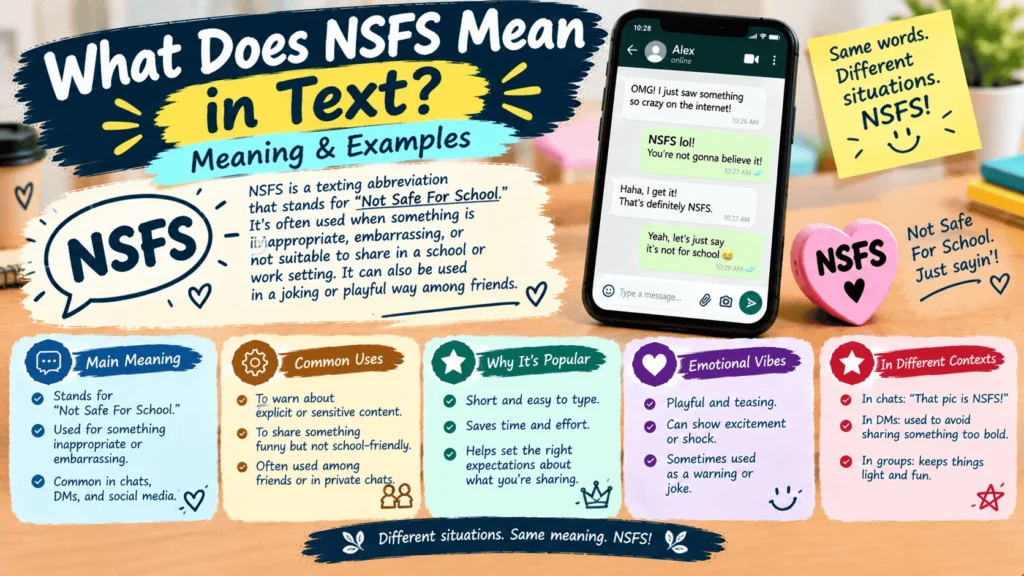
If you have seen “NSFS” in a text message, social media comment, or group chat, you may have wondered what those four letters actually mean. It is not one of the most universally recognized texting abbreviations, so the meaning can depend heavily on the conversation.
In internet slang, NSFS most commonly means “Not Safe for School.” It works much like NSFW, or “Not Safe for Work,” but shifts the setting from a workplace to a school environment. It is generally used as a warning that something may contain mature, inappropriate, embarrassing, vulgar, or otherwise unsuitable content for viewing at school.
People often search for NSFS meaning in text because abbreviations can be surprisingly difficult to interpret without context. A message such as “Don’t open that here, it’s NSFS” is not necessarily insulting or mysterious. The sender is usually telling you that whatever they are sharing may not be appropriate to view around teachers, classmates, or other people in a school setting.
There is another important point: NSFS is not as standardized as NSFW. Some online sources use NSFS for other phrases, including “Not Safe for Screens,” while slang dictionaries also record other niche expansions. So the surrounding conversation matters.
This guide explains the meaning, tone, origins, examples, cultural differences, related abbreviations, and the situations where using NSFS can create confusion.
NSFS Meaning in Text: Quick Meaning
NSFS usually means “Not Safe for School.”
It is an informal internet abbreviation used to warn someone that content may not be appropriate to view in a school environment.
In simple terms:
- NSFS = Not Safe for School
- It is usually a content warning.
- It can refer to mature, vulgar, suggestive, disturbing, or embarrassing material.
- It is closely related to NSFW, which means “Not Safe for Work.”
- It is informal and may not be understood by everyone.
The abbreviation is documented as internet and chat slang, particularly as a school-oriented variation of NSFW.
Here are a few natural examples:
“Don’t open that video in class. It’s NSFS.”
“I found the funniest NSFS meme 😂”
“Wait until you get home before watching that. NSFS.”
The tone can be serious, playful, or teasing depending on the material and the relationship between the people chatting.
Origin & Background of NSFS
The clearest way to understand NSFS is to look at NSFW, the much more established internet expression meaning “Not Safe for Work.” NSFW became a common warning for online material that might be inappropriate or uncomfortable to view in a professional or public environment.
NSFS follows the same basic pattern.
Instead of warning someone about their workplace, it warns about school.
This makes sense because students often communicate through phones, tablets, laptops, group chats, and social media while they are at school. Something that might be harmless at home could create an awkward situation if opened during class.
The expression has been documented in internet slang for many years. Slang references specifically describe NSFS as “Not Safe for School,” using it in much the same warning-label style as NSFW.
Its cultural influence comes from the broader internet habit of turning longer warnings into compact abbreviations. NSFW, NSFL, SFW, and similar expressions allow people to communicate a lot of information with only a few letters.
However, NSFS has never reached the same level of universal recognition as NSFW. That is why one person may immediately understand it while another may ask, “What does that mean?”
There is also a newer interpretation found online, “Not Safe for Screens,” which shifts the warning away from school and toward anything that should not be viewed openly on a screen. This demonstrates why context is especially important with NSFS.
NSFS in Real-Life Conversations
WhatsApp Conversation
Person A:
“Bro I found that video from last night 😂”
Person B:
“Send it.”
Person A:
“NSFS 💀”
Person B:
“I’m literally sitting in class.”
Person A:
“Exactly why I warned you.”
Here, NSFS means the video may be inappropriate or embarrassing to open at school.
Instagram DM
Person A:
“Did you see the picture she posted?”
Person B:
“No, what happened?”
Person A:
“I’ll send you the screenshot.”
Person B:
“Okay.”
Person A:
“NSFS though 😭”
The abbreviation creates a quick warning without explaining everything publicly.
TikTok Comments
User 1:
“The last five seconds caught me completely off guard.”
User 2:
“NSFS 😭”
User 3:
“Why did I watch this during lunch at school?”
In this situation, NSFS is being used humorously to describe content that might not be appropriate for school.
Text Message
Friend:
“I found your old school performance video.”
You:
“Please don’t send that.”
Friend:
“Too late 😂 NSFS.”
You:
“I hate you.”
Here, the warning may be less about adult material and more about embarrassment. The sender is joking about the social consequences of opening the video around other people.
Emotional & Psychological Meaning of NSFS
NSFS is technically a warning, but the emotion behind it can vary considerably.
Sometimes it communicates caution.
The sender genuinely wants the recipient to avoid opening something at school.
Sometimes it communicates humor.
Friends may label an embarrassing photograph or ridiculous video as NSFS simply because it would be awkward if classmates saw it.
Sometimes it creates curiosity.
Telling someone “That is NSFS” can make them even more interested in what is behind the warning.
This is a familiar psychological pattern in digital communication. A short warning can simultaneously protect someone and build suspense.
Imagine receiving a message from a close friend that says, “I found the old video. NSFS 😂.”
You probably understand two things immediately: the video should not be opened in a public setting, and the sender probably expects you to react emotionally.
That combination is one reason slang feels more expressive than formal language. The abbreviation does not merely deliver information. It also carries an attitude.
In modern texting, people frequently rely on shared context rather than complete sentences. NSFS is a good example of that compressed communication style.
NSFS Usage in Different Contexts
On Social Media
NSFS may appear in comments, captions, private messages, or group conversations.
Someone might write:
“The ending is NSFS 😂”
The exact reason could be sexual, vulgar, embarrassing, shocking, or simply unsuitable for a school environment.
Between Friends
Among friends, NSFS can be playful.
Someone might send an old photograph and write:
“NSFS throwback 😭”
The point may be embarrassment rather than genuinely inappropriate content.
In Relationships
Couples or close friends may use the expression when sharing private or suggestive material.
In this context, the warning is often about avoiding accidental exposure rather than criticizing the content itself.
At Work
NSFS is generally not appropriate for professional communication.
If you need to warn a colleague about sensitive material, a clearer phrase such as “sensitive content,” “confidential,” or “please review privately” is usually easier to understand.
Casual vs. Serious Tone
The same abbreviation can have very different emotional weight.
“NSFS 😂” may be a joke.
“Warning: NSFS” may be a genuine caution.
The content and surrounding language determine the tone.
When NOT to Use NSFS
NSFS is informal, so there are situations where spelling out the warning is much safer.
Avoid using it in formal school communication, official notices, academic assignments, professional emails, or serious reports.
You should also be careful when the material involves genuine trauma, violence, harassment, or disturbing real-world events. A playful abbreviation may make serious content sound trivial.
Another issue is audience familiarity.
If the recipient has never encountered NSFS before, they may not understand the warning at all.
This matters especially when the content could genuinely cause embarrassment or distress.
When clarity is important, simply saying “This may not be appropriate to open at school” is much more effective.
Common Misunderstandings About NSFS
1. NSFS Always Means Something Sexual
Not necessarily.
It can describe mature or suggestive material, but it can also refer to vulgar jokes, disturbing scenes, embarrassing photographs, or other content unsuitable for school.
2. NSFS and NSFW Are Exactly the Same
They are closely related, but the setting changes.
NSFW means “Not Safe for Work,” while NSFS is commonly used for “Not Safe for School.”
3. NSFS Has Only One Meaning
This is one of the biggest problems with the abbreviation.
Some online sources use NSFS for “Not Safe for Screens,” while other slang references record additional niche meanings.
4. Everyone Knows What It Means
No.
NSFS is considerably less established than NSFW, so the recipient may need clarification.
5. The “Safe” Part Means the Content Is Dangerous
No.
“Safe” refers to whether the content is appropriate to view in a particular environment. It does not necessarily mean that the material is physically dangerous.
NSFS vs. Other Related Terms
| Search Intent | Meaning | How It Is Used |
|---|---|---|
| NSFS meaning in text | Usually “Not Safe for School” | Warns that content may be inappropriate at school |
| How to use NSFS | Use it as an informal content warning | Add it before or alongside potentially unsuitable content |
| Examples of NSFS | “NSFS 😂” or “Don’t open this at school, NSFS” | Usually appears in casual chats and social media |
| NSFS vs NSFW | School vs. workplace warning | Both identify potentially inappropriate content |
| NSFS vs NSFL | School warning vs. extremely disturbing content | NSFL generally signals much more graphic or upsetting material |
| NSFS vs SFW | Not safe vs. safe for normal viewing | SFW indicates content is generally appropriate |
Key Insight: NSFS is best understood as a context-based warning, not a universal internet abbreviation. If you see it in a message, look at what is being shared and who is talking before deciding exactly what the sender means.
NSFS Variations and Related Types
Because NSFS belongs to a larger family of internet content-warning abbreviations, it is useful to know the related expressions.
1. NSFW Meaning in Text
NSFW = Not Safe for Work.
Used to warn that content may be inappropriate to open in a workplace or other formal environment.
2. NSFL Meaning in Text
NSFL = Not Safe for Life.
Usually signals extremely graphic, disturbing, or upsetting material and carries a stronger warning than ordinary NSFW.
3. SFW Meaning in Text
SFW = Safe for Work.
It indicates that content is generally appropriate to view in a workplace or public environment.
4. NSFP Meaning in Text
NSFP = Not Safe for Public.
This is a less standardized expression used to warn that something is better viewed privately.
5. NSFM Meaning in Text
NSFM = Not Safe for Mom.
An informal humorous variation suggesting that parents or family members should not see the content.
6. NSFD Meaning in Text
NSFD = Not Safe for Dad.
Another playful variation based on the same warning pattern.
7. NSFS Meaning in Chat
NSFS = Not Safe for School.
This is the primary school-related interpretation and is useful when the setting is clearly educational.
8. NSFS Meaning in Slang
NSFS = Not Safe for School, usually.
As slang, it may be used jokingly for embarrassing, vulgar, mature, or awkward content.
9. NSFS Meaning as an Abbreviation
NSFS is an initialism.
Each letter represents the first letter of “Not Safe for School.”
10. NSFS Meaning for Screens
NSFS can also mean “Not Safe for Screens” in some online usage.
This interpretation is less standardized and should be determined from context.
How to Respond When Someone Uses NSFS
Your response depends on the relationship and the situation.
Casual Replies
- “Okay, I’ll wait 😂”
- “Got it.”
- “Sending it later then.”
- “I’m not opening that here.”
Funny Replies
- “Now I’m even more curious 💀”
- “You could’ve just said that.”
- “Why did that warning make me want to click it?”
- “Okay, mystery unlocked later.”
Mature Replies
- “Thanks for the warning. I’ll check it privately.”
- “Got it. I’ll open it when I’m somewhere appropriate.”
- “Thanks for letting me know.”
Respectful Replies
- “Understood.”
- “Thanks for the heads-up.”
- “I’ll wait until I’m in a private setting.”
A simple acknowledgment is usually enough. You do not have to make the conversation awkward by asking for details immediately.
Regional & Cultural Usage of NSFS
Western Culture
NSFS fits naturally into online slang culture where abbreviations such as NSFW and NSFL are already familiar. Younger internet users may understand the pattern even if they have not personally used NSFS.
Asian Culture
The abbreviation may be less universally recognized, particularly outside English-speaking online communities. However, people who regularly use global social platforms may understand it through exposure to NSFW-style terminology.
Middle Eastern Culture
Among younger bilingual internet users, NSFS may be understood as an adaptation of English-language online slang. Cultural expectations around privacy and modesty can make content warnings particularly relevant, although actual usage varies greatly between individuals and communities.
Global Internet Usage
NSFS remains much less standardized than NSFW. Some communities may use it for “Not Safe for School,” while others may encounter alternative meanings.
That is why context should always come before assumption.
Gen Z vs. Millennials
Younger users who spend significant time communicating through social media may be more comfortable with rapidly changing abbreviations.
Millennials are more likely to recognize the established NSFW first and may need context before understanding NSFS.
This is not a strict generational rule. Online communities often matter more than age.
Is NSFS Safe for Kids?
The abbreviation itself is harmless.
The concern is the content being labeled NSFS.
Because NSFS can warn about mature, vulgar, suggestive, disturbing, or otherwise inappropriate material, parents and educators should focus on the actual content rather than the abbreviation.
A child seeing “NSFS” does not automatically mean they have encountered inappropriate material. It simply means the sender is applying a warning.
Context is everything.
FAQs About NSFS Meaning in Text
What does NSFS mean in texting?
NSFS most commonly means “Not Safe for School.” It warns that content may be inappropriate to view in a school environment.
Is NSFS the same as NSFW?
No. NSFS usually refers to school, while NSFW means “Not Safe for Work.” Both are informal content warnings.
Does NSFS always mean sexual content?
No. It can refer to vulgar, embarrassing, mature, disturbing, or otherwise unsuitable material.
What does NSFS mean on social media?
On social media, NSFS can be used as a warning that a post, video, image, or message may not be appropriate to view at school or around teachers and classmates.
Is NSFS a common abbreviation?
It is recognized as internet slang, but it is much less universally established than NSFW.
Can NSFS have another meaning?
Yes. Some online sources use NSFS for “Not Safe for Screens,” while other niche meanings also exist. Context is therefore important.
Should I use NSFS in professional messages?
Usually no. In professional or formal communication, a clear phrase such as “sensitive content” or “please view privately” is easier for everyone to understand.
Conclusion
So, what does NSFS mean in text?
In most slang and texting contexts where it refers to a content warning, NSFS means “Not Safe for School.” It is used to tell someone that a photo, video, joke, message, or other material may not be appropriate to open in a school environment.
The interesting part is that NSFS is not as standardized as NSFW. Other interpretations, including “Not Safe for Screens,” can appear online, which means the surrounding conversation should always guide your interpretation.
The easiest rule is simple: if someone sends you something and says “NSFS,” they are probably telling you to be careful about where you open it.
Understanding that small warning can save you from a very awkward moment in class, around family, or in any other setting where the wrong video appearing on your screen could suddenly become everyone’s business.




