
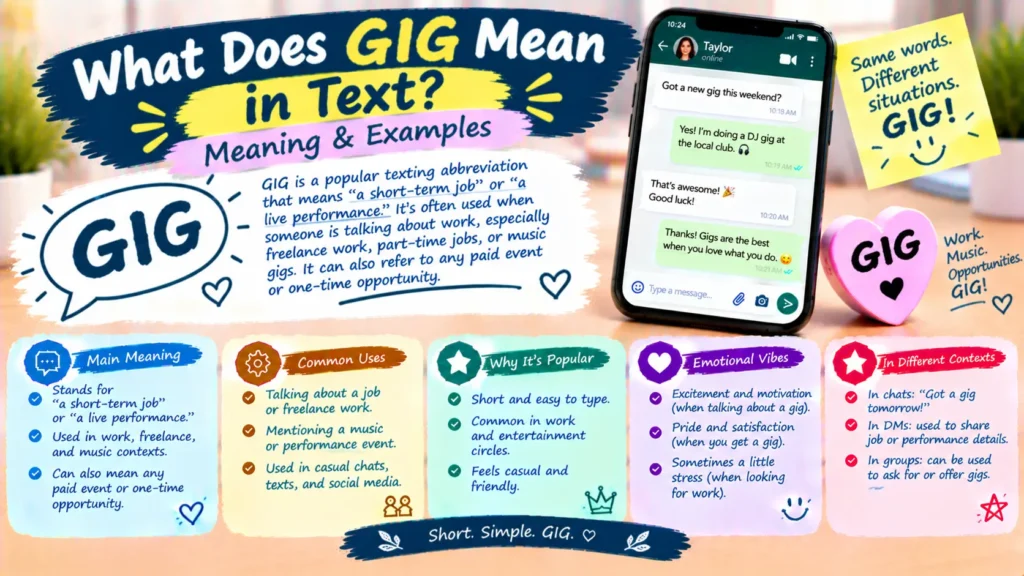
If you recently saw someone write “I have a gig tonight” or “Got a new gig,” you may have wondered what gig means in text. Is it a job, a performance, a side hustle, or something else?
In most casual conversations, gig means a job, task, or paid opportunity, especially one that is temporary, freelance, or project-based. The word is also commonly used for a live performance, particularly when talking about musicians, comedians, DJs, or other performers.
The interesting part is that “gig” does not always have one fixed meaning. Its meaning depends heavily on the conversation. A friend saying, “I’ve got a gig tonight,” may be talking about performing at a concert. Someone saying, “I picked up a weekend gig,” probably means they found temporary work.
That flexibility is exactly why people search for “what does gig mean in text.” Online communication has made the word even more common because people casually discuss freelance work, side jobs, concerts, deliveries, creative projects, and short-term opportunities.
So, if you received a message containing “gig,” the surrounding words usually provide the clue. In this guide, we will explore its meanings, emotional tone, cultural use, examples, variations, and the easiest ways to respond.
Gig Meaning in Text: Quick Meaning
In texting and online conversations, gig usually means a job, paid task, temporary opportunity, or performance.
Depending on context, it can mean:
- A temporary or freelance job
- A side job or side hustle
- A paid project
- A musical or entertainment performance
- A short-term work opportunity
- A specific task someone has been hired to complete
Examples
“I got a new gig this weekend.”
This usually means the person found a temporary or freelance job.
“My band has a gig tonight.”
Here, gig means a live musical performance.
“I’m doing a delivery gig after work.”
In this context, it refers to temporary or flexible work.
The key is simple: gig usually describes something someone does for work or payment, but the exact meaning comes from context.
Origin & Background of the Word Gig
The word gig has a surprisingly long history. Its modern meaning developed from informal English, particularly within entertainment and working communities.
The performance-related use became strongly associated with musicians and performers. A musician might say they had “a gig” when they had been hired to perform somewhere.
Over time, the word expanded beyond music. People began using it for comedy performances, acting jobs, creative projects, freelance assignments, and other short-term paid work.
The rise of the gig economy gave the word another major boost.
Today, people use “gig” when talking about freelance writing, graphic design, photography, delivery work, driving, tutoring, online services, event work, and many other forms of flexible employment.
Social media has also made the word feel more casual. Someone might post, “Booked another gig!” without explaining exactly what the work involves because their followers already understand the general idea.
That is an important part of modern slang: ordinary words often become shorter, more flexible, and more conversational online.
Real-Life Conversations Using Gig
WhatsApp Conversation
Person A:
“What are you doing Saturday?”
Person B:
“I’ve got a gig in the evening.”
Person A:
“Oh nice. Music?”
Person B:
“Yeah, playing with the band at a local café.”
Here, “gig” clearly means a live performance.
Instagram DM
Person A:
“Your photos are amazing. Do you do this professionally?”
Person B:
“Sometimes. I picked up a photography gig for a wedding next month.”
Person A:
“That’s awesome. Hope it goes well!”
In this conversation, “gig” means a paid photography assignment.
TikTok Comments
Commenter:
“How do you afford to travel so much?”
Creator:
“I pick up freelance gigs whenever I can.”
Commenter:
“That actually makes sense!”
Here, “gigs” refers to temporary or freelance jobs.
Text Message
Person A:
“Can you come out tonight?”
Person B:
“Wish I could, but I have a work gig.”
Person A:
“No worries. Another time!”
The speaker is using “gig” casually to describe a work commitment.
Emotional & Psychological Meaning of Gig
Unlike many texting abbreviations, gig does not normally express a particular emotion by itself. Its emotional meaning comes from how the speaker talks about the work or opportunity.
For example, “I finally got a gig!” may communicate excitement, relief, or pride.
“I have another gig tomorrow” could sound neutral.
“Ugh, I’ve got a gig tonight” might suggest tiredness or frustration.
The word can also carry a sense of independence. When someone talks about picking up gigs, they may be describing a flexible lifestyle where they earn money through different projects instead of following one traditional career path.
That reflects something broader about modern communication. Work is no longer always described with formal terms such as “employment” or “occupation.” People often say, “I have a gig,” because it feels more relaxed and immediate.
A personal-style example would be hearing a friend say, “I finally landed a gig doing social media for a small business.” The word makes the opportunity sound practical and active. You immediately understand that it is probably a specific paid project rather than necessarily a permanent position.
Gig in Different Contexts
Gig on Social Media
On Instagram, TikTok, Facebook, and similar platforms, gig commonly refers to freelance work, creative assignments, performances, or side jobs.
For example:
“Booked a new gig!”
This could mean anything from a photography job to a music performance.
Gig Among Friends
Friends often use the word casually.
“I can’t hang out tonight. I have a gig.”
The speaker may not need to explain the details because “gig” simply communicates that they have a work-related commitment.
Gig in Relationships
If someone tells their partner, “I have a gig Friday night,” the word may refer to a performance, event job, freelance assignment, or temporary shift.
The relationship determines how much explanation is expected.
Gig at Work
The word can be used professionally, especially in informal workplace conversations.
For example:
“I’m taking a freelance gig for the next two weeks.”
However, it may sound too casual in certain formal documents. “Contract,” “assignment,” “project,” or “temporary position” may be more appropriate depending on the situation.
Casual vs. Serious Tone
“Gig” is generally informal.
It works naturally in:
- Text messages
- Social media posts
- DMs
- Conversations with friends
- Informal workplace chats
For formal business communication, a more precise term may be better.
When NOT to Use Gig
Although “gig” is common, it is not appropriate in every situation.
Formal Documents
In a legal agreement or formal employment document, “gig” may be too vague. Terms such as “contract,” “assignment,” or “temporary position” are usually clearer.
When Precision Matters
If someone asks what your professional role is, saying “I do gigs” may not provide enough information.
You might instead say:
“I work as a freelance photographer.”
Cultural or Professional Sensitivity
Some people use “gig” casually, while others may associate it specifically with entertainment or freelance work.
If there is any possibility of confusion, explain what the gig involves.
Serious Employment Discussions
When discussing salary, benefits, contracts, or employment rights, precise language is usually more useful than casual slang.
Common Misunderstandings About Gig
One common misunderstanding is assuming that gig always means a concert.
That meaning is certainly common among musicians, but it is not the only one.
Another mistake is thinking that every gig is a full-time job. Usually, the word suggests something temporary, flexible, freelance, or specific, although people use it loosely.
People may also confuse “gig” with “side hustle.” They overlap, but they are not identical.
A gig is generally a specific job or paid assignment.
A side hustle is usually an ongoing income-generating activity outside someone’s main work.
For example, photographing one wedding can be a gig. Running a photography business on weekends can be a side hustle.
Context matters more than the word alone.
Comparison Table
| Term / Search Intent | Meaning in Text | How to Use It | Example | Compared With |
|---|---|---|---|---|
| Gig | A temporary job, paid task, or performance | Use it for casual conversations about work or performances | “I have a gig tonight.” | More informal than “job” |
| Job | Work someone does for income | Use it for general employment | “I found a new job.” | Broader than “gig” |
| Side hustle | An additional income activity | Use it when discussing ongoing extra work | “Photography is my side hustle.” | Usually more ongoing than a gig |
| Freelance | Working independently for different clients | Use it for independent professional work | “I freelance as a designer.” | Describes a work arrangement |
| Shift | A scheduled period of work | Use it for scheduled workplace hours | “I have a night shift.” | More schedule-specific |
| Performance | A public presentation or show | Use it for entertainment contexts | “We have a performance tonight.” | More formal than gig |
| Task | A particular piece of work | Use it for a specific assignment | “I finished the task.” | May be unpaid or part of a larger job |
| Contract | A formal work agreement | Use it in professional or legal contexts | “I signed a six-month contract.” | More formal and legally specific |
Key Insight
Gig is a flexible, informal word that usually points to a specific piece of paid work or a performance. If someone uses it in a text, look at the surrounding conversation before deciding exactly what they mean.
Variations and Related Types
Gig Meaning
A gig generally means a temporary job, paid assignment, or performance.
Gig in Text
In text messages, gig is usually casual shorthand for a work opportunity or performance.
Gig Abbreviation
“Gig” is not normally an abbreviation. It is a complete informal English word.
Gig Slang
As slang, “gig” commonly describes flexible, freelance, temporary, or performance-based work.
Gig in Chat
In chat, someone may say “got a gig” to mean they have secured a job, assignment, or performance.
Gig Work
Gig work refers to flexible or temporary paid work, often completed independently or for different clients.
Music Gig
A music gig is a live performance by a musician, singer, DJ, or band.
Freelance Gig
A freelance gig is a specific paid project completed for a client.
Side Gig
A side gig is additional work done alongside someone’s main job or primary activity.
One-Off Gig
A one-off gig is a single assignment rather than an ongoing position.
How to Respond When Someone Uses Gig
Your response depends on what the person means.
Casual Replies
If a friend says:
“I’ve got a gig tonight.”
You can reply:
- “Nice! What kind of gig?”
- “Good luck with it!”
- “Hope it goes well!”
- “Sounds interesting.”
Funny Replies
If you have a playful relationship:
- “Look at you being all professional!”
- “Another gig? You’re booked and busy!”
- “Save some work for the rest of us!”
Humor works best when you already understand the person’s personality.
Mature Replies
For a more thoughtful response:
- “That sounds like a good opportunity.”
- “I hope everything goes smoothly.”
- “Is it a one-time project or something ongoing?”
These responses show genuine interest.
Respectful Replies
If you are unsure what “gig” means in their message, simply ask:
“When you say gig, do you mean a job or a performance?”
There is nothing awkward about asking. Context is part of communication.
Regional & Cultural Usage
Western Culture
In the United States, Canada, the United Kingdom, Australia, and other English-speaking environments, “gig” is widely understood as an informal term for temporary work or a performance.
The gig economy has also made the employment-related meaning increasingly familiar.
Asian Culture
In many Asian countries where English is widely used, “gig” is increasingly common online, especially among younger people, freelancers, creators, and professionals working with international clients.
However, “job,” “work,” or “project” may still sound more natural in formal conversations.
Middle Eastern Culture
Among English-speaking communities in the Middle East, “gig” may appear in social media, freelance, entertainment, and professional contexts.
Because English usage varies considerably across countries and communities, the exact meaning should still be interpreted from context.
Global Internet Usage
Online, “gig” has become highly portable. A person can use the same word to describe a concert, freelance writing project, delivery work, coding assignment, or photography job.
That flexibility makes it particularly useful in internet conversations.
Gen Z vs. Millennials
Both Gen Z and Millennials commonly understand “gig,” especially in online work and social media contexts.
Younger users may connect it strongly with freelance work, creator income, and the gig economy, while older users may more readily associate it with musicians and live performances.
These are general tendencies, not strict rules. Individual experience matters more than generation alone.
Is Gig Safe for Kids?
Yes, gig is generally a harmless word for children to encounter or use.
It is not inherently vulgar, sexual, or offensive. The meaning is normally related to work, temporary employment, or entertainment.
However, children may encounter discussions about gig work that involve money, employment, contracts, or meeting clients. Those topics require appropriate adult guidance depending on the child’s age.
The word itself is not the concern. Context is what matters.
FAQs About Gig in Text
What does gig mean in text?
In text messages, gig usually means a temporary job, freelance assignment, paid task, or live performance.
Does gig mean job?
Often, yes. “Gig” can mean a temporary or freelance job, although it can also refer specifically to a performance.
Does gig mean concert?
Sometimes. Among musicians and performers, a gig commonly means a live performance, such as a concert or show.
Is gig slang?
Gig is an informal English word that is often used as slang for temporary work or a performance. It is not normally an abbreviation.
What does “I got a gig” mean?
“I got a gig” usually means “I got a job, paid assignment, or performance opportunity.” The exact meaning depends on the context.
What is a side gig?
A side gig is additional paid work someone does alongside their main job, studies, or primary activity.
Is gig appropriate in professional communication?
It depends on the situation. It is acceptable in many informal workplace conversations, but formal documents may require more precise words such as “contract,” “assignment,” or “project.”
Conclusion
So, what does gig mean in text? In most conversations, it means a temporary job, freelance assignment, paid task, or performance.
The word feels natural because it is short and flexible. A musician can have a gig at a local venue. A photographer can take a gig for a wedding. A designer can accept a freelance gig from a client. A student can pick up a weekend gig.
That flexibility is what makes the word so useful in modern communication.
When you see “gig” in a message, don’t immediately assume it means a concert or a regular job. Look at the surrounding words, the person’s occupation, and the tone of the conversation.
Once you understand that context, the meaning becomes straightforward.
Gig is simply one of those everyday English words that has evolved with the way people work, earn, create, and communicate.




