
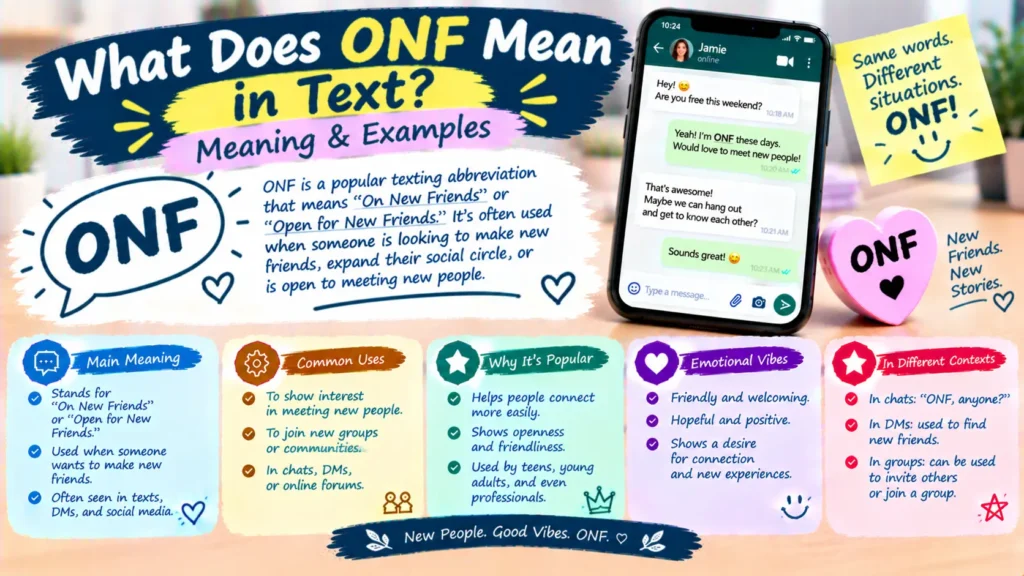
If someone suddenly texts you “ONF”, it can leave you wondering what those three letters actually mean. Is it a simple reaction, a way of saying “I swear,” or something connected to a particular slang community?
In modern texting, ONF most commonly appears as a slang abbreviation for “On Foe Nem,” a phrase associated with Chicago-influenced slang and used to emphasize that someone is being serious, truthful, or strongly agreeing with something. In some online contexts, people also interpret it similarly to “on God,” using it to add emphasis to a statement.
For example, someone might say, “That song is fire ONF,” meaning they strongly agree with the statement.
The important thing is that ONF is highly context-dependent. It is relatively niche compared with expressions such as “FR,” “ONG,” or “no cap,” and different online communities may use it differently.
So, if you have seen ONF in a text, TikTok comment, Instagram DM, or Snapchat conversation, this guide will help you understand not only its basic meaning but also its tone, cultural background, and appropriate use.
ONF Meaning in Text: Quick Meaning
ONF can mean “On Foe Nem” in slang-heavy online conversations.
In practical terms, it can communicate ideas such as:
- “I swear.”
- “I’m being serious.”
- “For real.”
- “I strongly agree.”
- “I’m telling you the truth.”
The expression is often used to add conviction to whatever comes immediately before or after it.
Examples
“That was the funniest movie ever ONF.”
“ONF, I thought I was going to miss the train.”
“This food is actually amazing ONF.”
Depending on the conversation, ONF can sound serious, excited, emphatic, or simply like casual internet slang.
One important detail is that ONF does not have one universal meaning. Online slang evolves quickly, and abbreviation databases also list numerous non-slang meanings for ONF.
Origin & Background of ONF
The slang use of ONF is closely associated with “on foe nem,” a phrase rooted in Chicago slang and street-language culture. “Foe nem” is connected to “foenem,” a Chicago expression referring broadly to one’s people, friends, or close associates.
As slang moved from local communities into music, social media, memes, and short-form video platforms, phrases that once belonged to particular communities began appearing in wider internet conversations.
Urban Dictionary entries show examples of ONF being used as “onfonem” and “on foenem,” including examples dating back several years. Because user-generated slang dictionaries are community-edited, they are useful for observing usage but should not be treated as formal linguistic authorities.
Social media has also changed how people encounter the expression. TikTok, Instagram, Snapchat, and comment sections allow slang from different communities to travel quickly across geographic and cultural boundaries.
That does not mean every person using ONF knows its original cultural background. Many people encounter a term in a meme, comment, song, or friend’s message and simply adopt its conversational meaning.
This is common with internet language. A phrase can retain its original cultural associations while developing broader meanings among people who use it online.
There are also completely unrelated meanings of ONF outside slang. For example, ONF can refer to organizations, geographic names, professional terms, and other abbreviations.
That is why the surrounding sentence matters.
Real-Life Conversations Using ONF
1. WhatsApp Conversation
Person A:
Did you really finish the whole assignment last night?
Person B:
ONF 😭 I stayed up until 4.
Person A:
No way. You need sleep.
Here, ONF reinforces Person B’s claim. It makes the statement feel more emphatic and personal.
2. Instagram DMs
Person A:
That jacket looks so good on you.
Person B:
ONF I almost didn’t buy it 😂
Person A:
I’m glad you did. It suits you.
In this conversation, ONF adds enthusiasm and agreement rather than creating a formal oath.
3. TikTok Comments
User 1:
This is the best part of the whole video.
User 2:
ONF 😭 I replayed it like ten times.
The commenter is strongly agreeing with the first person’s opinion.
4. Text Messages
Person A:
You said the concert started at 8, right?
Person B:
ONF, that’s what they told me.
Person A:
Okay, we’re leaving now.
Here, ONF gives the response extra emphasis and communicates confidence.
Emotional & Psychological Meaning of ONF
Text messages have one major weakness: they remove many of the cues we normally use to understand emotion.
When someone speaks face-to-face, you hear their voice, see their expression, and notice their body language. In texting, those signals disappear.
Short expressions such as ONF can help compensate for that loss.
When someone writes:
“I’m serious ONF.”
they are not simply communicating information. They are also signaling, “Please understand that I genuinely mean this.”
That makes ONF an example of how internet language can carry social and emotional information, not just literal meaning.
People may use it when they want to sound convincing, excited, strongly supportive, or emotionally invested.
Imagine telling a friend about something unbelievable that happened during your day. You could write:
“I almost missed my flight.”
Or you could write:
“ONF I almost missed my flight.”
The second version feels more animated. It sounds as though the writer wants the other person to understand how strongly they feel about the situation.
From my experience with everyday digital communication, this is one reason short slang expressions survive even when traditional abbreviations already exist. People are not always trying to save characters. They are trying to sound like themselves.
How ONF Is Used in Different Contexts
Social Media
ONF can appear in comments, captions, replies, and direct messages.
It is particularly natural when reacting strongly to another person’s statement.
Example:
“That ending was obsessed ONF.”
The phrase strengthens the reaction.
Friends & Relationships
Among close friends, ONF can make a message sound more relaxed and expressive.
Example:
“I missed you ONF.”
However, the meaning depends heavily on the relationship. Slang does not automatically make a message affectionate.
Work & Professional Settings
ONF is generally better avoided in professional communication.
A manager, client, teacher, or coworker who does not know the expression may not understand what you mean.
Instead of:
“I finished the report ONF.”
write:
“I finished the report and have sent it over.”
Professional communication benefits from clarity more than slang.
Casual vs. Serious Tone
ONF is fundamentally casual.
It can appear inside a serious personal conversation, but that does not automatically make the expression formal.
If the subject involves an important misunderstanding, legal matter, workplace issue, or sensitive personal situation, plain language is usually safer.
When NOT to Use ONF
Knowing slang also means knowing when to leave it out.
Avoid ONF when:
- You are writing a formal email.
- You are communicating with someone unfamiliar with internet slang.
- You are discussing a serious professional matter.
- You need your wording to be completely unambiguous.
- You are communicating across cultures where the phrase may not be understood.
- The expression’s cultural background may be inappropriate for you to imitate casually.
The last point deserves particular attention.
Because “on foe nem” has roots in a specific cultural and regional slang tradition, people outside that community should understand the expression rather than automatically treating it as a trendy replacement for “I swear.”
Using slang respectfully means recognizing where language comes from.
Common Misunderstandings About ONF
1. Thinking ONF Always Means “On God”
This is one of the biggest sources of confusion.
Some online explanations present ONF as essentially equivalent to “On God.” Other sources connect it to “On Foe Nem.”
These interpretations can overlap in conversational function because both can emphasize sincerity.
Still, they are not necessarily identical expressions.
2. Assuming Everyone Understands It
They do not.
ONF is much less universally recognized than abbreviations such as LOL, OMG, or TBH.
3. Taking It Literally
In most slang conversations, ONF is not asking you to interpret each individual letter literally.
Its purpose is usually conversational emphasis.
4. Assuming It Is Always Aggressive
ONF can sound strong, but strength does not automatically mean hostility.
The surrounding words, punctuation, relationship, and topic determine the tone.
5. Assuming There Is Only One Definition
ONF has numerous meanings outside slang as well. Abbreviation databases list professional, organizational, geographic, and other definitions.
Context should always come first.
ONF vs. Other Texting Expressions
| Expression | Meaning in Text | Typical Intent |
|---|---|---|
| ONF | Often “On Foe Nem,” used for strong emphasis | “I swear / I mean it” |
| FR | For real | Agreement or sincerity |
| ONG | On God | Strong emphasis or sincerity |
| TBH | To be honest | Introducing honesty or an opinion |
| No cap | No lie / seriously | Emphasizing truth |
| Deadass | Completely serious | Strong seriousness |
| I swear | Strong assertion | Directly emphasizing truth |
How to Use ONF
Use ONF when you’re in an informal conversation and want to add emphasis to a statement.
Examples of ONF
“That game was wild ONF.”
“ONF, I forgot my keys again.”
“You have to try this place ONF.”
ONF vs Other Slang
ONF tends to feel more culturally specific and less universally understood than FR or TBH.
If your goal is maximum clarity, “for real” or “seriously” is easier for a broad audience.
Key Insight
The real meaning of ONF comes from context, community, and tone. Treating every use as a fixed dictionary definition can lead to misunderstanding.
Variations and Related Texting Terms
Because ONF is used alongside other slang expressions, you may encounter related terms in the same conversation.
1. ONF Meaning
ONF meaning: Often “On Foe Nem,” used as an emphatic slang expression.
It commonly strengthens a statement or reaction.
2. ONF in Text
ONF in text: A casual abbreviation used to emphasize sincerity, agreement, or intensity.
Example: “That was obsessed ONF.”
3. ONF Abbreviation
ONF abbreviation: A shortened form associated with slang expressions such as “on foe nem.”
Its exact interpretation depends on context.
4. ONF Slang
ONF slang: Internet and conversational slang used mainly in informal communication.
It is not suitable for every audience.
5. ONF in Chat
ONF in chat: A quick way to make a statement sound more emphatic.
It can appear in group chats, DMs, comments, and texts.
6. FR
FR means “for real.”
It is a simpler and more widely understood way of expressing agreement or sincerity.
7. ONG
ONG generally means “on God.”
It is used to strongly emphasize that someone is telling the truth or expressing genuine conviction.
8. No Cap
No cap means “no lie” or “I am being truthful.”
It is commonly used to reinforce a claim.
9. Deadass
Deadass means “completely serious.”
It is stronger and more direct than many softer expressions of agreement.
10. TBH
TBH means “to be honest.”
Unlike ONF, it often introduces an opinion or personal admission rather than simply intensifying an existing statement.
How to Respond When Someone Uses ONF
Your response should depend on what the person is actually communicating.
Casual Replies
- “For real 😂”
- “I believe you.”
- “Facts.”
- “Yeah, seriously.”
- “I know right?”
Funny Replies
- “Okay, I’ll trust you this time 😂”
- “You said ONF, so it must be serious 😭”
- “Now I need the full story.”
- “That convinced me 😂”
Mature Replies
- “I understand what you mean.”
- “Thanks for clarifying.”
- “I get you.”
- “That makes sense.”
Respectful Replies
- “I understand.”
- “Thanks for being honest.”
- “Got it.”
- “I appreciate you explaining.”
You do not need to copy someone’s slang to show that you understand them.
Sometimes the most natural response is simply a normal sentence.
Regional & Cultural Usage of ONF
Western Culture
ONF is most closely associated with American internet and slang culture, particularly expressions influenced by regional African American and Chicago slang.
Its appearance online does not necessarily mean the person using it comes from that region.
Asian Culture
ONF may appear among users who consume American music, TikTok content, memes, or other English-language social media.
However, recognition varies significantly from person to person.
Middle Eastern Culture
English internet slang is widely encountered online, especially among younger social-media users.
Still, ONF is niche enough that many users may recognize it only from online content rather than everyday speech.
Global Internet Usage
Social media has made slang increasingly international.
A phrase can begin in one community, become popular in music or online culture, and then be adopted by users thousands of miles away.
That global spread can also disconnect a slang term from its original cultural context.
Gen Z vs. Millennials
Younger users who spend significant time on TikTok, Instagram, gaming communities, and other fast-moving online spaces may encounter ONF more often.
Millennials may understand it from context but use it less frequently.
Neither generation automatically understands every abbreviation. Digital exposure matters just as much as age.
Is ONF Safe for Kids?
ONF is generally not inherently harmful, but children should understand that slang can have cultural and contextual meanings.
The expression itself is usually used for emphasis rather than as an inherently dangerous term.
However, parents and educators should look at the whole conversation, not just one abbreviation.
Because ONF can have different meanings and may be connected to culturally specific slang, children should avoid copying expressions simply because they see them online.
Understanding language is more useful than memorizing a list of internet abbreviations.
FAQs About ONF
1. What does ONF mean in texting?
ONF commonly refers to “On Foe Nem” and is used as slang to emphasize sincerity, agreement, or a strong statement.
2. Does ONF mean “On God”?
Sometimes people use ONF in a way that functions similarly to “On God,” especially when emphasizing that they are serious. However, ONF is also associated with “On Foe Nem,” so context matters.
3. Is ONF a bad word?
Not necessarily. ONF itself is generally an abbreviation used for slang emphasis, although the phrase behind it has a specific cultural background.
4. What does ONF mean on TikTok?
On TikTok, ONF can be used as an emphatic reaction meaning something like “for real” or “I swear.” The exact meaning depends on the creator and conversation.
5. Is ONF the same as FR?
They can serve a similar conversational purpose, especially when expressing agreement or sincerity, but they are different slang expressions.
6. Can I use ONF in a formal email?
It is best to avoid it. ONF is informal slang and may be unclear to professional readers.
7. Why does ONF have different meanings?
ONF is an acronym used in multiple communities and fields. In addition to slang meanings, reference sources list unrelated organizational, professional, geographic, and technical meanings.
Conclusion
So, what does ONF mean in text?
In modern slang, ONF is commonly connected with “On Foe Nem” and is used to add emphasis, sincerity, or strong agreement to a message. In some online contexts, people use it similarly to “on God,” which explains why different definitions can appear when you search for the term.
The most important lesson is not to memorize ONF as one rigid definition.
Look at who sent it, what they were talking about, and how the rest of the message sounds. A friend saying “That song is fire ONF” is doing something very different from a professional document containing the letters ONF.
Internet slang is constantly changing because communication itself is changing. Understanding that context will help you interpret ONF naturally instead of getting stuck on the abbreviation alone.
When you understand the culture and tone behind a slang expression, those three little letters become much easier to read.




