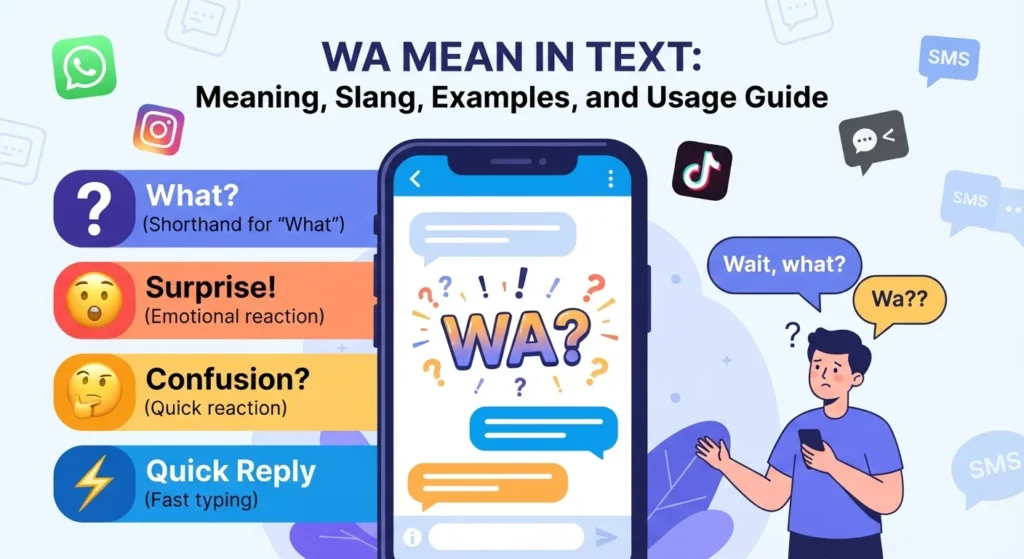
If you have ever received a message like “Wa you doing?” or “Wa??” and wondered what the sender meant, you are not alone. The phrase wa mean in text is searched because “wa” does not have one universal definition in digital communication.
In casual texting, “wa” can sometimes be a shortened form of “what.” In other situations, it can work as a quick reaction showing surprise, confusion, curiosity, or excitement. It may also simply be a typo caused by fast typing on a mobile keyboard.
The important thing is context. The words around “wa,” the punctuation, the relationship between the speakers, and the tone of the conversation can all change how it should be understood.
Unlike formal English vocabulary, “wa” is mainly associated with informal language and online conversations. You might see it in text messages, WhatsApp chats, Instagram DMs, TikTok comments, or casual conversations between friends.
So, what does wa mean in text exactly? Let’s look at its meanings, origins, examples, variations, and the situations where it is better to use standard English instead.
Wa Mean in Text – Quick Meaning
In texting and chat, “wa” usually works as an informal expression or shorthand. In many casual conversations, it is used instead of “what,” while in other cases it communicates an immediate emotional reaction.
Depending on context, “wa” can mean:
- “What” – a shortened or informal version of the word.
- Surprise – a quick reaction to unexpected information.
- Confusion – similar to “huh?” in some conversations.
- Curiosity – asking what happened or what someone means.
- Excitement – reacting strongly to interesting news.
- A typing shortcut – a shortened form created through fast typing.
- A typo – sometimes the person simply intended to type “what.”
For example:
“Wa you doing?”
Here, “wa” most likely means “what.”
“Wa?? You actually won?”
Here, it expresses surprise or disbelief.
“Wa, okay. I understand.”
In this example, it may simply be a casual reaction before acknowledging what someone said.
That is why there is no single fixed wa texting meaning. You need to consider the complete message.
Origin & Background
“Wa” does not have a single confirmed origin as a standard English texting abbreviation. Its use appears to have developed through informal typing, online slang, phonetic writing, and the natural tendency to shorten words during fast conversations.
Early SMS and internet communication encouraged people to type quickly and use fewer characters. Abbreviations and shortened words became especially common because people wanted conversations to feel quick and effortless.
Mobile keyboards strengthened this habit. When someone is replying quickly, they may leave out letters, shorten words, or type according to pronunciation rather than formal spelling.
Internet culture also made informal language more acceptable. People began writing messages in ways that reflected how they actually spoke with friends.
Social media platforms such as WhatsApp, Instagram, and TikTok pushed this trend even further. Short reactions work particularly well in comments and direct messages because users often want to respond immediately rather than write a complete sentence.
Cultural and linguistic influence can also affect how short expressions are interpreted. A sound or syllable that seems unusual in one language may have a familiar meaning or function in another.
As a result, “wa” should not automatically be treated as a formal abbreviation with one official definition. It is better understood as a flexible piece of texting slang whose meaning depends on the situation.
See Also: What Does YT Mean in Text? Meanings, Slang, and Examples
Real-Life Conversations
The easiest way to understand wa meaning in chat is to see how people actually use it.
Conversation 1: WhatsApp Chat
Person A: Wa you doing tonight?
Person B: Nothing much. Probably staying home.
Here, “wa” is an informal shorthand for “what.” The speaker could have written, “What are you doing tonight?”
Conversation 2: Instagram DM
Person A: I finally got the job!
Person B: Wa!! Seriously? That’s amazing!
Here, “wa” functions as an emotional reaction. The repeated exclamation marks make the surprise and excitement clearer.
Conversation 3: TikTok Comments
User 1: I did not expect that ending.
User 2: Wa 😭 I thought the same thing!
In this case, “wa” adds an immediate emotional response. The emoji also helps communicate the intended tone.
Conversation 4: Text Message
Person A: Wa happened yesterday? Everyone keeps talking about it.
Person B: You missed everything. I’ll tell you when I see you.
Here, “wa” is being used as a casual version of “what.”
These examples show why context matters. The same two letters can function as a question, reaction, or casual filler depending on the conversation.
Emotional & Psychological Meaning
Short expressions often communicate emotion faster than complete sentences.
When someone types “Wa??” instead of “What do you mean?”, the shorter version can feel more spontaneous. It suggests that the person is reacting immediately rather than carefully composing a formal response.
Depending on the situation, “wa” can communicate:
- Surprise
- Confusion
- Curiosity
- Excitement
- Shock
- Disbelief
- Casual friendliness
Punctuation plays an important role too.
“Wa?” may sound curious or confused, while “Wa!!” can suggest excitement or surprise. “Wa…” may feel more hesitant or uncertain.
This is one reason texting language can sometimes be difficult to interpret. Face-to-face conversations contain facial expressions, voice changes, pauses, and gestures. Text messages do not provide all those signals.
Imagine a friend suddenly tells you, “I’m moving to another country next month.”
Instead of typing, “What? I had no idea you were planning this,” you might instinctively respond, “Wa??”
That tiny response can communicate surprise, curiosity, and emotional engagement all at once.
From a communication perspective, this shows how modern digital language often prioritizes speed, spontaneity, and emotional expression over formal grammar.
Usage in Different Contexts
Social Media
“Wa” may appear in Instagram comments, TikTok discussions, short replies, and other online spaces where people communicate informally.
For example:
“Wa this is so cool 😮”
The expression works as a quick reaction rather than a carefully structured sentence.
Friends & Relationships
Among close friends, informal slang can make conversations feel relaxed and natural.
For example:
“Wa you serious right now?”
The sender is essentially asking, “What? Are you serious right now?”
Because the relationship is casual, the shortened form may feel completely normal.
Work and Professional Settings
Professional communication is different.
Using “wa” in an email to a manager, client, professor, or business partner could appear unclear or overly casual.
Instead of:
“Wa do you mean?”
A professional version would be:
“What do you mean?”
“Could you clarify what you mean?”
Standard English is generally the safer choice when clarity and professionalism matter.
Casual vs. Serious Tone
The tone of the conversation should always guide your choice.
In a casual conversation, “wa” can sound friendly and spontaneous.
In a serious discussion, however, it may create confusion or make the message seem careless.
If someone is discussing a sensitive issue, replacing “wa” with clear language is usually better.
When NOT to Use It
Although “wa” is generally harmless, it is not suitable for every situation.
Avoid using it in:
- Formal emails
- Job applications
- Academic assignments
- Professional documents
- Client communication
- Official requests
- Serious workplace discussions
- Sensitive conversations
For example, writing “Wa is the deadline?” to a client may sound too casual. “What is the deadline?” is clearer and more professional.
Cultural sensitivity matters as well. Not everyone who speaks English will recognize the same texting slang.
A person who rarely uses internet slang may interpret “wa” as a typo rather than a deliberate expression.
When communicating with someone unfamiliar with casual texting culture, clarity should come first.
Common Misunderstandings
One of the biggest mistakes people make is assuming that “wa” always means “what.”
That interpretation is common, but it is not always correct.
Consider:
“Wa??”
This could mean “What?” but it could also communicate surprise, disbelief, or confusion.
Another common misunderstanding is assuming that “wa” has one universal definition across all countries and online communities.
Texting language changes between cultures, age groups, friend groups, and platforms. An expression that feels completely normal to one person may look strange to another.
Tone can also be misunderstood.
Compare:
“Wa?”
with:
“Wa!!”
The first may suggest uncertainty or confusion. The second is much more likely to communicate excitement, shock, or surprise.
The surrounding words provide even more information.
“Wa you doing?”
Most readers can understand that “wa” is being used as “what.”
But:
“Wa!! No way!”
clearly functions more like an emotional reaction.
Context, punctuation, and surrounding words are therefore essential when interpreting informal digital language.
Comparison Table
| Expression | Meaning in Text | Tone | Common Usage |
|---|---|---|---|
| Wa | Informal reaction or shorthand for “what” | Casual | Text messages, chats, social media |
| What | Standard English question word | Neutral | Formal and informal communication |
| Huh | Expression of confusion or questioning | Casual | Conversations and texting |
| Wow | Reaction showing surprise or admiration | Emotional | Social media and casual chats |
| Hmm | Thinking, hesitation, or uncertainty | Neutral/casual | Reflective conversations |
| Wah | Can represent an emotional sound or expression in some contexts | Context-dependent | Informal or culturally influenced communication |
How to Use “Wa”
Use “wa” mainly when the conversation is casual and the other person is familiar with informal texting slang.
For example:
“Wa you doing later?”
Examples of “Wa”
“Wa?? You didn’t tell me!”
“Wa happened?”
“Wa, that’s crazy!”
“Wa” vs. “What”
“Wa” is informal and context-dependent, while “what” is the standard English word and works in both formal and informal situations.
Key Insight:
“Wa” is best understood as flexible texting slang rather than a formal English word. Its meaning comes from context, tone, punctuation, and the relationship between the people communicating.
Variations / Types of “Wa”
The form of “wa” can change the emotional meaning of a message.
1. Wa?
Wa? meaning: A short question or reaction.
Wa in text: Often communicates confusion or asks for clarification.
Wa abbreviation: Informal rather than a standardized abbreviation.
Wa slang: Commonly understood through casual context.
Wa in chat: Can replace “what?” in a relaxed conversation.
Example:
“Wa? I didn’t hear you.”
2. Wa??
Wa?? meaning: Stronger confusion or surprise.
Wa in text: Often signals that the sender did not expect something.
Wa abbreviation: Informal shortening.
Wa slang: Used as an emotional reaction.
Wa in chat: Common when reacting to unexpected news.
Example:
“Wa?? You actually did it?”
3. Wa!!
Wa!! meaning: Surprise, excitement, or shock.
Wa in text: The exclamation marks intensify the reaction.
Wa abbreviation: Informal digital shorthand.
Wa slang: Usually emotional and casual.
Wa in chat: Works well among friends.
Example:
“Wa!! That’s incredible!”
4. Wa you doing?
Wa you doing meaning: “What are you doing?”
Wa in text: Used as a casual question.
Wa abbreviation: A shortened form of “what.”
Wa slang: Informal conversational writing.
Wa in chat: Common in relaxed messages.
Example:
“Wa you doing after work?”
5. Wa happened?
Wa happened meaning: “What happened?”
Wa in text: Used to ask about an event.
Wa abbreviation: Informal shortening of “what.”
Wa slang: Casual and conversational.
Wa in chat: Useful when asking friends for an explanation.
Example:
“Wa happened at the meeting?”
6. Wa now?
Wa now meaning: “What now?” or “What is happening now?”
Wa in text: Can express uncertainty about the next step.
Wa abbreviation: Informal shorthand.
Wa slang: Depends heavily on context.
Wa in chat: Usually used casually.
Example:
“Okay, wa now?”
7. Wa bro?
Wa bro meaning: A casual question or reaction addressed to a friend.
Wa in text: Friendly and informal.
Wa abbreviation: Often functions as a shortened “what.”
Wa slang: Strongly associated with casual speech.
Wa in chat: More natural among friends.
Example:
“Wa bro? Why did you leave?”
8. Wa seriously?
Wa seriously meaning: “What, seriously?”
Wa in text: Expresses disbelief or amazement.
Wa abbreviation: Informal form of “what.”
Wa slang: Emotional and conversational.
Wa in chat: Best suited to casual relationships.
Example:
“Wa seriously? You won the competition?”
9. Wa is this?
Wa is this meaning: “What is this?”
Wa in text: Used when identifying or reacting to something.
Wa abbreviation: Informal shortening.
Wa slang: Casual expression.
Wa in chat: Often appears when someone sends a strange photo or message.
Example:
“Wa is this 😂?”
10. Wa going on?
Wa going on meaning: “What is going on?”
Wa in text: Used to ask about a situation.
Wa abbreviation: Informal shortening of “what.”
Wa slang: Casual digital language.
Wa in chat: Common when something unexpected is happening.
Example:
“Wa going on here?”
These variations demonstrate that punctuation and surrounding words can change the emotional force of the expression.
How to Respond When Someone Uses It
Your response should match the relationship and tone of the conversation.
Casual Replies
If a friend says:
“Wa you doing?”
You could respond:
“Just getting ready. What about you?”
Or:
“Nothing much. What’s up?”
Funny Replies
If the conversation is playful, you could respond:
“Wa means I’m officially confused 😂”
Or:
“Wa is today’s mood.”
Humor works best when you already have a comfortable relationship with the person.
Mature Replies
If you are unsure what they mean:
“Do you mean ‘what’?”
Or:
“Could you clarify what you mean?”
This keeps the conversation clear without making assumptions.
Respectful Replies
When speaking with someone you do not know well, try:
“I’m not sure I understand. Could you explain?”
Or:
“Could you tell me what you mean?”
A respectful response is especially useful when the meaning of “wa” is ambiguous.
Regional & Cultural Usage
The meaning and familiarity of “wa” can vary between communities.
Western Culture
In many English-speaking Western online spaces, “wa” may be interpreted as a typo, informal shortening of “what,” or casual reaction.
Its interpretation depends heavily on the surrounding message.
Asian Culture
In some Asian online communities, short sounds and syllables may be used as expressive reactions, although their exact meaning varies significantly between languages and cultures.
It is therefore risky to assume that every use of “wa” has the same meaning.
Middle Eastern Culture
In Middle Eastern online conversations, people may combine English texting slang with expressions influenced by their native language.
As a result, “wa” can sometimes have a meaning that is different from the standard English interpretation.
Global Internet Usage
Social media has made informal language increasingly international.
Someone in one country may understand a slang expression because they have encountered it on TikTok, Instagram, gaming communities, or other online spaces.
Still, global exposure does not create one universal meaning. Context remains the most reliable guide.
Generational Differences
Gen Z users are generally more accustomed to rapidly changing internet slang and informal digital expressions.
Millennials may recognize “wa” as shorthand, a typo, or a reaction depending on context.
Older generations who use less texting slang may find it unclear.
These differences do not mean one generation uses language correctly and another does not. They simply show how digital communication evolves over time.
Is It Safe for Kids?
Yes. “Wa” itself is generally a harmless and non-offensive texting expression.
The important issue is not the word itself but where and how it is used.
Children can encounter informal slang naturally through social media, games, messaging apps, and conversations with friends.
They should still understand the difference between casual communication and formal communication.
For example, “Wa?” may be fine in a friendly chat, but standard English is more appropriate for school assignments, formal emails, or communication with teachers.
Teaching children to recognize context helps them communicate effectively without treating every informal expression as appropriate everywhere.
FAQs
1. What does wa mean in text?
“Wa” commonly means “what” in casual texting, but it can also express surprise, confusion, curiosity, or excitement depending on context.
2. What does wa mean in chat?
In chat, “wa” is usually an informal shorthand or reaction. The exact meaning depends on the surrounding words and punctuation.
3. Is wa a real English word?
“Wa” is not normally considered a standard English word when used as texting slang. It is mainly an informal digital expression.
4. Can wa mean surprise?
Yes. “Wa?” or “Wa!!” can express surprise, disbelief, shock, or excitement, especially when reacting to unexpected information.
5. Why do people type wa instead of what?
People may type “wa” because of fast typing, informal writing habits, phonetic spelling, or the desire to make a message shorter and more casual.
6. Is wa considered slang?
Yes. When “wa” is used as a shortened form or reaction in digital conversations, it is generally considered informal texting slang.
7. Is wa appropriate in professional messages?
Generally, no. In professional communication, it is safer to use standard English such as “what,” “could you clarify,” or “what do you mean?”
Conclusion
Understanding wa mean in text is less about memorizing one definition and more about learning to read the situation.
In many casual conversations, “wa” is simply an informal version of “what.” In other messages, it can communicate surprise, confusion, excitement, curiosity, or disbelief.
The tone becomes even clearer when you look at punctuation and surrounding words. “Wa?” may feel uncertain, while “Wa!!” can show a much stronger emotional reaction.
The expression also reflects a broader change in digital communication. People naturally shorten words, react quickly, and adapt language to fit fast-moving conversations.
There is nothing wrong with using informal texting slang when the situation calls for it. The key is knowing your audience.
Use “wa” with friends or in relaxed online conversations when it feels natural. When clarity, professionalism, or sensitivity matters, choose standard English instead.
Once you start paying attention to context, expressions like “wa” become much easier to understand—and you can respond without second-guessing what the other person meant.