
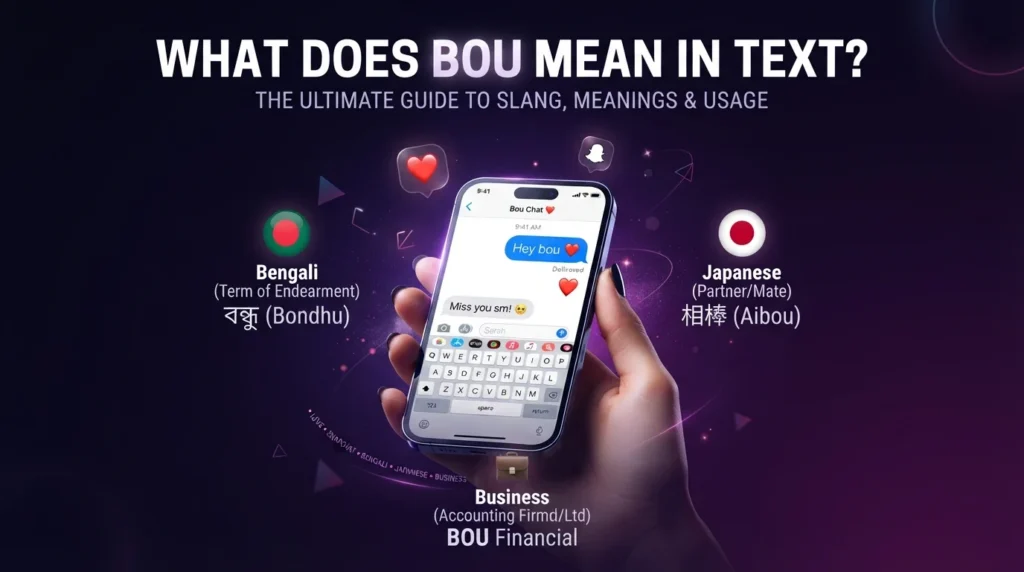
If you’ve received a message like “Hey bou ❤️” or “Miss you, bou,” you may have wondered what the unusual spelling means. Is bou a typo, a nickname, slang, or something with a completely different meaning?
In most English-language texting, bou is used as a playful or affectionate variation of “boo.” It can describe someone a person feels close to, such as a romantic partner, close friend, or someone they are flirting with. However, bou does not have one universal meaning. Context, language, culture, and even capitalization can change how it should be understood.
The spelling also appears in other languages. For example, Bengali বউ (bou) means wife, bride, daughter-in-law, or married woman, while Japanese bou can represent several different words depending on the kanji.
So, if someone used “bou” in a text, don’t immediately assume it means one particular thing. The surrounding conversation is the best clue.
What Does Bou Mean in Text? – Quick Meaning
In casual English texting, bou usually means an affectionate nickname similar to “boo,” “babe,” or “love.”
It may communicate:
- Affection
- Romantic interest
- Friendship and closeness
- Playfulness
- Emotional familiarity
- A personalized spelling of “boo”
For example:
“Good morning, bou ❤️”
This can mean something like “Good morning, babe” or “Good morning, my love.”
Another example:
“You coming with us, bou? 😂”
Here, it could simply be a playful way of addressing a close friend.
And:
“I miss you, bou.”
In this situation, the affectionate meaning is much stronger.
The important point is that bou is not a standardized English abbreviation with one fixed definition. Online slang sources commonly describe it as a personalized or stylistic spelling of “boo.”
See Also: Meaning of BBG in Chat: What Does BBG Mean in Text, Instagram & TikTok?
Origin & Background of Bou
The modern English use of bou appears closely connected to boo, an established slang term for a close acquaintance or significant other. One documented etymology for boo connects it to beau, from French beau, while the term has also become strongly associated with African American slang and popular culture.
Digital communication then made spelling much more flexible.
People regularly alter familiar words to make messages sound cuter, more personal, humorous, or distinctive. A small spelling change can turn an ordinary nickname into something that feels like an inside expression between two people.
That is one reason you may see bou, boo, bby, bae, babe, and similar expressions in social conversations.
Social media has strengthened this habit. Instagram captions, TikTok comments, Snapchat messages, and private DMs often favor informal language over traditional spelling.
There is also another important point: bou exists independently in several languages, so not every occurrence should be interpreted as English internet slang.
For example, Bengali বউ (bou) means wife and can also refer to a bride, daughter-in-law, or married woman.
That distinction matters when you’re interpreting a message from someone who speaks another language.
Real-Life Conversations Using Bou
WhatsApp Conversation
Person A:
“Hey bou, are you free tonight?”
Person B:
“Yeah 😂 why?”
Person A:
“Movie and dinner?”
Here, bou sounds affectionate and familiar. It could be romantic, but the rest of the conversation is needed to determine whether the relationship is romantic.
Instagram DM
Person A:
“You looked amazing in that picture bou 😍”
Person B:
“Haha thank youu ❤️”
The heart and compliment make the term feel flirtatious or romantic.
TikTok Comments
Person A:
“Bou really thought she ate 😂”
Person B:
“I DID though 😭”
Here, the word may simply be playful. There is no reason to assume romantic meaning.
Text Messages
Person A:
“You okay, bou?”
Person B:
“Yeah. Just had a rough day.”
Person A:
“Call me if you wanna talk.”
In this example, the word communicates familiarity and emotional warmth more than romance.
Emotional & Psychological Meaning of Bou
Words such as bou often do more than communicate information. They communicate relationship.
Calling someone “bou” instead of using their name can create a softer emotional atmosphere. It suggests that the speaker sees the other person as familiar or special.
That doesn’t automatically mean love.
A close friendship can also produce this kind of language. The difference usually becomes clear through other words, emojis, conversation history, and the relationship between the people.
Modern texting is particularly interesting because people often use tiny linguistic choices to communicate emotional distance or closeness.
Compare:
“Goodnight, Sarah.”
with:
“Goodnight bou ❤️”
The second message feels more intimate even though the basic information is exactly the same.
A simple real-life situation shows this well. Imagine someone you’ve been talking to for several weeks suddenly starts calling you “bou.” You may notice the change immediately because nicknames often signal increased comfort. The word itself isn’t a declaration of love, but the change in language may reflect a change in emotional familiarity.
Bou Meaning in Love
When bou appears in a romantic conversation, it usually works as a term of endearment.
It can mean something close to:
- My love
- Babe
- Baby
- Boo
- My special person
For example:
“Sleep well, bou ❤️”
or:
“I can’t wait to see you, bou.”
In a romantic relationship, the meaning is usually warm and intimate.
However, don’t use one word as proof that someone is romantically interested. If a friend says “hey bou,” they may simply be using playful slang.
Context determines whether bou is romantic, friendly, or flirtatious.
What Does Bou Mean on Snapchat?
On Snapchat, bou is generally interpreted in the same informal way as other social-media messages: as an affectionate or playful nickname, often similar to “boo.”
Snapchat encourages short, casual communication, so users may experiment with spellings, abbreviations, emojis, and personal nicknames.
For example:
“wyd bou? 👀”
could simply mean:
“What are you doing, boo?”
If someone sends:
“Miss you bou ❤️”
the romantic possibility becomes stronger.
But Snapchat doesn’t give bou a special official meaning. The platform itself doesn’t change the dictionary meaning of the word.
Bou Meaning in French
There is an important distinction here.
Bou is not a standard French equivalent of “love,” “babe,” or “lady.” If you see bou in a French-language conversation, you should not automatically interpret it as English texting slang.
French has words such as beau, belle, mon amour, and chéri/chérie for various affectionate meanings.
Interestingly, the English slang word boo has an etymological connection to beau according to one dictionary source, but that does not mean French speakers normally use bou as a modern French equivalent of “boo.”
Also, Bou can appear as a proper geographical name in French contexts, including the commune of Bou in France.
So if someone says “bou” in a French conversation, look at the complete sentence before assigning it a slang meaning.
Bou Meaning Lady
The phrase “bou meaning lady” can be confusing because bou has meanings outside English slang.
In Bengali, বউ (bou) is a genuine word associated with a married woman. Depending on context, it can mean wife, bride, daughter-in-law, sister-in-law, or a married woman.
So if you saw “bou” translated as “lady” or “woman,” the source may have been referring to Bengali rather than English internet slang.
For example, a Bengali speaker might romanize বউ as “bou.”
That is completely different from someone typing “Hey bou ❤️” in an English Snapchat conversation.
Bou Meaning in Business
In business communication, BOU is more likely to be an acronym than an affectionate nickname.
One established business meaning is Bank of Uganda, commonly abbreviated as BoU. Official Ugandan government material also uses BOU for Bank of Uganda.
Other acronym databases list additional meanings, including Both Of You in internet/chat usage and several organization-specific meanings.
Therefore, capitalization matters.
Compare:
“Hey bou 😊”
Likely casual slang or a nickname.
“BOU announced the new policy.”
Likely an organization or industry acronym.
Never interpret an uppercase business acronym using the same assumptions you would make about casual texting slang.
Bou Meaning in Korean
There is no single standard Korean texting meaning of the English spelling bou.
If someone writes “bou” while speaking Korean, it could represent a romanized Korean sound, a username, a name, or a word borrowed from another language.
This is an important lesson with romanization: the same Latin letters can represent completely different sounds or words in different languages.
Therefore, if you see “bou” in a Korean conversation, you need the original Korean spelling or surrounding sentence to determine its meaning accurately.
It should not automatically be translated as “boo” simply because the spelling looks similar.
Bou Meaning in Japanese
Japanese makes the situation even more interesting because bou can represent several different Japanese words.
For example, 坊 (ぼう, bou) can refer informally to a boy or son and may have an affectionate or old-fashioned flavor depending on context.
Other Japanese words pronounced bou have completely different meanings. For instance, 棒 means a pole, rod, or stick, while 某 can mean “certain” or “one.”
Japanese therefore demonstrates why spelling alone isn’t enough.
If “bou” comes from Japanese, the original characters are extremely important.
For example:
坊 (ぼう) → boy/young boy in certain contexts
棒 (ぼう) → rod or stick
某 (ぼう) → certain/one
So Japanese bou is not automatically the same thing as English boo.
Boo Meaning
Boo is the closest English slang term to the common texting use of bou.
In informal English, boo can refer to a romantic partner, significant other, or close person.
It can also be used as the familiar sound “Boo!” when someone is pretending to frighten another person.
For example:
“That’s my boo.”
usually means:
“That’s my partner or someone I’m romantically close to.”
But:
“Boo! I scared you!”
has an entirely different meaning.
This is why context matters even with the more familiar word “boo.”
Usage of Bou in Different Contexts
Social Media
On Instagram, TikTok, Snapchat, and similar platforms, bou can feel playful, affectionate, or trendy.
Example:
“Weekend with my bou ❤️”
Friends and Relationships
Close friends may use it as a nickname without romantic intentions.
Example:
“You good, bou?”
Work and Professional Settings
Avoid using bou as an affectionate nickname in professional communication unless you know the person extremely well and the relationship clearly supports that style.
“Hi bou, attached is the report” would sound inappropriate in most workplaces.
Casual vs. Serious Tone
The word works best in relaxed conversations.
A serious message such as:
“Bou, we need to discuss the contract.”
would sound strange because the affectionate nickname clashes with the professional subject.
When NOT to Use Bou
Although the word itself is generally harmless, it isn’t suitable everywhere.
Avoid using it:
- In formal emails
- In job applications
- In academic writing
- With unfamiliar clients
- With senior professional contacts
- With strangers
- During sensitive disagreements
- When you are unsure how the other person feels about nicknames
It can also cause misunderstanding when people from different linguistic backgrounds are communicating.
Someone may understand bou as a Bengali word, a Japanese romanization, a business acronym, or a spelling mistake rather than English slang.
Common Misunderstandings About Bou
“Bou always means boyfriend or girlfriend.”
Not necessarily.
It can be affectionate without defining the relationship.
“Bou and boo are completely different words.”
In casual English texting, bou is often simply a stylistic spelling of boo, although other languages and contexts give it independent meanings.
“If someone calls me bou, they definitely like me romantically.”
Not always.
Look at the rest of the conversation, not one nickname.
“Bou is a standard English abbreviation.”
No.
It is better understood as informal slang or a personalized spelling in English texting.
“BOU always means the same thing.”
Definitely not.
BOU can be an acronym with completely different meanings in business, organizations, education, and other fields.
Bou vs. Other Texting Terms
| Term | Meaning in text | How to use it | Example | Main difference |
|---|---|---|---|---|
| Bou | Affectionate nickname or variant of “boo” | Casual conversations | “Hey bou ❤️” | Less standardized spelling |
| Boo | Romantic partner or close person | Casual/affectionate | “Miss you, boo” | More established English slang |
| Bae | Romantic interest or partner | Casual/social media | “My bae ❤️” | Often more explicitly romantic |
| Babe | Term of affection | Relationships and close conversations | “Thanks, babe” | Common and widely understood |
| Love | Affectionate address | Romantic or friendly contexts | “Thanks, love” | More traditional |
| Bestie | Very close friend | Friendly conversations | “Hey bestie!” | Usually friendship rather than romance |
| BOU | Possible acronym | Professional or specialized contexts | “BOU issued the report” | Meaning depends heavily on context |
Key Insight
The safest way to understand bou is to read the sentence around it. In English texting, it often carries the warmth of boo, but in other languages or professional contexts, it may have an entirely different meaning.
Variations and Related Forms
Bou meaning
Usually an affectionate or playful form of address in casual English texting.
Bou in text
Often means a personalized spelling of “boo” when addressing someone close.
Bou abbreviation
“Bou” is not a universal abbreviation. In uppercase, BOU can represent different acronyms depending on the field.
Bou slang
As slang, it commonly functions like an affectionate nickname.
Bou in chat
In chat, tone depends heavily on the surrounding message and emojis.
Bou meaning in love
It can mean “babe,” “boo,” or “my love” when used romantically.
Bou meaning on Snapchat
Usually a casual nickname similar to “boo,” although context remains important.
Bou meaning in Bengali
Bengali বউ (bou) means wife and can also refer to a bride, daughter-in-law, or married woman.
Bou meaning in Japanese
Japanese bou can represent multiple words, including 坊, which can refer to a boy in certain informal contexts.
Boo vs. bou
In English texting, bou is often a creative spelling of boo, while boo is the more established term.
How to Respond When Someone Uses Bou
Your response should match the relationship.
Casual Replies
- “Heyyy bou 😂”
- “What’s up?”
- “Haha, hey you!”
- “I’m good, bou.”
Funny Replies
- “Bou? Since when? 😂”
- “That’s a new nickname!”
- “Who taught you that spelling? 😂”
- “Okayyy bou 😭”
Mature Replies
- “Hey, good to hear from you.”
- “I’m glad you checked in.”
- “How have you been?”
- “Nice hearing from you.”
Respectful Replies
If you’re unsure whether the person is being romantic, keep your response neutral:
“Hey! How are you?”
That lets you continue the conversation without accidentally returning romantic language you don’t intend to use.
Regional & Cultural Usage
Western Culture
In English-speaking Western internet culture, bou is most likely to be understood as a creative variation of “boo” when used in an affectionate message.
Asian Culture
The spelling may have completely different meanings depending on the language.
Bengali bou, for example, has a direct cultural and linguistic connection to marriage and family relationships.
Japanese bou also represents several independent words.
Middle Eastern Culture
There is no single universal Middle Eastern meaning for “bou.” Its interpretation may depend on the speaker’s native language, dialect, transliteration habits, or whether they are using English internet slang.
This is another reason not to assign a cultural meaning based solely on spelling.
Global Internet Usage
Internet communication allows slang to travel rapidly across countries.
Someone in one country may use “bou” as a personalized version of “boo,” while another person may recognize it as a word from their native language.
Gen Z vs. Millennials
Younger internet users are generally comfortable with creative spellings, shortened words, emojis, and personalized expressions.
Millennials may recognize boo, babe, and bae more readily, while newer spellings can feel more platform-specific or playful.
Still, these aren’t strict generational rules. Individual communication style matters more than age.
Is Bou Safe for Kids?
Yes. Bou itself is generally harmless when it is being used as an affectionate nickname.
The important issue is context.
A child seeing “bou” in a comment or message doesn’t need to assume that it is romantic or inappropriate. However, parents and educators should consider the overall conversation, especially when an unfamiliar person is using affectionate language toward a child.
The word itself isn’t the concern; the relationship and surrounding behavior are what matter.
FAQs
What does bou mean in text?
In casual English texting, bou usually means an affectionate nickname similar to “boo,” “babe,” or “love.”
Is bou the same as boo?
Often, yes. In English internet slang, bou is commonly used as a playful or personalized spelling of “boo.” However, bou can have unrelated meanings in other languages.
Does bou mean boyfriend or girlfriend?
No. Bou does not specifically mean boyfriend or girlfriend. It can be used for a romantic partner, close friend, or someone the speaker feels affection toward.
What does bou mean in love?
In a romantic context, bou can mean something like “my love,” “babe,” or “boo.” The surrounding conversation determines how romantic it actually is.
What does bou mean on Snapchat?
On Snapchat, bou usually works as an informal, affectionate nickname, particularly when used with romantic emojis or a warm message.
What does bou mean in Bengali?
Bengali বউ (bou) commonly means wife, and can also mean bride, daughter-in-law, or married woman depending on context.
Is bou appropriate in professional communication?
Usually, no. If bou is being used as a nickname, it is too casual for most professional emails, reports, and workplace messages. However, BOU may have a separate professional meaning as an acronym.
Conclusion
So, what does bou mean in text?
In everyday English texting, it is most commonly an affectionate and playful variation of “boo.” Someone may use it to address a romantic partner, close friend, or simply someone they feel comfortable with.
But there’s more to the word than its internet-slang meaning.
In Bengali, bou has a genuine meaning connected with wife, bride, and married women. In Japanese, bou can represent several different words depending on the characters used. In business communication, BOU can function as an acronym with an entirely different definition.
That’s why context is your best guide.
If someone texts you “Hey bou ❤️,” an affectionate meaning is likely. If you see BOU in a business document, look for the organization or industry context instead.
Language isn’t always about finding one perfect dictionary definition. Sometimes, the real meaning lives in the relationship, culture, and situation surrounding the word.