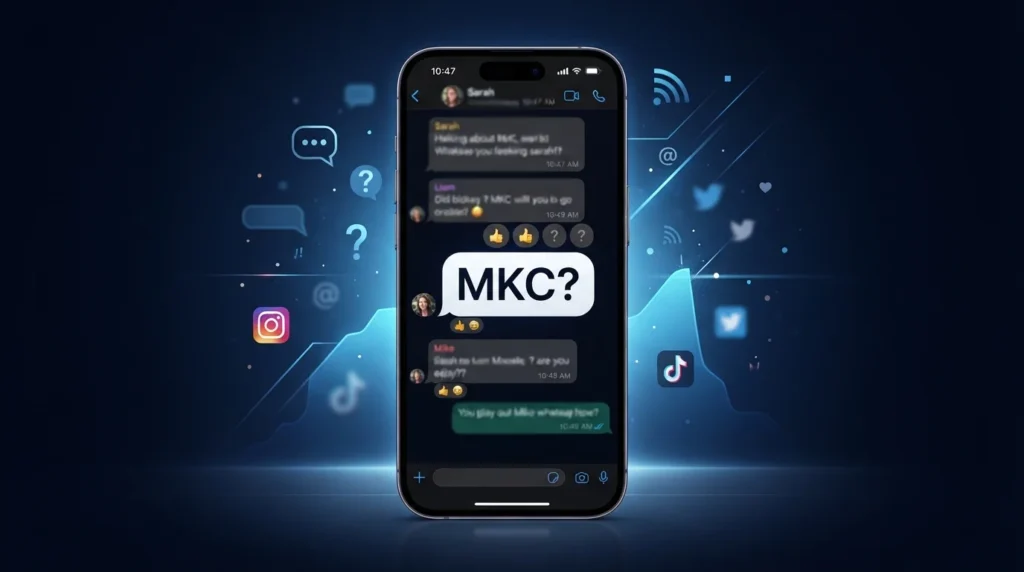
If you have seen “MKC” in a WhatsApp message, Instagram comment, TikTok conversation, or online game chat, you may have wondered what it actually means. The abbreviation looks harmless at first, but its meaning can be quite offensive depending on the context.
MKC is commonly used online as a shortened form of a highly vulgar Hindi/Hinglish swear phrase. In casual internet conversations, people may use it as an insult, an angry reaction, or sometimes jokingly among close friends.
Understanding the meaning is important because the same three letters can feel very different depending on who says them, who receives them, and what happened before the message.
This guide explains MKC meaning in chat, how people use it, where it comes from, what emotions it can express, and when you should avoid using it.
MKC Meaning in Chat – Quick Meaning
MKC is an abbreviation commonly associated with a vulgar Hindi/Hinglish insult. It is derived from “madarchod,” an extremely offensive swear word literally referring to a sexual insult involving someone’s mother.
In everyday internet usage, however, people do not always use MKC literally. It can function more like an aggressive exclamation, insult, or expression of shock.
Depending on context, MKC may communicate:
- Anger or irritation
- Surprise or disbelief
- Frustration
- Mocking or teasing
- Strong emphasis
- Aggressive humor between friends
For example:
“MKC, I forgot my keys again.”
Here, the speaker may simply be frustrated with themselves.
“MKC, you actually won?”
In a close-friend conversation, this could express surprise rather than serious hostility.
“MKC, don’t talk to me like that.”
Here, the abbreviation is clearly being used aggressively.
The important point is that MKC is still vulgar, even when the speaker intends it as a joke.
Origin and Background of MKC
The expression behind MKC comes from Hindi profanity and has existed in spoken language long before social media became popular.
As texting culture developed, people began shortening long expressions into initials. This made offensive phrases easier and faster to type, particularly in informal chats and online communities.
Abbreviations such as MKC became more visible through messaging apps, gaming communities, memes, comment sections, and Indian social-media culture.
The internet also changed how profanity is perceived. A word that would sound extremely harsh when spoken directly can sometimes appear almost casual when typed between friends.
That does not necessarily make it less offensive.
Context has become especially important. Someone might type MKC while laughing with a close friend, while another person could interpret the exact same message as a serious personal attack.
This is one reason slang can be difficult for language learners. The dictionary meaning alone does not explain the social meaning.
TMKC Full Form
TMKC full form is commonly understood as a variation of the same vulgar Hindi/Hinglish profanity associated with MKC. The added T can appear in informal online conversations, memes, comments, and chats, depending on the speaker and context.
Like MKC, TMKC is not a polite or neutral abbreviation. It can be used to express anger, frustration, shock, teasing, or exaggerated humor among people who are familiar with this type of slang.
For example:
“TMKC, I completely forgot about the deadline.”
Here, the abbreviation may be used as an emotional reaction rather than as a literal insult.
Because the exact expansion and intended meaning can vary across online communities, it is important to look at the surrounding conversation before interpreting TMKC. Regardless of the variation, it should generally be treated as vulgar slang and avoided in professional or formal communication.
Real-Life Conversations Using MKC
WhatsApp Conversation
Person A:
Bro, I studied all night and the exam was nothing like the notes.
Person B:
MKC 😭 Same. I didn’t understand half the questions.
Here, MKC works as an emotional reaction between friends. It communicates frustration and shared disbelief.
Instagram DM
Person A:
Did you see that he posted my private photo?
Person B:
MKC, seriously? That’s not okay.
In this situation, the abbreviation adds anger and shock. It is not being used playfully.
TikTok Comment
Person A:
I watched this tutorial five times and still can’t do it.
Person B:
MKC 😂 I thought I was the only one.
The comment uses the abbreviation casually and humorously. Still, it remains profanity and may not be appropriate for every audience.
Text Message
Person A:
I accidentally sent the message to the wrong group.
Person B:
MKC 😭😭 What did you send?
Here, the abbreviation expresses shock and curiosity rather than a literal insult.
Emotional and Psychological Meaning of MKC
Internet slang often communicates emotion more quickly than formal language.
When someone types MKC, they may be trying to make their reaction feel stronger. A simple “What?” might sound neutral, while MKC can make the reaction feel dramatic, angry, surprised, or humorous.
There is also a social element.
Among close friends, strong profanity can sometimes create a sense of informality. People who know each other’s boundaries may use offensive words without intending genuine hostility.
However, this only works when there is mutual understanding.
Imagine two friends joking after one loses a video game. One sends “MKC 😂” and both laugh. If the same message is sent to a stranger after an argument, it can immediately sound threatening or disrespectful.
From my experience with everyday communication, this is where many slang misunderstandings happen: people copy the word but miss the relationship behind it.
The abbreviation itself does not tell you whether someone is joking. The surrounding conversation, relationship, punctuation, emojis, and previous behavior all matter.
MKC Usage in Different Contexts
MKC on Social Media
On Instagram, TikTok, Facebook, YouTube, and similar platforms, MKC can appear in comments, replies, memes, and private messages.
It is generally associated with informal communication and may be used for humor, frustration, or shock.
Because social-media posts can reach large audiences, however, using profanity publicly can affect how other people perceive the speaker.
MKC Between Friends and Relationships
Close friends may use MKC casually, especially when joking, gaming, teasing, or reacting to unexpected situations.
That does not mean everyone in the friendship group will be comfortable with it.
In romantic relationships, the same rule applies. One partner may see it as playful while another may consider it disrespectful.
MKC at Work
Avoid MKC in professional communication.
Do not use it in workplace emails, applications, business chats, client conversations, meetings, LinkedIn messages, or formal correspondence.
Even if your colleagues use casual slang privately, professional communication requires a different level of judgment.
Casual vs. Serious Tone
MKC can range from playful to hostile.
An emoji such as 😂 may suggest joking, while an angry message without humor may indicate genuine aggression.
Still, emojis cannot guarantee harmless intent. The safest approach is to consider the entire conversation rather than relying on one signal.
When NOT to Use MKC
There are many situations where using MKC is a poor choice.
Avoid it when:
- You are speaking with someone you do not know well.
- You are communicating with a teacher or employer.
- You are writing a professional email.
- You are speaking to a customer or client.
- You are participating in a formal discussion.
- You are unsure about the other person’s boundaries.
- The conversation already involves conflict.
- Children or younger audiences may be present.
- You are communicating across cultures and do not know how the phrase will be understood.
The strongest reason to avoid it is simple: MKC contains an extremely offensive insult.
Even if you intend it as humor, another person may experience it as personal abuse.
Common Misunderstandings About MKC
One common mistake is assuming that MKC always means the speaker is genuinely angry.
That is not necessarily true. Friends sometimes use profanity as exaggerated humor.
Another misunderstanding is believing that abbreviating a swear word makes it polite.
It does not.
Writing three letters instead of the complete expression may make the word less visually obvious, but people familiar with Hindi/Hinglish slang generally understand what it represents.
Some people also assume that an abbreviation has the same emotional strength in every situation.
It doesn’t.
Compare:
“MKC 😂 I can’t believe we did that.”
with:
“MKC. Don’t message me again.”
The first can sound like joking frustration. The second sounds openly hostile.
Tone, relationship, and context completely change the interpretation.
MKC Meaning in Text: Comparison Table
| Search or Phrase | Meaning / Intent | How It Is Used |
|---|---|---|
| MKC meaning in text | A vulgar Hindi/Hinglish abbreviation | Used in informal online conversations |
| How to use MKC | Using the abbreviation as slang or an emotional reaction | Usually limited to very casual conversations |
| Examples of MKC | Real examples showing its tone | Often appears in jokes, arguments, reactions, and memes |
| MKC vs other Hindi slang | Comparison with other informal expressions | Helps explain differences in offensiveness and context |
| MKC abbreviation | Shortened form of a vulgar phrase | Commonly typed instead of the full expression |
| MKC slang | Internet-style Hindi/Hinglish profanity | Seen in chats, comments, gaming, and memes |
TMKC full form | A variation of vulgar Hindi/Hinglish slang related to MKC | Usually appears in informal chats, memes, comments, and online conversation |
Key Insight
MKC is not a neutral texting abbreviation. Its meaning and emotional force depend heavily on context, but the underlying expression is vulgar. If you are unsure whether someone will find it acceptable, choose a cleaner alternative.
Variations and Related Forms
People may encounter several related forms when reading Hindi/Hinglish internet slang.
MKC Meaning
MKC is commonly used as a shortened form of a vulgar Hindi swear phrase.
MKC in Text
In texting, MKC can function as an emotional reaction, insult, or exaggerated expression among people familiar with the slang.
MKC Abbreviation
The letters M-K-C are used to shorten the original phrase, making it quicker to type.
MKC Slang
As slang, MKC belongs to informal Hindi/Hinglish profanity frequently seen online.
MKC in Chat
In chat conversations, the meaning can range from joking frustration to genuine anger.
MKC in WhatsApp
WhatsApp users may use it in group chats or private conversations, particularly among friends.
MKC on Instagram
On Instagram, it may appear in DMs, comments, memes, and replies.
MKC on TikTok
TikTok users may use MKC as a reaction to funny, surprising, frustrating, or unexpected content.
MKC in Gaming
Gamers sometimes use strong slang when reacting to losing, winning, lag, mistakes, or surprising plays.
MKC Meme Usage
Meme culture can make offensive expressions appear humorous or exaggerated. The meme context does not automatically make the underlying phrase polite.
How to Respond When Someone Uses MKC
Your response should depend on the relationship and tone.
Casual Replies
If a close friend uses MKC jokingly, you might respond:
“Bro, chill 😂”
“I know, right?”
“Exactly! 😭”
Funny Replies
If the conversation is clearly playful:
“Language, please 😂”
“Someone woke up angry today.”
“Okay, okay, calm down!”
Mature Replies
If you want to keep things calm:
“I get that you’re frustrated, but let’s keep the conversation respectful.”
“I understand what you’re saying. There’s no need for the language, though.”
Respectful Replies
If someone directs MKC at you aggressively:
“Please don’t speak to me that way.”
“If there’s an issue, we can discuss it without insults.”
You do not have to respond with another insult simply because someone used one against you.
Regional and Cultural Usage
Western Culture
In Western online spaces, people who do not understand Hindi/Hinglish may not recognize MKC immediately.
Those who do recognize it may understand it as an Indian profanity rather than ordinary English slang.
Asian Culture
Across South Asian online communities, Hindi and Hinglish profanity can spread quickly through memes, entertainment, gaming, and social media.
Its familiarity does not mean it is universally acceptable.
Middle Eastern Culture
In multilingual online communities across the Middle East, users may encounter MKC through Indian, Pakistani, Bangladeshi, or other South Asian communities.
Because these communities interact online, slang can cross linguistic boundaries very quickly.
Global Internet Usage
Modern internet culture has made regional slang increasingly global.
A phrase can begin in one language community and become recognizable internationally through memes, gaming, short-form videos, and comment sections.
However, recognition and understanding are not the same thing. Someone may know that MKC is offensive without understanding its exact linguistic origin.
Gen Z vs. Millennials
Gen Z internet communication tends to move quickly between abbreviations, memes, emojis, and multilingual slang.
Millennials may also recognize MKC, particularly if they participate in South Asian social-media or gaming communities, but their interpretation may differ depending on personal experience.
Age alone does not determine how someone will interpret profanity. Relationship and cultural background matter more.
Is MKC Safe for Kids?
MKC should not be treated as child-friendly language.
Although children may encounter the abbreviation online without understanding its origin, the phrase behind it is highly vulgar.
Parents, teachers, and older siblings can explain that some online abbreviations represent offensive language and that understanding slang does not mean children need to repeat it.
For younger users, cleaner alternatives such as “OMG,” “seriously,” “what the heck,” or “no way” are much safer choices.
FAQs
What is the TMKC full form?
TMKC is commonly used online as a variation of vulgar Hindi/Hinglish slang related to MKC. Its exact interpretation can depend on the context and online community.
What does MKC mean in chat?
MKC is commonly used as an abbreviation for a highly vulgar Hindi/Hinglish swear phrase. In chats, it may express anger, frustration, surprise, or joking emphasis.
Is MKC a bad word?
Yes. MKC represents an offensive swear expression. Although friends may sometimes use it jokingly, it is not considered polite or appropriate language.
What does MKC mean in WhatsApp?
On WhatsApp, MKC can be used as an informal reaction among friends. Its tone depends on the surrounding conversation and relationship between the people involved.
Is MKC used as an insult?
Yes. MKC can be directed at another person as an insult. It can also be used more loosely as an emotional exclamation without being intended literally.
Can I use MKC with friends?
You should only consider it if you know your friends are comfortable with strong profanity. Even among friends, it can easily be misunderstood.
Is MKC appropriate at work?
No. MKC is inappropriate for professional communication because it represents vulgar language and can come across as disrespectful or hostile.
What should I say instead of MKC?
If you want to express frustration without profanity, try “Seriously?” “Come on!” “No way!” “What the heck?” or “I can’t believe this!”
Conclusion
Understanding MKC meaning in chat is less about memorizing three letters and more about understanding the culture behind internet language.
MKC is commonly associated with a highly vulgar Hindi/Hinglish expression. Online, people may use it to show anger, frustration, surprise, humor, or exaggerated emotion.
The important thing is to recognize the difference between understanding slang and using slang.
You may see MKC frequently in memes, chats, gaming conversations, or social-media comments without needing to repeat it yourself. If you do encounter it, look at the relationship, tone, and situation before deciding what the sender intended.
When there is any doubt, respectful language is usually the better choice. Good communication is not about knowing every slang term—it is about knowing when a word fits the moment and when it doesn’t.