If someone suddenly sends you “TMU” in a text, Instagram DM, WhatsApp chat, or TikTok comment, it can leave you wondering what those three letters actually mean.
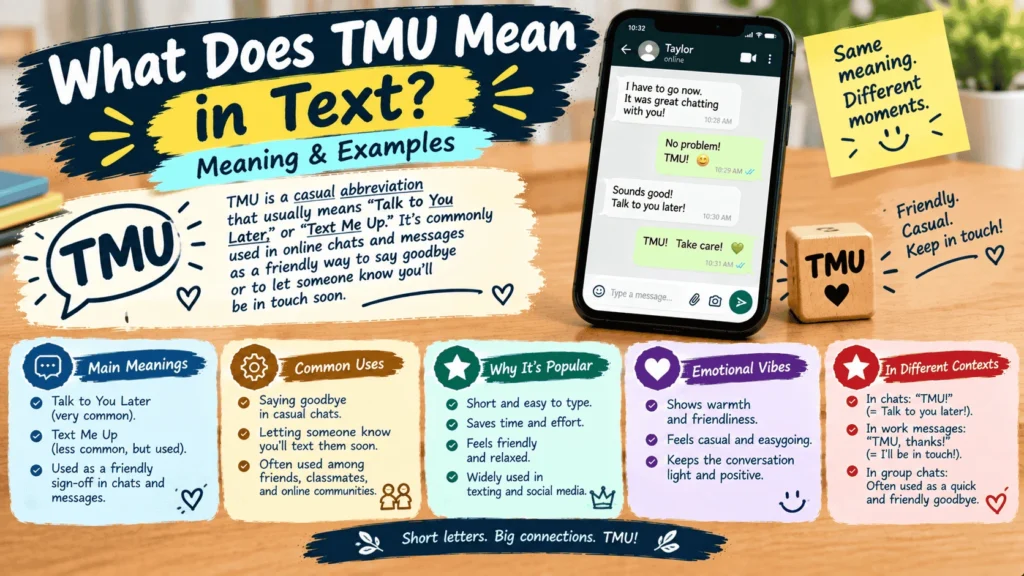
The most common casual-texting interpretation is “Text Me Up,” meaning “message me,” “text me,” or “get in touch with me.” However, TMU is not a standardized abbreviation like LOL, BRB, or IDK, so its meaning can shift with the conversation. Some users also use it for expressions such as “Tell Me When” or “Turn Me Up.”
That context matters.
For example, “TMU later” is likely asking someone to message later, while “TMU!” in a music or hype-related conversation may mean “Turn Me Up!” The surrounding words, relationship, platform, and tone usually provide the answer.
So, if you searched “Whats TMU Mean in Text,” you are probably trying to avoid one of those small but surprisingly awkward texting misunderstandings.
TMU – Quick Meaning
In everyday informal texting, TMU commonly means “Text Me Up.”
In simple English, it can mean:
- Text me
- Message me
- Get in touch with me
- Contact me later
- Continue the conversation by text
For example:
“I have to go now, TMU later.”
This naturally means: “I have to go now, text me later.”
Another example:
“TMU when you’re free.”
Here, the sender is asking you to message them when you become available.
And:
“Had fun today 😂 TMU!”
This can be a friendly invitation to keep the conversation going.
One important point: TMU does not have one universally fixed meaning in texting. Current slang references commonly identify “Text Me Up,” while other sources document context-based interpretations such as “Tell Me When.”
Origin & Background of TMU
There is no reliably documented single person, event, or website that can be credited as the creator of TMU as texting slang.
That is common with internet language.
Texting culture has always encouraged people to shorten phrases. Early SMS encouraged compact messages, while instant messaging, social networks, and smartphones made abbreviated language even more natural.
TMU fits into that broader culture of compression: a longer thought becomes three letters that make sense to people who share the same conversational habits.
Unlike established abbreviations such as LOL or BRB, TMU remains relatively flexible. That flexibility is one reason different online communities may interpret it differently.
Social media has also changed how abbreviations evolve.
A phrase can begin in one online community, appear in memes or comments, and then acquire a slightly different meaning somewhere else. TikTok, Instagram, Snapchat, WhatsApp, Discord, and gaming communities all encourage fast, informal communication.
There is also a documented “Turn Me Up” use of TMU in slang, particularly in hype-oriented contexts.
So the safest rule is simple:
Don’t decode TMU from the letters alone. Decode it from the conversation.
Real-Life Conversations
1. WhatsApp — Asking Someone to Message Later
Person A:
I’m heading into class now.
Person B:
Okayyy, TMU after? 😊
Person A:
Sure, I’ll text you when I’m done.
Here, TMU means something like “text me later” or “message me afterward.”
The friendly emoji also makes the message feel warm rather than demanding.
2. Instagram DM — Continuing a Conversation
Person A:
That story was actually hilarious 😂
Person B:
I have a whole story behind it lol.
Person A:
Wait I need to hear this.
Person B:
TMU tonight.
In this context, TMU works as a casual invitation to message later and continue the conversation.
3. TikTok Comment — Hype Context
Person A:
This beat is ridiculous 🔥
Person B:
TMU!!!
Here, interpreting TMU as “Text Me Up” would not make much sense.
In a music or hype setting, “Turn Me Up!” is a more plausible interpretation. That use is documented in slang references and is associated with the idea of increasing energy, excitement, or volume.
4. Text Message — Context Is Everything
Person A:
Let me know when you get home.
Person B:
TMU when I get there.
Here, the sender may be using TMU as shorthand for “text me” or “tell me when,” depending on their personal texting style.
Because this interpretation is less standardized, a person’s established habits matter.
Emotional & Psychological Meaning of TMU
An abbreviation like TMU may look purely functional, but texting is rarely just about saving characters.
When someone says “TMU later,” they are often doing more than asking for a message.
They may be signaling:
- “I want to keep talking.”
- “Don’t disappear.”
- “Let’s continue this conversation.”
- “I enjoy hearing from you.”
- “Contact me when you have time.”
The emotional meaning depends heavily on the relationship.
From a close friend, “TMU later” may feel completely ordinary. From someone you have recently started dating, the same words can carry a little more warmth or interest.
This is one of the interesting things about digital communication: brevity does not necessarily mean emotional distance.
I have seen this happen in ordinary conversations where two people are clearly comfortable with each other. A short “TMU when you’re free” can actually feel more natural than a formal “Please contact me when you become available.”
The shorter message works because the relationship supplies the missing context.
Usage in Different Contexts
Social Media
TMU can appear in Instagram DMs, TikTok comments, Snapchat conversations, and other informal online spaces.
When it means “Text Me Up,” it generally invites someone to continue communicating.
However, social media is also where alternative meanings can become important. A hype comment may use TMU as “Turn Me Up,” while a personal message may use it as shorthand for “text me.”
Friends & Relationships
Among friends, TMU can be a relaxed way of saying:
“Message me later.”
It can also help keep a conversation open without sounding overly serious.
In romantic conversations, context becomes even more important.
“Goodnight ❤️ TMU tomorrow.”
That can feel like a simple invitation to reconnect.
But the same abbreviation from a casual acquaintance may simply mean, “Send me a message.”
Don’t automatically treat TMU as flirtatious.
Work & Professional Settings
TMU is generally not ideal for professional communication.
If you are emailing a manager, client, teacher, customer, or professional contact, write the complete thought instead:
- “Please message me when you’re available.”
- “Let me know when you arrive.”
- “Please contact me later.”
Professional communication benefits from clarity, especially when the recipient may not know your personal abbreviation style.
Casual vs. Serious Tone
TMU is primarily casual.
It works naturally among people who already communicate informally, but it becomes less suitable when the message involves important instructions, deadlines, money, safety, or sensitive information.
When accuracy matters, spell it out.
When NOT to Use TMU
Avoid TMU when there is a realistic chance that the other person will misunderstand it.
For example, don’t rely on it for:
- Important workplace instructions
- Formal emails
- Customer communication
- Academic writing
- Medical or safety-related information
- Legal or financial communication
- Conversations with someone unfamiliar with texting slang
Cultural and generational differences can also matter.
Someone who spends a lot of time on social media may immediately recognize TMU, while another person may interpret it as an acronym from work, education, or technology.
When the stakes are high, clarity beats cleverness.
Common Misunderstandings About TMU
1. Assuming it always means “Text Me Up”
“Text Me Up” is a common texting interpretation, but it is not universal.
If someone uses TMU in a completely different sentence, forcing that definition onto the conversation can create confusion.
2. Confusing TMU with HMU
HMU commonly means “Hit Me Up.”
That is much more established in casual internet slang.
TMU can sometimes serve a similar conversational purpose, but the abbreviations are not identical.
3. Assuming TMU is always romantic
It isn’t.
A friend, sibling, classmate, coworker, or partner could use it. The relationship and surrounding conversation matter more than the three letters.
4. Thinking every abbreviation has one dictionary meaning
Internet slang doesn’t work that neatly.
People modify phrases, invent shortcuts, and give old abbreviations new meanings. TMU is a good example of why context matters.
TMU vs. Other Texting Terms
| Term / Search Intent | Meaning in Text | How to Use It | Example |
|---|---|---|---|
| TMU | Often “Text Me Up”; context-dependent | Use casually when the recipient understands your slang | “TMU later.” |
| HMU | Hit Me Up | Ask someone to contact you | “HMU when you’re free.” |
| LMK | Let Me Know | Ask someone to provide information or an update | “LMK when you arrive.” |
| DM me | Direct Message Me | Ask someone to contact you privately on social media | “DM me the details.” |
| Text me | Send me a text | Clear, informal request | “Text me when you get home.” |
| TTYL | Talk To You Later | Signal that you’ll continue the conversation later | “Gotta go, TTYL.” |
Key Insight
TMU is more context-dependent than many familiar texting abbreviations. If the sentence clearly suggests contacting someone, “Text Me Up” is a sensible interpretation. If the conversation is about music, energy, or hype, “Turn Me Up” may make more sense.
Variations / Types of TMU
Because TMU is flexible, you may encounter several interpretations.
1. TMU — “Text Me Up”
TMU meaning: Message me or get in touch.
TMU in text: A casual request to contact the sender.
“TMU later.”
This is one of the most commonly reported modern texting interpretations.
2. TMU — “Text Me”
TMU slang: A shortened request for a message.
TMU in chat: Similar in practical meaning to “text me.”
“TMU when you’re done.”
The exact expansion may be informal rather than grammatically precise.
3. TMU — “Tell Me When”
TMU abbreviation: Used by some people to request an update.
TMU in texting: “Tell me when something happens.”
“TMU when you get home.”
This interpretation is documented in current texting references, although it is less universal.
4. TMU — “Turn Me Up”
TMU slang: Increase the energy, excitement, or volume.
TMU in chat: Often appears in music, entertainment, sports, or hype situations.
“This song is crazy. TMU!”
This use is documented in slang sources.
5. TMU — Context-Based “Tell Me You…”
TMU meaning: Can begin a phrase such as “Tell me you…”
TMU in chat: Usually requires the rest of the sentence to understand it.
“TMU you didn’t actually do that 😂”
This is highly context-dependent.
6. TMU — Personal Friend-Group Slang
TMU abbreviation: A private shorthand created within a group.
TMU in text: Meaning can be understood only by people familiar with the group.
This is one reason online slang dictionaries cannot always provide a single definitive answer.
7. TMU — Social Media Hype
TMU slang: A short expression of excitement.
TMU in comments: Can overlap with “Turn Me Up!”
It is especially understandable when the surrounding post involves music, dancing, sports, or celebration.
8. TMU — Message-Continuation Cue
TMU in chat: A way to indicate that the conversation should continue later.
TMU meaning: “Contact me later.”
“I have to run. TMU tonight.”
How to Respond When Someone Uses TMU
Your response should depend on what you think they mean.
Casual Replies
If they’re asking you to message them:
“Sure, I will!”
“Yep, TMU later 😄”
“Definitely.”
Funny Replies
If you’re close friends:
“TMU? You mean I have homework now? 😂”
“Say less 😂”
“Okay boss, incoming text.”
Mature Replies
If you’re unsure:
“Sure — do you mean text you later?”
That is often the smartest response because it resolves ambiguity without making the conversation awkward.
Respectful Replies
For someone you don’t know well:
“Sure. What time would you like me to message you?”
Or:
“Of course. Just let me know when you’re available.”
A clear response is always better than pretending to understand.
Regional & Cultural Usage
Western Culture
In American and other Western online communities, texting abbreviations are strongly associated with casual digital communication.
TMU can appear alongside expressions such as HMU, LMK, TTYL, and similar shortcuts.
Still, familiarity varies considerably between individuals.
Asian Culture
In many Asian online communities, English texting abbreviations are mixed with local languages and informal expressions.
A person may understand the letters while interpreting the surrounding sentence through their own language and cultural communication style.
That can make context especially important.
Middle Eastern Culture
English abbreviations are common in many multilingual digital conversations, particularly among younger internet users.
However, people may combine English slang with Arabic or other languages. TMU can therefore appear inside a mixed-language message where the intended meaning is obvious to the participants but less obvious to an outsider.
Global Internet Usage
The internet has made slang travel quickly.
A phrase that feels natural in one online community can appear unfamiliar somewhere else only weeks later.
That is why there is no guarantee that every person using TMU has the same definition in mind.
Gen Z vs. Millennials
Younger users may be more comfortable with rapidly changing social-media shorthand, while Millennials may recognize older texting conventions more readily.
But generation alone cannot determine meaning.
A person’s platform habits, friend group, language background, and online communities can matter just as much.
Is TMU Safe for Kids?
Generally, TMU itself is not inherently offensive or dangerous.
When used to mean “Text Me Up,” it is simply informal communication shorthand.
The important issue is context.
Parents and younger users should look at the entire conversation rather than treating every unfamiliar abbreviation as harmless or suspicious. Since TMU can have multiple meanings, understanding who sent it, what came before it, and what follows it is more useful than relying on the abbreviation alone.
For younger children, clear language is usually preferable when communication involves plans, safety, strangers, or personal information.
FAQs About TMU
1. What does TMU mean in text?
TMU commonly means “Text Me Up,” a casual way of asking someone to message or contact them. However, its meaning can vary by context.
2. What does TMU mean on Instagram?
On Instagram, TMU may mean “Text Me Up” when someone wants you to continue the conversation by message. In some contexts, it can have another meaning, so read the surrounding DM or comment.
3. What does TMU mean on TikTok?
On TikTok, TMU can mean “Text Me Up” or “Turn Me Up,” depending on whether the conversation is about contacting someone or creating excitement/hype.
4. Is TMU the same as HMU?
Not exactly. HMU commonly means “Hit Me Up,” while TMU is more context-dependent and is often interpreted as “Text Me Up.”
5. Is TMU a romantic abbreviation?
Not necessarily. Friends, relatives, classmates, and romantic partners can all use it. The relationship and surrounding conversation determine the tone.
6. Can TMU have different meanings?
Yes. TMU can represent different phrases in different communities, including “Text Me Up,” “Tell Me When,” and “Turn Me Up.”
7. What should I do if I don’t understand TMU?
Look at the surrounding message first. If the meaning still isn’t clear, simply ask, “What do you mean by TMU?” It is better to clarify than to build a whole interpretation around three letters.
Conclusion
So, what does TMU mean in text?
In everyday casual messaging, TMU is commonly used to mean “Text Me Up”—essentially, “message me,” “text me,” or “get in touch.”
But there is an important lesson behind this little abbreviation: context matters more than the letters.
TMU can mean something different in a hype-filled TikTok comment, a private Instagram conversation, a WhatsApp message, or a personal friend group. “Turn Me Up” is one documented alternative, while “Tell Me When” is another context-based interpretation.
If you receive TMU and understand the surrounding conversation, you can usually interpret it naturally. If you don’t, there is nothing embarrassing about asking.
Good communication isn’t about knowing every piece of internet slang.
It’s about making sure the other person understands what you mean—and you understand what they mean.