
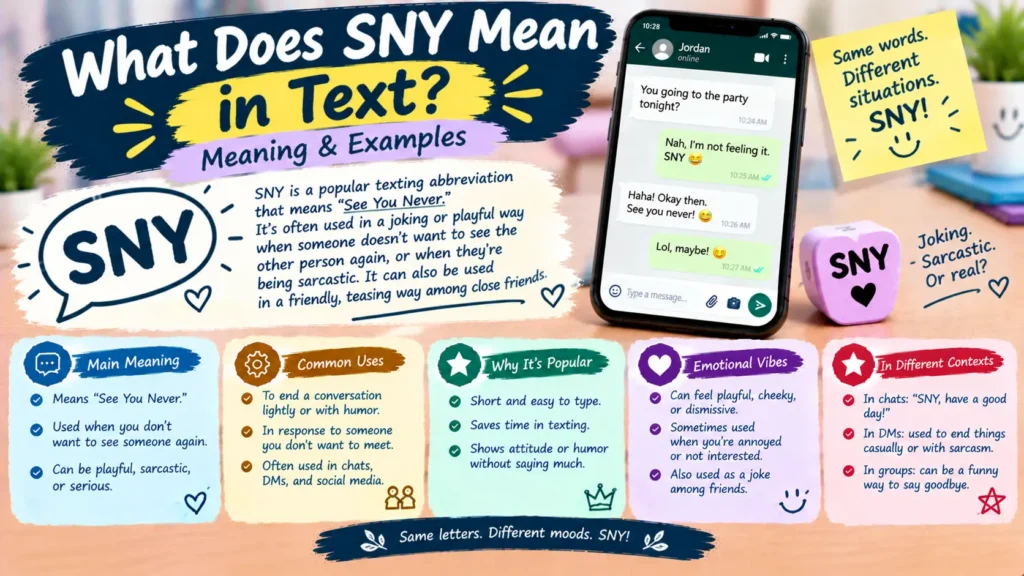
If someone suddenly texts you “SNY”, you might wonder whether they are joking, being sarcastic, or trying to say something more personal. Three letters can feel surprisingly confusing when there is no obvious clue about what they mean.
In casual texting, SNY can mean “So Not You.” It is commonly used when someone does something that feels unusual, unexpected, or different from their normal personality. For example, a friend who hates waking up early might say they are going jogging at 5 a.m., and you could respond, “SNY 😂.”
However, SNY is not a universally fixed abbreviation. Some abbreviation references also list “Still Need You” as an internet-chat meaning, while other sources document completely unrelated meanings outside texting.
That is why context matters.
If you saw SNY in a conversation with friends, a social-media comment, or a private message, the surrounding words, relationship, and tone can help reveal what the sender intended.
This guide explains what SNY means in text, how people use it, what emotional tone it can carry, and how to respond without misunderstanding the message.
SNY – Quick Meaning
In casual texting, SNY most commonly refers to “So Not You,” meaning something is unlike a person’s usual behavior, personality, style, or attitude.
SNY can express:
- So Not You
- Something feels out of character
- Surprise about someone’s behavior
- Playful teasing
- Light disagreement or disbelief
- A reaction to an unexpected change
Some abbreviation directories also list “Still Need You” as an internet-chat interpretation.
So, if someone sends only “SNY,” do not automatically assume one definition. Look at the conversation first.
Simple examples
“You’re wearing all black today? SNY 😂”
“You actually apologized first? SNY.”
“I’m going to wake up at 5 tomorrow.”
“SNY 😭 You never wake up before noon.”
In these examples, SNY means something like “That is so unlike you.”
Origin & Background of SNY
Unlike established abbreviations such as LOL, BRB, or IDK, SNY does not have one universally documented origin in everyday texting.
Modern messaging culture encourages people to shorten phrases into quick combinations of letters. “So Not You” naturally fits that pattern because each major word contributes an initial.
The rise of texting, social media, comments, and private messaging has also encouraged increasingly compact communication. People often assume that friends will understand shortened expressions because they already share context.
That context is especially important with SNY.
The phrase “so not you” existed long before texting. People have traditionally used it in spoken English to point out that someone’s behavior seems unusual.
Digital communication simply gives the phrase a shorter form.
For example, instead of writing:
“That is so unlike you.”
someone might type:
“SNY 😂”
Social-media culture can make the expression even more playful. A short abbreviation can work almost like a reaction rather than a complete sentence.
It can also evolve within individual friend groups. Some people may use SNY for “So Not You,” while another person may understand it as “Still Need You.” Reference sources demonstrate that SNY has multiple meanings, so assuming one interpretation without context can create confusion.
Real-Life Conversations
The best way to understand SNY meaning in text is to see how it works in natural conversations.
1. WhatsApp Chat
Person A:
I think I’m going to start waking up at 6 every morning.
Person B:
SNY 😂
Person A:
Why are you laughing?
Person B:
Because you literally sleep until noon every weekend.
Here, SNY means “So Not You.” The sender is teasing their friend because the new plan seems completely different from their usual routine.
2. Instagram DM
Person A:
I bought a bright pink jacket today.
Person B:
SNY 😭
Person A:
Excuse me??
Person B:
You always say pink isn’t your color 😂
The expression is playful. The sender knows the other person’s normal style and is pointing out the contrast.
3. TikTok Comments
User 1:
Me deleting my entire playlist and listening only to classical music now.
User 2:
SNY 💀
User 1:
Character development, okay?!
In this situation, SNY works almost like a humorous reaction to an unexpected personality change.
4. Text Messages
Person A:
I finally told him how I feel.
Person B:
SNY?
Person A:
I know. I surprised myself too.
Here, the meaning is more emotional. The friend is surprised because the person normally avoids emotionally difficult conversations.
Emotional & Psychological Meaning of SNY
The interesting thing about SNY is that it usually depends on familiarity.
You generally need to know something about a person’s normal behavior before you can say that something is “so not them.”
That gives SNY a relational quality.
It can communicate:
- Surprise
- Familiarity
- Playful teasing
- Affection
- Concern
- Mild criticism
- Recognition of a personality change
For example, if your normally quiet friend suddenly posts ten dramatic selfies, saying “SNY 😂” can mean, “This is completely different from the person I know.”
The phrase can therefore reveal something about how people communicate online. Short expressions often carry information that is not written directly.
The sender may be saying:
“I know you well enough to notice that this isn’t your usual behavior.”
That can feel affectionate when the relationship is close.
A personal-style scenario
Imagine a friend who always insists they hate public speaking. One day, they tell you they volunteered to give a presentation in front of hundreds of people.
You might reply:
“SNY. Who are you and what happened to my friend? 😂”
You are not necessarily criticizing them. You are recognizing a surprising change.
That is where tone becomes more important than the abbreviation itself.
Usage in Different Contexts
Social Media
On Instagram, TikTok, Snapchat, and similar platforms, SNY can work as a quick reaction to something unexpected.
A friend may post a completely different hairstyle, unusual outfit, new hobby, or surprising opinion.
A comment such as:
“SNY 😂”
can mean:
“This is so unlike you.”
The shorter format works especially well in fast-moving comment sections.
Friends and Relationships
SNY is most natural between people who already understand each other’s personalities.
Friends may use it to tease each other about unexpected choices.
In romantic relationships, however, the tone needs more attention.
“SNY” can sound affectionate between close partners, but it can also feel judgmental if someone is already insecure about a decision.
Work and Professional Settings
SNY is generally better avoided in professional communication.
Even if you know what it means, your manager, client, colleague, or business partner may not.
Professional communication benefits from clarity. Instead of:
“SNY 😂”
you could write:
“That’s quite different from your usual approach.”
That removes the ambiguity.
Casual vs. Serious Tone
SNY is primarily casual.
An emoji can make the intention clearer:
“SNY 😂” = playful
“SNY 😭” = surprised or dramatically amused
“SNY…” = potentially skeptical or concerned
“SNY?” = questioning the unexpected behavior
The punctuation can change the emotional impression.
When NOT to Use SNY
There are several situations where using SNY may create unnecessary confusion.
Formal Communication
Avoid it in formal emails, business proposals, academic communication, and official messages.
The abbreviation is informal and may not be understood.
With Someone You Barely Know
Telling a new acquaintance that their behavior is “so not them” can sound presumptuous.
You may not know them well enough to make that judgment.
During Sensitive Conversations
If someone is discussing grief, relationship problems, anxiety, family issues, or another serious subject, a casual “SNY” may come across as dismissive.
A direct and compassionate response is usually clearer.
When the Meaning Is Unclear
If you mean “Still Need You” rather than “So Not You,” spell it out.
Because SNY has multiple documented interpretations, clarity is more valuable than brevity when the message is important.
Common Misunderstandings About SNY
1. Assuming SNY Always Means One Thing
This is probably the biggest mistake.
SNY has several documented meanings across different contexts. In texting, “So Not You” is one interpretation, while “Still Need You” is also listed by abbreviation references.
2. Thinking It Is Automatically Rude
SNY is not inherently rude.
Between close friends, it can be affectionate teasing.
However, without a friendly relationship or an emoji, it may sound critical.
3. Missing the Personality Context
“So Not You” depends on knowing what the person is normally like.
If you do not know the person well, the expression can feel strange.
4. Confusing Literal and Figurative Meaning
SNY is not normally a literal description.
When it means “So Not You,” it points toward a contrast between someone’s current behavior and their expected personality.
5. Assuming Everyone Knows the Abbreviation
Not everyone uses niche texting abbreviations.
Even frequent social-media users may interpret SNY differently.
Comparison Table
| Expression | Meaning in Text | How to Use It | Example | Tone |
|---|---|---|---|---|
| SNY | So Not You | React to unexpected behavior | “You like camping now? SNY 😂” | Playful/surprised |
| Still Need You | Indicates someone is still needed or wanted | Use when the context clearly supports this meaning | “SNY, don’t leave yet.” | Personal |
| That’s so unlike you | Direct version of SNY | Use when clarity matters | “That’s so unlike you.” | Neutral |
| Out of character | Behavior doesn’t match someone’s usual personality | Use for a clearer description | “That seems out of character.” | Neutral |
| Not your vibe | Something does not match someone’s usual style | Use casually with friends | “That outfit isn’t your vibe.” | Casual |
| This isn’t you | A more direct statement about unexpected behavior | Use when expressing concern or surprise | “This isn’t you. What happened?” | Serious |
| SMH | Shaking my head | Use for disbelief or frustration | “You forgot again? SMH.” | Critical/playful |
Key Insight
SNY is strongly dependent on context. When it means “So Not You,” it works best when the sender and receiver already know each other’s personalities. If the meaning could be misunderstood, spelling out the phrase is safer.
Variations and Related Types
Here are several expressions and forms that may appear around the same conversational idea.
1. SNY Meaning
SNY meaning: Usually “So Not You” in the casual context discussed here.
It points out that someone’s behavior seems unusual for them.
2. SNY in Text
SNY in text: A short reaction to unexpected or out-of-character behavior.
Example: “You’re cooking now? SNY 😂”
3. SNY Abbreviation
SNY abbreviation: An abbreviated three-letter expression whose meaning depends on context.
The letters can represent different phrases in different settings.
4. SNY Slang
SNY slang: Informal internet shorthand used for quick reactions.
It is much more appropriate for casual conversation than formal writing.
5. SNY in Chat
SNY in chat: Often used as a short response when a friend does something unexpected.
Example: “You actually went to the gym? SNY 😭”
6. “So Not You”
So Not You: The expanded phrase behind the conversational interpretation.
It means the behavior does not seem typical of that person.
7. “That’s Not You”
That’s not you: A more direct alternative.
It can sound more serious because it lacks the playful ambiguity of SNY.
8. “Out of Character”
Out of character: A clearer expression for behavior that differs from someone’s established personality.
It is suitable in both casual and somewhat more serious conversations.
9. “Not Your Vibe”
Not your vibe: A modern casual phrase suggesting something does not match someone’s normal preferences or style.
It is less focused on behavior than SNY can be.
10. “This Isn’t You”
This isn’t you: A stronger and more emotionally loaded variation.
It can be supportive, concerned, or confrontational depending on context.
How to Respond When Someone Uses SNY
Your response should depend on the tone behind the message.
Casual Replies
- “I know 😂 I’m trying something new.”
- “People change!”
- “Let me surprise you for once.”
- “I’m full of surprises.”
Funny Replies
- “Character development 😎”
- “Plot twist.”
- “New personality unlocked.”
- “You clearly don’t know me anymore 😂”
Mature Replies
- “Yeah, I’ve been thinking differently lately.”
- “I know it’s different from what I usually do.”
- “Sometimes people change their minds.”
- “I wanted to try something outside my comfort zone.”
Respectful Replies
If you are unsure whether the person is teasing or criticizing you, ask:
“What do you mean by SNY?”
That simple question can prevent a surprisingly large misunderstanding.
Regional & Cultural Usage
The interpretation and tone of SNY can change depending on the communication culture.
Western Culture
In many casual Western online conversations, short slang expressions are commonly used between friends.
SNY may be interpreted playfully when accompanied by laughing or crying emojis.
However, familiarity still matters more than geography.
Asian Culture
In many Asian communication settings, indirect communication and relationship-based context can influence how slang is received.
A phrase such as “SNY” may be understood among close friends but could feel too blunt or unclear in a more formal interaction.
The exact reaction varies widely between countries and individuals.
Middle Eastern Culture
Among close friends, informal English abbreviations may appear frequently in digital conversations.
However, relationships, age, respect, and social setting can strongly influence whether playful teasing feels appropriate.
In formal or sensitive conversations, a clearer phrase is usually preferable.
Global Internet Usage
Internet slang travels quickly across borders.
A person in one country may learn SNY from an American, British, or international social-media community and use it differently from someone who encountered it elsewhere.
This is one reason online abbreviations can have multiple meanings.
Generational Differences
Younger users who spend considerable time on social media may be more comfortable interpreting short forms from context.
Millennials and older users may recognize some abbreviations but prefer the complete phrase.
Neither group automatically interprets SNY the same way.
Digital language is shaped by individual communities as much as by age.
Is SNY Safe for Kids?
Generally, SNY is not inherently offensive or explicit when used to mean “So Not You.”
The bigger issue is context.
Children and younger teens should understand that abbreviations can be ambiguous. A phrase intended as playful teasing may sound rude when written without an emoji or explanation.
Parents and educators can use examples to teach an important digital-communication skill: short does not always mean clear.
If a message could reasonably have two meanings, asking for clarification is a healthy response.
FAQs About SNY Meaning in Text
1. What does SNY mean in texting?
In casual texting, SNY can mean “So Not You,” referring to behavior that seems unusual or out of character for someone.
2. Is SNY slang?
Yes. When used as “So Not You,” SNY functions as informal texting or internet shorthand rather than standard formal English.
3. Is SNY rude?
Not necessarily. Among close friends, it can be playful teasing. Without the right relationship or context, however, it may sound judgmental.
4. Can SNY mean something else?
Yes. Some abbreviation references list “Still Need You” as an internet-chat meaning, while SNY has numerous unrelated meanings in other fields.
5. What does SNY mean from a girl?
There is no special universal meaning based on gender. If she uses SNY to mean “So Not You,” the exact tone depends on the conversation and your relationship.
6. What does SNY mean from a guy?
It can similarly mean “So Not You” when someone is reacting to behavior that seems unlike you. The surrounding message is more important than the sender’s gender.
7. How should I respond to SNY?
If it is clearly playful, you can respond with humor. If you are unsure, simply ask, “What do you mean?” This is the safest way to resolve an ambiguous abbreviation.
Conclusion
So, what does SNY mean in text?
In a casual conversation, SNY can mean “So Not You,” especially when someone is reacting to behavior that feels unexpected or out of character.
It can be playful, affectionate, surprised, or mildly critical depending on who says it and how it is written.
At the same time, SNY is not a universal abbreviation with only one meaning. Reference sources also document interpretations such as “Still Need You,” along with several meanings outside everyday texting.
That is why context should always come first.
If a close friend writes “SNY 😂,” they may simply be teasing you because you did something completely unexpected. If the same three letters appear in a serious conversation, another interpretation may make more sense.
The best habit with internet slang is not to memorize every abbreviation perfectly. It is to pay attention to the relationship, conversation, punctuation, and emotional situation.
Sometimes three letters say a lot. Sometimes they need three more words to make the meaning clear.




