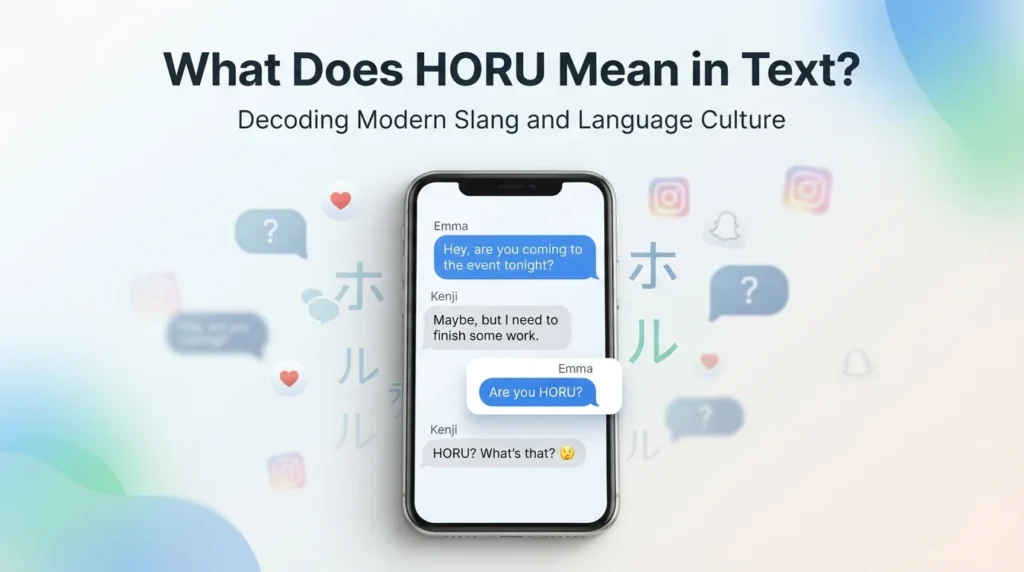
If you’ve received a message containing “horu”, you may have wondered whether it is slang, an abbreviation, a typo, or a word borrowed from another language.
The confusion makes sense because HORU can have more than one meaning online. In internet slang, HORU is commonly listed as an abbreviation for “How Old Are You?”
However, context matters. If you saw “horu” in a Japanese-related conversation, it may refer to the Japanese verb horu, which can have different meanings depending on the kanji and dialect. In standard Japanese, 掘る (horu) means “to dig,” while related forms such as 彫る (horu) mean “to carve” or “engrave.”
So, what does horu mean in text? In casual English-language chat, the most relevant slang meaning is usually “How Old Are You?”
Let’s break down the meanings, examples, cultural context, and ways to respond.
Horu Meaning in Text – Quick Meaning
In online slang, HORU means “How Old Are You?”
It is an informal acronym used when someone wants to know another person’s age.
For example:
“Hey, HORU?”
means:
“Hey, how old are you?”
You might also see:
“HORU and where are you from?”
Here, the person is asking your age and location.
Another example:
“Can I ask HORU?”
This is a softer way of asking someone how old they are.
What does HORU mean in simple words?
- HORU = How Old Are You?
- Type: Internet slang/acronym
- Used in: Texting, chats, social media
- Tone: Usually casual and direct
- Best for: Informal conversations
The acronym is documented by slang references as meaning “How Old Are You?”
That said, don’t automatically assume every occurrence means this. A Japanese conversation, a typo, or a personal username can point to something completely different.
Origin & Background of HORU
HORU isn’t a standard English word. Its slang use comes from the broader culture of online abbreviations, where people shorten common questions to type faster.
The pattern is similar to expressions such as “HBU” for “How About You?” or “HRU” for “How Are You?”
HORU follows the same idea:
H = How
O = Old
R = Are
U = You
This kind of shorthand became especially common in chat rooms, messaging platforms, forums, and early social networks.
One slang reference describes HORU as an internet-chat acronym used when someone wants to ask another person’s age.
HORU meaning Snapchat
If you’re searching specifically for “horu meaning Snapchat,” the important thing to remember is that Snapchat does not automatically give the word a completely different definition.
Someone sending:
“HORU?”
may simply be asking:
“How old are you?”
Snapchat’s informal communication style makes abbreviations particularly natural. However, context still matters because users sometimes invent personal shorthand or use words from other languages.
Real-Life Conversations
The easiest way to understand HORU is to see how it works in actual conversations.
WhatsApp Conversation
Person A:
Hey! We haven’t talked before. HORU?
Person B:
I’m 22. You?
Person A:
24. Nice to meet you!
Here, HORU is simply a quick way to ask someone’s age.
Instagram DM
Person A:
You seem really cool 😂 HORU?
Person B:
Haha thanks! I’m 21.
Person A:
Oh nice, I’m 23.
The tone is casual and friendly. The acronym makes the question feel like normal social-media shorthand.
TikTok Comments
Person A:
Your videos are actually so good!
Person B:
Thank youu 😭❤️
Person A:
HORU btw?
Person B:
I’m 19!
Here, the person is asking the creator’s age after commenting on their content.
Text Message
Person A:
Wait, I never asked you this. HORU?
Person B:
I’m 27 lol.
Person A:
No way, I thought you were younger 😂
The meaning is still “How Old Are You?”
Emotional & Psychological Meaning of HORU
At first glance, HORU looks like a purely informational question. But asking someone’s age can carry different social intentions.
Sometimes the person is simply curious.
Sometimes they’re trying to find common ground.
And sometimes they’re trying to determine whether a friendship, conversation, or relationship feels appropriate.
That’s why the tone surrounding HORU matters more than the acronym itself.
For example:
“HORU? Just curious!”
sounds harmless.
But:
“HORU? Don’t lie.”
feels more intrusive.
The words around the acronym change the emotional meaning.
Why do people use HORU?
People often use abbreviations because they make conversations feel faster and more relaxed.
Writing “How old are you?” can sound slightly formal in a casual chat.
“HORU?” feels more like internet language.
I’ve seen this same pattern across online communication: people often shorten questions not because they’re trying to be unclear, but because they want the conversation to feel effortless.
That small difference can influence how comfortable the other person feels.
HORU in Different Contexts
Social Media
On social platforms, HORU can be used when someone wants to know a creator’s or follower’s age.
It may appear in comments, direct messages, or casual conversations.
However, asking someone’s age publicly can sometimes feel intrusive, especially if the person hasn’t shared it themselves.
Friends and Relationships
Among friends, HORU is generally harmless.
Someone might ask it when meeting a new person or discovering that they have similar interests.
In dating conversations, however, age can be more important and sensitive.
It’s better to ask respectfully rather than treating HORU as an excuse to pressure someone into answering.
Work and Professional Settings
HORU is not appropriate for most professional communication.
Avoid writing:
“HORU?”
to a manager, client, teacher, or professional contact.
Instead, if someone’s age is genuinely relevant, ask politely and explain why you need the information.
Casual vs. Serious Tone
HORU is strongly associated with casual communication.
It works better in:
- DMs
- Friend groups
- Casual texting
- Online communities
- Informal chats
It doesn’t belong naturally in formal emails, business proposals, academic writing, or official documents.
When NOT to Use HORU
There are situations where asking someone’s age can create discomfort.
Don’t use HORU simply because you feel entitled to someone’s personal information.
Be especially careful when talking to strangers online.
If someone doesn’t answer, don’t repeatedly ask.
For example, if someone says:
“I’d rather not say.”
A respectful response is:
“No worries!”
That’s much better than pushing them for an answer.
Cultural sensitivity matters
Age can be a more sensitive topic in some cultures and social settings than others.
Some people don’t mind discussing their age. Others consider it personal.
The safest approach is to read the situation rather than assuming everyone will appreciate the question.
Common Misunderstandings About HORU
1. Thinking HORU is a regular English word
It isn’t standard English vocabulary in this slang sense.
It’s an acronym.
2. Assuming every “horu” means “How Old Are You?”
This is one of the biggest mistakes.
Horu can refer to other linguistic meanings, especially in Japanese.
3. Confusing slang HORU with Japanese horu
The Japanese word horu has meanings that are completely unrelated to “How Old Are You?”
For example, 掘る (horu) means “to dig.”
So if someone says:
“穴を掘る”
the context is Japanese, not internet slang.
4. Assuming it is always safe to answer
You don’t have to tell a stranger your age.
If the question makes you uncomfortable, you can simply decline.
HORU Comparison Table
| Term / Phrase | Meaning / Intent | How to Use | Example |
|---|---|---|---|
| HORU | How Old Are You? | Casual online chat | “HORU?” |
| How old are you? | Direct age question | General conversation | “Can I ask how old you are?” |
| Hru | How are you? | Casual texting | “Hru today?” |
| HBU | How about you? | Follow-up question | “I’m 20. HBU?” |
| HRU | How are you? | Informal messages | “Hey, HRU?” |
| HORU vs Japanese horu | Different meanings | Check language/context | “HORU?” vs “掘る” |
Key Insight
HORU is usually an informal abbreviation for “How Old Are You?” in online slang, but “horu” can mean something completely different in Japanese. Always use the surrounding conversation to determine the intended meaning.
Variations and Related Forms
Because online slang changes quickly, you may encounter related expressions when someone wants to ask personal or conversational questions.
1. HORU meaning
HORU means “How Old Are You?”
It is the standard slang interpretation found in internet-slang references.
2. HORU in text
HORU in text is generally used as a quick question about someone’s age.
Example:
“We’ve been chatting for weeks. HORU?”
3. HORU abbreviation
As an abbreviation, HORU compresses the four-word question “How Old Are You?” into four letters.
It follows the common internet habit of representing words with their initial letters.
4. HORU slang
As slang, HORU belongs to informal digital communication.
It isn’t something you’d normally expect in formal writing.
5. HORU in chat
In chat, HORU can stand alone:
“HORU?”
The context usually makes it clear that the sender wants to know your age.
6. HORU on Snapchat
HORU on Snapchat can carry the same “How Old Are You?” meaning when used as an acronym.
But don’t assume Snapchat-specific meaning without checking the conversation.
7. HORU on Instagram
On Instagram, HORU may appear in DMs or comments when someone asks another user about their age.
The casual platform environment makes abbreviated language common.
8. HORU on TikTok
A TikTok commenter might use HORU when asking a creator’s age.
However, comments can lack context, so the person may simply be using a personal abbreviation.
9. Japanese horu
Japanese horu is different.
For example, 掘る (horu) means “to dig.”
There are also other Japanese words pronounced horu with different kanji and meanings.
10. Kansai Japanese horu
Regional Japanese can create another layer of confusion.
In Kansai usage, horu can mean “to throw away,” unlike the standard Japanese sense of “to dig.”
This is why translating a word purely from its Romanized spelling can be misleading.
How to Respond When Someone Uses HORU
Your response depends on your relationship with the person and whether you’re comfortable sharing your age.
Casual Replies
“I’m 22. You?”
“24 haha, what about you?”
“I’m 20 😄”
Funny Replies
“Old enough to know better 😂”
“That’s classified information.”
“Take a guess 👀”
These responses keep things light without necessarily revealing your exact age.
Mature Replies
“I’m 25. Can I ask why?”
This is useful when you want to understand someone’s intention.
Respectful Replies
If you don’t want to answer:
“I’d rather keep that private, hope you don’t mind.”
Or simply:
“I don’t usually share my age online.”
You don’t owe a stranger personal information just because they asked.
Regional & Cultural Usage
HORU as internet slang isn’t tied to one specific culture. Online language travels quickly across countries.
Western Culture
In English-speaking online communities, HORU may be understood as an abbreviated age question.
However, it’s still relatively niche compared with more familiar expressions such as “How old are you?”
Asian Culture
The situation becomes more complicated because horu also appears as a Japanese romanization.
In Japanese, the meaning depends on the kanji and context.
For example:
掘る (horu) = to dig.
This demonstrates why the same Romanized spelling can represent different words.
Middle Eastern Culture
Among English-speaking internet users in the Middle East, HORU may be understood as online slang if the person is familiar with English chat abbreviations.
But cultural expectations around discussing age can vary significantly.
Global Internet Usage
The internet mixes languages constantly.
A person might use English slang in one conversation, Japanese words in another, and local expressions in the same chat.
That makes context essential.
Gen Z vs. Millennials
Younger internet users tend to experiment heavily with abbreviations, shortened words, emojis, and intentional misspellings.
Millennials who grew up with chat rooms and SMS also understand many abbreviations, but niche expressions may be less familiar.
In other words, HORU isn’t necessarily a “Gen Z word.” It’s better understood as a niche internet acronym.
Is HORU Safe for Kids?
The acronym itself isn’t inherently harmful.
However, the conversation behind the question matters.
If a stranger asks a child:
“HORU?”
the child should understand that they don’t have to provide personal information.
Parents and guardians can teach children a simple rule: don’t share personal details with strangers online unless a trusted adult says it’s appropriate.
Age, school, location, phone number, and private photographs can all become sensitive information in the wrong conversation.
FAQs About HORU
What does HORU mean in text?
HORU usually means “How Old Are You?” in informal internet slang.
What does HORU mean on Snapchat?
On Snapchat, HORU can mean “How Old Are You?” when used as an internet acronym. The exact meaning still depends on the surrounding conversation.
Is HORU a Japanese word?
Horu is also a Japanese romanization, but its meaning depends on the kanji. 掘る (horu) means “to dig.”
Is HORU an acronym or slang?
It is generally treated as an internet slang acronym meaning “How Old Are You?”
How should I respond to “HORU?”
If you’re comfortable sharing your age, you can answer directly. If not, say that you’d rather keep it private.
Is HORU appropriate in professional messages?
Generally, no. HORU is informal internet slang and isn’t suitable for most professional communication.
Can HORU have another meaning?
Yes. Context matters. Japanese horu, for example, can have meanings unrelated to the English slang acronym.
Conclusion
So, what does HORU mean in text?
In casual internet slang, it usually means “How Old Are You?” It’s a short, informal way of asking someone’s age.
But there’s an important catch: horu isn’t limited to one meaning.
If you see HORU in an English-language chat, the acronym interpretation is a strong possibility. If you see horu in a Japanese conversation, you need to look at the language, kanji, and surrounding words before deciding what it means.
That small distinction can save you from a very awkward misunderstanding.
And if someone sends you “HORU?” online, remember that you’re in control of what you share. You can answer, joke about it, or politely decline. Good communication isn’t just about understanding slang—it’s also about knowing when a question deserves an answer.