
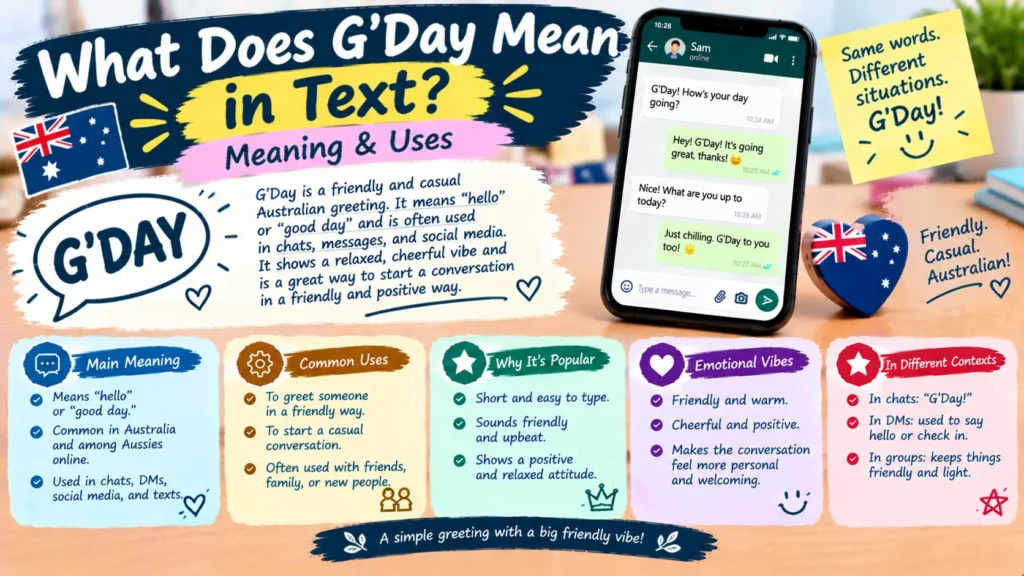
If someone sends you “G’day” in a text, DM, comment, or online conversation, they are usually giving you a friendly Australian-style greeting. It is an informal shortened form of “good day” and is commonly understood as “hello” or “hi.”
The interesting part is that G’day does not usually mean “good day” literally in modern texting. When someone writes “G’day!” they are generally greeting you, not commenting on whether your day is actually good.
You may see it in messages such as “G’day mate,” “G’day! How are you?” or simply “G’day 👋.” Its tone is usually relaxed, friendly, casual, and sometimes distinctly Australian.
People often search for the meaning of G’day because it appears in conversations with Australians, travel content, social media comments, movies, gaming chats, or messages from someone who enjoys Australian slang. Understanding the cultural background makes the expression much easier to interpret.
So, if you’re wondering what does G’Day mean in text, the simplest answer is:
G’day = Hello, hi, or a friendly informal greeting, especially associated with Australian English.
G’Day – Quick Meaning
G’day is an informal Australian English greeting derived from “good day.” Cambridge Dictionary describes it as Australian English used when meeting or greeting someone.
In texting, it can mean:
- Hello
- Hi
- Hey
- Good day
- A friendly Australian-style greeting
The apostrophe represents the shortened form of good, giving us g’day.
Here are a few natural examples:
“G’day! How’s your morning going?”
This simply means, “Hi! How is your morning going?”
“G’day mate, long time no see!”
This is a warm, casual greeting between people who know each other.
“G’day 👋 What are you up to?”
The emoji makes the greeting feel even more relaxed and conversational.
The exact feeling depends on the relationship and surrounding message. From a close friend, it can feel playful. From an Australian speaker, it may simply feel completely ordinary.
Origin & Background
G’day comes from the phrase “good day” and became strongly associated with Australian English. The Australian National Dictionary Centre records the expression from the 1880s, showing that it has a much longer history than modern internet slang.
It is important to understand that G’day is not a newly invented texting abbreviation. Digital communication has simply given an older spoken expression another place to live.
The Australian National Dictionary Centre describes G’day as an abbreviation of “good day” and notes that it is a familiar greeting used frequently at different times of day.
Its international recognition grew considerably during the 1980s, particularly through Australian tourism advertising featuring actor and comedian Paul Hogan. The phrase became a recognizable part of Australia’s international popular image.
Australian educational resources also describe G’day as an informal greeting and give examples such as “G’day, how you going?”
Social media has taken the expression even further. Today, someone does not have to live in Australia to write “G’day.” People around the world use it when discussing Australia, adopting Australian slang, joking with friends, or creating a relaxed and adventurous tone.
That said, frequent Australian usage and playful international usage are not necessarily the same thing. An Australian person may use G’day naturally, while someone elsewhere might use it deliberately because they want an Australian flavor.
Real-Life Conversations
1. WhatsApp Conversation
Person A:
G’day mate! You still coming over tonight?
Person B:
G’day 😂 Yep, I’ll be there around 8.
Person A:
Perfect. Bring your terrible playlist.
Person B:
Absolutely not. My music taste is elite.
Here, G’day creates a playful, friendly opening. Neither person is discussing the quality of the day.
2. Instagram DM
Person A:
G’day! I saw your travel photos. Is that Sydney?
Person B:
Yep! You’ve been there?
Person A:
Not yet, but it’s definitely on my list.
In this situation, G’day adds an Australian or travel-related feeling to the conversation.
3. TikTok Comments
Person A:
G’day from Canada 😂
Person B:
Haha, greetings from Australia!
The commenter is borrowing Australian-style language playfully. The phrase is not necessarily evidence that the person is Australian.
4. Text Messages
Person A:
G’day! Haven’t heard from you in ages.
Person B:
Hey! I know, life got mistaken.
Person A:
We need to catch up soon.
Person B:
Definitely. Coffee this weekend?
Here, the greeting feels warm and informal. The rest of the conversation gives it a friendly rather than formal tone.
Emotional & Psychological Meaning
A greeting may look like a tiny part of a message, but it can influence the emotional temperature of the conversation.
G’day generally feels easygoing and approachable. Compared with a formal greeting such as “Good afternoon,” it feels less stiff and more conversational.
That relaxed quality is one reason people enjoy regional greetings online. A person can communicate more than simple information. They can also signal personality, humor, familiarity, or cultural interest.
For example, “Hello” is neutral and universal. “G’day” carries a little more personality because of its strong connection with Australian English.
Imagine receiving this from an online friend:
“G’day! How’ve you been?”
It can feel like they are deliberately opening the conversation in a cheerful, laid-back way.
In my experience with everyday communication, greetings often tell you how someone wants the conversation to feel before the actual topic even begins. G’day tends to lower the formality level immediately.
However, context still matters. A person could use “G’day” sarcastically, jokingly, or as an imitation of an Australian accent. The word itself does not guarantee a particular emotion.
Usage in Different Contexts
Social Media
On Instagram, TikTok, Facebook, Reddit, or other social platforms, G’day can be used as a friendly comment or conversation starter.
Example:
“G’day! Your camping setup looks amazing.”
It can also be used to give a comment an Australian or adventurous flavor.
Friends & Relationships
Among friends, G’day can sound relaxed and playful.
Example:
“G’day mate, you free tonight?”
Between romantic partners, it may sound cute or teasing, particularly if one person regularly uses Australian expressions.
Work & Professional Settings
G’day is possible in informal workplace communication, especially in Australian environments where casual language is normal.
However, it is not appropriate for every professional situation.
A formal email to a client may be better started with:
“Hello Sarah,”
rather than:
“G’day Sarah!”
The right choice depends heavily on workplace culture, relationship, and communication style.
Casual vs. Serious Tone
G’day is overwhelmingly associated with casual communication.
If someone is discussing a serious complaint, sensitive matter, or formal business issue, the greeting alone does not make the entire conversation casual.
For example:
“G’day, I wanted to discuss an issue with my order.”
The greeting is informal, but the subject can still be serious.
When NOT to Use It
Although G’day is harmless in ordinary conversation, there are situations where another greeting may be more appropriate.
Formal Communication
Avoid it when writing highly formal letters, official documents, or very traditional professional correspondence unless the organization specifically uses informal language.
Sensitive Conversations
If you are contacting someone about grief, a serious complaint, or another sensitive matter, a straightforward greeting may be more suitable.
Cultural Imitation
Using G’day once in a friendly conversation is different from exaggerating Australian slang or imitating an accent to make fun of Australians.
Context and intention matter.
When You Are Unsure of the Relationship
If you’re speaking to a senior professional, new client, or unfamiliar person, “Hello” is safer than immediately adopting very casual language.
Common Misunderstandings
One common mistake is thinking G’day literally means “good day” every time.
Historically, it comes from “good day,” but in contemporary Australian English it functions primarily as a greeting.
Another misunderstanding is assuming it can only be used during the daytime.
The Australian National Dictionary Centre specifically notes that G’day is a familiar greeting used frequently at any hour.
People may also assume that everyone who says G’day is Australian. That is not necessarily true. The expression has become internationally recognizable through travel, entertainment, social media, and internet culture.
Finally, G’day should not automatically be interpreted as romantic. If someone texts you “G’day,” it generally means hello. Any romantic meaning comes from the surrounding relationship and conversation.
Comparison Table
| Term / Search Intent | Meaning in Text | How to Use | Example |
|---|---|---|---|
| G’day mean in text | Hello, hi, friendly greeting | Use in casual conversations | “G’day! How are you?” |
| How to Use G’day | Australian-style informal greeting | Use with friends or in relaxed settings | “G’day mate!” |
| Examples of G’day | Real conversational greetings | Put it at the beginning of a message | “G’day! Long time no see.” |
| G’day vs. Hello | Both can mean a greeting | G’day is more regional and informal | “G’day!” vs. “Hello!” |
| G’day vs. Hey | Both can be casual greetings | G’day adds Australian flavor | “G’day, what’s up?” |
| G’day vs. Good morning | Both can greet someone | G’day is not restricted to morning | “G’day!” at any hour |
Key Insight
G’day is best understood as a friendly greeting rather than a literal comment about having a good day. Its Australian cultural association gives it a relaxed personality that ordinary “hello” may not have.
Variations / Types of G’Day
1. G’day
G’day meaning: Hello or hi.
G’day in text: A casual greeting.
G’day abbreviation: Shortened from “good day.”
G’day slang: Informal Australian English.
G’day in chat: A friendly way to start a conversation.
2. G’day Mate
G’day mate meaning: Hello, friend.
G’day mate in text: A more distinctly Australian-style greeting.
G’day mate abbreviation: No separate standard abbreviation.
G’day mate slang: Informal Australian expression.
G’day mate in chat: Friendly and familiar.
3. G’day!
G’day! meaning: Hi!
G’day! in text: Short, energetic greeting.
G’day! abbreviation: Informal shortening of good day.
G’day! slang: Casual greeting.
G’day! in chat: Useful as a simple opener.
4. G’day Mate 👋
This version combines the greeting with a waving emoji, making the message feel warmer and more playful.
5. G’day Everyone
This is a casual way to greet a group, especially in online communities or social posts.
6. G’day Guys
A relaxed group greeting. The suitability of “guys” depends on the audience and individual preferences.
7. G’day There
This can sound playful or conversational, particularly when addressing someone directly.
8. G’day, How Are You?
This turns the greeting into a complete friendly opener and makes the intention especially clear.
9. G’day From Australia
This phrase is often used when someone is greeting an international audience from Australia.
10. G’day From [Place]
People can also use the structure playfully even when they are outside Australia, especially when joking about Australian expressions.
How to Respond When Someone Uses It
You do not need a special response. Treat G’day like “hello.”
Casual Replies
- “G’day! How are you?”
- “Hey! What’s up?”
- “Hi! How’s it going?”
- “G’day! Long time no see.”
Funny Replies
- “G’day, mate! 😎”
- “G’day! Where’s my kangaroo?”
- “G’day! I’m officially feeling Australian now 😂”
- “G’day! That greeting has serious Aussie energy.”
Mature Replies
- “G’day! Hope you’re doing well.”
- “Hello! Nice to hear from you.”
- “G’day. How have things been?”
Respectful Replies
If the person is unfamiliar to you, a simple “Hello! How are you?” works perfectly.
You do not have to imitate Australian slang just because someone else uses it.
Regional & Cultural Usage
Western Culture
In Australia, G’day is a familiar informal greeting and is strongly connected with Australian English. Australian educational resources describe it as a common informal greeting.
Outside Australia, people in other English-speaking countries may recognize it through films, television, tourism, or online culture.
Asian Culture
In many Asian online communities, G’day may appear as borrowed English slang rather than as a naturally occurring local greeting.
Someone might use it because they are communicating with Australians, discussing Australia, or simply enjoying international internet expressions.
The intended tone is usually more important than the geographical origin of the person using it.
Middle Eastern Culture
English-language online conversations in the Middle East can also incorporate regional expressions from English-speaking cultures.
When G’day appears, it generally retains its basic meaning of hello. The surrounding conversation determines whether it sounds humorous, friendly, or simply casual.
Global Internet Usage
The internet has made regional expressions travel quickly.
A phrase that once belonged strongly to a particular speech community can become recognizable worldwide without losing all of its cultural identity.
G’day is a good example. It remains strongly associated with Australia while also functioning as a recognizable internet greeting.
Gen Z vs. Millennials
There is no strict generational rule for G’day.
Gen Z users may use it ironically, humorously, or as part of internet culture. Millennials may encounter it more naturally through Australian media, travel, or everyday exposure to English varieties.
Australian users of different generations can also use it normally, without intending anything humorous.
The key difference is often context, not age.
Is It Safe for Kids?
Yes. G’day is generally a harmless, informal greeting.
It does not contain profanity or inherently sexual or violent meaning. Children may encounter it in messages, games, videos, books, travel content, or conversations with Australian speakers.
As with any slang expression, children should still learn that casual language is not automatically appropriate in every setting.
For example, “G’day mate!” may be perfectly fine with a friend, while a formal school letter might call for “Dear Mr. Smith” or another conventional greeting.
FAQs
What does G’Day mean in text?
G’day means “hello” or “hi” in text. It is an informal greeting strongly associated with Australian English.
Is G’Day short for good day?
Yes. G’day is a shortened form of “good day.” Historically, the expression has been used as a familiar greeting in Australian English.
Is G’Day only used in Australia?
No. It is strongly associated with Australia, but people around the world use it because of Australian culture, travel, entertainment, and internet communication.
Does G’Day mean good morning?
Not necessarily. Although it comes from “good day,” G’day can function as a general greeting at different times of day.
What does G’Day mate mean?
“G’day mate” means “hello, friend” or simply “hi.” “Mate” adds a familiar, friendly Australian flavor.
Is G’Day formal or informal?
G’day is informal. It works naturally in casual conversations but may not be suitable for highly formal professional communication.
How should I reply to G’Day?
You can simply respond with “G’day!”, “Hey!”, “Hi, how are you?”, or another friendly greeting. You do not need to use Australian slang in your response.
Conclusion
So, what does G’Day mean in text?
In most conversations, it simply means “hello,” “hi,” or “hey,” with a distinctly Australian flavor. It comes from “good day,” but modern usage is generally about greeting someone rather than literally wishing them a good day.
Its history reaches back to Australian English of the late nineteenth century, while its international popularity grew through Australian culture and media.
In a text message, Instagram DM, TikTok comment, or casual chat, G’day usually makes the conversation feel relaxed and approachable.
If someone sends you “G’day!”, there is usually no hidden meaning to decode. A simple “Hey!” or “G’day!” right back is enough.
Sometimes the smallest words carry the strongest sense of place. G’day is one of those expressions. It says hello, but it also brings a little piece of Australian conversational culture along with it.




