
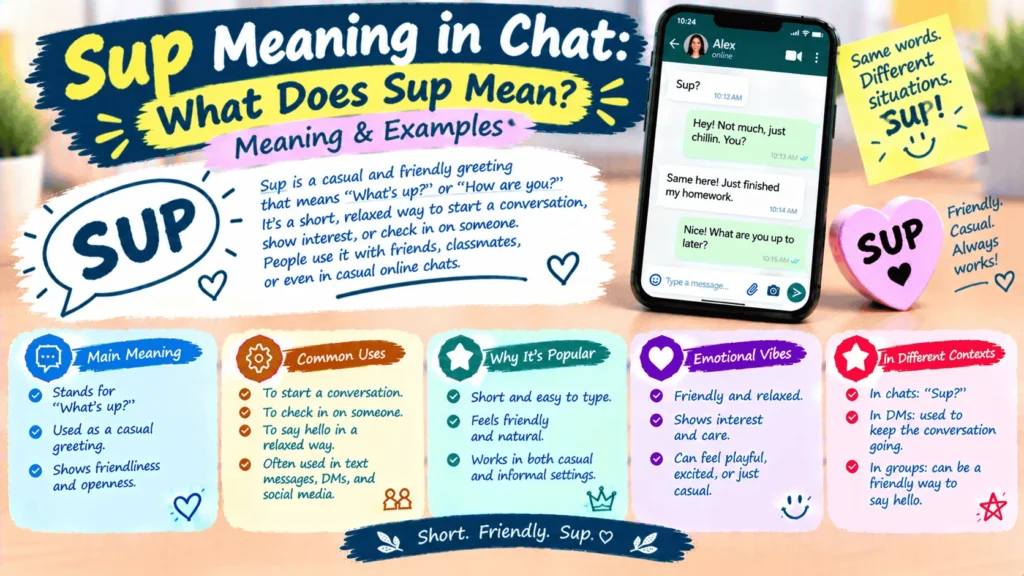
If someone sends you “sup?” in a chat, they are usually asking a very simple question: “What’s up?” or “How are you?” It is one of the shortest and most casual ways to start a conversation online.
The word can look confusing if you have never seen it before. Is it a greeting? A question? An invitation to talk? In most cases, it is all three at once.
Understanding sup meaning in chat becomes especially useful because the exact tone depends on who sends it, when they send it, and what your relationship with them is like.
A close friend might write “sup?” simply to check in. Someone you like might use it as an easy way to start talking without making their interest too obvious. On social media, it can even function almost like “hey.”
The good news is that “sup” is usually friendly, informal, and harmless. It does not normally carry a deep hidden meaning by itself. The conversation around it tells you much more than the three letters do.
Sup Meaning in Chat: Quick Meaning
Sup is an informal shortened form of “What’s up?”
It can mean:
- “What’s up?”
- “How are you?”
- “What are you doing?”
- “Hey, what’s going on?”
- “Want to talk?”
The most common use is as a casual greeting.
For example:
“Sup bro?”
This usually means:
“Hey, what’s up?”
Another example:
“Sup? You free tonight?”
Here, the person is casually checking whether you are available.
You may also see it without a question mark:
“Sup”
That still generally means “What’s up?” The missing punctuation simply makes the message feel even more relaxed.
Origin & Background of “Sup”
The word sup developed as a shortened, conversational form of “what’s up?” It belongs to the broader tradition of shortening everyday expressions in spoken English.
“What’s up?” itself became a familiar informal greeting in American English, particularly through everyday conversation and popular culture.
As texting and instant messaging became common, people naturally began shortening phrases to make communication faster. “What’s up?” became “what’s up,” then “’sup,” and eventually the very compact “sup.”
The rise of SMS, online chatrooms, gaming communities, social networks, and messaging apps helped make these shortened forms normal.
Today, you may see “sup” on Instagram, WhatsApp, Snapchat, TikTok, Discord, gaming chats, or ordinary text messages.
Its popularity also comes from its flexibility. You can use it with a friend you have not spoken to all day, someone you just met online, or a person you regularly chat with.
The meaning remains simple, but the emotional tone can change depending on the relationship.
Real-Life Conversations Using “Sup”
1. WhatsApp Conversation
Person A:
Sup?
Person B:
Not much lol. Just got home. You?
Person A:
Same. Wanna grab something to eat?
Here, “sup?” is simply an easy conversation opener.
2. Instagram DM
Person A:
Sup 👋
Person B:
Heyyy! Nothing much. What’s up with you?
Person A:
Saw your story. That place looked amazing.
In this situation, “sup” opens the door to a longer conversation.
3. TikTok Comments
Person A:
Sup bro 😂
Person B:
Lmao just watching random videos at 2am
Person A:
Same energy 😭
The expression feels playful because of the surrounding slang and emojis.
4. Text Messages
Person A:
Sup
Person B:
Hey, everything good?
Person A:
Yeah. Just wanted to talk for a bit.
Here, the simple greeting may be the beginning of a more personal conversation.
Emotional & Psychological Meaning of “Sup”
At first glance, “sup” may seem almost meaningless. But short messages often carry subtle social signals.
When someone sends “sup,” they are usually making a low-pressure attempt to connect.
Instead of writing:
“Hey, I haven’t spoken to you today. How are you feeling?”
they can simply write:
“Sup?”
It requires very little effort from either person.
That is one reason short greetings work so well in digital communication. They give the other person room to decide how much they want to say.
A friend might respond with one word:
“Chilling.”
Or they might open up:
“Honestly, rough day.”
The original “sup?” does not force either response.
There can also be a subtle psychological reason someone uses it. They may want to talk but not know how to begin.
I have seen this kind of communication many times in everyday messaging. Someone wants to reconnect, but sending a serious opening message feels awkward. “Sup?” becomes a comfortable first step.
It says, in effect, “I’m here. Want to talk?”
“Sup” in Different Contexts
On Social Media
On Instagram, TikTok, Snapchat, or similar platforms, “sup” is usually casual.
Someone may send:
“Sup 👀”
The emoji can make the greeting feel more playful or curious.
Between Friends
Friends commonly use “sup” because there is no need for formal language.
“Sup dude?”
“Sup, you coming?”
The expression can feel warm even though it is extremely short.
In Romantic Conversations
If someone you like texts “sup,” do not automatically assume it is flirting.
It may simply mean:
“Hey, I want to talk.”
However, if the person repeatedly initiates conversations, responds quickly, asks personal questions, or keeps finding reasons to talk, the broader pattern may suggest stronger interest.
The word itself is not enough to prove romantic intent.
At Work
This is where you should be more careful.
“Sup?” may be acceptable among close coworkers who already communicate casually, but it is generally too informal for a manager, client, formal email, interview, or professional introduction.
Instead, use:
“Hi, how are you?”
or
“Hi, do you have a moment?”
Casual vs. Serious Tone
“Sup” is overwhelmingly casual.
If someone needs to discuss something serious, they will normally use clearer language.
For example:
“Sup?”
feels relaxed.
But:
“Hey, can we talk about something important?”
signals a completely different emotional situation.
When NOT to Use “Sup”
Although “sup” is common, it does not belong everywhere.
Avoid it in formal emails, job applications, academic writing, professional introductions, and serious business communication.
Writing:
“Sup, I wanted to ask about the position.”
to a potential employer could sound careless.
It can also be inappropriate when speaking to someone who expects a respectful or formal communication style.
Cultural and generational differences matter too. Someone familiar with internet slang may immediately understand it, while another person may find it overly casual or unclear.
When you are unsure, “Hi” is the safer choice.
Common Misunderstandings About “Sup”
1. Thinking It Has a Secret Meaning
Usually, it does not.
“Sup” is generally just a shortened form of “what’s up?”
2. Assuming It Is Always Flirty
Not necessarily.
A friend, coworker, stranger, or romantic interest can all say “sup.”
Look at the larger conversation instead.
3. Thinking It Is Rude
It can sound overly casual, but that does not automatically make it rude.
Between friends, “sup” can be perfectly friendly.
4. Confusing It With Formal English
“Sup” is slang and informal speech.
It is not appropriate for every situation.
5. Overanalyzing a One-Word Message
If someone sends only “sup,” there may not be a complicated hidden message.
Sometimes “sup” really does just mean:
“Hey.”
Comparison Table
| Term / Search Intent | Meaning or Usage |
|---|---|
| Sup meaning in text | A casual way to say “What’s up?” |
| How to use sup | Use it as an informal greeting with friends or familiar people |
| Examples of sup | “Sup?”, “Sup bro?”, “Sup, you free?” |
| Sup vs. what’s up | “Sup” is shorter, more casual, and more slang-oriented |
| Sup vs. hey | Both can start a conversation, but “sup” usually carries the idea of asking what is happening |
| Sup vs. hi | “Hi” is more neutral and can work in more situations |
| Sup vs. yo | Both are casual greetings, although “yo” can feel even more energetic or attention-grabbing |
Key Insight
The important thing about sup meaning in chat is not the word itself but the context around it. A friend saying “sup?” may simply be checking in, while someone interested in you may be using it as an easy excuse to start talking.
Variations and Types of “Sup”
Here are several common forms you may encounter while texting.
1. Sup Meaning
Sup means “What’s up?” and works as a casual greeting.
2. Sup in Text
Sup in text is an informal way to ask someone what they are doing or how things are going.
3. Sup Abbreviation
Sup is commonly treated as a shortened slang form of “what’s up?”
4. Sup Slang
As slang, sup is relaxed and conversational rather than formal.
5. Sup in Chat
In chat, sup is often used to begin a conversation without needing a specific topic.
6. Sup Bro
Sup bro is a friendly greeting often used between male friends or people communicating casually.
7. Sup?
Adding a question mark can make it feel like a direct invitation for a response.
8. Sup Lol
Adding “lol” makes the message more playful.
“Sup lol?”
This can sound less serious and more relaxed.
9. Sup 👀
The eyes emoji can add curiosity or playful energy.
“Sup 👀”
Depending on the relationship, this may feel teasing or suggestive, but context still matters.
10. Sup 😂
Adding a laughing emoji makes the greeting feel humorous or lighthearted.
“Sup 😂”
It may signal that the person is approaching the conversation playfully.
How to Respond When Someone Says “Sup”
There is no single correct response. Match your reply to the relationship and mood.
Casual Replies
- “Not much, you?”
- “Hey! I’m good. What’s up?”
- “Just chilling. You?”
- “Nothing much lol.”
Funny Replies
- “The ceiling 😂”
- “My stress levels.”
- “Absolutely nothing productive 😭”
- “Just surviving lol.”
Mature Replies
- “Hey, I’m doing well. How are you?”
- “Not much at the moment. How’s your day going?”
- “I’m good, thanks. What have you been up to?”
Respectful Replies
- “Hi! I’m doing well. How are you?”
- “Hey, hope you’re doing well.”
- “Hello! What can I help you with?”
If you want to continue the conversation, avoid answering with only “nothing.”
Instead, add a question:
“Not much. Just finished work. How about you?”
That gives the other person something to respond to.
Regional & Cultural Usage
Western Culture
In American and other Western online communities, “sup” is strongly associated with informal communication.
It is common among friends, younger people, gamers, and social media users.
Asian Culture
English internet slang is widely used across Asian digital communities, particularly among younger users.
However, communication can still depend heavily on age, education, relationship, and local communication norms.
Someone may understand “sup” perfectly but choose a more traditional greeting in everyday conversation.
Middle Eastern Culture
English slang appears frequently in online conversations among multilingual internet users.
Still, the level of informality matters. A person may use “sup” with friends but prefer a more respectful greeting with older people or in professional situations.
Global Internet Usage
Because social media has created a shared internet vocabulary, “sup” is now recognizable far beyond its original cultural setting.
Its meaning generally remains stable:
“What’s up?”
Gen Z vs. Millennials
Younger users may treat “sup” as ordinary internet slang, while some Millennials may associate it more strongly with earlier texting, instant messaging, or gaming culture.
Neither group necessarily gives it a completely different definition.
The difference is often more about style and familiarity than meaning.
Is “Sup” Safe for Kids?
Yes, “sup” is generally harmless slang.
It is simply a casual greeting and does not inherently contain sexual, violent, or offensive meaning.
However, parents and educators should still teach children that context matters.
A child may understand “sup” as a greeting, but they should also learn that strangers online can use casual language to start conversations.
The important lesson is not to fear the word itself, but to understand who is communicating, why they are contacting the child, and whether the conversation remains appropriate.
FAQs About “Sup” in Chat
What does “sup” mean in chat?
“Sup” usually means “What’s up?” It is an informal greeting used to ask how someone is doing or what they are doing.
Is “sup” the same as “what’s up”?
Yes. “Sup” is a shortened, more casual version of “what’s up?”
Is “sup” a slang word?
Yes. “Sup” is informal internet and conversational slang.
Is “sup” flirty?
Not necessarily. It can be friendly, casual, or occasionally flirty depending on the person, relationship, and surrounding conversation.
How do I reply to “sup”?
You can say “Not much, you?”, “I’m good, what’s up?”, or give a playful response such as “The ceiling 😂.”
Is “sup” rude?
Usually not. It is simply very informal. It may seem too casual in professional or formal situations.
Can I use “sup” at work?
Use it only with coworkers you already communicate with casually. For clients, managers, interviews, and formal messages, choose a more professional greeting.
Conclusion
So, what does sup mean in chat?
In most conversations, it simply means “What’s up?” It is a short, relaxed greeting that gives someone an easy way to start talking.
The real meaning comes from the context. A friend may use “sup” to check in, a stranger may use it to start a conversation, and someone you like may use it as a low-pressure opening.
The important thing is not to overthink the three letters. Pay attention to the full conversation, the relationship between the people, and the tone created by emojis or follow-up messages.
When you understand those details, “sup” becomes exactly what it usually is: a simple digital way of saying, “Hey, I’m here. What’s going on with you?”




