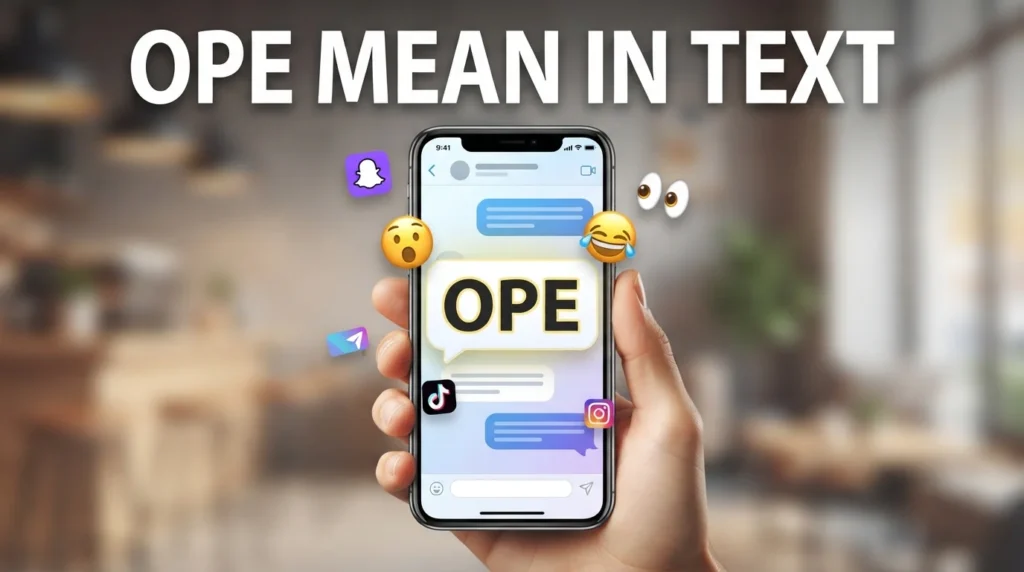
If you’ve seen someone type “ope” in a text, Snapchat message, TikTok comment, or Instagram DM, you may have wondered what they actually mean. Is it an abbreviation? A slang word? Or simply a funny reaction?
In most casual conversations, “ope” is a short interjection used when someone suddenly notices something, makes a small mistake, encounters an unexpected situation, or reacts with mild surprise.
For example, someone might say:
“Ope, I didn’t see you there.”
Or:
“Ope, sent that to the wrong person.”
It often carries a light, spontaneous feeling rather than strong emotion.
The confusion comes from the fact that ope can mean slightly different things depending on context. On social media, it can express surprise or awkwardness. In professional or technical settings, similar-looking forms such as OPE may be an abbreviation with an entirely different meaning.
So, let’s break down what OPE mean in text, where it came from, how people use it, and when you should—or shouldn’t—use it.
OPE Mean in Text – Quick Meaning
In texting and online conversation, “ope” usually means a quick reaction to something unexpected, awkward, accidental, or suddenly noticed.
Think of it as a softer version of:
- “Oh!”
- “Oops!”
- “Oh, wait!”
- “Uh-oh!”
- “Well, I didn’t expect that.”
The exact feeling depends on the situation.
Common meanings of “ope” in text
- Surprise: “Ope, that happened fast.”
- Accidental mistake: “Ope, wrong chat.”
- Sudden realization: “Ope, I forgot the meeting.”
- Awkward moment: “Ope… should I not have said that?”
- Moving around someone: “Ope, sorry, let me get through.”
- Unexpected discovery: “Ope, I found your old post.”
Simple examples
“Ope, I forgot to reply.”
“Ope! Didn’t mean to send that.”
“Ope, there you are!”
The word is usually informal and conversational.
Origin & Background of “Ope”
The exact origin of “ope” as modern internet slang is difficult to pin to one specific moment. However, its popularity is strongly associated with casual Midwestern American speech.
In this style of conversation, “ope” can appear almost automatically when a person encounters something unexpected.
Imagine someone walking around a crowded room and suddenly realizing another person is standing directly in front of them.
They might naturally say:
“Ope, sorry!”
It isn’t necessarily a carefully chosen word. It works more like a spontaneous sound.
That quality is part of its charm.
Over time, social media helped turn this everyday conversational expression into recognizable internet slang. Memes, TikTok videos, tweets, comments, and casual messaging made ope familiar to people far beyond the region where it was commonly heard.
The meaning also became broader online.
Someone doesn’t have to physically bump into another person to use it. They can type “ope” after discovering a mistake, seeing something unexpected, or realizing that they accidentally revealed something.
This is a good example of how internet language often develops: a small spoken expression becomes written slang because people want their messages to sound more like natural conversation.
Real-Life Conversations Using “Ope”
The easiest way to understand ope meaning in text is to see how it works in actual conversations.
WhatsApp Conversation
Person A:
I just realized the deadline was yesterday.
Person B:
Ope 😭
Person A:
Please don’t remind me.
Here, ope expresses mild shock and sympathy. The person isn’t necessarily angry or seriously concerned.
Instagram DM
Person A:
I accidentally liked your post from 2019.
Person B:
Ope 😂 caught you stalking.
Person A:
I was investigating!
Here, “ope” makes the awkward situation feel playful rather than embarrassing.
TikTok Comments
Person A:
That ending was NOT what I expected.
Person B:
Ope 💀
The commenter uses “ope” to react to a sudden or unexpected moment in the video.
Text Message
Person A:
Are you still talking to him?
Person B:
Ope… you weren’t supposed to know that.
In this example, “ope” signals sudden realization. The speaker realizes that the other person has discovered something they wanted to keep quiet.
Emotional & Psychological Meaning of “Ope”
One interesting thing about ope is that it often communicates emotion without explaining the emotion directly.
When people type “ope,” they’re usually not trying to provide information. They’re showing a reaction.
It can make a message feel more human because real conversations aren’t made entirely of complete, carefully planned sentences.
People pause.
They react.
They notice things.
They correct themselves.
“Ope” captures that little moment.
It can express mild surprise
Someone says:
“Ope, that’s your ex?”
The speaker has just learned something unexpected.
It can soften embarrassment
“Ope, I sent that to my boss.”
The word makes the mistake sound less dramatic.
It can create humor
“Ope, looks like someone got exposed.”
The expression adds a playful reaction.
It can show sudden awareness
“Ope, you’re actually here.”
The person has just noticed something.
From a communication perspective, this is why small slang expressions matter. They don’t simply communicate facts; they communicate attitude, timing, and emotional tone.
I’ve found that words like “ope” are especially useful when someone wants to acknowledge an awkward moment without making it feel heavy. A simple reaction can sometimes make a conversation much more comfortable.
Usage in Different Contexts
Ope on Social Media
On platforms such as TikTok, Snapchat, Instagram, and other social spaces, “ope” is usually playful.
You may see it in comments like:
“Ope, someone got exposed.”
“Ope, that escalated quickly.”
“Ope, didn’t expect that.”
It works especially well with emojis such as 😂, 😭, 👀, or 💀.
Ope With Friends and Relationships
Friends often use “ope” after an accidental reveal or embarrassing moment.
For example:
“Ope, did I just expose your crush?”
It can also make teasing sound less aggressive.
In relationships, however, tone still matters. “Ope” doesn’t automatically make a sensitive comment harmless.
Ope in Professional Settings
This is where context becomes important.
If you’re chatting casually with a close coworker, you might occasionally see “ope” in an informal message.
But it isn’t normally appropriate for formal emails, reports, presentations, client communication, or official documents.
For example, instead of:
“Ope, I missed the deadline.”
A professional message would be clearer:
“I apologize. I overlooked the deadline and will address it immediately.”
Professional communication generally benefits from direct wording.
Casual vs. Serious Tone
Casual:
“Ope, my bad!”
More serious:
“I apologize for the mistake.”
“Ope” belongs primarily to relaxed communication.
When NOT to Use “Ope”
Although “ope” is harmless in most casual situations, there are times when it’s better to avoid it.
1. Formal emails
Don’t use it in an important professional email unless the relationship is extremely informal.
2. Serious situations
If someone is discussing grief, a major conflict, an emergency, or another sensitive subject, “ope” can sound dismissive.
3. Important apologies
If you genuinely need to apologize, “ope” isn’t enough.
“Ope, sorry” might work after accidentally bumping into someone.
It doesn’t work well when you’ve seriously hurt someone’s feelings.
4. Academic writing
Avoid it in essays, assignments, research papers, and formal reports.
5. When your audience doesn’t know slang
Some people may simply interpret “ope” as a typo or abbreviation.
If clarity matters, use ordinary language instead.
Common Misunderstandings About “Ope”
Is “ope” the same as “oops”?
Not exactly.
Both can appear after mistakes, but “oops” more directly signals an error, while “ope” can express a wider range of sudden reactions.
Is “ope” an acronym?
Usually, no.
In casual texting, it is generally an interjection rather than an acronym with a fixed full form.
However, OPE in capital letters can represent different abbreviations in specialized contexts, so don’t assume every “OPE” means internet slang.
Is “ope” rude?
Usually not.
Its tone is generally light, casual, and sometimes humorous.
However, context can change how any expression sounds.
Is “ope” only American?
Its modern slang popularity is particularly associated with American English, especially Midwestern speech, but internet culture has spread it much more widely.
OPE Meaning on Snapchat, TikTok, Gaming, and More
What does ope mean on Snapchat?
On Snapchat, “ope” usually expresses surprise, awkwardness, sudden realization, or a small mistake.
Example:
“Ope, didn’t mean to send that snap to you.”
Ope meaning on TikTok
On TikTok, people often use “ope” as a reaction to unexpected, awkward, funny, or surprising content.
Example:
“Ope, he really said that 😭”
Ope in gaming
In gaming conversations, “ope” can react to an unexpected event.
For example:
“Ope, I walked straight into that trap.”
It can signal surprise rather than having a special gaming definition.
Ope in business
In business contexts, OPE may have specialized meanings depending on the industry. It should not automatically be interpreted as internet slang.
If you’re reading a financial report or company document, look at the surrounding terminology before deciding what it means.
Ope in accounting
Similarly, OPE in accounting or finance may be an abbreviation defined by the specific organization, document, or accounting context.
Capitalization matters here. “ope” in a text message and “OPE” in a financial document should not automatically be treated as the same thing.
OPE Meaning vs. Other Casual Reactions
| Term / Search Intent | Meaning | How to Use It | Example |
|---|---|---|---|
| OPE mean in text | Sudden surprise, awkwardness, or realization | Casual conversations | “Ope, my mistake.” |
| How to use OPE | A quick informal reaction | Texts, DMs, comments | “Ope, didn’t see you there.” |
| Examples of OPE | Real conversational uses | After surprises or mistakes | “Ope, wrong person!” |
| OPE vs. Oops | Similar but not identical reactions | Oops focuses more on mistakes | “Oops, I forgot.” |
| OPE vs. Oh | Ope feels more spontaneous and informal | Use when reacting naturally | “Ope, what’s happening?” |
| OPE vs. Uh-oh | Ope is often lighter | Use for mild awkwardness | “Ope, that’s not good.” |
Key Insight
“Ope” is less about a dictionary definition and more about conversational reaction. Its meaning comes from what just happened. The surrounding message, emojis, and relationship between the speakers help determine its exact tone.
Variations and Related Searches
Because people search for slang in different ways, you may encounter several versions of the same question.
1. OPE meaning
Meaning: A casual reaction to something unexpected, awkward, or suddenly noticed.
2. OPE meaning in text
In text: Usually signals surprise, realization, or a minor mistake.
3. OPE abbreviation
Abbreviation: In casual slang, “ope” generally isn’t an abbreviation. Capitalized OPE may have specialized meanings in different fields.
4. OPE slang
Slang: An informal interjection commonly associated with spontaneous reactions.
5. OPE in chat
In chat: Used to make a response sound immediate, casual, and conversational.
6. OPE meaning on Snapchat
Snapchat: Usually means “oops,” “oh,” or “I just noticed that,” depending on the situation.
7. OPE meaning on TikTok
TikTok: Often appears in comments reacting to unexpected, funny, awkward, or dramatic moments.
8. OPE pronunciation
Pronunciation: It is generally pronounced as one short syllable, similar to a quick spoken reaction.
9. OPE full form
Full form: In casual slang, there is generally no standard full form. Don’t treat “OPE” as an acronym unless the specific context defines it that way.
10. OPE Urban Dictionary
Urban Dictionary: Slang dictionaries and user-generated definitions may contain informal explanations of “ope,” but these entries can vary because they are community-written rather than standardized dictionary definitions.
How to Respond When Someone Uses “Ope”
Your response should match the situation.
Casual replies
If a friend says:
“Ope, I forgot.”
You could answer:
“Haha, it happens.”
Or:
“😂 You’re good.”
Funny replies
If someone says:
“Ope, I just exposed myself.”
You might respond:
“Too late now 😂”
Or:
“The damage is done.”
Mature replies
If the situation is more serious:
“No worries. Thanks for letting me know.”
This keeps the conversation calm and respectful.
Respectful replies
If someone uses “ope” after making a mistake:
“It’s okay. Don’t worry about it.”
The important thing isn’t to copy the slang. It’s to understand the emotion behind it.
Regional & Cultural Usage of “Ope”
Language changes depending on geography, age, and online communities.
Western culture
In American English, “ope” has strong associations with casual Midwestern speech and has become a recognizable internet expression.
It often sounds friendly, understated, and spontaneous.
Asian culture
English-speaking internet users across Asian countries may encounter “ope” primarily through TikTok, Instagram, gaming, memes, and American online culture.
Its meaning generally remains the same, although its naturalness can vary from person to person.
Middle Eastern culture
Among people who communicate online in English, “ope” may appear through global social media culture.
However, it isn’t necessarily a traditional expression in Middle Eastern languages. A speaker may understand it perfectly while still preferring other conversational expressions.
Global internet usage
Social media has weakened many traditional language boundaries.
A slang expression that once sounded strongly regional can quickly become recognizable worldwide.
“Ope” is a good example.
Gen Z vs. Millennials
Younger internet users may use “ope” alongside emojis, memes, reaction phrases, and other casual slang.
Millennials may recognize it but use it less frequently, depending on their online communities.
Of course, age doesn’t determine slang usage completely. Individual communication style matters more than a generation label.
Is “Ope” Safe for Kids?
Yes, “ope” is generally considered harmless casual slang when used appropriately.
It does not inherently contain profanity, sexual content, or offensive meaning.
However, parents and educators should still consider the surrounding conversation. Any slang expression can take on a different meaning in a particular community or context.
For children learning English, “ope” can also be useful as an example of how spoken reactions become informal written expressions.
The key lesson is context.
FAQs About OPE Mean in Text
What does OPE mean in text?
“Ope” is an informal reaction used to express surprise, sudden realization, awkwardness, or a small mistake.
What does ope mean on Snapchat?
On Snapchat, “ope” usually expresses a quick reaction such as “oops,” “oh,” or “I just noticed that.”
What does ope mean on TikTok?
On TikTok, “ope” is commonly used in comments to react to something unexpected, awkward, funny, or surprising.
Is ope a bad word?
No. “Ope” is generally harmless and informal, although the surrounding context can affect its tone.
What is the OPE full form?
In casual texting, “ope” usually has no standard full form because it is an interjection rather than an acronym.
How do you pronounce ope?
“Ope” is normally pronounced as a short, single-syllable spoken reaction.
Is ope the same as oops?
They overlap, especially when someone makes a small mistake. However, “ope” can also express sudden awareness, surprise, or an awkward encounter without an actual mistake.
Conclusion
So, what does OPE mean in text?
Most of the time, it is a quick, informal reaction to something unexpected. It can mean “oops,” “oh,” “wait,” or simply communicate that the speaker has suddenly noticed something.
Its charm comes from how natural it feels.
You might type “ope” after sending a message to the wrong person, discovering an embarrassing detail, noticing someone unexpectedly, or realizing that you’ve made a tiny mistake.
Just remember that context controls the meaning.
In a TikTok comment or group chat, “ope” can sound funny and relaxed. In a formal email, academic assignment, or serious conversation, clearer language is usually the better choice.
Once you understand that difference, using—or interpreting—“ope” becomes much easier. It isn’t complicated slang. It’s simply a small word that captures a very human moment: “Oh… I didn’t expect that.”