
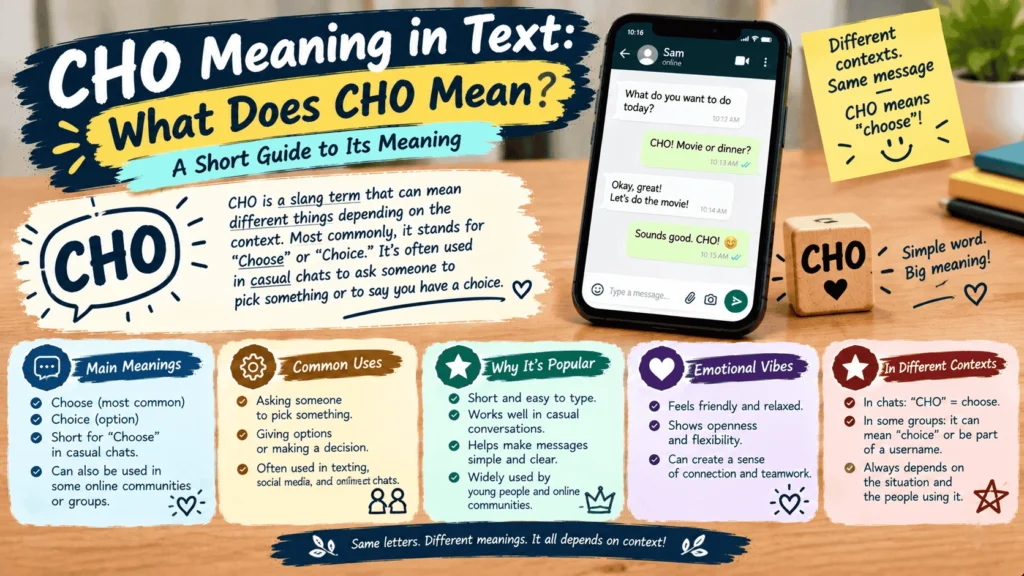
If you have seen “CHO” in a text, Instagram DM, TikTok comment, or WhatsApp conversation, you may have wondered whether it is an abbreviation, slang word, typo, or something else entirely.
The important thing to know is that CHO does not have one universal meaning in texting. In some casual online usage, “cho” is used as a stylized form of “you” or “your,” particularly in speech-inspired slang. In other communities, it can have completely different meanings.
That context matters.
For example, “I told cho already” may be intended as “I told you already,” while a completely different conversation could use CHO as an acronym for something professional or technical. Wiktionary, for example, lists CHO as an abbreviation for “chief happiness officer” and “chief health officer,” as well as a scientific abbreviation.
So, if someone has sent you “CHO,” don’t immediately assume what it means. Look at the sentence, the relationship, and the platform.
CHO Meaning in Text – Quick Meaning
In casual texting and social-media slang, CHO can be used as a stylized form of “you” or “your.” It is informal and often reflects the way someone speaks rather than standard written English.
Common interpretations include:
- CHO = you
- CHO = your in some slang constructions
- A playful or speech-inspired spelling
- A casual expression used among friends or online communities
Examples:
“I told cho already 😂”
Meaning: “I told you already.”
“Cho really did that?”
Meaning: “You really did that?”
“That’s cho problem, bro.”
Meaning: “That’s your problem, bro.”
However, these interpretations are context-dependent, not universal definitions.
Origin & Background of CHO
The informal use of “cho” appears to come from the way words can change when people speak quickly or use regional and community-based pronunciation.
Online slang frequently turns spoken pronunciation into written spelling. Instead of writing exactly what a dictionary would recommend, people write something that captures how a word sounds in everyday conversation.
That is why forms such as “chu,” “cho,” and other phonetic spellings can appear in informal digital communication. One contemporary explanation of CHO specifically describes it as speech-inspired slang associated with casual communication and social-media usage.
There is not, however, one well-established historical origin that explains every use of CHO.
That distinction is important because “cho” exists in several unrelated slang traditions. Community slang dictionaries document meanings ranging from an exclamation to money-related slang and other highly localized meanings.
Social media has made this even more complicated.
TikTok, Instagram, YouTube, gaming communities, and private group chats allow expressions from different regions to mix together. A word that originally belonged to one community can suddenly appear in another community with a slightly different meaning.
In other words, internet language travels quickly, but its meaning does not always travel intact.
Real-Life Conversations Using CHO
The easiest way to understand informal slang is to see it in context.
1. WhatsApp Conversation
Person A:
Where you at?
Person B:
I told cho I’m coming 😭
Person A:
You said that 20 minutes ago!
Here, “cho” is being used informally for “you.”
The crying emoji also makes the exchange feel playful rather than genuinely hostile.
2. Instagram DMs
Person A:
That outfit is actually fire 🔥
Person B:
Cho always hyping me up 😂
Person A:
Because you know I’m right.
In this context, CHO contributes to an informal, familiar tone.
3. TikTok Comments
User 1:
Cho really thought that was going to work 😭
User 2:
Leave me alone bro 😂
The spelling makes the comment feel more conversational and humorous.
4. Text Messages
Person A:
Did you finish the assignment?
Person B:
Why cho stressing me out already 😩
Person A:
Because it’s due tomorrow!
Here, the expression is part of playful complaining between people who are comfortable with each other.
Emotional & Psychological Meaning of CHO
Slang is rarely just about saving characters.
When someone writes “cho” instead of “you,” they may be trying to reproduce the sound, rhythm, or personality of spoken conversation.
That can make a message feel less formal.
Compare:
“You always do this.”
with:
“Cho always do this 😂”
The second version can feel more like something said aloud between friends.
This is one reason informal spellings are so common online. They allow people to communicate not only the literal message, but also something about their identity and relationship with the reader.
A person might use CHO to sound:
- Relaxed
- Playful
- Familiar
- Teasing
- Conversational
- Connected to a particular slang community
A Simple Real-Life Scenario
Imagine a friend who normally speaks casually with you.
They text:
“I told cho not to worry.”
You probably won’t read it as formal writing. You hear the personality behind it.
The spelling suggests familiarity.
That is an important feature of digital communication: people often type for emotional tone rather than grammatical perfection.
CHO Usage in Different Contexts
Social Media
CHO may appear in comments, captions, replies, memes, or direct messages where casual language is expected.
For example:
“Cho really thought nobody noticed 😂”
It can help make a comment sound more conversational.
Friends & Relationships
Among close friends, slang can create a sense of shared language.
A message such as:
“Cho better not forget my birthday.”
may sound teasing rather than formal.
With romantic partners, however, meaning depends heavily on the couple’s existing communication style.
Work & Professional Settings
Generally, avoid using CHO as slang in professional communication.
An email such as:
“I told cho about the meeting.”
could confuse the reader or make the message appear unnecessarily informal.
There is another issue: CHO is already used professionally as an acronym, including “chief health officer” and “chief happiness officer.”
Therefore, context becomes especially important in workplace writing.
Casual vs. Serious Tone
CHO works best when the conversation is already relaxed.
In serious conversations, standard wording is safer.
For example:
“You need to call me when you get home.”
is clearer than:
“Cho need to call me.”
When emotions are high, clarity matters more than slang.
When NOT to Use CHO
Although informal slang can be fun, there are situations where it can create unnecessary confusion.
Avoid CHO when:
- Writing a formal email
- Applying for a job
- Communicating with a teacher
- Writing an academic assignment
- Speaking to an unfamiliar professional
- Discussing a serious problem
- Communicating with someone who may not understand slang
- Writing something that needs to be legally or professionally clear
Cultural sensitivity also matters.
A spelling that feels natural to one online community may sound strange, forced, or even disrespectful when copied by someone outside that community.
The safest approach is simple: understand the expression before adopting it.
Common Misunderstandings About CHO
1. “CHO” Must Be a Formal Acronym
Not necessarily.
In lowercase or casual conversation, cho may simply be slang or a phonetic spelling.
2. Everyone Uses CHO the Same Way
They don’t.
Different communities can attach completely different meanings to the same short expression. Community slang references show multiple unrelated interpretations of “cho.”
3. It Is Always a Typo
Not necessarily.
If the surrounding conversation contains other informal spellings, CHO may be intentional.
4. CHO Always Means “You”
This is perhaps the biggest mistake.
In one casual texting context, CHO may mean “you” or “your.” Elsewhere, it can mean something entirely different.
For example, CHO can also refer to professional or scientific terminology, including chief health officer and Chinese hamster ovary in scientific contexts.
CHO Comparison Table
| Expression | Meaning in Text | Typical Use |
|---|---|---|
| CHO | Informal “you/your” in some slang contexts | Casual chat |
| YOU | Standard second-person pronoun | Any context |
| CHU | Informal phonetic variation of “you” in some communities | Casual/slang |
| YA | Casual shortening of “you” | Informal texting |
| YOUR | Standard possessive form | General writing |
| BRO | Friend, buddy, or close person | Casual conversation |
How to Use CHO
Use CHO only when the conversation already supports informal slang.
For example:
“Cho better be ready by 8 😂”
It should feel natural within the relationship rather than inserted simply to sound trendy.
Examples of CHO
“I told cho.”
“Cho funny for that.”
“That’s cho problem.”
CHO vs. Other Slang
Unlike a universally recognized abbreviation such as “LOL,” CHO is much more context-dependent. Some people may immediately understand it, while others may interpret it as an acronym, typo, name, or unrelated slang term.
Key Insight
CHO is less about a fixed dictionary definition and more about context, community, and conversational style. Before interpreting it, read the entire sentence and consider who sent it.
Variations and Types of CHO
Because informal internet language changes quickly, these forms should not be treated as official English vocabulary. They are examples of constructions you may encounter.
1. Cho
Meaning: Often a casual form of “you” or “your” in certain slang usage.
CHO in text: Informal and conversational.
2. Chu
Meaning: A phonetic/slang spelling associated with “you” in some online communities.
CHO abbreviation: Not technically a standard abbreviation.
3. Cho self
Meaning: A playful version of “yourself.”
CHO in chat: Used casually among friends.
4. Cho fault
Meaning: “Your fault.”
CHO slang: Usually teasing or accusatory depending on tone.
5. Cho problem
Meaning: “Your problem.”
CHO in text: Can be playful or dismissive.
6. Cho turn
Meaning: “Your turn.”
CHO in chat: Commonly understandable when the surrounding context is informal.
7. Cho idea
Meaning: “Your idea.”
CHO slang: Indicates possession in a stylized sentence.
8. Cho vibe
Meaning: “Your vibe” or someone’s personal energy/style.
CHO in text: Casual social-media language.
9. Cho side
Meaning: “Your side.”
CHO in chat: Often used when discussing opinions or relationships.
10. Cho people
Meaning: “Your people” or the people associated with you.
CHO slang: Meaning depends strongly on context.
Remember that these are informal constructions rather than standardized grammatical forms.
How to Respond When Someone Uses CHO
Your response should depend on the relationship and the tone.
Casual Replies
“What you mean? 😂”
“I know, I know.”
“You already told me!”
Funny Replies
“Why you blaming cho? 😭”
“Cho is innocent 😂”
“Not my problem, apparently!”
Mature Replies
“I understand what you mean.”
“Okay, I got you.”
“Fair enough.”
Respectful Replies
If you’re unsure what the person means:
“What do you mean by ‘cho’ here?”
That’s actually one of the best responses.
There is no need to pretend you understand slang when you don’t.
Regional & Cultural Usage
Western Culture
In English-speaking online communities, CHO can appear as informal slang or a phonetic spelling. However, it is not a universally recognized English texting abbreviation.
Some slang databases also record unrelated regional meanings, demonstrating why geographic and community context matters.
Asian Culture
CHO is not a standard English texting expression across Asia.
People who use English heavily online may encounter it through social platforms, gaming, music, or international communities, but interpretation can vary considerably.
Middle Eastern Culture
Similarly, CHO does not have one universal meaning across Middle Eastern English-language communication.
Someone encountering it in an international social-media conversation should rely on the surrounding sentence rather than assuming a regional definition.
Global Internet Usage
The internet has blurred traditional language boundaries.
A slang term can move from one community to another through memes, music, creators, gaming, and short-form videos.
The meaning may also change during that process.
Gen Z vs. Millennials
Younger users are generally more accustomed to experimental spellings, phonetic slang, memes, and rapidly changing internet vocabulary.
Millennials may recognize many of these expressions but may use them less frequently.
Neither group has one fixed interpretation, though. Online community is often more important than age alone.
Is CHO Safe for Kids?
Generally, the slang use of CHO is not inherently inappropriate.
If a child uses it to mean “you” or “your” in a casual conversation, the expression itself is usually harmless.
The important point is that CHO has multiple meanings in different communities. Some online slang references contain unrelated or adult interpretations, so parents and educators should consider the complete sentence and surrounding conversation rather than judging the three letters alone.
Children should also learn the difference between informal slang and standard English.
Knowing when to write:
“I told you.”
instead of:
“I told cho.”
is an important communication skill.
FAQs About CHO Meaning in Text
1. What does CHO mean in text?
In some informal texting contexts, CHO can mean “you” or “your.” It is a slang-style spelling rather than standard English.
2. Is CHO a slang word?
It can be. The lowercase cho is sometimes used as informal slang, but its meaning varies between communities.
3. Is CHO the same as “you”?
Not always. In certain conversations it functions like “you,” but context is essential because CHO has other meanings.
4. Is CHO appropriate for formal writing?
Generally, no. Use standard words such as “you” and “your” in professional, academic, or formal communication.
5. Is CHO rude?
Not inherently. It can be playful and friendly, but tone and context may make it sound dismissive or sarcastic.
6. What is the difference between CHO and CHU?
Both can function as informal, phonetic spellings related to “you” in some slang communities. Their exact use depends on the speaker and community.
7. Why do people write CHO instead of you?
People may use CHO to imitate spoken pronunciation, express personality, sound more relaxed, or participate in a particular slang style.
Conclusion
CHO meaning in text depends heavily on context.
In some casual online conversations, it is used as a playful or speech-inspired form of “you” or “your.” It can make a message feel more relaxed, familiar, humorous, or culturally connected.
But CHO does not have one universal definition.
That is the real lesson with internet slang: three letters can carry very different meanings depending on who writes them, where they write them, and what comes before and after them.
So if someone sends you “CHO,” don’t overthink it—and don’t automatically assume one definition either.
Read the sentence.
Consider the relationship.
Notice the tone.
Once you understand those three things, slang becomes much easier to decode.
The goal isn’t to memorize every internet abbreviation. It’s to understand the human conversation happening around the word.