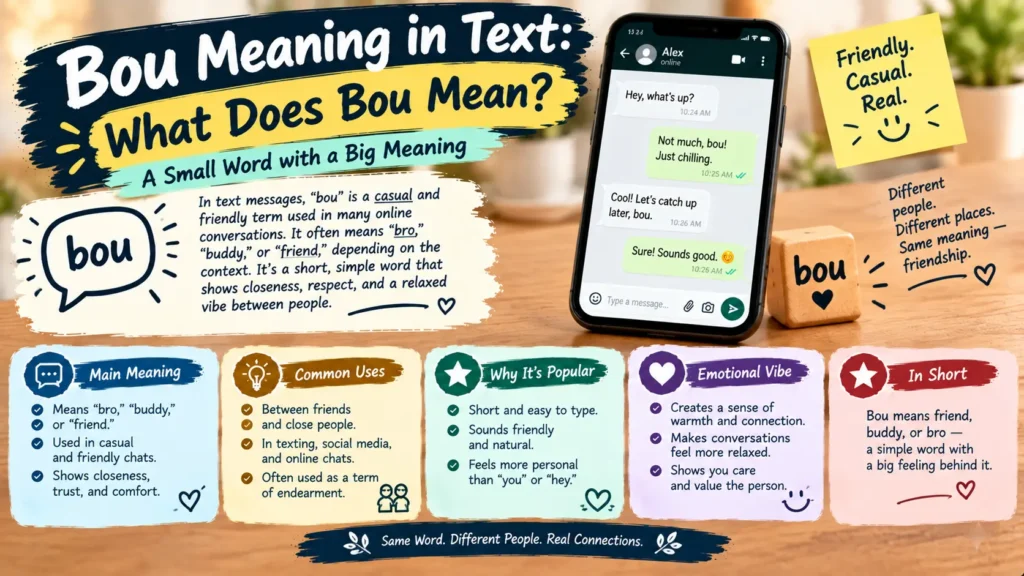
If someone suddenly texts you “Hey bou”, comments “my bou ❤️”, or writes “Miss you, bou,” it is natural to pause and wonder what they actually mean.
Is bou another spelling of “boo”? Is it romantic? Is it slang? Or does it have a completely different meaning in another language?
In everyday English texting, bou is commonly used as a playful or affectionate form similar to “boo,” “babe,” “bae,” or “love.” However, there is an important cultural distinction: বউ (bou) is also an established Bengali word meaning wife, and depending on context it can refer to a bride or daughter-in-law.
That is why the surrounding conversation matters so much.
A message such as “Goodnight bou ❤️” probably carries affection. But a Bengali speaker writing “amar bou” may literally be referring to their wife.
Let’s break down the different meanings so you can understand bou in text without guessing.
Bou Meaning in Text – Quick Meaning
In casual English texting, bou generally functions as an affectionate nickname or playful spelling of “boo.”
It can communicate:
- Romantic affection — similar to “babe” or “my love”
- Closeness — a nickname for someone special
- Playfulness — an intentionally informal spelling
- Friendship — sometimes used between close friends
- Cultural meaning — in Bengali, bou means wife, bride, or daughter-in-law depending on context
For example:
“Hey bou, how was your day?”
“Miss you, bou ❤️”
“That’s my bou right there!”
The first two sound affectionate, while the third could be romantic or simply playful depending on the relationship.
Origin & Background of “Bou”
The English internet use of bou does not have one universally accepted origin.
In many casual online conversations, it appears to be a creative spelling related to familiar expressions such as boo and other affectionate nicknames. Digital communication makes this kind of spelling variation especially common.
People frequently change the spelling of ordinary words to make them sound more personal, humorous, cute, or distinctive.
That is why you may see forms such as boo, bou, bae, bby, babe, and similar nicknames circulating in texts and social media.
The established word boo itself has a much longer history. Collins Dictionary records “boo” as an informal English term with several meanings and separate historical senses.
However, bou has another completely independent linguistic history in Bengali.
The Bengali word বউ (bou) is derived historically from Sanskrit vadhū through Prakrit and means wife, bride, or daughter-in-law.
This cultural meaning is especially important when interpreting messages from Bengali-speaking communities.
So, “bou” isn’t necessarily just internet slang.
Sometimes it is a genuine word from another language.
Real-Life Conversations Using “Bou”
Understanding slang becomes much easier when you see how people actually use it.
WhatsApp Conversation
Person A:
You home yet?
Person B:
Almost, bou. Five more minutes ❤️
Person A:
Okay, drive safe.
Here, bou is clearly being used as an affectionate nickname.
Instagram DM
Person A:
You looked amazing in that picture.
Person B:
Haha thank you bou 😂
Person A:
You know I’m always hyping you up.
This could be flirtatious, romantic, or simply playful between close friends.
The relationship provides the missing context.
TikTok Comments
Person A:
My bou really thought he could dance 😭
Person B:
I absolutely destroyed that dance.
Person A:
In your dreams 😂
Here, bou is being used publicly as a playful term for someone close.
Text Message
Person A:
Goodnight bou. Talk tomorrow.
Person B:
Goodnight ❤️ sleep well.
In this situation, the combination of “goodnight” + “bou” + heart emoji makes the affectionate tone especially clear.
Emotional & Psychological Meaning of “Bou”
Words like bou are interesting because they often communicate more than their literal definition.
When someone gives another person a nickname, they are often creating a small sense of familiarity.
Compare:
“Hello, Sarah.”
with:
“Hey bou ❤️”
The second message feels much more personal.
Nicknames can create a feeling of belonging because they suggest that the relationship has its own informal language.
That doesn’t automatically mean romantic love, though.
A person might call a romantic partner bou, but close friends can also develop playful names for one another.
A small real-life-style example
Imagine two people who have been friends for years.
One normally says:
“Hey, are you coming tonight?”
But after years of inside jokes, the same person might write:
“Bou, are you coming or are you disappearing again? 😂”
The word doesn’t necessarily change the factual meaning of the sentence.
It changes its emotional texture.
That is one of the fascinating things about modern digital communication: tiny words can carry relationship history.
Bou Meaning in Different Contexts
Bou on Social Media
On Instagram, TikTok, Snapchat, or similar platforms, bou can function as an affectionate nickname.
Examples include:
- “My bou ❤️”
- “Miss my bou.”
- “Bou looking good today.”
- “Going out with my bou.”
The exact emotional level depends on the relationship.
Bou Between Friends
Friends sometimes use affectionate slang without romantic intentions.
For example:
“Bou, you really forgot my birthday?”
That could simply mean:
“You’re my close friend, and I’m teasing you.”
So don’t automatically interpret bou as romantic.
Bou in Love
When used between romantic partners, bou can carry a meaning similar to:
- Babe
- Boo
- Baby
- My love
- Darling
For example:
“Can’t wait to see you, bou ❤️”
In this setting, the word is clearly affectionate.
Bou in Work
Using bou in a professional workplace message is generally inappropriate if you intend it as an affectionate nickname.
For example:
“Hey bou, can you send me the report?”
would sound strange in most professional environments.
A workplace may have completely different meanings for BOU as an acronym.
That is why capitalization and context matter.
Bou in Gaming
Gaming chats are informal, so playful nicknames can appear naturally.
For example:
“Bou, queue up!”
or:
“My bou carried the whole team 😂”
In gaming, bou is likely to be a nickname or slang expression rather than a technical gaming term.
When NOT to Use “Bou”
Although bou can sound warm and friendly, it isn’t appropriate everywhere.
1. Formal emails
Avoid:
“Hey bou, please review the attached document.”
Use:
“Hi Alex, could you please review the attached document?”
2. First-time professional communication
Calling someone bou before you know them well can feel overly familiar.
3. Sensitive situations
If someone is upset, grieving, angry, or discussing a serious issue, playful slang may make your message seem dismissive.
4. Cross-cultural communication
If you are communicating with someone from a Bengali-speaking background, remember that bou may have its literal Bengali meaning rather than the English internet-slang meaning.
5. Public comments
A nickname that feels cute privately might sound overly intimate when posted publicly.
Common Misunderstandings About “Bou”
One of the biggest mistakes is assuming bou always means boyfriend or girlfriend.
It doesn’t.
Context determines the interpretation.
Another common misunderstanding comes from confusing bou with boo.
Sometimes the writer may intentionally be using a variation of “boo.” Other times, bou may be a genuine word from another language.
Urban Dictionary also contains several user-submitted definitions for BOU/bou, including unrelated slang interpretations. Because those entries are user-generated and can conflict with one another, they should be treated as evidence of niche usage rather than a universal definition.
There is also a Bengali meaning that is much more established linguistically: বউ (bou) means wife, bride, or daughter-in-law.
So the safest rule is simple:
Read the whole message, not just the word.
Bou vs Other Affectionate Terms
| Term / Question | Meaning in Text | How to Use | Example |
|---|---|---|---|
| Bou | Affectionate nickname or culturally, Bengali “wife” | Casual conversations | “Hey bou ❤️” |
| Boo | Romantic partner or loved person | Informal/affectionate | “Miss you, boo.” |
| Bae | Romantic partner or someone special | Casual social media/texting | “Going out with bae.” |
| Babe | Romantic or affectionate nickname | Relationships and close conversations | “Thanks, babe.” |
| Love | Person you care about | Often romantic, sometimes friendly | “Take care, love.” |
| Bro | Close friend or male peer; increasingly gender-flexible informally | Friendly conversation | “Bro, seriously?” |
Key Insight
Bou is highly context-dependent. In casual English texting it can resemble “boo” or another affectionate nickname, while in Bengali it is an established word meaning wife, bride, or daughter-in-law.
Variations and Types of “Bou”
1. Bou Meaning
Usually an affectionate or playful nickname in English-language casual texting.
It can also mean wife, bride, or daughter-in-law in Bengali.
2. Bou in Text
A casual spelling used in messages to address someone close.
Example:
“Hey bou, what are you doing?”
3. Bou Abbreviation
Bou is not a universal English abbreviation.
If written as BOU, it can represent different acronyms depending on the organization or subject.
4. Bou Slang
As slang, it can work as an affectionate or informal term of address.
Its meaning varies significantly by community.
5. Bou in Chat
In chat, bou is generally casual and personal.
Emoji and surrounding words can reveal whether it is romantic or friendly.
6. Bou in Love
In romantic messages, it can mean something close to boo, babe, baby, or my love.
7. Bou in Bengali
In Bengali, বউ (bou) means wife, and may also mean bride or daughter-in-law according to context.
8. My Bou
“My bou” generally suggests a person who is emotionally close to the speaker.
In English slang, it may mean “my boo.”
In Bengali, a similar phrase may literally identify someone’s wife.
9. Bou ❤️
The heart emoji strongly increases the likelihood of an affectionate interpretation.
Still, it does not prove that the relationship is romantic.
10. Hey Bou
“Hey bou” is simply an informal greeting when bou is being used as a nickname.
The relationship between the two people determines the emotional meaning.
How to Respond When Someone Calls You “Bou”
Your response should match the relationship and tone.
Casual Replies
“Heyyy 😂 what’s up?”
“Hey bou, how are you?”
“Haha, you again?”
Funny Replies
“Bou? Since when? 😂”
“That nickname needs an explanation.”
“You’re getting creative now 😂”
Mature Replies
“Hey, good to hear from you. How have you been?”
“Hi! What’s going on?”
Respectful Replies
If you’re unsure whether they mean it romantically:
“Hey! I wasn’t sure what you meant by ‘bou’ there.”
That is often better than making an assumption.
Regional & Cultural Usage
Western Culture
In English-speaking online spaces, bou may be interpreted as an informal spelling associated with affectionate slang.
However, boo is much more established in English dictionaries than bou.
Therefore, English users may interpret bou based largely on context.
Asian Culture
In South Asian communication, language mixing is extremely common.
People may combine English slang with local-language words in the same message.
For Bengali speakers, bou has a specific cultural and linguistic meaning connected with wife, bride, or daughter-in-law.
This can create confusion when someone assumes every instance is English slang.
Middle Eastern Culture
The meaning of bou is not universal across Middle Eastern languages.
If you encounter it in a Middle Eastern social-media conversation, examine the surrounding language rather than automatically translating it as “boo.”
Online communities often borrow English expressions while adapting spellings.
Global Internet Usage
The internet has made slang highly portable.
A person in one country can encounter a nickname from another country, adopt it, modify its spelling, and give it a completely new social meaning.
That is why words such as bou can have several overlapping interpretations.
Gen Z vs Millennials
Younger internet users tend to experiment more freely with spelling, abbreviations, emojis, and deliberately altered words.
Millennials may be more familiar with established forms such as boo, babe, bae, although there is plenty of overlap between generations.
The important point is that age alone cannot determine the meaning.
Relationship and context remain stronger clues.
Is “Bou” Safe for Kids?
Generally, bou itself is not inherently harmful or adult language.
In one context, it may simply be an affectionate nickname.
In another, it may be a Bengali word meaning wife or bride.
However, children should understand that slang can be misunderstood, particularly when communicating with strangers online.
Parents and educators can encourage children to ask:
“What does this word mean in this conversation?”
rather than assuming every unfamiliar slang term has one fixed definition.
FAQs About Bou Meaning in Text
What does bou mean in text?
In casual English texting, bou commonly functions as an affectionate nickname similar to “boo,” “babe,” or “love.” It can also have other cultural meanings.
What does bou mean in love?
In a romantic conversation, bou can mean something like “boo,” “babe,” or “my love.” The surrounding message determines how romantic it is.
Is bou the same as boo?
Not necessarily. Bou may be a playful spelling of “boo,” but it can also have independent meanings, including the Bengali word বউ, meaning wife, bride, or daughter-in-law.
What does bou mean in Bengali?
The Bengali word বউ (bou) means wife and can also refer to a bride or daughter-in-law depending on context.
What does “my bou” mean?
In casual English slang, “my bou” can mean my boo or someone close to the speaker. In a Bengali context, the interpretation may relate literally to a wife.
Is bou a romantic word?
It can be. When used with phrases such as “I miss you, bou ❤️,” it is likely affectionate or romantic. But friends can also use it playfully.
Can I use bou at work?
Usually not as an affectionate nickname. It is better to use someone’s name or a neutral greeting in professional communication.
Conclusion
So, what does bou mean in text?
In casual English messages, bou is often an affectionate, playful nickname that can resemble boo, babe, bae, or love.
But that’s only part of the story.
If the person is Bengali-speaking, বউ (bou) has a genuine linguistic meaning: wife, bride, or daughter-in-law, depending on context.
That distinction is important because texting language rarely lives in isolation.
A heart emoji, the relationship between the speakers, the language surrounding the word, and even the platform can change how a tiny expression feels.
So if someone messages you “Hey bou ❤️,” you can reasonably read it as affectionate. If you see bou in a Bengali sentence, pause before assuming it’s English slang.
The best way to understand modern communication isn’t simply to memorize slang.
It’s to read the person, the relationship, and the situation together.