Have you ever received a message that simply said “DG” and wondered what the person was trying to say?
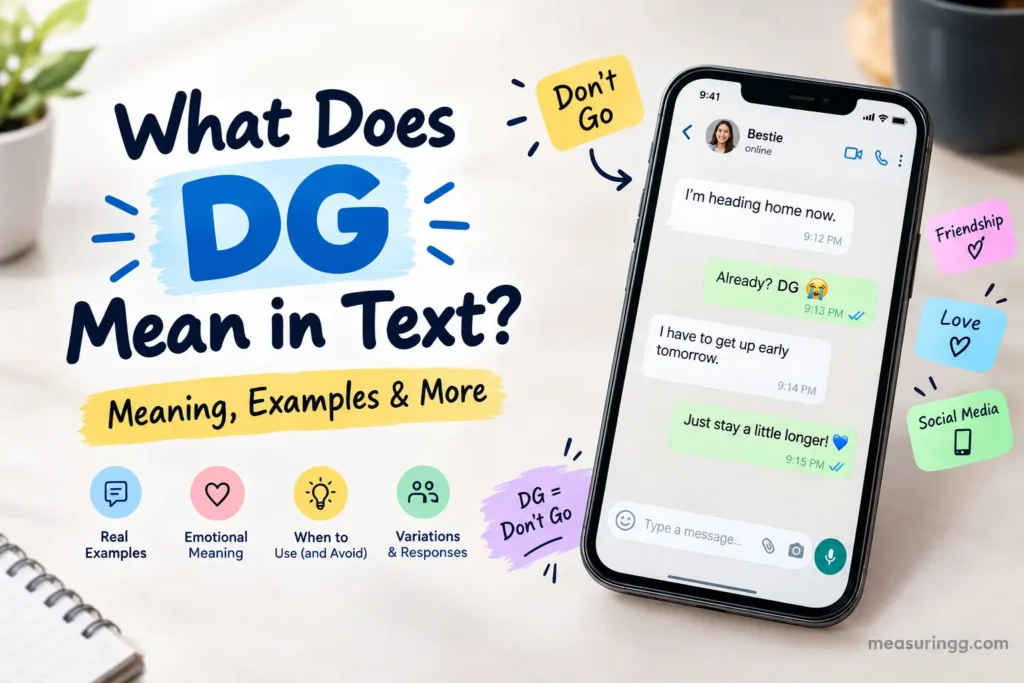
In most casual texting situations, DG means “Don’t Go.” It is a short way of asking someone not to leave, whether they are physically leaving a place, ending a conversation, leaving a group chat, or taking a break from social media.
The abbreviation is especially useful when someone wants to express a feeling quickly. Instead of typing “Please don’t go,” a person may simply write “dg” and let the surrounding conversation provide the emotional meaning.
That said, DG is not a universal abbreviation with only one definition. Acronym references list several possible meanings for DG, so context matters. In texting and slang dictionaries, “Don’t Go” is one of the established meanings.
DG – Quick Meaning
In text messages, DG usually means “Don’t Go.”
It can communicate a request, emotional reaction, or playful attempt to keep someone around.
For example:
“dg, stay for five more minutes.”
“Wait, dg yet 😭”
“You’re leaving already? dg!”
Depending on the conversation, DG can sound affectionate, funny, emotional, or urgent.
A useful clue is what comes immediately before it. If someone has just said they are leaving, logging off, ending a call, or taking a break, “DG” very likely means “Don’t Go.”
Texting references specifically identify “Don’t Go” as the common slang interpretation of DG.
Origin & Background
“DG” is a straightforward example of how digital communication turns ordinary phrases into compact shorthand.
There is no strong evidence that “DG” began with one particular social-media platform. Rather, it fits the broader tradition of shortening frequently used expressions in online communication. Internet slang dictionaries have recorded dg = don’t go for years, alongside related expressions such as “dga” for “don’t go anywhere.”
The growth of instant messaging made this kind of shorthand especially practical. People communicate quickly through texts, direct messages, comments, and group chats, where a few letters can replace an entire sentence.
Social media has also changed how these abbreviations feel.
“Don’t go” can sound formal or direct when written completely. “dg 😭” feels much more like an immediate emotional reaction.
That difference is important. Internet language is not only about saving typing time; it also allows people to communicate tone through brevity, punctuation, capitalization, emojis, and repetition.
As a result, the meaning of a short expression such as “DG” depends heavily on the relationship between the people and the situation surrounding it.
Real-Life Conversations
1. WhatsApp Conversation
Person A:
I should probably head home now. It’s getting late.
Person B:
Already? dg 😭
Person A:
I have class early tomorrow.
Person B:
Okay, okay. Five more minutes then?
Here, “dg” clearly expresses “Don’t go.” The emoji makes the message feel affectionate and playful rather than demanding.
2. Instagram DM
Person A:
I think I’m going to deactivate Instagram for a while.
Person B:
Wait what? dg pls 😭
Person A:
I just need a break from everything.
Person B:
I understand. I’ll miss seeing your posts.
In this situation, DG is about someone leaving a social platform rather than physically walking away.
3. TikTok Comment
Creator:
Taking a little break from posting. See you soon!
Commenter:
dg 😭 we need your videos!
Creator:
I’ll be back soon, promise.
The comment uses “DG” emotionally but not romantically. It expresses that the audience does not want the creator to disappear.
4. Text Message Between Friends
Person A:
I might leave the group chat. It’s getting too chaotic.
Person B:
Nooo dg 😂
Person A:
You guys are impossible.
Person B:
Fine, we’ll behave. Stay!
The abbreviation here is clearly playful. The person is not necessarily asking their friend to remain somewhere physically; they are asking them not to leave the conversation.
Emotional & Psychological Meaning
The interesting thing about DG is that its emotional meaning can be stronger than its literal meaning.
“Don’t go” suggests that someone’s presence matters. It can express attachment, disappointment, affection, loneliness, or simply the desire to continue enjoying a conversation.
The emotion depends on context.
A friend writing “dg 😂” may simply be joking. A close friend writing “dg please” after an emotional conversation may be expressing genuine concern about losing contact.
In digital communication, people often have fewer emotional signals available than they would have during a face-to-face conversation. There is no facial expression, voice, or immediate body language. Short phrases and emojis therefore carry extra weight.
A simple personal-style example makes this clearer.
Imagine chatting with a friend late at night after having a surprisingly meaningful conversation. When you say, “I should sleep,” they reply, “dg 😭.” They may not literally be asking you to stay all night. They may simply mean, “I’m enjoying talking to you, and I’m not ready for this conversation to end.”
That is the emotional layer behind the abbreviation.
Usage in Different Contexts
Social Media
On TikTok, Instagram, and other social platforms, DG can appear when someone announces that they are leaving, taking a break, deleting an account, or ending a live conversation.
The tone is usually informal.
Friends & Relationships
Among close friends, DG can be affectionate or humorous.
In romantic conversations, it may express that someone wants their partner or crush to stay longer. However, the abbreviation itself does not automatically indicate romance.
Work / Professional Settings
DG is generally not a good choice in professional communication when you mean “Don’t Go.”
A colleague might not understand the abbreviation immediately, and workplace communication usually benefits from clarity.
Instead of:
“DG, we still need to discuss this.”
Write:
“Please don’t leave yet; we still need to discuss this.”
Casual vs. Serious Tone
The same two letters can create different impressions depending on punctuation and surrounding words.
“dg 😂” usually feels playful.
“dg pls” can sound more emotional.
“DG.” may feel unusually serious or abrupt.
That is why capitalization alone should not determine the meaning. Read the entire conversation.
When NOT to Use It
Although “DG” is harmless slang in ordinary conversation, it is not suitable everywhere.
Avoid using it in formal emails, school assignments, official messages, or professional documents where the reader may not recognize the abbreviation.
It can also cause confusion when speaking with someone who does not regularly use English-language internet slang.
Cultural sensitivity matters as well. Not every person interprets short digital expressions in the same way. Someone unfamiliar with texting abbreviations may interpret “DG” as initials, a technical abbreviation, or something completely unrelated.
It is also better to avoid relying on “DG” when the situation is genuinely serious and clarity matters. A complete sentence is usually better when there is potential for misunderstanding.
Common Misunderstandings
One common mistake is assuming that DG always means “Don’t Go.”
That is not necessarily true.
Acronym databases list many meanings for the letters DG across different fields, including professional, technical, organizational, and internet contexts.
Another misunderstanding happens when readers interpret the emotional intensity incorrectly.
For example:
“dg 😂”
may be playful.
But:
“Please don’t go.”
may be a much more serious request.
The relationship between the speakers also matters. A friend, romantic partner, stranger, or social-media follower may use the same abbreviation with very different intentions.
The safest approach is simple: look at the surrounding conversation before deciding what DG means.
Comparison Table
| Expression | Meaning in Text | How to Use It | Example |
|---|---|---|---|
| DG | Don’t Go | Casual request for someone to stay | “dg, stay a little longer” |
| DGA | Don’t Go Anywhere | Asking someone to remain available | “DGA, I’ll be back soon” |
| DGU | Don’t Give Up | Encouragement rather than a request to stay | “DGU, you’re almost there” |
| BRB | Be Right Back | Saying you will temporarily leave | “BRB, getting some water” |
| Stay | Remain where you are | Direct and universally clearer | “Please stay for a minute” |
| Bye | Goodbye | Ending a conversation or departure | “Okay, bye!” |
Related slang dictionaries also list forms such as DGA (“Don’t Go Anywhere”) and DGU (“Don’t Give Up”), showing why the surrounding letters and context are important.
Key Insight
DG is usually more emotionally expressive than simply saying “stay.” It is short, informal, and often carries a feeling of attachment or reluctance to end a moment.
Variations / Types
The following are common conversational forms built around “DG.” They are better understood as informal variations rather than official meanings of the abbreviation.
1. DG
DG meaning: Don’t Go
DG in text: A direct request to stay.
DG abbreviation: Shortened form of “Don’t Go.”
DG slang: Casual digital shorthand.
DG in chat: “dg, we’re having fun.”
2. DG pls
DG meaning: Don’t Go, please.
DG in text: Adds a polite or emotional request.
DG abbreviation: DG + “pls.”
DG slang: Informal emotional shorthand.
DG in chat: “dg pls 😭.”
3. DG yet
DG meaning: Don’t go yet.
DG in text: Asking someone to delay leaving.
DG abbreviation: DG + “yet.”
DG slang: Casual and conversational.
DG in chat: “dg yet, I need to tell you something.”
4. DG rn
DG meaning: Don’t go right now.
DG in text: Adds immediate urgency.
DG abbreviation: DG + “rn” for “right now.”
DG slang: Fast-paced texting language.
DG in chat: “dg rn!”
5. DG fr
DG meaning: Don’t go, for real.
DG in text: Signals sincerity.
DG abbreviation: DG + “fr.”
DG slang: Stronger informal emphasis.
DG in chat: “dg fr, I’m serious.”
6. DG bro
DG meaning: Don’t go, bro.
DG in text: Friendly rather than romantic.
DG abbreviation: DG + a familiar form of address.
DG slang: Casual friendship language.
DG in chat: “dg bro 😂.”
7. DG babe
DG meaning: Don’t go, babe.
DG in text: Adds an affectionate relationship context.
DG abbreviation: DG + affectionate address.
DG slang: Informal relationship language.
DG in chat: “dg babe, stay a little longer.”
8. DG 😭
DG meaning: Don’t go, with visible sadness or dramatic emotion.
DG in text: The emoji intensifies the feeling.
DG abbreviation: DG with an emotional visual cue.
DG slang: Common expressive texting style.
DG in chat: “dg 😭.”
9. DG 😂
DG meaning: Don’t go, but in a joking or playful way.
DG in text: Suggests the request is not completely serious.
DG abbreviation: DG plus a laughing emoji.
DG slang: Lighthearted digital expression.
DG in chat: “dg 😂 we just started talking.”
10. DGA
DG meaning: Not the same exact phrase; commonly listed as “Don’t Go Anywhere.”
DG in text: Used when asking someone to remain available.
DG abbreviation: DGA rather than DG.
DG slang: Related internet shorthand.
DG in chat: “DGA, I need to ask you something.”
Established slang references list DGA separately from DG, so it should not automatically be treated as another spelling of “Don’t Go.”
How to Respond When Someone Uses It
Your response should match the relationship and tone.
Casual Replies
- “Haha, okay, I’ll stay.”
- “Just for five more minutes 😂”
- “I’m not going anywhere yet.”
Funny Replies
- “Fine, but you owe me snacks.”
- “Okay, okay. You win 😂”
- “Why are you making this so dramatic?”
Mature Replies
- “I can stay for a little while longer.”
- “I understand. Let’s finish our conversation first.”
- “I need to leave soon, but we can talk again later.”
Respectful Replies
- “I understand. I’ll let you know before I leave.”
- “Thanks for saying that. I need to go now, but we can continue later.”
- “I appreciate that. Take care.”
A good response does not have to copy the slang. You can answer naturally while still acknowledging the emotion behind the message.
Regional & Cultural Usage
Western Culture
In English-speaking Western online communities, “DG” can function as casual internet shorthand for “Don’t Go.” Its interpretation still depends on the relationship and conversation.
Among close friends, it can be humorous. In a romantic conversation, it can sound affectionate.
Asian Culture
English internet slang is widely encountered in many Asian online communities, especially among younger users who communicate through English-language social platforms.
However, local communication styles can influence how abbreviations are interpreted. Someone who uses English regularly online may understand DG immediately, while another person may prefer the complete phrase.
Middle Eastern Culture
English abbreviations are also common in multilingual digital conversations across the Middle East.
However, many users naturally switch between English and Arabic or other languages. In those conversations, context can become especially important because the same Latin letters may be understood differently depending on the language being used.
Global Internet Usage
Internet slang travels quickly across borders.
A phrase that begins in one online community can become recognizable elsewhere through memes, comments, short videos, gaming communities, and messaging apps.
Still, global exposure does not mean everyone knows every abbreviation. Clear communication remains more important than using slang.
Generational Differences: Gen Z vs. Millennials
Younger internet users may be more comfortable interpreting abbreviations from context, emojis, punctuation, and platform-specific habits.
Millennials also use texting shorthand, but individual familiarity varies considerably.
The important point is that generation does not guarantee understanding. Someone’s personal online habits matter more than their age alone.
Is It Safe for Kids?
Yes, “DG” meaning “Don’t Go” is generally harmless slang when used in ordinary conversations.
The important lesson for younger users is context. Children and teens should understand that abbreviations can be misunderstood, particularly when communicating with people they do not know well.
If a message is confusing or emotionally serious, using complete words is usually clearer than relying on slang.
FAQs
1. What does DG mean in text?
In most casual texting contexts, DG means “Don’t Go.” It is usually used when someone wants another person to stay.
2. Is DG a slang word?
Yes. DG is commonly documented as an informal texting abbreviation for “Don’t Go.”
3. Is DG always romantic?
No. DG can be used between friends, family members, online communities, or romantic partners. The relationship and context determine the tone.
4. What does “DG 😭” mean?
“DG 😭” usually means “Don’t go” with an emotional or dramatic tone. The crying emoji makes the message feel more expressive.
5. Can I use DG at work?
It is better to avoid it in professional communication because not everyone will recognize the abbreviation. A complete phrase such as “Please don’t leave yet” is clearer.
6. Can DG have other meanings?
Yes. DG has many meanings outside casual texting, including technical, professional, organizational, and other abbreviation uses. Context is essential.
7. Is DG the same as “Don’t Go Anywhere”?
Not exactly. DG commonly means “Don’t Go,” while DGA is separately listed as “Don’t Go Anywhere.”
Conclusion
So, what does DG mean in text?
In ordinary casual texting, the most common interpretation is “Don’t Go.” It is a compact way to tell someone that you would rather they stayed, whether they are leaving a place, ending a conversation, leaving a group chat, or stepping away from social media.
But the real meaning often comes from the emotion surrounding those two letters.
“DG” can be playful between friends, affectionate in a close relationship, or simply a quick reaction to someone announcing that they are leaving.
The best way to understand it is to look beyond the abbreviation itself. Read the messages before and after it, notice the emojis and punctuation, and consider who sent it.
Two letters can be surprisingly expressive. Once you understand the context, DG becomes less confusing and much easier to use naturally.