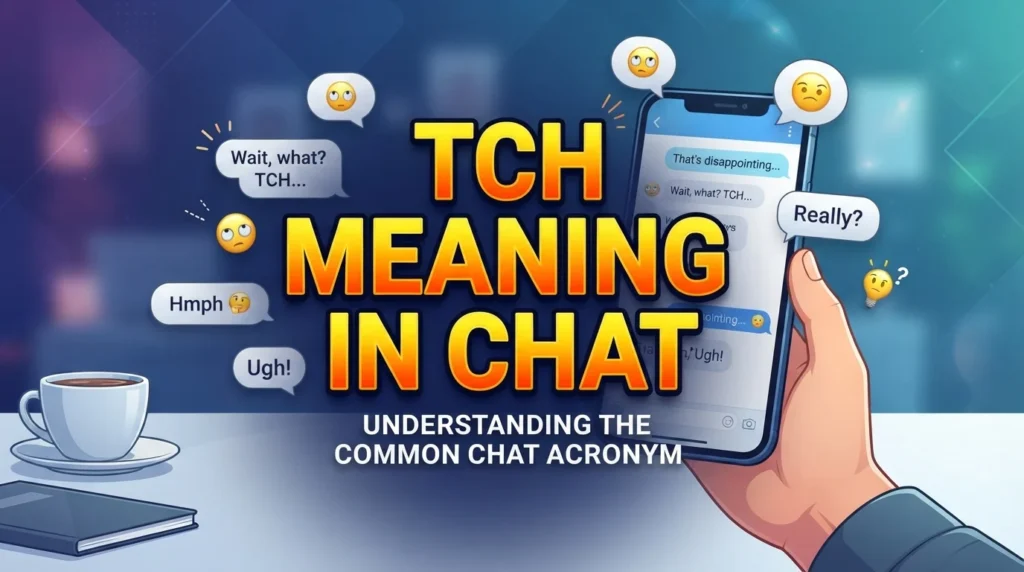
If someone sends you “tch” in a text, WhatsApp message, Instagram DM, or comment, the meaning can feel unclear. Is the person annoyed? Disappointed? Joking? Or simply reacting to something they do not like?
In most online conversations, “tch” is a written expression of disapproval, irritation, impatience, or mild annoyance. It is similar to the sound people make when they click their tongue in frustration.
For example, someone might reply “tch” after hearing an excuse they do not believe. A friend may use it playfully after you tease them. A person may also write “tch tch” to show stronger disappointment.
The exact meaning depends heavily on the conversation, the relationship between the people, and the surrounding words. That is why understanding the tone matters more than simply memorizing one definition.
Tch Meaning in Chat
“Tch” in chat usually expresses annoyance, disapproval, disappointment, or impatience.
It is often used as a written version of a tongue-clicking sound. In real life, a person might make a short “tch” sound to show that they are unimpressed.
Common meanings include:
- Mild annoyance
- Disbelief
- Disapproval
- Frustration
- Disappointment
- Playful teasing
- Impatience
Examples
“Tch, you forgot again?”
“Tch. I knew you would say that.”
“Tch tch, that was not a good idea.”
The tone can be serious or playful. A close friend may write “tch” while joking, whereas a stranger may use it to show genuine irritation.
What Is the Meaning of TCH?
The meaning of TCH depends on how it is written and where it appears.
In casual online communication, “tch” is usually not a formal acronym. It is an expressive sound or interjection that represents a tongue click.
It can communicate an attitude without requiring a full sentence.
For example:
“Tch.”
That one short message might mean:
- “I am annoyed.”
- “Seriously?”
- “I do not believe you.”
- “That was disappointing.”
- “You should have known better.”
The meaning becomes clearer when you look at the conversation before it.
If someone says, “I forgot your birthday,” and you reply “Tch,” your message may show playful disappointment.
If someone insults you and you respond “Tch,” it may sound dismissive or irritated.
What Does TCH Stand For?
In casual chat, TCH does not usually stand for one fixed phrase.
Many people use “tch” as an expressive sound rather than as a traditional abbreviation. It is similar to writing sounds such as:
- “Hmm” for thinking or uncertainty
- “Ugh” for frustration
- “Pfft” for disbelief or dismissal
- “Tsk” for disapproval
- “Tch” for annoyance or disappointment
However, TCH can have different meanings in specialized contexts, including business, education, technology, medicine, or organization names.
That is why context is essential. In a casual text, “tch” most likely expresses an emotion rather than representing a formal full form.
Tch Meaning in Chat in English
In English chat, “tch” commonly represents a tongue-clicking sound associated with irritation or disapproval.
The closest natural meanings may be:
- “Seriously?”
- “Come on.”
- “I cannot believe you.”
- “That is annoying.”
- “Whatever.”
- “You should have known better.”
For example:
Person A: “I ate the last slice of your pizza.”
Person B: “Tch. You are unbelievable.”
Here, “tch” shows playful irritation.
In another situation:
Person A: “I missed the deadline again.”
Person B: “Tch… you need to be more careful.”
This version sounds more genuinely disappointed.
Tch Meaning in WhatsApp Chat
On WhatsApp, “tch” is usually used as a quick emotional reaction.
People may send it when they do not want to write a long response but still want to show how they feel.
Example 1: Playful annoyance
Person A: I told you not to eat my snacks.
Person B: Tch 😒
Here, the message could be teasing rather than truly angry.
Example 2: Disappointment
Person A: I forgot to bring the tickets.
Person B: Tch… now what are we going to do?
This sounds more frustrated.
Example 3: Disbelief
Person A: I swear I studied all night.
Person B: Tch. And you still failed?
In this case, “tch” may communicate disbelief or mild sarcasm.
WhatsApp also gives users extra clues through emojis, punctuation, and previous messages. “Tch 😭” may be playful, while “Tch.” can sound colder and more serious.
Tch Tch Reply in Chat
“Tch tch” usually makes the reaction stronger.
Repeating the sound can suggest:
- Greater disappointment
- Stronger disapproval
- Playful scolding
- Frustration
- “You really did that?”
For example:
Person A: I forgot to charge my phone again.
Person B: Tch tch. When will you learn?
This does not necessarily mean the person is angry. It may sound like affectionate teasing between friends.
Another example:
Person A: I lied to my parents and got caught.
Person B: Tch tch… that was not smart.
Here, the repeated expression shows disapproval.
The emotional meaning depends on the relationship. Between close friends, it can be funny. Between strangers, it may sound judgmental.
Tch Meaning in Chat Instagram
On Instagram, “tch” can appear in DMs, comments, Stories, and reactions.
Its meaning is generally similar to its meaning in texting: mild annoyance, disbelief, disappointment, or playful disapproval.
Instagram DM Example
Person A: I posted the embarrassing photo of you.
Person B: Tch 😭 delete it right now.
The “tch” adds a playful, dramatic reaction.
Instagram Comment Example
User A: I said I was going to stop buying shoes.
User B: Tch. We both know that is not happening.
Here, the word creates a teasing tone.
On social media, short expressive words often work like emotional punctuation. They help communicate attitude when facial expressions and voice are missing.
Tch Meaning in Chat in Urdu
In Urdu-speaking online conversations, “tch” may express feelings similar to:
- افسوس — disappointment
- ناراضی — annoyance
- جھنجھلاہٹ — frustration
- ناپسندیدگی — disapproval
- ارے یار — come on
- ہونہہ — a dismissive or unimpressed reaction
For example:
“Tch, tum phir late ho gaye.”
This may mean:
“Oh, come on, you are late again.”
Another example:
“Tch tch, yeh tum ne kya kar diya?”
This may mean:
“Oh no, what have you done?”
In Urdu chat, the meaning often becomes more emotional when combined with words such as yaar, uff, or emojis.
Tch Meaning in Chat From a Girl
When a girl sends “tch” in chat, it does not have one special meaning simply because she is a girl.
The message may express:
- Playful annoyance
- Genuine frustration
- Disappointment
- Teasing
- Disbelief
- Mild anger
For example:
You: I forgot to reply for three hours.
Her: Tch 🙄
This could mean she is mildly annoyed but not seriously angry.
Another example:
You: I bought the dress you said you liked.
Her: Tch, you actually bought it?
This could be playful surprise.
The best way to understand her meaning is to consider her usual communication style. Does she often use expressive words? Does she add laughing emojis? Is the conversation serious?
One short word cannot reliably reveal romantic interest or anger without context.
TCH Full Form
In everyday chat, TCH usually does not have one universal full form.
Most commonly, lowercase “tch” functions as an expressive sound rather than an acronym.
However, uppercase TCH may represent different terms in specialized fields. Its meaning can change depending on the subject being discussed.
For casual texting, the safest interpretation is:
TCH = a written expression of annoyance, disapproval, impatience, or disappointment.
Do not automatically assume that every use of TCH has the same formal expansion.
Tch Meaning in Chat in Hindi
In Hindi chat, “tch” can express feelings such as:
- झुंझलाहट — irritation
- नाराज़गी — annoyance
- निराशा — disappointment
- अविश्वास — disbelief
- असहमति — disapproval
For example:
“Tch, tum phir late ho gaye.”
Meaning:
“अरे यार, तुम फिर लेट हो गए।”
Another example:
“Tch tch, ye tumne kya kar diya?”
Meaning:
“अरे, तुमने ये क्या कर दिया?”
The expression is often understood through tone rather than through a dictionary definition.
Origin and Background of “Tch”
The written expression “tch” is connected to a sound commonly made by clicking the tongue.
In spoken communication, people use tongue-clicking sounds to express reactions such as disapproval, impatience, or disappointment.
Digital communication began converting these physical sounds into text.
Just as people started writing “hmm,” “ugh,” “tsk,” and “pfft,” they also began using “tch” to represent a particular emotional reaction.
The rise of texting and social media made these short expressions even more useful.
Online conversations remove many natural communication signals. People cannot always see your facial expression or hear your voice. A short word like “tch” helps add attitude to a message.
Over time, its meaning became flexible. It can sound annoyed, dramatic, sarcastic, playful, or even affectionate.
Real-Life Conversations Using “Tch”
WhatsApp Conversation
Person A: I forgot to send the file again.
Person B: Tch 😑
Person A: I know, I know. I will send it now.
Here, “tch” expresses mild frustration.
Instagram DM
Person A: I posted your old school picture.
Person B: Tch 😭 Why would you do that?
Person A: Because everyone deserves to see your haircut.
This is playful rather than genuinely angry.
TikTok Comments
User A: Me saying I will only watch one video.
User B: Tch. Three hours later and you are still scrolling.
The expression adds humorous disapproval.
Text Message
Person A: I forgot our plans.
Person B: Tch… that actually hurt.
Here, the word carries emotional disappointment.
The Emotional and Psychological Meaning of “Tch”
At a psychological level, “tch” is often a low-effort way to communicate a high-context emotion.
The sender may not want to explain everything. Instead of writing:
“I am disappointed that you did that, and I expected better from you,”
they may simply write:
“Tch.”
This creates an emotional signal that the other person must interpret.
That is one reason short expressions can sometimes feel powerful. They leave space for the reader to sense the attitude behind the word.
In my experience with everyday digital communication, the same short expression can feel completely different depending on punctuation. “Tch 😂” feels playful. “Tch.” can feel cold.
The psychological message is often less about the literal sound and more about the relationship between the people communicating.
How “Tch” Is Used in Different Contexts
Social Media
On social media, “tch” is often humorous, sarcastic, or dramatic.
People may use it in comments to react to a relatable mistake or funny situation.
Friends and Relationships
Between friends or romantic partners, it may be a playful way to show annoyance.
For example:
“Tch, you ignored my message again.”
The actual emotion may be much lighter than the words suggest.
Work and Professional Settings
Using “tch” in professional communication is generally not recommended.
A manager, client, or colleague may interpret it as rude, dismissive, or immature.
Instead of writing:
“Tch.”
a professional response could be:
“I understand, but this may cause a problem.”
Casual vs Serious Tone
The surrounding message determines the tone.
“Tch 😂” = likely playful.
“Tch, seriously?” = irritation or disbelief.
“Tch.” = potentially cold or dismissive.
When Not to Use “Tch”
Avoid using “tch” when the situation requires clarity and professionalism.
You should be cautious when:
- Speaking with a client
- Discussing a serious conflict
- Apologizing for something important
- Communicating with someone you barely know
- Talking about sensitive emotional issues
The expression may also create cultural misunderstandings.
Someone familiar with casual internet language may understand it immediately. Another person may interpret it as disrespectful or confusing.
When emotions are serious, clear words are usually better than ambiguous reactions.
Common Misunderstandings About “Tch”
One common mistake is assuming that “tch” always means anger.
It does not.
It may represent anything from mild teasing to genuine disappointment.
Another misunderstanding is believing that “tch” is always an acronym.
In casual chat, it is often simply a written sound.
People also sometimes assume that receiving “tch” from a girl or guy automatically indicates romantic interest. That is not reliable. The word alone cannot prove attraction, anger, or any particular relationship.
Finally, punctuation matters.
Compare:
- Tch 😂 — playful
- Tch 🙄 — annoyed or sarcastic
- Tch… — disappointed or tired
- Tch. — possibly cold or dismissive
Comparison Table: “Tch” and Similar Chat Expressions
| Expression | Meaning in Text | How to Use It | Example | Compared With |
|---|---|---|---|---|
| Tch | Mild annoyance or disapproval | Use as a short emotional reaction | “Tch, you forgot again.” | More expressive than “okay” |
| Tsk | Disapproval or criticism | Use when reacting to a mistake | “Tsk, that was careless.” | Often sounds more judgmental |
| Ugh | Frustration or dislike | Use when something is irritating | “Ugh, not again.” | Stronger frustration |
| Pfft | Disbelief or dismissal | Use when rejecting an idea | “Pfft, I don’t believe you.” | More dismissive |
| Hmm | Thinking or uncertainty | Use when considering something | “Hmm, maybe.” | Less annoyed |
| Sigh | Tiredness or disappointment | Use when emotionally exhausted | “Sigh, here we go again.” | More emotionally tired |
| SMH | Disbelief or disappointment | Use in casual online chat | “SMH, what were you thinking?” | More internet-specific |
Key Insight
“Tch” is a flexible emotional reaction, not a word with one rigid definition. The surrounding conversation, punctuation, and relationship usually determine its real meaning.
Variations and Types of “Tch” in Chat
Tch Meaning
A short expression of annoyance, disapproval, disbelief, or disappointment.
Tch in Text
Used as a quick reaction when someone does not want to write a complete emotional response.
Tch Abbreviation
Usually, it is not a traditional abbreviation in casual conversation.
Tch Slang
Online slang-style usage can make it sound playful, sarcastic, or dramatic.
Tch in Chat
Most often communicates a reaction similar to “come on,” “seriously,” or “I am disappointed.”
Tch Tch Meaning
Repeated “tch” usually strengthens the feeling of disapproval or playful scolding.
Tch With an Emoji
“Tch 😂” often sounds humorous, while “Tch 😒” usually sounds annoyed.
Tch With Ellipsis
“Tch…” may suggest disappointment, tiredness, or quiet frustration.
Tch With a Full Stop
“Tch.” can sound more serious, cold, or dismissive.
TCH in Capital Letters
Uppercase TCH may add emphasis, but it can also refer to a formal term in a specialized context. Context remains important.
How to Respond When Someone Uses “Tch”
Your response should match the tone.
Casual Replies
- “What now? 😂”
- “Okay, okay, I get it.”
- “Don’t tch me 😭”
- “I said I’m sorry!”
Funny Replies
- “That was the sound of disappointment, wasn’t it?”
- “Tch received loud and clear 😂”
- “Please calm down, professor.”
- “I can explain!”
Mature Replies
- “I can tell you are annoyed. What happened?”
- “I understand why that upset you.”
- “Let me explain what I meant.”
- “You seem disappointed, and I understand.”
Respectful Replies
- “I’m sorry if I frustrated you.”
- “I did not mean to upset you.”
- “Would you like to talk about it?”
- “I understand your reaction.”
If the person is clearly joking, a playful answer is appropriate. If they seem genuinely upset, do not respond with more sarcasm.
Regional and Cultural Usage
Western Culture
In Western online communication, “tch” is often understood as a written sound of disapproval or annoyance.
Its use can be playful, especially between friends.
Asian Culture
In many Asian online communities, short expressive sounds may be used with local languages and emojis.
The meaning can range from teasing to mild frustration.
Middle Eastern Culture
In Middle Eastern digital communication, the emotional meaning may be understood through the surrounding Arabic, Urdu, Persian, or other language context.
The same “tch” may sound playful in one conversation and disrespectful in another.
Global Internet Usage
The internet has made expressive reactions more universal.
People from different countries may recognize “tch” as a sign of annoyance even if they use different spoken sounds in their own languages.
Gen Z vs Millennials
Gen Z may use “tch” in a highly ironic or exaggerated way, especially alongside emojis and memes.
Millennials may use it more literally as a written expression of frustration or disapproval.
These are general patterns, not strict rules. Individual communication styles vary widely.
Is “Tch” Safe for Kids?
Yes, “tch” is generally harmless by itself.
It is not typically a vulgar or dangerous expression. However, children should still learn to understand tone and context.
A child may use it playfully with a friend but accidentally sound disrespectful to a teacher or adult.
Parents and educators can explain that short online expressions do not always communicate clearly. When a conversation involves serious emotions, children should use direct and respectful language.
FAQs About Tch Meaning in Chat
What does “tch” mean in chat?
“Tch” usually expresses annoyance, disappointment, disapproval, impatience, or disbelief. Its exact meaning depends on context.
Is “tch” a bad word?
No. “Tch” is generally not a swear word. However, it can sound rude or dismissive in certain situations.
What does “tch tch” mean in texting?
“Tch tch” usually expresses stronger disapproval, disappointment, or playful scolding.
What does “tch” mean from a girl?
It can mean annoyance, teasing, disbelief, or disappointment. The word alone does not indicate romantic interest.
What is the difference between “tch” and “tsk”?
Both can express disapproval. “Tch” often feels more like an emotional reaction, while “tsk” can sound more openly judgmental.
What does “tch” mean on WhatsApp?
On WhatsApp, “tch” is usually a quick reaction showing mild annoyance, disbelief, frustration, or playful disappointment.
Does TCH have a full form?
In casual chat, TCH usually does not have one universal full form. It is often an expressive sound rather than a formal abbreviation.
Conclusion
The tch meaning in chat is usually connected to annoyance, disappointment, disbelief, or disapproval. Sometimes it is serious. Sometimes it is completely playful.
That flexibility is what makes online language interesting. A single short expression can carry different emotions depending on the people involved, the punctuation used, and the conversation happening around it.
If you see “tch” in a message, do not immediately assume the person is angry. Look at the context. Check the emojis. Think about your relationship with the sender.
In casual conversations, “tch” can be a natural way to show a quick emotional reaction. In serious or professional situations, however, clear words are usually safer.
When you understand the tone behind it, “tch” becomes much easier to read—and much easier to use confidently.