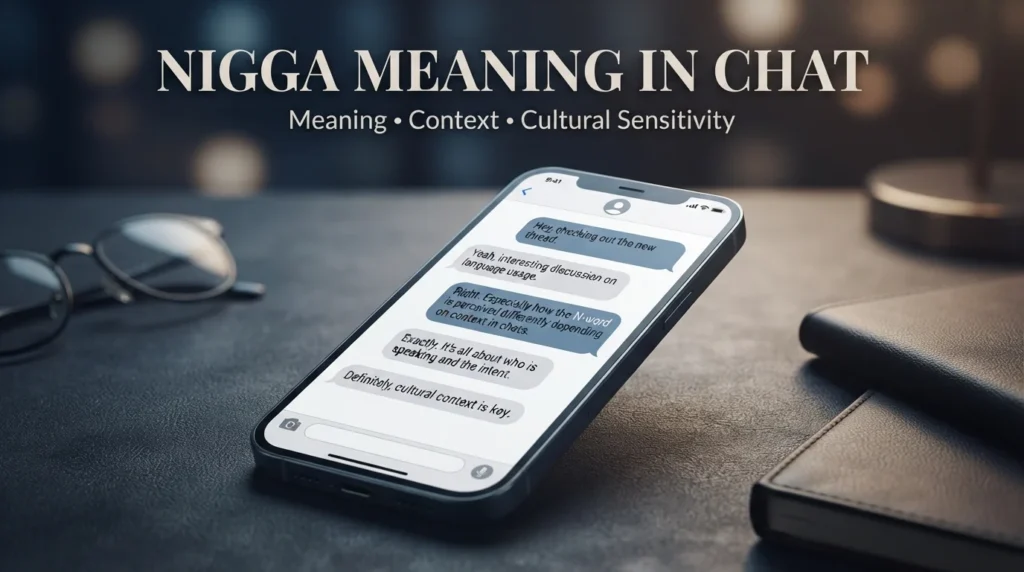
When people see the word “nigga” in a text, Instagram comment, TikTok video, or online conversation, they may wonder whether it is friendly slang, an insult, or simply another spelling of a racial slur.
The answer depends heavily on who is using it, who is receiving it, the relationship between the speakers, and the cultural context. Unlike ordinary internet abbreviations, this word carries a long and painful history connected to anti-Black racism.
In some Black communities, related forms of the word have been reclaimed and may appear in informal speech between friends. Outside those contexts, however, using it can easily be offensive or deeply disrespectful.
This guide explains the “nigga meaning in chat” without treating the word as ordinary slang. Understanding its history and social context is essential before deciding how to interpret a message containing it.
Nigga Meaning in Chat – Quick Meaning
In chat, “nigga” is a highly sensitive racialized slang term derived from a historically racist slur directed at Black people.
Its meaning can change according to context:
- Among some Black speakers, it may be used informally as a reclaimed term for a friend, person, or fellow Black person.
- In some conversations, it can function similarly to “bro,” “guy,” or “man.”
- When used by someone outside the relevant community, it may be perceived as racist or offensive.
- When directed aggressively at a person, it can clearly function as an insult.
For example, a message such as “That nigga is my best friend” may be intended differently from an openly hostile statement. However, the word’s history means that outsiders should not assume they can use it simply because they see other people using it.
The safest interpretation is always based on context, speaker, audience, relationship, and tone.
Origin & Background
The modern spelling developed from historical forms of a racist anti-Black slur. That older word was used for centuries as a degrading label for Black people, particularly in societies shaped by slavery, segregation, colonialism, and racial discrimination.
Over time, some Black communities transformed and reclaimed related language. In certain settings, the term began appearing in music, literature, comedy, everyday conversation, and popular culture with meanings that could be very different from its original use.
This process is often called linguistic reclamation. A community may take a word historically used against it and give the word a different social meaning or reduce its power within particular in-group contexts.
That does not mean the word became universally acceptable.
Hip-hop and rap culture also played a major role in making the spelling “nigga” widely visible to international audiences. Lyrics, films, memes, social media posts, and online communities exposed millions of people to forms of the word.
The internet then made the situation even more complicated. A person may see Black creators using the term casually and assume that anyone can use it in exactly the same way.
Language does not work that simply.
A word can carry different meanings depending on identity, history, relationship, setting, and social power. That is especially important with racially sensitive language.
See Also: TT Meaning in Chat: What Does TT Mean in Texting, TikTok & Relationships?
Real-Life Conversations
The following examples demonstrate how context can change interpretation. They are designed to explain usage, not encourage people to repeat the term.
Person A: Did you see what happened in the group?
Person B: Yeah, my friend was talking about it all morning.
Here, the speakers can discuss a person without using a racialized term at all. In everyday communication, neutral alternatives are usually clearer and safer.
Instagram DMs
Person A: Why did that person comment that?
Person B: I think they were trying to be funny, but it came across badly.
If a person receives the sensitive term from someone they do not know, they may interpret it very differently from how a close friend within their own community might use it.
TikTok Comments
Commenter A: The creator is using that word casually.
Commenter B: Context matters. Not every viewer will understand the cultural background behind it.
This is a common source of confusion online. Social media removes much of the personal context that exists in face-to-face conversations.
Text Messages
Person A: He called me that during the argument.
Person B: If he used it to demean you, I can understand why that upset you.
The same spelling can have radically different emotional effects depending on intention and circumstances.
Emotional & Psychological Meaning
Words do more than communicate dictionary definitions. They can also trigger memories, social associations, belonging, exclusion, anger, humor, or discomfort.
For some Black speakers, a reclaimed use of the term may communicate familiarity, solidarity, informality, or group identity. In that setting, the speaker may not intend racial hostility.
For someone hearing it from an outsider, however, the historical meaning may dominate the conversation. The listener may experience the word as disrespectful even when the speaker claims they were “only joking.”
That difference between intention and impact is important.
I have seen this principle repeatedly in language discussions: people often focus on what they meant while overlooking how the other person reasonably understood the words.
Modern communication makes this especially relevant because text removes facial expressions, gestures, and vocal tone.
A message that seems harmless to one person can feel aggressive or insulting to another.
Usage in Different Contexts
Social Media
Social media is one of the most common places where people encounter the term.
Comments, memes, rap lyrics, reaction videos, and online conversations may contain it. But social media audiences are usually mixed, so a word that feels normal within one community may be offensive to another viewer.
Friends and Relationships
Close friends may have their own language patterns and shared expressions. In some Black friendships, reclaimed forms of the term can appear naturally in informal conversation.
That does not automatically make it appropriate for people outside that community.
A close relationship also does not guarantee that everyone has the same boundaries. People can have different personal preferences about sensitive language.
Work and Professional Settings
The term should be avoided in professional communication.
Emails, meetings, job applications, presentations, customer conversations, workplace chats, and business social media accounts require language that respects a diverse audience.
Even discussing the word academically should be handled carefully and only when the context genuinely requires it.
Casual vs. Serious Tone
A casual conversation can still contain language with serious historical weight.
That is one reason the word should not be treated like ordinary internet slang such as “bro,” “dude,” or “fr.”
Its meaning depends on much more than casual tone.
When NOT to Use It
For most people, especially those who are not Black, the simplest rule is do not use the term casually.
Avoid it when:
- You are speaking to strangers.
- You are in a workplace or professional setting.
- You are communicating with customers or clients.
- You do not know the person’s cultural background.
- You are trying to imitate lyrics or social media slang.
- You believe “everyone online says it.”
- You are angry at someone.
- You want to make a joke about race.
- You are unsure whether the person is comfortable with it.
Do not assume that repeating a word because a celebrity, musician, influencer, or friend uses it gives everyone permission to use it.
If you are quoting historical material or discussing the word academically, consider whether writing the complete term is necessary. In many contexts, “the N-word” is a more respectful alternative.
Common Misunderstandings
One major misunderstanding is believing that “nigga” and “the N-word” always have exactly the same social meaning.
They are closely related historically, but contemporary speakers may use the spelling and pronunciation differently in different contexts. That does not erase the history of the term.
Another mistake is assuming that one person’s use gives permission to everyone else.
It does not.
A third misunderstanding involves intention. Someone may say, “I didn’t mean anything bad by it.” That may explain their intention, but it does not automatically remove the impact of the word.
People also sometimes believe that adding a friendly tone makes the term harmless.
Tone matters, but history and social context matter too.
Comparison Table
| Term or phrase | Meaning in text | How to use it | Example intent | Safer alternative |
|---|---|---|---|---|
| nigga | A reclaimed or racialized slang term depending on context | Highly context-dependent; generally avoid unless you belong to a context where its use is accepted | Informal in-group speech or potentially offensive reference | Bro, friend, guy, person |
| the N-word | Euphemism for the historical racial slur | Useful when discussing the word without repeating it | Educational or sensitive discussion | The N-word |
| bro | Friend, man, or fellow person | Casual conversations | Friendship or familiarity | Bro, buddy |
| dude | Person, man, or friend | Informal speech | Casual reference | Dude, person |
| homie | Close friend or associate | Very informal | Friendship or familiarity | Friend, buddy |
| man | Person, friend, or conversational address | Broad casual usage | Informal conversation | Man, friend |
Key Insight
The important distinction is that ordinary casual slang generally does not carry the same racial history. Context can influence meaning, but it does not erase history. If you are unsure whether a sensitive racial term is appropriate, choosing a neutral alternative is usually the better communication decision.
Variations / Types
Because the word is highly sensitive, these related expressions should not be treated as interchangeable. Their social meaning depends on context.
“N-word” Meaning
N-word meaning refers to the euphemistic way people discuss the historical racial slur without saying it directly.
It is common in news reporting, education, and sensitive conversations.
“N-word” in Text
N-word in text usually indicates that someone is referring to the racial slur without writing it.
It can be useful when discussing language respectfully.
“N-word” Abbreviation
There is no universally accepted abbreviation that makes the underlying slur appropriate.
Writers often use N-word instead.
Reclaimed Slang
Reclaimed slang describes language that a historically targeted community adopts or transforms for its own use.
Reclamation does not necessarily extend permission to outsiders.
In-Group Slang
In-group slang is language used within a particular social, cultural, or identity group.
The same expression may feel different when used by an insider versus an outsider.
Racial Slur
A racial slur is a derogatory term directed at a person or group because of race or ethnicity.
The historical form behind this word belongs to that category.
Hip-Hop Usage
Hip-hop usage refers to appearances of related language in rap and hip-hop culture.
Music helped spread the term globally, but exposure does not mean universal permission to use it.
Internet Slang
Internet slang includes informal expressions used on platforms such as TikTok, Instagram, Reddit, Discord, and messaging apps.
The term may appear online, but its sensitivity makes it different from ordinary internet abbreviations.
Reclaimed Racial Language
Reclaimed racial language describes words historically used against a community that members of that community may repurpose.
Its interpretation depends strongly on speaker identity, audience, and situation.
Sensitive Slang
Sensitive slang refers to informal language that can carry social, cultural, racial, or historical implications.
Understanding the background is more important than simply memorizing a dictionary definition.
How to Respond When Someone Uses It
Your response should depend on the relationship and situation.
Casual Replies
If you are unsure what someone means:
- “What do you mean by that?”
- “I’m not sure how you meant that.”
- “Can you explain what you meant?”
Funny Replies
Humor should not reinforce racial stereotypes. A safer humorous response can redirect the conversation:
- “Okay, but let’s use normal vocabulary today.”
- “You lost me there. Try that sentence again.”
Mature Replies
If the term makes you uncomfortable:
- “I understand what you meant, but I’d rather you not use that word with me.”
- “I know you may not have intended offense, but that language makes me uncomfortable.”
Respectful Replies
If you are learning about cultural language:
- “I’ve seen that word online, but I don’t want to misuse it.”
- “Can you explain how you understand the term in this context?”
Asking respectfully is often better than pretending to understand something you do not.
Regional & Cultural Usage
Western Culture
In the United States and other Western societies, the word is strongly connected to the history of anti-Black racism.
Its use can therefore be highly sensitive, especially when the speaker is not Black.
Asian Culture
In many Asian countries, people may encounter the term primarily through American music, films, gaming, and social media.
That exposure can create confusion because someone may know the word from entertainment without fully understanding its historical background.
Middle Eastern Culture
The term may also appear through international online culture, music, and gaming communities.
People unfamiliar with its history may mistake it for a general synonym for “friend” or “guy.” That interpretation can be dangerously incomplete.
Global Internet Usage
The internet has made regional language increasingly global.
A word that originated in a particular historical and cultural environment can now appear in conversations between people who have completely different backgrounds.
That makes cultural awareness especially important.
Generational Differences
Younger internet users may encounter the term through memes, music, gaming, and short-form video platforms.
Millennials may have encountered it primarily through music, television, films, and earlier social networks.
Neither generation should assume that familiarity equals acceptability.
Is It Safe for Kids?
Children and young teenagers may encounter the word through music, gaming chats, TikTok, YouTube, memes, or conversations with friends.
Parents and educators should explain why the term is sensitive rather than simply saying “never say it” without context.
A child should understand that words can have historical and emotional consequences.
It is also useful to teach children the difference between seeing a word and having permission to repeat it.
If a child asks what the word means, an age-appropriate explanation can focus on its history, racial context, and why many people consider it offensive.
FAQs
What does “nigga” mean in chat?
In chat, the term can function as reclaimed slang in some Black communities, while in other contexts it can be perceived as a racial insult. Context and speaker identity matter greatly.
Is “nigga” a bad word?
It is a highly sensitive racialized term. Although some Black speakers use it as reclaimed informal language, it can be deeply offensive when used by outsiders or used to demean someone.
Can anyone use the word if their Black friends use it?
No. One person’s use does not automatically give another person permission to use it. Cultural context and individual boundaries matter.
Is “nigga” the same as the N-word?
The terms are historically related, but their contemporary use can differ by context. The broader history of anti-Black racism remains important when interpreting either form.
Why do rappers use the word?
Some artists use related forms of the term as part of reclaimed cultural expression, identity, storytelling, or informal speech. That does not mean every listener should repeat it.
What should I say instead?
If you want a casual word for a friend or person, alternatives such as bro, buddy, friend, dude, man, or homie are generally safer depending on the context.
Why does the word cause such a strong reaction?
Its history is connected to centuries of anti-Black discrimination and racial violence. For many people, that history gives the word emotional significance far beyond its literal use in a sentence.
Conclusion
Understanding “nigga meaning in chat” requires more than finding a simple synonym.
The term has a complicated history, and its modern use can vary considerably between communities and situations. Some Black speakers may use it as reclaimed informal language, while others may dislike it entirely. When used by outsiders, it can easily be interpreted as racist or disrespectful.
The biggest lesson is simple: context matters, but history matters too.
If you encounter the word online, look at who said it, who they were speaking to, and what they were trying to communicate. If you are unsure whether you should use it yourself, choose a neutral alternative.
Good communication is not just about knowing what words mean. It is also about understanding when words carry weight—and respecting that weight.