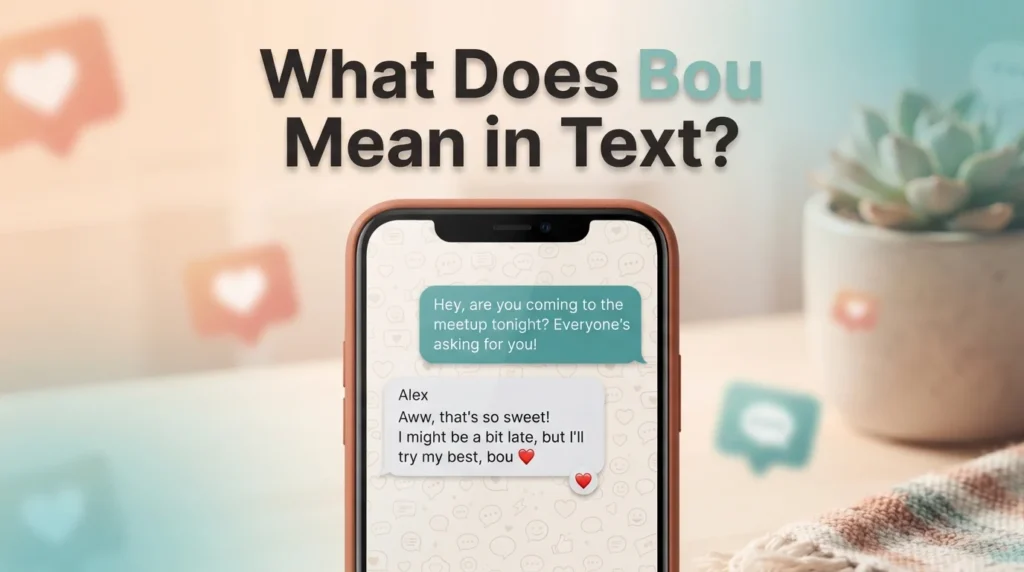
If someone texts you “Hey bou ❤️”, comments “my bou,” or says “miss you bou,” it can be confusing. Is bou a typo for boo? Is it a romantic nickname? Does it have another meaning on Snapchat?
In most casual online conversations, “bou” is a playful spelling of “boo” or an affectionate nickname for someone close. The exact meaning depends heavily on the sentence, relationship, and platform.
Unlike standard English words, bou does not have one universal definition in texting. It can also appear as a name, abbreviation, regional expression, or word from another language. That is why context matters.
This guide explains what does bou mean in text, what it means in love, Snapchat, French, Korean, business communication, and everyday conversations.
Bou Meaning in Text – Quick Meaning
In casual texting, bou usually means “boo,” “babe,” “love,” or another affectionate nickname.
It can describe a romantic partner, close friend, or someone the speaker feels emotionally connected to.
Common meanings include:
- Bou = boo
- Bou = babe
- Bou = someone special
- Bou = an affectionate nickname
- Sometimes, bou is simply a person’s preferred spelling or nickname
For example:
“Goodnight, bou ❤️”
This probably means:
“Goodnight, babe/boo.”
Another example:
“I miss you, bou.”
Here, the sender is expressing affection or emotional closeness.
And:
“Hey bou, what are you doing?”
This sounds casual and familiar rather than formal.
The important point is that bou doesn’t automatically mean boyfriend or girlfriend. Friends can use affectionate language too.
Origin and Background of “Bou”
There isn’t one universally accepted origin for the modern texting use of bou.
The most common interpretation is that it developed as a playful spelling variation of boo, an established English term of affection.
“Boo” has long been used informally for a romantic partner or someone dear to you. Digital communication then made spelling much more flexible.
People often change spellings to make messages sound more personal, cute, humorous, or distinctive. That’s how variations such as boo, bou, bby, bae, and babe can appear in online conversations.
Social media has accelerated this process.
Instagram captions, Snapchat messages, TikTok comments, and private DMs encourage people to create language that feels personal rather than textbook-correct.
So when you see bou, don’t immediately assume it is a completely separate English word. In many cases, it’s simply someone’s preferred variation of boo.
There are also regional meanings. For example, some Cajun usage records bou as a form of “boy” or “kid,” pronounced similarly to boo.
That’s why context is essential.
Real-Life Conversations Using “Bou”
The easiest way to understand slang is to see it in a real conversation.
WhatsApp Conversation
Person A:
“Are you home yet, bou?”
Person B:
“Almost 😂 Why?”
Person A:
“Just checking on you. Drive safe ❤️”
Here, bou is clearly affectionate. It could be romantic, but the relationship between the two people determines that.
Instagram DM
Person A:
“Your new picture looks amazing!”
Person B:
“Aww thank you bou 🥹❤️”
Person A:
“You already know!”
This sounds warm and friendly. The word doesn’t necessarily indicate a romantic relationship.
TikTok Comments
Person A:
“My bou really understood the assignment 😂🔥”
Person B:
“That’s your bou?? I’m jealous 😂”
In this setting, bou may refer to a partner, best friend, or someone the commenter is close to.
Text Message
Person A:
“Good luck today, bou. You’ve got this.”
Person B:
“Thank you 🥹 I really needed that.”
Here, the word adds emotional warmth. The message would still make sense without it, but bou makes the relationship sound more personal.
Emotional and Psychological Meaning of “Bou”
Words such as bou, boo, babe, and love do more than communicate information.
They communicate relationship.
When someone says:
“Are you okay?”
the message is caring.
But:
“Are you okay, bou?”
can feel even more personal because the nickname signals familiarity.
This is one reason people use affectionate slang online. Digital messages don’t have facial expressions, gestures, or tone of voice. A small nickname can help communicate emotional intention.
In my experience with everyday English communication, these tiny choices often tell you more about the relationship between speakers than the dictionary meaning of the word itself.
Someone might call a close friend bou without romantic feelings. Someone else might use exactly the same word for a boyfriend or girlfriend.
The emotional meaning comes from the relationship.
Bou Meaning in Different Contexts
Bou on Social Media
On Instagram, TikTok, Snapchat, and other platforms, bou can appear in captions, comments, usernames, and private messages.
For example:
“Weekend with my bou ❤️”
This probably refers to someone important to the speaker.
Social media also encourages stylized spelling, so the unusual spelling may simply be part of someone’s online personality.
Bou Between Friends
Close friends sometimes use affectionate language that sounds romantic outside their friendship.
For example:
“You better call me when you get there, bou.”
This could simply mean:
“You better call me when you get there, friend.”
The surrounding conversation tells you whether there is romance involved.
Bou in Relationships
Between romantic partners, bou can function like:
- Babe
- Boo
- Baby
- Love
- Sweetheart
For example:
“I can’t wait to see you, bou ❤️”
Here, the romantic interpretation is much stronger.
Bou in Work or Business
This is where you should be careful.
Bou meaning in business communication is usually not appropriate as an affectionate nickname.
If a coworker says:
“Thanks, bou!”
they may simply be using casual language with a friend.
But writing:
“Dear Client, thank you for your payment, bou.”
would sound extremely informal and possibly unprofessional.
In business emails, proposals, invoices, and formal messages, use the person’s name or a professional form of address instead.
Casual vs. Serious Tone
The same word can feel completely different depending on the message.
Casual:
“Hey bou 😂”
Affectionate:
“Miss you, bou ❤️”
Supportive:
“You’ve got this, bou.”
Professional:
Avoid it unless you already have a very informal relationship.
When Not to Use “Bou”
Although bou is generally harmless, it isn’t suitable everywhere.
Avoid using it when:
- You don’t know the person well.
- You’re writing a formal email.
- You’re communicating with a client.
- You’re speaking to a senior professional.
- The relationship is still unclear.
- The other person prefers formal communication.
- The word could be interpreted as flirting.
Context can completely change how a nickname feels.
Calling your best friend bou may sound natural.
Calling a new manager bou could sound strange or overly familiar.
Cultural expectations matter too. Some people enjoy playful communication, while others prefer clear boundaries.
Common Misunderstandings About “Bou”
Is Bou Always Romantic?
No.
It can be romantic, but it can also be friendly or simply playful.
Is Bou Just a Typo?
Sometimes.
If someone normally writes boo but accidentally types bou, it may genuinely be a typo.
However, if they repeatedly use bou, it’s more likely a deliberate spelling choice.
Does Bou Mean Boyfriend?
Not necessarily.
A boyfriend might be called bou, but the word itself doesn’t literally mean boyfriend.
Does Bou Mean Girlfriend?
Again, not automatically.
The surrounding conversation determines the relationship.
Is Bou the Same as Boo?
In many online conversations, yes, functionally.
But bou can have other meanings in regional or multilingual contexts, so you shouldn’t treat every occurrence as an English boo.
Comparison Table
| Term / Search Intent | Meaning in Text | How to Use It | Example |
|---|---|---|---|
| Bou meaning in love | Affectionate nickname for someone special | Use with a romantic partner or close person | “Goodnight, bou ❤️” |
| What does bou mean on Snapchat? | Usually a playful version of boo | Use casually in snaps or chats | “Hey bou 👀” |
| Bou meaning in French | Can represent the French spelling of the interjection “boo” | Interpret according to French context | “Bou!” |
| Bou meaning lady | Not a standard English meaning for “lady” | Don’t assume it means woman | Check context |
| Bou meaning in English | Usually an informal affectionate or stylized term | Use casually | “Miss you, bou.” |
| Bou meaning in business | No standard professional meaning | Avoid using it as formal business language | Use the person’s name |
| What does bou mean in Korean? | Not one universal Korean texting meaning | Check the original Korean spelling/context | Context required |
| Boo meaning | A common affectionate nickname | Use for someone close | “Hey boo!” |
Key Insight
Bou is a context-dependent expression, not a word with one fixed definition. In modern English texting, it most often works as a cute variation of boo, but regional and multilingual meanings can be different.
Bou Meaning in Love
When someone searches “bou meaning in love,” they’re usually trying to understand whether the person who used it has romantic feelings.
In a romantic context, bou can mean:
- My love
- My boo
- My babe
- Someone special
- My partner
For example:
“I can’t sleep without saying goodnight to my bou.”
That’s strongly affectionate.
But don’t judge the relationship based on the nickname alone. Some friendships use extremely warm language.
Look at the complete conversation.
What Does Bou Mean on Snapchat?
On Snapchat, bou generally carries the same casual meaning as it does in texting.
Someone might write:
“What you doing bou?”
or:
“Goodnight bou ❤️”
The platform doesn’t give the word a special Snapchat-only definition.
Snapchat simply encourages short, informal communication, which makes slang and personalized spellings common.
Bou Meaning in French
This one requires special attention.
In French, bou can represent the sound “boo,” especially as an interjection used to frighten someone or express disapproval. French dictionaries translate the English interjection boo as bou in these contexts.
So if you see bou in French, don’t automatically assume it means “babe.”
For example, a French speaker using “Bou!” could be imitating the English-style “Boo!” used to scare someone.
That’s completely different from:
“Hey bou ❤️”
in an English-language romantic conversation.
Bou Meaning as “Lady”
Bou does not have a standard English dictionary meaning of “lady.”
If someone tells you that bou means “lady,” treat that claim carefully.
It could be a nickname, regional slang, personal spelling, or an interpretation from a particular community.
The sentence is more important than an isolated internet definition.
What Does Bou Mean in Korean?
There isn’t one universal Korean texting meaning for the Latin spelling bou.
“Bou” can be a romanization of Korean sounds, a name, a username, or a representation of a Korean word. For example, 보우 (bou) is a Korean form with a recorded romanization, but that does not make bou a universal Korean equivalent of English boo.
If you encounter bou in a Korean conversation, the safest approach is to check the original Hangul and the surrounding sentence.
Variations and Related Forms of “Bou”
1. Bou Meaning
Bou meaning: An affectionate or playful nickname in many English-language chats.
2. Bou in Text
Bou in text: Usually a casual form of boo.
3. Bou Abbreviation
Bou abbreviation: It isn’t a standardized English abbreviation. Its meaning depends on context.
4. Bou Slang
Bou slang: Informal internet language that can express closeness or affection.
5. Bou in Chat
Bou in chat: Often used when addressing a friend, partner, or someone special.
6. Bou in Love
Bou in love: Can mean babe, boo, or my love.
7. Bou on Snapchat
Bou on Snapchat: Usually a playful nickname rather than a platform-specific term.
8. Bou vs. Boo
Bou vs. boo: Boo is the more established English spelling; bou is often a stylized variation.
9. Bou vs. Bae
Bou vs. bae: Both can express affection, but bae has its own slang history and isn’t simply another spelling of bou.
10. Bou vs. Babe
Bou vs. babe: Babe is a widely recognized affectionate term, while bou is more informal and context-dependent.
How to Respond When Someone Calls You “Bou”
Your response depends on the relationship and the tone.
Casual Replies
“Hey bou 😂”
“What’s up?”
“Haha, you’re cute.”
Funny Replies
“Bou? Since when? 😂”
“Who gave me this new title?”
“Okay bou, calm down 😂”
Mature Replies
“I appreciate that. How are you doing?”
“That’s sweet of you.”
“You always know how to make me smile.”
Respectful Replies
If you’re unsure what the person means:
“Haha, what do you mean by bou?”
That’s perfectly reasonable.
You don’t have to guess someone’s intention from one slang word.
Regional and Cultural Usage
Western Culture
In Western online communication, bou is generally understood through its similarity to boo or as a personalized nickname.
However, it isn’t as standardized as boo, babe, or love.
Asian Culture
Asian internet users frequently mix English slang with local languages.
That means bou may be borrowed from English, used as a personal nickname, or represent a romanized local-language word.
Context is particularly important in multilingual conversations.
Middle Eastern Culture
English slang is widely used online across many Middle Eastern communities, especially among younger social-media users.
A person may use bou simply because it resembles familiar terms such as boo, babe, or love.
Still, cultural expectations around relationships and familiarity can differ considerably, so the word shouldn’t automatically be interpreted as romantic.
Global Internet Usage
The internet has made slang cross borders.
A person in Pakistan might use a phrase popular in the United States. Someone in France may use an English-inspired expression. Someone in Korea may type a romanized Korean word.
As a result, spelling alone isn’t always enough to determine meaning.
Gen Z vs. Millennials
Gen Z communication often embraces creative spellings, abbreviations, emojis, and deliberately altered words.
Millennials also use internet slang, but some expressions may feel more natural to one generation than another.
That doesn’t mean every Gen Z user understands bou the same way.
Online language changes quickly, and personal communities often create their own vocabulary.
Is “Bou” Safe for Kids?
Generally, bou itself is not an inherently unsafe or explicit word.
However, children should understand that slang can have different meanings depending on context.
If a child sees bou in a message, parents or teachers shouldn’t automatically assume it’s romantic or inappropriate.
Instead, look at the surrounding conversation.
For younger children, it’s also useful to teach a broader digital-communication lesson: not every unfamiliar slang term has one fixed meaning.
FAQs About “Bou” in Text
What does bou mean in text?
In many casual English conversations, bou is a playful spelling of “boo” or an affectionate nickname for someone close.
Does bou mean boyfriend or girlfriend?
Not necessarily. Bou can refer to a romantic partner, close friend, or someone special. The context determines the relationship.
What does bou mean on Snapchat?
On Snapchat, bou usually works as a casual or affectionate nickname. It doesn’t have a special Snapchat-only definition.
Is bou the same as boo?
Often, yes. Many people use bou as a creative spelling of boo. However, bou can have other meanings in regional or multilingual contexts.
What does bou mean in love?
In a romantic context, bou can mean boo, babe, sweetheart, or my love.
Does bou mean lady?
No. Bou is not a standard English word meaning “lady.” If someone uses it that way, it is likely a community-specific or personal usage.
What does bou mean in Korean?
There is no single universal Korean texting meaning for bou. It may represent a romanized Korean word, name, or other expression, so the original Korean context matters.
Conclusion
So, what does bou mean in text?
Most of the time, it is a playful, affectionate variation of “boo” used for someone a person feels close to. It can sound romantic when used between partners, but friends can use it too.
The biggest mistake is assuming that every use of bou has the same meaning.
A message like “Goodnight, bou ❤️” probably carries affection. A phrase written in French may have a completely different meaning. A Korean conversation requires attention to the original language, while a business message is usually better without the slang.
When you’re unsure, don’t overthink the spelling. Read the whole conversation, consider the relationship, and pay attention to the tone. That’s usually where the real meaning is hiding.